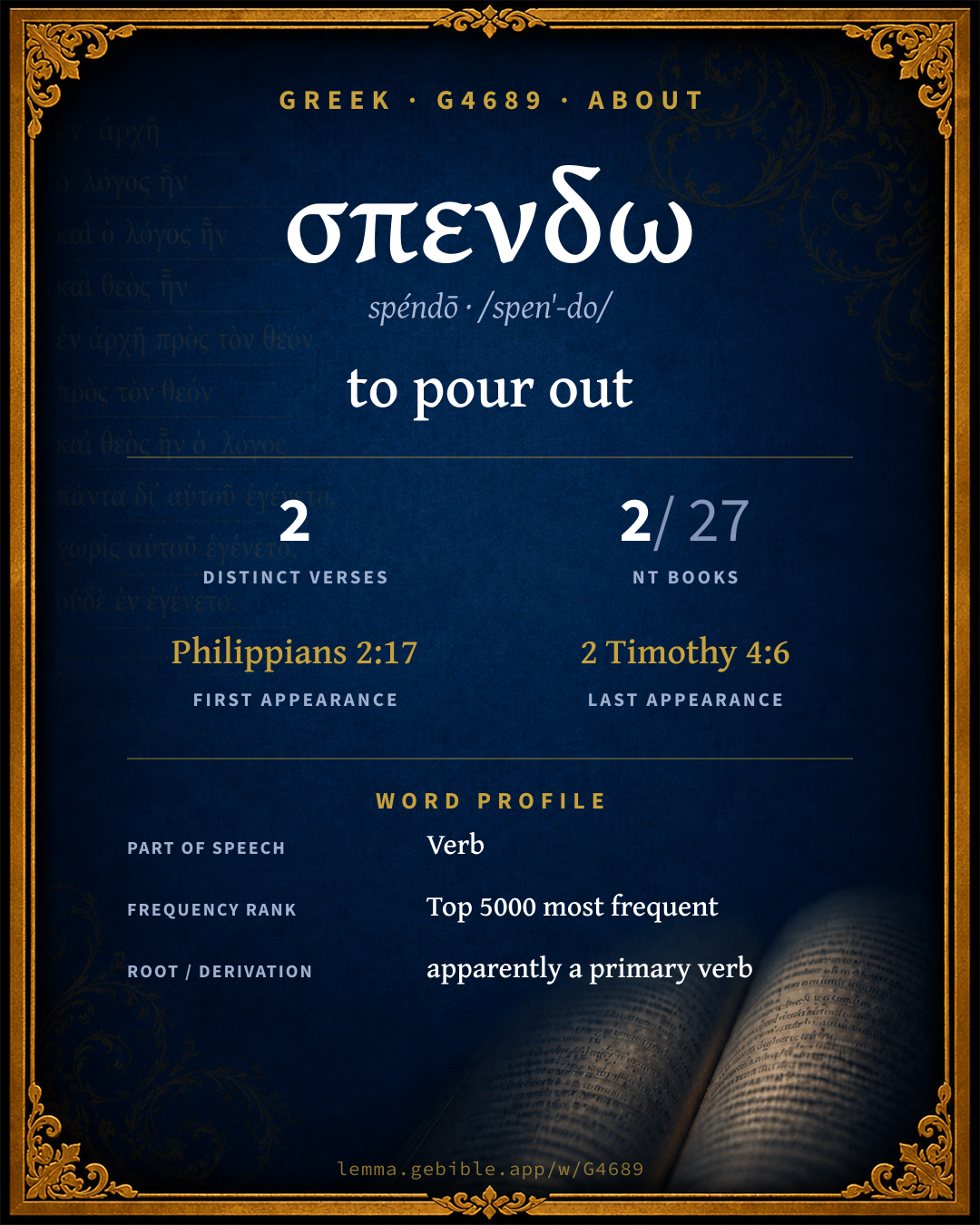
σπένδω
to pour out
‘to pour out’ is one of 3 main senses fuller range ↓
Full lexicon entry — Thayer's Greek Lexicon
From Thayer's Greek Lexicon
Where this word appears
Grammar key — what these labels mean
Part of speech
- Verb
- An action or state-of-being word.
Tense
- Present
- Ongoing or general action in present time (imperfective aspect).
Voice
- Passive
- The subject receives the action.
Mood
- Indicative
- States a fact or asks a factual question (the mood of reality).
Person
- 1st person
- The speaker (“I / we”).
Number
- Singular
- One.
Every verse where G4689 appears — 2 distinct verses across 2 books. Click any verse to open its interlinear word-by-word view. Verse text shown in the World English Bible for context — . Each verse’s Greek form is shown with its reference; the English is not keyword-highlighted, since the data carries no word-level English alignment. Use “Compare translations” on any verse to read it across multiple English versions. This concordance covers the Greek New Testament; Septuagint (Greek Old Testament) occurrences of this word are not indexed here.
Philippians 1 verse
2 Timothy 1 verse
About this entry
At a glance — auto-summarized from this page’s data, not written by a person. Every figure links to its source below. This summary describes the numbers; it doesn’t interpret them.
The Greek verb σπενδω centers on the idea of “to pour out.” The Greek New Testament uses it only 2 verses. Philippians dominates its distribution — 1 of 2 verses. Its earliest occurrence is Philippians 2:17. Thayer's distinguishes 3 senses for it. Dig into 2-verse concordance and the renderings breakdown below.
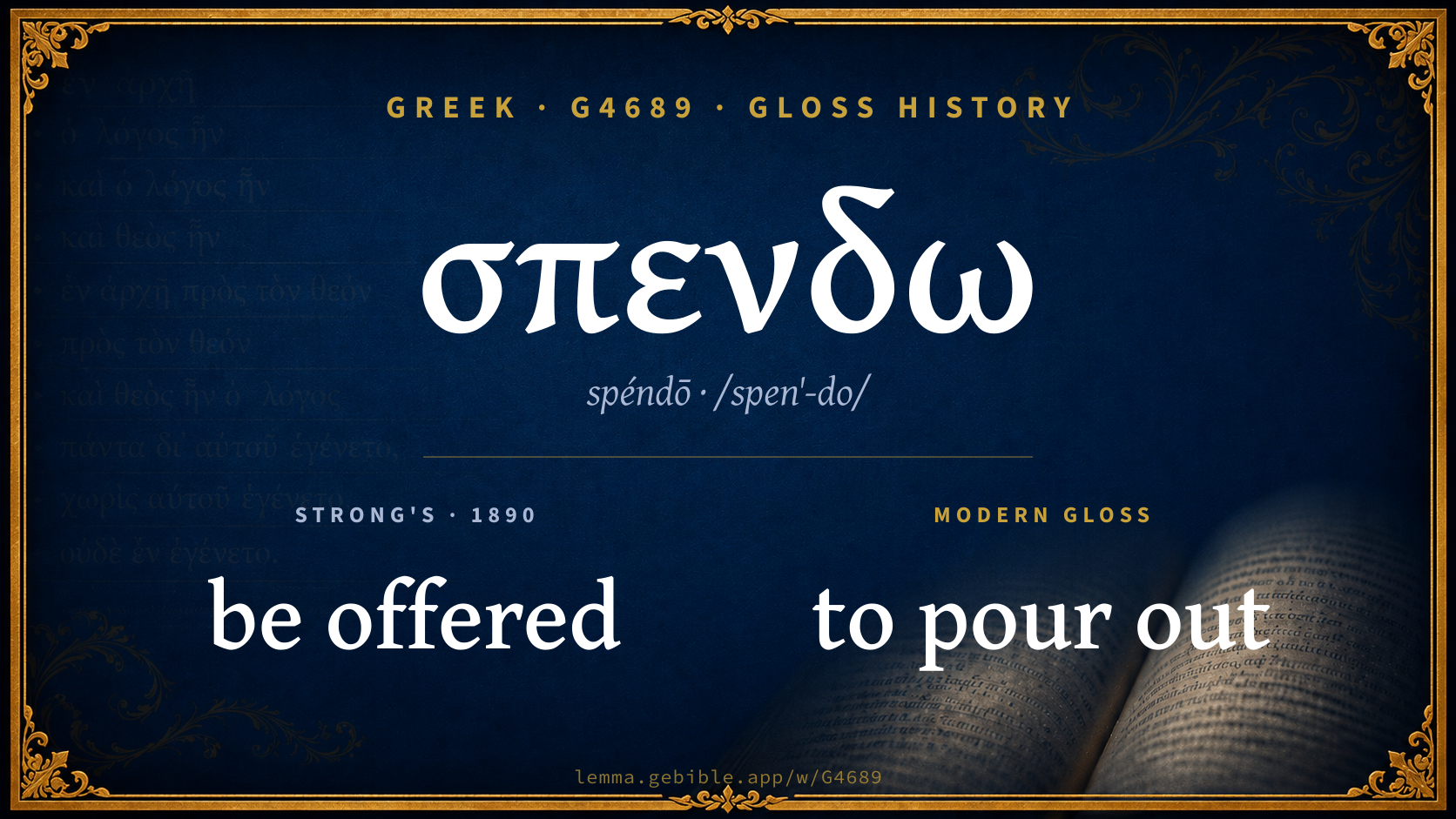
Gloss history
Strong's 1890 vs modern scholarship
About this word
Strong's G4689 catalogs a Greek word from the Greek New Testament.
These counts are not copied from any lexicon or concordance. They are computed here, from the morphology-tagged Greek New Testament. What Lemma adds →
- 2
- distinct verses
- The word appears in 2 distinct verses.
- 2 / 27
- NT books
- The word appears in 2 of 27 New Testament books.
- #2,678
- by frequency
- Top 5000 most frequent Greek words (rank 2,678 of 5,347 Greek words by occurrence).
View all 2 occurrences in the concordance →
Most concentrated in
- Philippians 1 verse 50%
- 2 Timothy 1 verse 50%
By section of the New Testament
By traditional corpus
Conventional, traditional groupings — biblical authorship is debated, so this is a traditional corpus grouping, not an authorship claim. Some books belong to more than one corpus (Luke is in both the Gospels and the Lukan corpus, and so on), so these shares overlap and need not total 100%. Each figure is a share of the word’s 2 distinct verses.
- Pauline corpus 2 verses · 100%
How translations render this word
Counts come from each version’s own published word-to-Strong’s tagging or interlinear alignment — an approximate guide to how each version renders this word, not a word-level alignment the data otherwise carries. Because each total is that version’s own tagged count, the per-version totals vary from one another and need not match the appearance or distinct-verse counts above. These counts may also differ from a printed concordance because Lemma counts each distinctly tagged rendering and does not collapse phrase taggings into a single head-word total. This is a fixed set of word-tagged versions (KJV, ASV, BSB, ULT) and does not change with the reading translation you choose elsewhere. Each version’s license is shown beside its name below (and on Sources).
- King James Version: Am 1×, I be offered 1×, Ready to be offered 1×
- American Standard Version: Am 1×, Being offered 1×, I am offered 1×
- Berean Standard Bible: Being poured out like a drink offering 1×, I am being poured out like a drink offering 1×
- unfoldingWord Literal Text: Am 1×, Being poured out as an offering 1×, I am being poured out as an offering 1×
King James Version Public Domain
Renders G4689 across 3 tagged occurrences — most commonly:
American Standard Version Public Domain
Renders G4689 across 3 tagged occurrences — most commonly:
Berean Standard Bible Public Domain
Renders G4689 across 2 tagged occurrences — most commonly:
unfoldingWord Literal Text CC BY-SA 4.0
Renders G4689 across 3 tagged occurrences — most commonly:
Senses in Thayer's
The 3 senses Thayer's distinguishes for this word, in lexicon order (not ranked by frequency or importance). The full entry — with sub-senses — is in the Lexicon Entry tab.
- to pour out as a drink offering, make a libation
- in the NT to be offered as a libation
- fig. used of one whose blood is poured out in a violent death for the cause of God
Word origin
Origin: apparently a primary verb
Apparently a primary verb; to pour out as a libation that is (figuratively) to devote (one´ s life or blood as a sacrifice) (spend): - (be ready to) be offered.
— Strong’s Exhaustive Concordance (1890), public domain.
Septuagint usage
The same Greek word σπενδω appears 16 times in the Greek Old Testament (Septuagint), across 15 verses in 7 books.
- 16
- LXX occurrences
- Tagged occurrences of this Greek word in the Septuagint.
- 15
- verses
- Distinct Septuagint verses containing this word.
- 7 / 39
- OT books
- The word appears in 7 of the 39 Old Testament books.
Sample Septuagint occurrences
- Genesis 35:14 σπένδω
- Exodus 25:29 σπένδω
- Numbers 4:7 σπένδω
- 1 Chronicles 11:18 σπένδω
- Jeremiah 7:18 σπένδω
- Ezekiel 20:28 σπένδω
- Hosea 9:4 σπένδω
Septuagint occurrences (same lexeme)
Every verse where the same Strong’s number (G4689) appears in the Greek Septuagint. Verse text shown in the World English Bible for context; the Greek form is the matched word — the English is not keyword-highlighted.
- Genesis 35:14 σπένδω Jacob set up a pillar in the place where he spoke with him, a pillar of stone. He poured out a drink-offering on it, and poured oil on it.
- Exodus 25:29 σπένδω You shall make its dishes, its spoons, its ladles, and its bowls to pour out offerings with. Of pure gold shall you make them.
- Exodus 30:9 σπένδω You shall offer no strange incense on it, nor burnt offering, nor meal-offering; and you shall pour no drink-offering on it.
- Exodus 38:12 σπένδω For the west side were hangings of fifty cubits, their pillars ten, and their sockets ten; the hooks of the pillars, and their fillets, of silver.
- Numbers 4:7 σπένδω On the table of show bread they shall spread a blue cloth, and put on it the dishes, the spoons, the bowls, and the cups with which to pour out; and the continual bread shall be on it.
- Numbers 28:7 σπένδω The drink-offering of it shall be the fourth part of a hin for the one lamb: in the holy place shall you pour out a drink-offering of strong drink to Yahweh.
- 1 Chronicles 11:18 σπένδω The three broke through the host of the Philistines, and drew water out of the well of Bethlehem, that was by the gate, and took it, and brought it to David: but David would not drink of it, but poured it out to Yahweh,
- Jeremiah 7:18 σπένδω The children gather wood, and the fathers kindle the fire, and the women knead the dough, to make cakes to the queen of the sky, and to pour out drink-offerings to other gods, that they may provoke me to anger.
- Jeremiah 19:13 σπένδω and the houses of Jerusalem, and the houses of the kings of Judah, which are defiled, shall be as the place of Topheth, even all the houses on whose roofs they have burned incense to all the host of the sky, and have poured out drink-offerings to other gods.
- Jeremiah 39:29 σπένδω
- Jeremiah 51:17 σπένδω Every man is become brutish [and is] without knowledge; every goldsmith is disappointed by his image; for his molten image is falsehood, and there is no breath in them.
- Jeremiah 51:19 σπένδω The portion of Jacob is not like these; for he is the former of all things; and [Israel] is the tribe of his inheritance: Yahweh of Hosts is his name.
- Jeremiah 51:25 σπένδω Behold, I am against you, destroying mountain, says Yahweh, which destroy all the earth; and I will stretch out my hand on you, and roll you down from the rocks, and will make you a burnt mountain.
- Ezekiel 20:28 σπένδω For when I had brought them into the land, which I swore to give to them, then they saw every high hill, and every thick tree, and they offered there their sacrifices, and there they presented the provocation of their offering; there also they made their sweet savor, and they poured out there their drink-offerings.
- Hosea 9:4 σπένδω They won't pour out wine offerings to Yahweh, Neither will they be pleasing to him. Their sacrifices will be to them like the bread of mourners; All who eat of it will be polluted; For their bread will be for their appetite. It will not come into the house of Yahweh.
These are occurrences of the same Greek lexeme (G4689) in the Septuagint — not a translation of any one Hebrew word. The store carries no word-level Hebrew↔Greek alignment, so no Hebrew original is asserted here. Counts come from the recovered LXX Strong's tagging — high-frequency vocabulary is well covered, while rare or late forms may be untagged — so they reflect tagged occurrences and may slightly undercount.