
Numbers 8:23

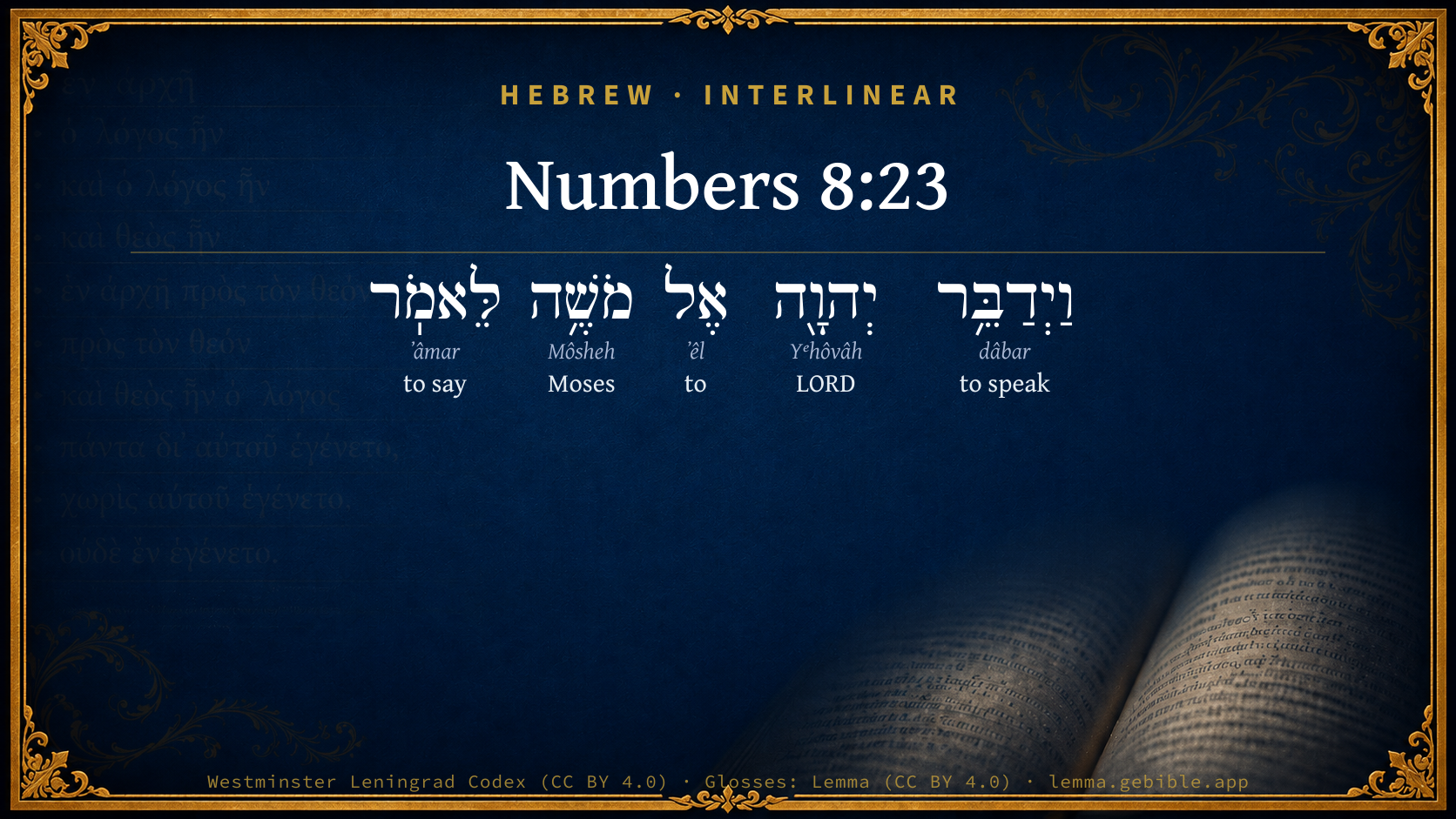
Hebrew (Westminster Leningrad Codex) Numbers 8:23 appears in the Hebrew Old Testament. The text above is from the Westminster Leningrad Codex. Each word links to its Strong’s number, a concise gloss, and parsing drawn from the Open Scriptures Hebrew Bible morphology. Click any word for its full Brown-Driver-Briggs (BDB) entry.
Download image
Cite this verse

Numbers 8:23 (World English Bible). Public Domain. Lemma interlinear Bible study tool, https://lemma.gebible.app/v/numbers/8/23.

Show BibTeX & RIS
BibTeX
RIS
English Translation
Yahweh spoke to Moses, saying,
World English Bible · Public Domain
Download a study sheet

One document with this verse’s original text, its word-by-word gloss line, the meaning frame, cross-references with their text, attributed commentary, and full source and license credits — printable, and it pastes into notes with its structure intact.

This verse Autodidact and up

Study sheet (.html) Plain text (.txt)

A passage Seminary Student

Up to 50 verses in one chapter. A passage sheet keeps up to 6 commentary sources and 12 cross-references per verse, in the order this page ranks them, and says so on the sheet whenever that leaves anything out. Ask for a single verse and you get the Autodidact verse sheet above.

Everything on this page stays free to read, with no account — the sheet is a download of what is already on screen, not access to it.

Want to remove ads? Support Godless Engineer
Compare translations 3

The same verse in 3 English versions, stacked beneath the original-language interlinear above. Click any original word for its lexicon entry.

Each is an independent rendering of the whole verse — the interlinear is not word-aligned to these translations.

Highlighted words mark where these versions differ — a whole-verse word diff, not a word-by-word alignment.

  • World English Bible Public Domain
    Yahweh spoke to Moses, saying,
  • King James Version Public Domain
    And the LORD spake unto Moses, saying,
  • unfoldingWord Literal Text CC BY-SA 4.0
    And Yahweh spoke to Moses, saying,

unfoldingWord Literal Text — © unfoldingWord, licensed CC BY-SA 4.0. Word-aligned USFM3 via Door43 (git.door43.org/unfoldingWord/en_ult).

Versions to compare (up to 4)

3 of 4 selected

Show all 18 translations

Every available English version of this verse, each an independent rendering of the whole verse.

  • World English Bible Public Domain
    Yahweh spoke to Moses, saying,
  • Berean Standard Bible Public Domain
    And the LORD said to Moses,
  • Majority Standard Bible Public Domain
    And the LORD said to Moses,
  • King James Version Public Domain
    And the LORD spake unto Moses, saying,
  • American Standard Version (1901) Public Domain
    And Jehovah spake unto Moses, saying,
  • Revised Version (1885) Public Domain
    And the LORD spake unto Moses, saying,
  • Geneva Bible (1599) Public Domain
    And the Lord spake vnto Moses, saying,
  • Douay-Rheims (1899) Public Domain
    And the Lord spoke to Moses, saying:
  • Young's Literal Translation Public Domain
    And Jehovah speaketh unto Moses, saying,
  • Literal Standard Version CC BY-SA 4.0
    And YHWH speaks to Moses, saying,
  • Unlocked Literal Bible CC BY-SA 4.0
    Yahweh spoke again to Moses. He said,
  • unfoldingWord Literal Text CC BY-SA 4.0
    And Yahweh spoke to Moses, saying,
  • Darby Bible Public Domain
    And Jehovah spoke to Moses, saying,
  • World Messianic Bible Public Domain
    The LORD spoke to Moses, saying,
  • Webster's Bible Public Domain
    And the LORD spoke to Moses, saying,
  • Free Bible Version CC BY-SA 4.0
    The Lord told Moses,
  • Bible in Basic English Public Domain
    And the Lord said to Moses,
  • JPS Tanakh (1917) Public Domain
    And the LORD spoke unto Moses, saying:

Literal Standard Version (2020), Covenant Press — licensed CC BY-SA 4.0. Text via the HelloAO Bible API (eBible.org). Unlocked Literal Bible (unfoldingWord) — licensed CC BY-SA 4.0. Text via the HelloAO Bible API (eBible.org). unfoldingWord Literal Text — © unfoldingWord, licensed CC BY-SA 4.0. Word-aligned USFM3 via Door43 (git.door43.org/unfoldingWord/en_ult). Free Bible Version, Dr. Jonathan Gallagher — licensed CC BY-SA 4.0. Text via the HelloAO Bible API (eBible.org).

Word by word

More ways to search: Search by grammar → Find every occurrence → Compare this word →

Practice this passage: Drill this verse → Learn its vocabulary →

About this verse

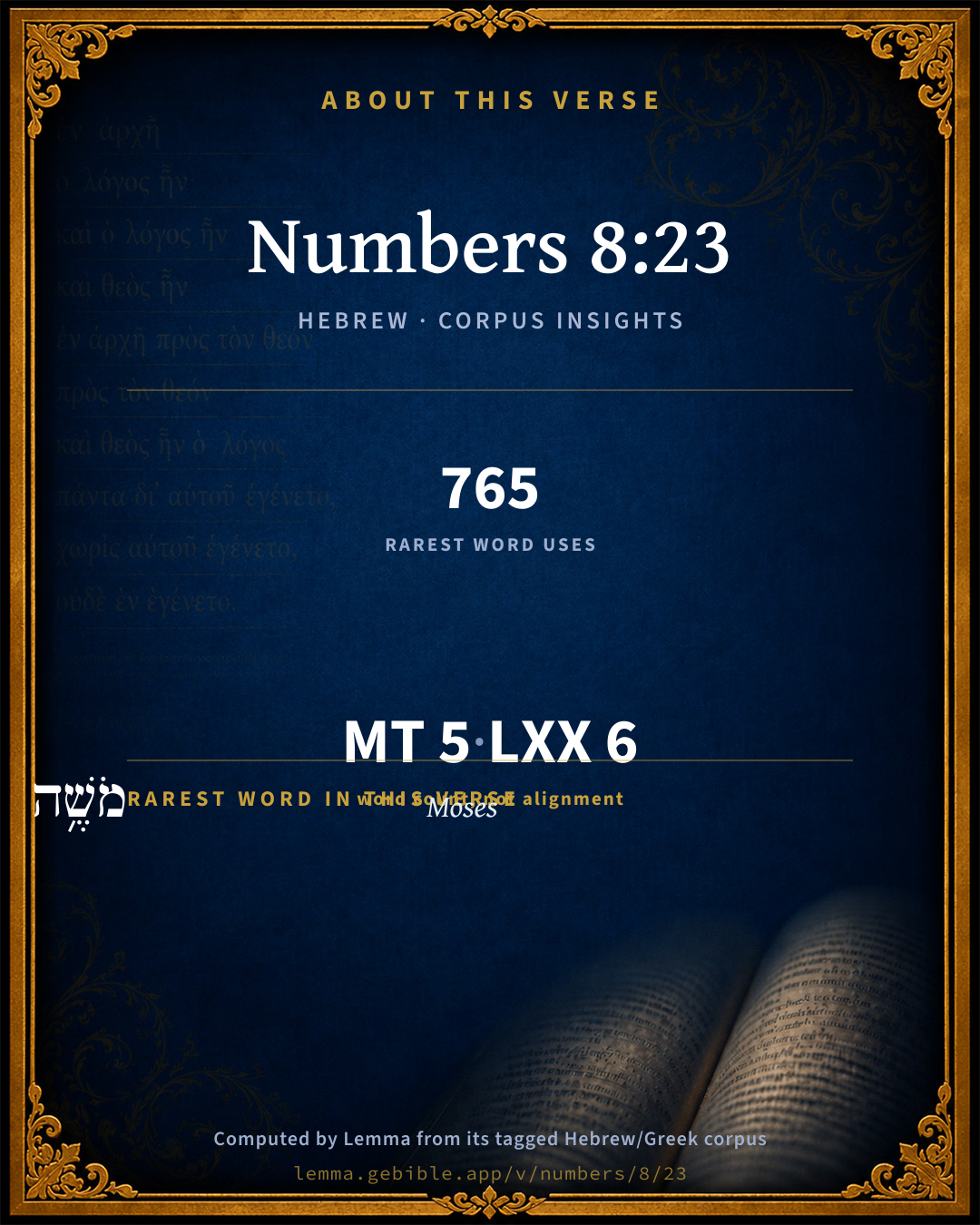
These counts appear in no published source. They are computed here, from the morphology-tagged text and Lemma’s own curated glosses. What Lemma adds →

5
words
5
distinct lemmas
Pentateuch
section

Grammatical profile

  • 2 verbs
  • 2 nouns
  • 1 preposition

Verb forms

  • וַיְדַבֵּ֥ר Piel · Sequential Imperfect
  • לֵּאמֹֽר Qal · Infinitive Construct

Hebrew & Septuagint length

In English translation the verse runs 5 words from the Hebrew and 7 from the Septuagint (LXX English) — closely comparable.

A rough comparison of the two English renderings, which tokenize alike — not a word-level alignment.

Word counts can differ between the Hebrew and the Greek without any difference in meaning — e.g. the Hebrew direct-object marker אֵת has no separate Greek word, and Greek often adds the article ὁ.

In the original languages it is 5 Hebrew tokens and 6 Greek tokens — but the two are counted differently (Hebrew bundles its prefixes and suffixes into one token; the Greek is in lemma form), so that isn’t a like-for-like length.

Hebrew and Greek witnesses Masoretic Hebrew ↔ Greek Septuagint

The same verse in the two great witnesses to the Old Testament, shown verse-for-verse.

These are two independent witnesses, not word-aligned to each other, and the Septuagint is shown in lemma (dictionary) form.

Hebrew Numbers 8:23 Masoretic · Westminster Leningrad Codex

וַיְדַבֵּ֥ר יְהוָ֖ה אֶל מֹשֶׁ֥ה לֵּאמֹֽר

Yahweh spoke to Moses, saying,

World English Bible · Public Domain

Greek LXX Numbers 8:23 Septuagint · lemma form

καί λαλέω κύριος πρός μωυσῆς λέγω

And the Lord spoke to Moses, saying,

LXX2012 (modern English Septuagint) · Public Domain

Hebrew: Westminster Leningrad Codex (CC BY 4.0). Greek: Septuagint (public domain); English from LXX2012 (modern English Septuagint) (Public Domain). How the Septuagint differs from the Hebrew →

Targum (Aramaic paraphrase)

2

The Targum is the ancient Jewish Aramaic paraphrase of the Hebrew Scriptures — an interpretive translation, not the Hebrew text itself. Onkelos (literal) and Pseudo-Jonathan (expansive) render the Torah, and Jonathan the Prophets. Coverage is partial: where no permissively-licensed English translation exists for a verse, only the Aramaic is shown. This is verse-level text, not a word-by-word alignment to the Hebrew.

  1. Targum Onkelos Torah (Genesis–Deuteronomy)
    וּמַלִיל יְיָ עִם משֶׁה לְמֵימָר

    (no public-domain English translation for this verse)

    Targum Onkelos — Aramaic: “Onkelos Genesis” (public domain); “Onkelos Exodus” (public domain); “Onkelos Leviticus” (public domain); “Onkelos Numbers” (public domain); “Onkelos Deuteronomy” (public domain). English: “Sefaria Community Translation” (CC0 1.0 (public-domain dedication)); “J.W. Etheridge. The Targums of Onkelos and Jonathan Ben Uzziel on the Pentateuch. London: Longmans, Green, 1862” (public domain). Text via Sefaria.

  2. Targum Pseudo-Jonathan Torah (Genesis–Deuteronomy)
    וּמַלֵיל יְיָ עִם משֶׁה לְמֵימָר

    And the Lord spake with Mosheh, saying:

    Targum Pseudo-Jonathan — Aramaic: “Targum Jonathan on Genesis” (public domain); “Targum Jonathan on Exodus” (public domain); “Targum Jonathan on Leviticus” (public domain); “Targum Jonathan on Numbers” (public domain); “Targum Jonathan on Deuteronomy” (public domain). English: “The Targum of Jonathan ben Uzziel, trans. J. W. Etheridge, London, 1862” (public domain). Text via Sefaria.

Commentary

Notes on Numbers 8:23 from classic Christian and Jewish commentators (each source and its license shown beneath its notes). The classic Christian expositions comment on the surrounding passage and are grouped to its opening verse, so a note may address several verses; the Jewish commentaries on the Tanakh (Rashi and others) are per-verse, so they appear only where the commentator wrote on this verse.

Lemma curates 59 commentaries, every one of them public domain or Creative Commons licensed, each selected and text-cleaned for this edition rather than reprinted as found. About our sources →

The Biblical Illustrator

Joseph S. Exell

Num_8:23-26

The Levites; from twenty and five years.

Service

I. The service God demands of all levites.

1. Burden-bearing.

2. Singing.

3. Study of the law, Search the Scriptures.

4. Attendance on the ordinances of the sanctuary.

II. God demands the service in our prime. From twenty and five.

III. God demands this service when it can be most easily rendered. He suits the burden to the back. All He asks is, that we shall do what we can. (R. A. Griffin.)

The Divine Master and His human servants

I. The necessity of fitness for the divine service. In learning any handicraft or trade, years are spent under instructors; for the practice of law or medicine men must have special training; and is it not important that they who engage in religious services should be qualified for such services?

II. The variety of employment in the divine service.

1. An encouragement to persons of feeble powers and narrow opportunities to try to do good.

2. A rebuke to those who plead inability as an excuse for their indolence in religious service.

III. The care of the great master for his servants. Conclusion. This subject supplies--

1. Encouragement to enter into this service. Come thou with us, &c.

2. Encouragement to persevere in this service. A glorious reward awaits those who patiently continue in well-doing. (W. Jones.)

Age and youth in relation to service

1. They were to enter upon the service at twenty-five years old (Num_8:24). They were not charged with the carrying of the tabernacle and the utensils of it till they were thirty years old (Num_4:3). But they were entered to be otherwise serviceable at twenty-five years old--a very good age for ministers to begin their public work. The work then required that strength of body, and the work now requires that maturity of judgment and staidness of behaviour which men rarely arrive at till about that age : and novices are in danger of being lifted up with pride.

2. They were to have a writ of ease at fifty years old; then they were to return from the warfare, as the phrase is (Num_8:25), not cashiered with disgrace--but preferred rather to the rest, which their age required, to be loaded with the honours of their office, as hitherto they had been with the burdens of it. They shall minister with their brethren in the tabernacle, to direct the junior Levites, and set them in; and they shall keep the charge, as guards upon the avenues of the tabernacle, to see that no stranger intruded, nor any person in his uncleanness; but they shall not be put upon any service which may be a fatigue to them. If Gods grace provide that men shall have ability according to their work, mans prudence should take care that men have work but according to their ability. The aged are most fit for truths, and to keep the charge; the younger are most fit for work, and to do the service. Those that have used the office of a servant well, purchase to themselves a good degree (1Ti_3:13). Yet indeed gifts are not tied to ages (Job_32:9), but all these worketh that one and the self-same Spirit. (Matthew Henry, D. D.)

.

The Biblical Illustrator, edited by Joseph S. Exell (c. 1880s–1900s) — public domain. Text from a community e-Sword module.

Whedon's Commentary on the Bible

Daniel D. Whedon

AGE LIMITS TO LEVITICAL SERVICE, Num_8:23-26.

There is great propriety in fixing the limits of active service in the case of all who are set apart to an office for life. Yet the priests for some reason were not restricted in this respect. The office of the sons of Aaron did not require the same degree of physical strength as that of the Levites; whereas, the service of the latter being more severe, especially until the tabernacle was permanently located, it was more necessary that they should be protected by the law. See Num_4:3. For the discrepancy between twenty-five years, the lower limit in this chapter, and thirty years, as prescribed in chapter iv, see General Remarks, (2,) at the end of the latter chapter. “In Moses’s time the Levites from the age of twenty-five were employed in the lighter kinds of service, while, for the transportation of the heavier materials of the tabernacle, when the Israelites were on the march, men older and stronger were required. After the temple was built, its much less onerous service permitted the standard of age to be lowered to twenty years. After the age of fifty the Levites were simply to keep the charge, or guard, in the tabernacle, but were exempted from all laborious duties.” — Haley.

Daniel D. Whedon (gen. ed.), Commentary on the Old and New Testaments (1874–1909) — public domain. Text from a community e-Sword module.

Tyndale Open Study Notes

Tyndale Open Resources

8:23-26 Guidelines regarding the Levites’ length of service. • Whereas 4:3 states that their Tabernacle service began at age 30, 8:24 gives the age as 25. The discrepancy might reflect age requirements followed in different periods when the number of Levite men available for service varied, or those aged 25–29 may have been considered unofficial workers or apprentices. • Both passages establish the retirement age at 50; retired Levites could serve the Tabernacle as guards (cp. Ps 84:10).

Tyndale Open Study Notes — © Tyndale Open Resources, licensed CC BY-SA 4.0. Text via the HelloAO Bible API.

John Gill's Exposition

This is it that belongeth unto the Levites,.... The fixed and settled time for their service, as is after related:

from twenty and five years old and upward, they shall go in to wait upon the service of the tabernacle of the congregation; in Num 4:3; the time for the Levites entering on the work of the tabernacle is fixed to thirty years and upward, which Jarchi reconciles thus; at twenty five years old the Levite goes in to learn the rites of service, and he learns five years, and when thirty years of age he services; the same is observed by others (w); but what Aben Ezra proposes seems much better; at thirty years of age a Levite entered into the service of bearing and carrying burdens; and at twenty five years of age he entered into the service of the tent or tabernacle, where he was employed in lighter service, such as opening and shutting the doors of the sanctuary, keeping out strangers and unclean persons, and singing the songs of the sanctuary; but was not concerned till thirty years of age in carrying the vessels of the sanctuary on the shoulders, as the Kohathites; or in taking down and setting up the tabernacle, loading and unloading the wagons, as the Gershonites and Merarites; which is the business assigned unto them, and spoken of in Num 4:22, where the age of thirty years, and upward, is mentioned, as the time of their entrance on it, Num 4:23.

(w) Ben Gersom in loc. Bartenora in Pirke Abot, c. 5. sect. 21.

John Gill's Exposition of the Whole Bible (1746–1763) — public domain (CC PDM 1.0). Text via the HelloAO Bible API.

Keil & Delitzsch

C. F. Keil & F. Delitzsch

The Levitical period of service is fixed here at twenty-five years of age and upwards to the fiftieth year. "This is what concerns the Levites," i.e., what follows applies to the Levites. "From the age of twenty-five years shall he (the Levite) come to do service at the work of the tabernacle; and at fifty years of age shall he return from the service of the work, and not work any further, but only serve his brethren at the tabernacle in keeping charge," i.e., help them to look after the furniture of the tabernacle. "Charge" (mishmereth), as distinguished from "work," signified the oversight of all the furniture of the tabernacle (see Num 3:8); "work" (service) applied to laborious service, e.g., the taking down and setting up of the tabernacle and cleaning it, carrying wood and water for the sacrificial worship, slaying the animals for the daily and festal sacrifices of the congregation, etc.

Num 8:26

"So shalt thou do to the Levites (i.e., proceed with them) in their services." משׁמרת from משׁמרת, attendance upon an official post. Both the heading and final clause, by which this law relating to the Levites' period of service is bounded, and its position immediately after the induction of the Levites into their office, show unmistakeably that this law was binding for all time, and was intended to apply to the standing service of the Levites at the sanctuary; and consequently that it was not at variance with the instructions in ch. 4, to muster the Levites between thirty and fifty years of age, and organize them for the transport of the tabernacle on the journey through the wilderness (Num 4:3-49). The transport of the tabernacle required the strength of a full-grown man, and therefore the more advanced age of thirty years; whereas the duties connected with the tabernacle when standing were of a lighter description, and could easily be performed from the twenty-fifth year (see Hengstenberg's Dissertations, vol. ii. pp. 321ff.). At a later period, when the sanctuary was permanently established on Mount Zion, David employed the Levites from their twentieth year (Ch1 23:24-25), and expressly stated that he did so because the Levites had no longer to carry the dwelling and its furniture; and this regulation continued in force from that time forward (cf. Ch2 31:17; Ezr 3:8). But if the supposed discrepancy between the verses before us and Num 4:3, Num 4:47, is removed by this distinction, which is gathered in the most simple manner from the context, there is no ground whatever for critics to deny that the regulation before us could have proceeded from the pen of the Elohist.

Keil & Delitzsch — Biblical Commentary on the Old Testament (1861–1891) — public domain (CC PDM 1.0). Text via the HelloAO Bible API. (Old Testament only.)

Kretzmann's Popular Commentary

Paul E. Kretzmann

The Age at Which the Levites Served

v. 23. And the Lord spake unto Moses, saying,

v. 24. This is it that belongeth unto the Levites, this is the special regulation fixing the age limit of the Levites: from twenty and five years old and upward they shall go in to wait upon the service of the Tabernacle of the Congregation, be engaged in the ministry connected with the Lord’s Sanctuary;

v. 25. and from the age of fifty years they shall cease waiting upon the service thereof and shall serve no more, not be obliged to do the heavy work connected with the transport of the Tabernacle;

v. 26. but shall minister with their brethren in the Tabernacle of the Congregation, to keep the charge, have the supervision over the furniture and the vessels of the Sanctuary, and shall do no service. Thus shalt thou do unto the Levites touching their charge, with regard to all the services which they were to perform. It was not a complete retirement which the Levites suffered, but they were relieved of the more difficult manual and physical labor connected with the offering of the sacrifices and with the service of the Tabernacle. David later modified these regulations by having all the Levites serve from the time they were twenty years old, 1Ch 23:24-25, and this ordinance remained in power while the kingdom of Judah existed.

Paul E. Kretzmann, Popular Commentary of the Bible (1921–1924) — public domain. Text from a community e-Sword module.

unfoldingWord translationNotes

Door43 World Missions Community

All of this is for the Levites

"All of these commandments are for the Levites"

twenty-five years old

"25 years old" (See: Numbers)

must join the company to serve in the tent of meeting

The word "company" refers to the rest of the people working in the tent of meeting. See how you translated this phrase in Numbers 4:3.

translationWords

Levi

tent of meeting

unfoldingWord translationNotes — © Distant Shores Media and the Door43 World Missions Community, licensed CC BY-SA 4.0. Source: git.door43.org/Door43/en_tn.

Lesson kit

Teaching starters — assembled from the data on this page, not authored interpretation. Every prompt links to the verse data it draws on. Edit before teaching.

Numbers, in the Pentateuch, opens this verse with 5 words (5 distinct Hebrew lemmas). Its most distinctive word is Môsheh (“Moses”). A historical commentator’s framing appears above. Read the whole chapter for the surrounding context.

Discussion questions

  1. How does “Moses” (Môsheh) shape what this verse is saying?
  2. These translations render this verse differently. What is at stake in choosing one wording over another?
  3. «וַיְדַבֵּ֥ר» is a Piel Sequential Imperfect verb. How does that grammatical form shape the action described?
  4. Compare how The Biblical Illustrator and Whedon's Commentary on the Bible read this verse. Where do they agree or differ?

Things to notice

Reading settings

Reading text

Shown beneath each verse's original-language words.

Old Testament
Old Testament edition

Read the OT as the Masoretic Hebrew (MT) or the Greek Septuagint (LXX).

English shown for the Greek Septuagint (in the Hebrew ↔ Greek comparison).

Comparing translations? Open the Compare panel on any verse page to stack up to four side by side.