
Numbers 4:21

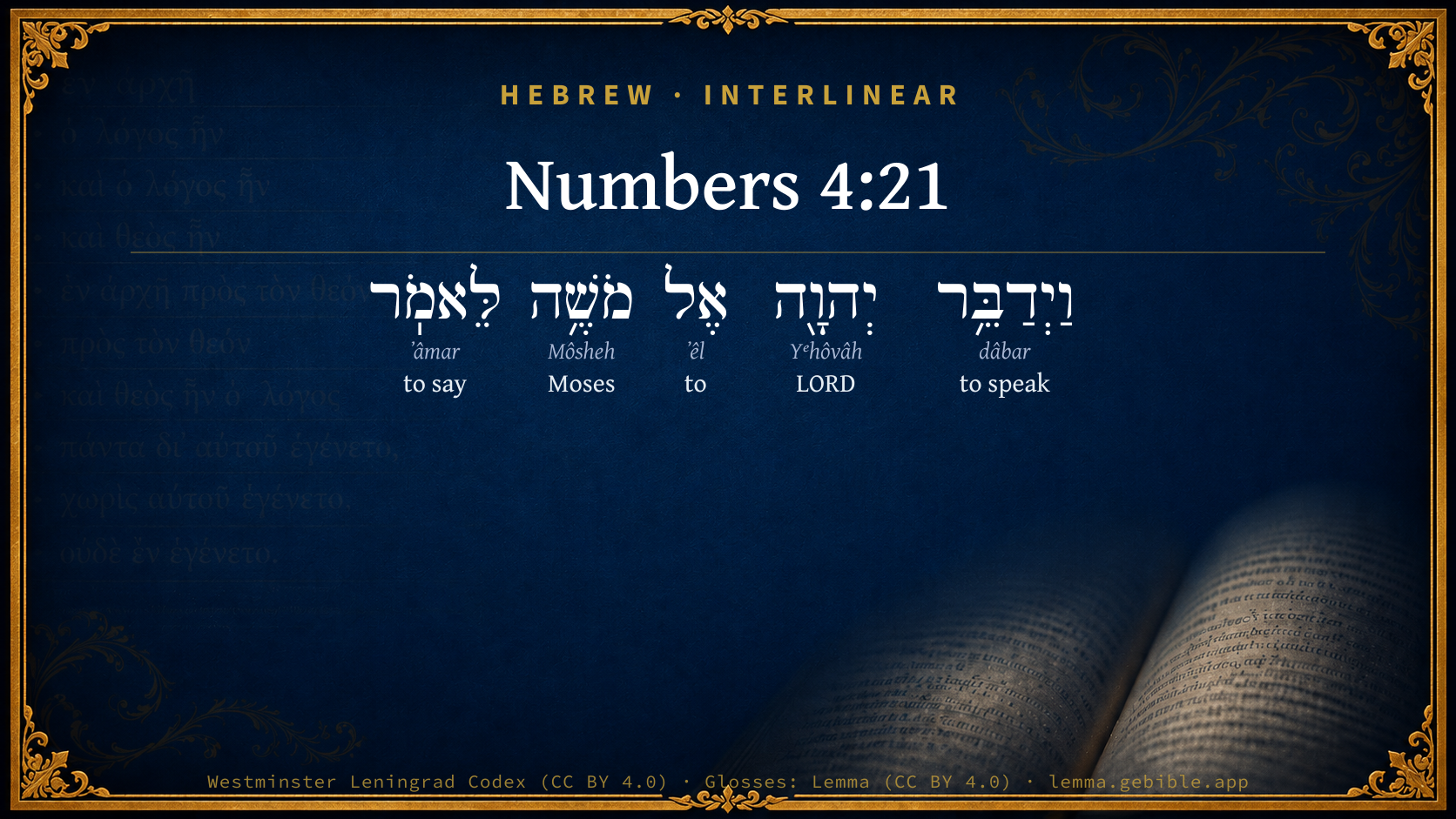
Hebrew (Westminster Leningrad Codex) Numbers 4:21 appears in the Hebrew Old Testament. The text above is from the Westminster Leningrad Codex. Each word links to its Strong’s number, a concise gloss, and parsing drawn from the Open Scriptures Hebrew Bible morphology. Click any word for its full Brown-Driver-Briggs (BDB) entry.
Download image
Cite this verse

Numbers 4:21 (World English Bible). Public Domain. Lemma interlinear Bible study tool, https://lemma.gebible.app/v/numbers/4/21.

Show BibTeX & RIS
BibTeX
RIS
English Translation
Yahweh spoke to Moses, saying,
World English Bible · Public Domain
Download a study sheet

One document with this verse’s original text, its word-by-word gloss line, the meaning frame, cross-references with their text, attributed commentary, and full source and license credits — printable, and it pastes into notes with its structure intact.

This verse Autodidact and up

Study sheet (.html) Plain text (.txt)

A passage Seminary Student

Up to 50 verses in one chapter. A passage sheet keeps up to 6 commentary sources and 12 cross-references per verse, in the order this page ranks them, and says so on the sheet whenever that leaves anything out. Ask for a single verse and you get the Autodidact verse sheet above.

Everything on this page stays free to read, with no account — the sheet is a download of what is already on screen, not access to it.

Want to remove ads? Support Godless Engineer
Compare translations 3

The same verse in 3 English versions, stacked beneath the original-language interlinear above. Click any original word for its lexicon entry.

Each is an independent rendering of the whole verse — the interlinear is not word-aligned to these translations.

Highlighted words mark where these versions differ — a whole-verse word diff, not a word-by-word alignment.

  • World English Bible Public Domain
    Yahweh spoke to Moses, saying,
  • King James Version Public Domain
    And the LORD spake unto Moses, saying,
  • unfoldingWord Literal Text CC BY-SA 4.0
    And Yahweh spoke to Moses, saying,

unfoldingWord Literal Text — © unfoldingWord, licensed CC BY-SA 4.0. Word-aligned USFM3 via Door43 (git.door43.org/unfoldingWord/en_ult).

Versions to compare (up to 4)

3 of 4 selected

Show all 18 translations

Every available English version of this verse, each an independent rendering of the whole verse.

  • World English Bible Public Domain
    Yahweh spoke to Moses, saying,
  • Berean Standard Bible Public Domain
    And the LORD said to Moses,
  • Majority Standard Bible Public Domain
    And the LORD said to Moses,
  • King James Version Public Domain
    And the LORD spake unto Moses, saying,
  • American Standard Version (1901) Public Domain
    And Jehovah spake unto Moses, saying,
  • Revised Version (1885) Public Domain
    And the LORD spake unto Moses, saying,
  • Geneva Bible (1599) Public Domain
    And the Lord spake vnto Moses, saying,
  • Douay-Rheims (1899) Public Domain
    And the Lord spoke to Moses, saying:
  • Young's Literal Translation Public Domain
    And Jehovah speaketh unto Moses, saying,
  • Literal Standard Version CC BY-SA 4.0
    And YHWH speaks to Moses, saying,
  • Unlocked Literal Bible CC BY-SA 4.0
    Yahweh spoke again to Moses. He said,
  • unfoldingWord Literal Text CC BY-SA 4.0
    And Yahweh spoke to Moses, saying,
  • Darby Bible Public Domain
    And Jehovah spoke to Moses, saying,
  • World Messianic Bible Public Domain
    The LORD spoke to Moses, saying,
  • Webster's Bible Public Domain
    And the LORD spoke to Moses, saying,
  • Free Bible Version CC BY-SA 4.0
    The Lord told Moses,
  • Bible in Basic English Public Domain
    And the Lord said to Moses,
  • JPS Tanakh (1917) Public Domain
    And the LORD spoke unto Moses saying:

Literal Standard Version (2020), Covenant Press — licensed CC BY-SA 4.0. Text via the HelloAO Bible API (eBible.org). Unlocked Literal Bible (unfoldingWord) — licensed CC BY-SA 4.0. Text via the HelloAO Bible API (eBible.org). unfoldingWord Literal Text — © unfoldingWord, licensed CC BY-SA 4.0. Word-aligned USFM3 via Door43 (git.door43.org/unfoldingWord/en_ult). Free Bible Version, Dr. Jonathan Gallagher — licensed CC BY-SA 4.0. Text via the HelloAO Bible API (eBible.org).

Word by word

More ways to search: Search by grammar → Find every occurrence → Compare this word →

Practice this passage: Drill this verse → Learn its vocabulary →

About this verse

These counts appear in no published source. They are computed here, from the morphology-tagged text and Lemma’s own curated glosses. What Lemma adds →

5
words
5
distinct lemmas
Pentateuch
section

Grammatical profile

  • 2 verbs
  • 2 nouns
  • 1 preposition

Verb forms

  • וַיְדַבֵּ֥ר Piel · Sequential Imperfect
  • לֵּאמֹֽר Qal · Infinitive Construct

Hebrew & Septuagint length

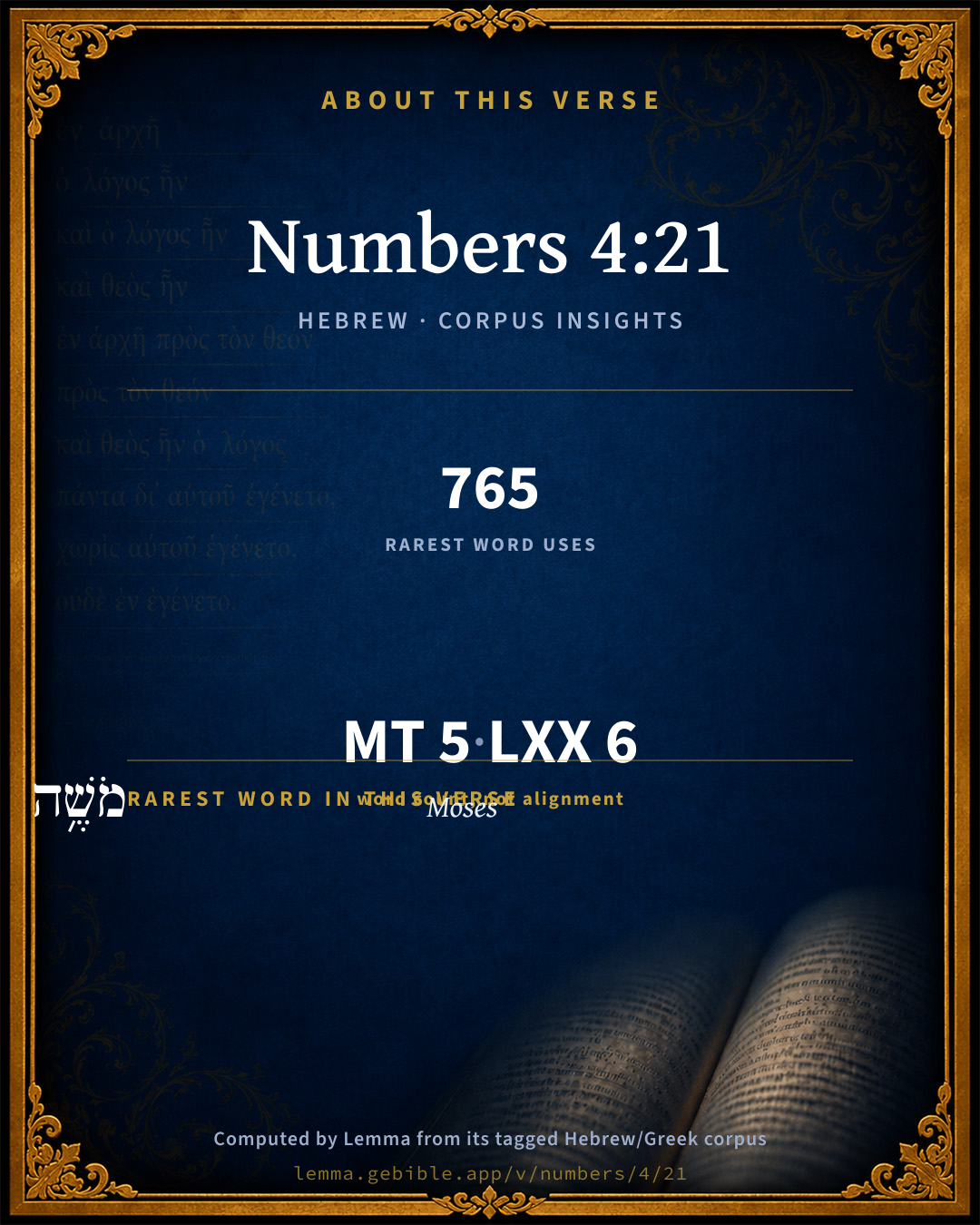
In English translation the verse runs 5 words from the Hebrew and 7 from the Septuagint (LXX English) — closely comparable.

A rough comparison of the two English renderings, which tokenize alike — not a word-level alignment.

Word counts can differ between the Hebrew and the Greek without any difference in meaning — e.g. the Hebrew direct-object marker אֵת has no separate Greek word, and Greek often adds the article ὁ.

In the original languages it is 5 Hebrew tokens and 6 Greek tokens — but the two are counted differently (Hebrew bundles its prefixes and suffixes into one token; the Greek is in lemma form), so that isn’t a like-for-like length.

Hebrew and Greek witnesses Masoretic Hebrew ↔ Greek Septuagint

The same verse in the two great witnesses to the Old Testament, shown verse-for-verse.

These are two independent witnesses, not word-aligned to each other, and the Septuagint is shown in lemma (dictionary) form.

Hebrew Numbers 4:21 Masoretic · Westminster Leningrad Codex

וַיְדַבֵּ֥ר יְהוָ֖ה אֶל מֹשֶׁ֥ה לֵּאמֹֽר

Yahweh spoke to Moses, saying,

World English Bible · Public Domain

Greek LXX Numbers 4:21 Septuagint · lemma form

καί λαλέω κύριος πρός μωυσῆς λέγω

And the Lord spoke to Moses, saying,

LXX2012 (modern English Septuagint) · Public Domain

Hebrew: Westminster Leningrad Codex (CC BY 4.0). Greek: Septuagint (public domain); English from LXX2012 (modern English Septuagint) (Public Domain). How the Septuagint differs from the Hebrew →

Targum (Aramaic paraphrase)

2

The Targum is the ancient Jewish Aramaic paraphrase of the Hebrew Scriptures — an interpretive translation, not the Hebrew text itself. Onkelos (literal) and Pseudo-Jonathan (expansive) render the Torah, and Jonathan the Prophets. Coverage is partial: where no permissively-licensed English translation exists for a verse, only the Aramaic is shown. This is verse-level text, not a word-by-word alignment to the Hebrew.

  1. Targum Onkelos Torah (Genesis–Deuteronomy)
    וּמַלִיל יְיָ עִם משֶׁה לְמֵימָר

    (no public-domain English translation for this verse)

    Targum Onkelos — Aramaic: “Onkelos Genesis” (public domain); “Onkelos Exodus” (public domain); “Onkelos Leviticus” (public domain); “Onkelos Numbers” (public domain); “Onkelos Deuteronomy” (public domain). English: “Sefaria Community Translation” (CC0 1.0 (public-domain dedication)); “J.W. Etheridge. The Targums of Onkelos and Jonathan Ben Uzziel on the Pentateuch. London: Longmans, Green, 1862” (public domain). Text via Sefaria.

  2. Targum Pseudo-Jonathan Torah (Genesis–Deuteronomy)
    וידבר וּמַלֵיל יְיָ עִם משֶׁה לְמֵימָר

    AND the Lord spake with Mosheh, saying:

    Targum Pseudo-Jonathan — Aramaic: “Targum Jonathan on Genesis” (public domain); “Targum Jonathan on Exodus” (public domain); “Targum Jonathan on Leviticus” (public domain); “Targum Jonathan on Numbers” (public domain); “Targum Jonathan on Deuteronomy” (public domain). English: “The Targum of Jonathan ben Uzziel, trans. J. W. Etheridge, London, 1862” (public domain). Text via Sefaria.

Commentary

Notes on Numbers 4:21 from classic Christian and Jewish commentators (each source and its license shown beneath its notes). The classic Christian expositions comment on the surrounding passage and are grouped to its opening verse, so a note may address several verses; the Jewish commentaries on the Tanakh (Rashi and others) are per-verse, so they appear only where the commentator wrote on this verse.

Lemma curates 59 commentaries, every one of them public domain or Creative Commons licensed, each selected and text-cleaned for this edition rather than reprinted as found. About our sources →

Whedon's Commentary on the Bible

Daniel D. Whedon

SERVICE OF THE SONS OF GERSHON, Num_4:21-28.

The special service assigned to this great family of Levites was the transportation of the cloth and skin coverings of the tabernacle, with its numerous hangings, cords, and curtains. There are no minute directions respecting the packing of these, because they were deemed less sacred than the furniture. They were taken down and folded up by the Levites, (Num_1:51,) under the superintendence of Ithamar, the son of Aaron. The Gershonites were allowed two covered wagons, drawn by four oxen. Num_7:3; Num_7:7.

SERVICE OF THE SONS OF MERARI, Num_4:29-33.

The framework of the movable temple still remains to be transported. The family of Merari are charged with the boards, posts, pins, bars, and cordage pertaining to the support of the structure. They were allowed the assistance of four covered wagons drawn by eight oxen. Num_7:3; Num_7:8. On the march, this family, as well as the Gershonites, were under the command of Ithamar the priest. His column was to precede the Kohathites with the sacred furniture, in order to pitch the tabernacle and have it in readiness for them. Num_10:17; Num_10:21.

Daniel D. Whedon (gen. ed.), Commentary on the Old and New Testaments (1874–1909) — public domain. Text from a community e-Sword module.

Keil & Delitzsch

C. F. Keil & F. Delitzsch

The service of the Gershonites is introduced in Num 4:21-23 in the same manner as that of the Kohathites in Num 4:1-3; and in Num 4:24-26 it is described in accordance with the brief notice and explanation already given in Num 3:24-26.

Keil & Delitzsch — Biblical Commentary on the Old Testament (1861–1891) — public domain (CC PDM 1.0). Text via the HelloAO Bible API. (Old Testament only.)

Tyndale Open Study Notes

Tyndale Open Resources

4:21-28 The men of the Gershonite clan (see 3:21-26) were responsible for general service and carrying loads (4:24). This involved handling the curtains and coverings, ropes, and related equipment that was less central to Israel’s worship. Their duties focused on the Tabernacle in general instead of on the sacred objects of the inner sanctuary that were the responsibility of Kohath’s clan.

Tyndale Open Study Notes — © Tyndale Open Resources, licensed CC BY-SA 4.0. Text via the HelloAO Bible API.

Matthew Henry's Commentary

We have here the charge of the other two families of the Levites, which, though not so honourable as the first, yet was necessary, and was to be done regularly. 1. The Gershonites were charged with all the drapery of the tabernacle, the curtains, and hangings, and the coverings of badgers' skins, Num 4:22-26. These they were to take down when the cloud removed, and the ark and the rest of the holy things were carried away, to pack up and bring with them, and then to set up again, where the cloud rested. Aaron and his sons allotted to them their respective charge: "You shall take care of such a curtain, and you of such a hanging, that every one may know his work, and there may be no confusion," Num 4:27. Ithamar particularly was to take the oversight of them, Num 4:28. 2. The Merarites were charged with the heavy carriage, the boards and bars, the pillars and sockets, the pins and cords, and these were delivered to them by name, Num 4:31, Num 4:32. An inventory was given them of every particular, that it might be forthcoming, and nothing to seek, when the tabernacle was to be set up again. Though these seemed of less importance than the other things pertaining to the sanctuary, yet there was this care taken of them, to teach us with the greatest exactness to preserve pure and entire all divine institutions, and to take care that nothing be lost. It also intimates the care God takes of his church, and every member of it; the good Shepherd calls his own sheep by name, Joh 10:3. Here were thousands of men employed about these services, though a much less number would have served for the bearing of those burdens; but it was requisite that the tabernacle should be taken down, and set up, with great expedition, and many hands would make quick work, especially when every one knew his work. They had tents of their own to take care of, and to take along with them, but the young men under thirty, and the old men above fifty, might serve for them; nor is there any mention of them, for God's house must always be preferred before our own. Their care was preposterous who built and ceiled their own houses while God's house lay waste, Hag 1:4, Hag 1:9. The death of the saints is represented as the taking down of the tabernacle (Co2 5:1), and the putting of it off, Pe2 1:14. The immortal soul, like the most holy things, is first covered and taken away, carried by angels, unseen, under the inspection of the Lord Jesus, our Eleazar. Care is also taken of the body - the skin and flesh, which are as the curtains, the bones and sinews which are as the bars and pillars; none of these shall be lost; commandment is given concerning the bones, a covenant made with the dust; these are in safe custody, and shall all be produced in the great day, when this tabernacle shall be set up again, and these vile bodies made like the glorious body of Jesus Christ.

Matthew Henry's Commentary on the Whole Bible (1708–1710) — public domain (CC PDM 1.0). Text via the HelloAO Bible API.

The Cambridge Bible for Schools and Colleges

gen. ed. J. J. S. Perowne

21–28. The Gershonites and their duties.

They carry (in wagons Num_7:7) all the hangings and coverings of which the Dwelling and the court are composed.

The Cambridge Bible for Schools and Colleges (gen. ed. J. J. S. Perowne; Cambridge University Press, 1878–1918) — public domain. Text from a community e-Sword module.

John Gill's Exposition

From thirty years old and upward, until fifty years old,

shalt thou number them,.... Take an account how many there are of that age, and so fit for service (a); See Gill on Num 4:3,

to do the work in the tabernacle of the congregation; as the rest of the Levites; see Num 4:3;

(a) "ad militandum militiam", Montanus, Drusius.

John Gill's Exposition of the Whole Bible (1746–1763) — public domain (CC PDM 1.0). Text via the HelloAO Bible API.

Kretzmann's Popular Commentary

Paul E. Kretzmann

The Work of the Gershonites

v. 21. And the Lord spake unto Moses, saying,

v. 22. Take also the sum of the sons of Gershon, throughout the houses of their fathers, by their families;

v. 23. from thirty years old and upward until fifty years old shall thou number them, when they, according to God’s order, were fit for service; all that enter in to perform the service, literally, "to war the warfare," for their service was a branch of warfare for God, to do the work in the Tabernacle of the Congregation.

v. 24. This is the service of the families of the Gershonites, to serve, and for burdens, in carrying a part of the paraphernalia of the Sanctuary;

v. 25. and they shall bear the curtains of the Tabernacle, and the Tabernacle of the Congregation, his covering, and the covering of the badgers’ skins that is above upon it, and the hanging for the door of the Tabernacle of the Congregation,

v. 26. and the hangings of the court, and the hanging for the door of the gate of the court, which is by the Tabernacle and by the altar round about, and their cords, and all the instruments of their service, and all that is made for them; so shall they serve. Cf Num 3:24-26.

v. 27. At the appointment of Aaron and his sons, literally, "at his mouth," at his directions, shall be all the service of the sons of the Gershonites, in all their burdens, and in all their service; and ye shall appoint unto them in charge of all their burdens. Both as porters on the way and in their work of assisting in the Sanctuary the Levites were strictly under the command of the priests, as directed by God.

v. 28. This is the service of the families of the sons of Gershon in the Tabernacle of the Congregation; and their charge shall be under the hand of Ithamar, the son of Aaron, the priest.

Paul E. Kretzmann, Popular Commentary of the Bible (1921–1924) — public domain. Text from a community e-Sword module.

unfoldingWord translationNotes

Door43 World Missions Community

of the descendants of Gershon

This refers only to men. AT: "of the male descendants of Gershon" (See: Assumed Knowledge and Implicit Information)

Gershon

See how you translated this man's name in Numbers 3:17.

thirty years old to fifty years old

"30 years old to 50 years old" (See: Numbers)

join the company to serve in the tent of meeting

The word "company" refers to the rest of the people working in the tent of meeting. See how you translated this phrase in Numbers 4:3.

translationWords

census

family

servant

unfoldingWord translationNotes — © Distant Shores Media and the Door43 World Missions Community, licensed CC BY-SA 4.0. Source: git.door43.org/Door43/en_tn.

Lesson kit

Teaching starters — assembled from the data on this page, not authored interpretation. Every prompt links to the verse data it draws on. Edit before teaching.

Numbers, in the Pentateuch, opens this verse with 5 words (5 distinct Hebrew lemmas). Its most distinctive word is Môsheh (“Moses”). A historical commentator’s framing appears above. Read the whole chapter for the surrounding context.

Discussion questions

  1. The word Môsheh carries the sense “Moses.” How does it shape the verse?
  2. The translations on this page render this verse differently — a whole-verse word diff, not a word-by-word alignment. What might account for the different wordings?
  3. «וַיְדַבֵּ֥ר» is a Piel Sequential Imperfect verb. How does that grammatical form shape the action described?
  4. Compare how Whedon's Commentary on the Bible and Keil & Delitzsch read this verse. Where do they agree or differ?

Things to notice

Reading settings

Reading text

Shown beneath each verse's original-language words.

Old Testament
Old Testament edition

Read the OT as the Masoretic Hebrew (MT) or the Greek Septuagint (LXX).

English shown for the Greek Septuagint (in the Hebrew ↔ Greek comparison).

Comparing translations? Open the Compare panel on any verse page to stack up to four side by side.