
Numbers 36:8

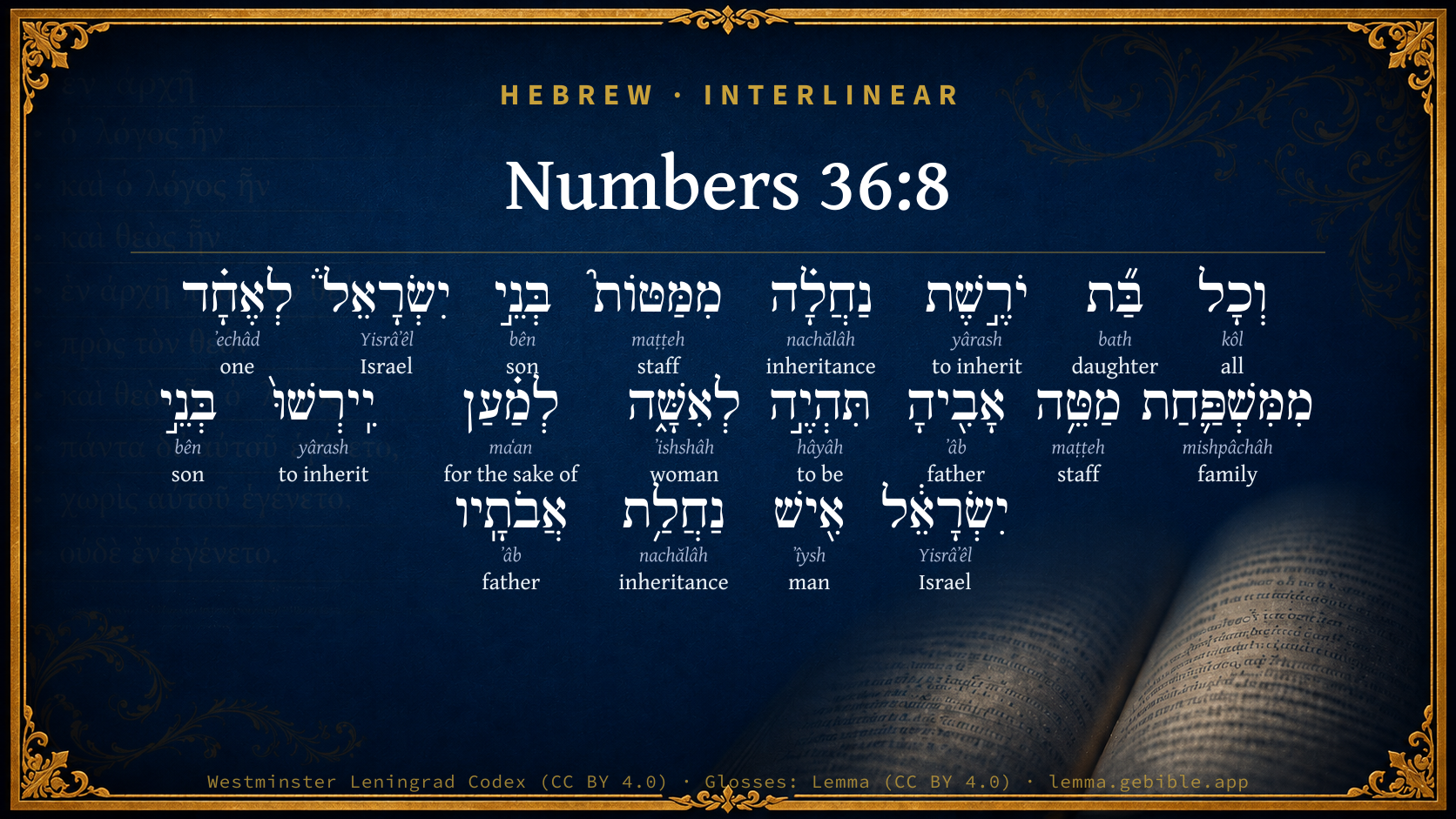
Hebrew (Westminster Leningrad Codex) Numbers 36:8 appears in the Hebrew Old Testament. The text above is from the Westminster Leningrad Codex. Each word links to its Strong’s number, a concise gloss, and parsing drawn from the Open Scriptures Hebrew Bible morphology. Click any word for its full Brown-Driver-Briggs (BDB) entry.
Download image
Cite this verse

Numbers 36:8 (World English Bible). Public Domain. Lemma interlinear Bible study tool, https://lemma.gebible.app/v/numbers/36/8.

Show BibTeX & RIS
BibTeX
RIS
English Translation
Every daughter, who possesses an inheritance in any tribe of the children of Israel, shall be wife to one of the family of the tribe of her father, that the children of Israel may possess every man the inheritance of his fathers.
World English Bible · Public Domain
Download a study sheet

One document with this verse’s original text, its word-by-word gloss line, the meaning frame, cross-references with their text, attributed commentary, and full source and license credits — printable, and it pastes into notes with its structure intact.

This verse Autodidact and up

Study sheet (.html) Plain text (.txt)

A passage Seminary Student

Up to 50 verses in one chapter. A passage sheet keeps up to 6 commentary sources and 12 cross-references per verse, in the order this page ranks them, and says so on the sheet whenever that leaves anything out. Ask for a single verse and you get the Autodidact verse sheet above.

Everything on this page stays free to read, with no account — the sheet is a download of what is already on screen, not access to it.

Want to remove ads? Support Godless Engineer
Compare translations 3

The same verse in 3 English versions, stacked beneath the original-language interlinear above. Click any original word for its lexicon entry.

Each is an independent rendering of the whole verse — the interlinear is not word-aligned to these translations.

Highlighted words mark where these versions differ — a whole-verse word diff, not a word-by-word alignment.

  • World English Bible Public Domain
    Every daughter, who possesses an inheritance in any tribe of the children of Israel, shall be wife to one of the family of the tribe of her father, that the children of Israel may possess every man the inheritance of his fathers.
  • King James Version Public Domain
    And every daughter, that possesseth an inheritance in any tribe of the children of Israel, shall be wife unto one of the family of the tribe of her father, that the children of Israel may enjoy every man the inheritance of his fathers.
  • unfoldingWord Literal Text CC BY-SA 4.0
    And every daughter who possesses an inheritance from the tribes of the sons of Israel shall become a wife for one from the clan of the tribe of her father, so that the sons of Israel will have a possession, a man, the inheritance of his fathers.

unfoldingWord Literal Text — © unfoldingWord, licensed CC BY-SA 4.0. Word-aligned USFM3 via Door43 (git.door43.org/unfoldingWord/en_ult).

Versions to compare (up to 4)

3 of 4 selected

Show all 18 translations

Every available English version of this verse, each an independent rendering of the whole verse.

  • World English Bible Public Domain
    Every daughter, who possesses an inheritance in any tribe of the children of Israel, shall be wife to one of the family of the tribe of her father, that the children of Israel may possess every man the inheritance of his fathers.
  • Berean Standard Bible Public Domain
    Every daughter who possesses an inheritance from any Israelite tribe must marry within a clan of the tribe of her father, so that every Israelite will possess the inheritance of his fathers.
  • Majority Standard Bible Public Domain
    Every daughter who possesses an inheritance from any Israelite tribe must marry within a clan of the tribe of her father, so that every Israelite will possess the inheritance of his fathers.
  • King James Version Public Domain
    And every daughter, that possesseth an inheritance in any tribe of the children of Israel, shall be wife unto one of the family of the tribe of her father, that the children of Israel may enjoy every man the inheritance of his fathers.
  • American Standard Version (1901) Public Domain
    And every daughter, that possesseth an inheritance in any tribe of the children of Israel, shall be wife unto one of the family of the tribe of her father, that the children of Israel may possess every man the inheritance of his fathers.
  • Revised Version (1885) Public Domain
    And every daughter, that possesseth an inheritance in any tribe of the children of Israel, shall be wife unto one of the family of the tribe of her father, that the children of Israel may possess every man the inheritance of his fathers.
  • Geneva Bible (1599) Public Domain
    And euery daughter that possesseth any inheritance of the tribes of the children of Israel, shalbe wife vnto one of the familie of the tribe of her father: that the children of Israel may enioye euery man the inheritance of their fathers.
  • Douay-Rheims (1899) Public Domain
    And all women shall take husbands of the same tribe: that the inheritance may remain in the families,
  • Young's Literal Translation Public Domain
    `And every daughter possessing an inheritance, of the tribes of the sons of Israel, is to one of the family of the tribe of her father for a wife, so that the sons of Israel possess each the inheritance of his fathers,
  • Literal Standard Version CC BY-SA 4.0
    And every daughter possessing an inheritance from the tribes of the sons of Israel is for a wife to one from the family of the tribe of her father, so that the sons of Israel each possess the inheritance of his fathers,
  • Unlocked Literal Bible CC BY-SA 4.0
    Every woman of the people of Israel who owns a share in her tribe must marry someone from the clans belonging to her father's tribe. This is so that everyone of the people of Israel may own an inheritance from his ancestors.
  • unfoldingWord Literal Text CC BY-SA 4.0
    And every daughter who possesses an inheritance from the tribes of the sons of Israel shall become a wife for one from the clan of the tribe of her father, so that the sons of Israel will have a possession, a man, the inheritance of his fathers.
  • Darby Bible Public Domain
    And every daughter that possesseth an inheritance among the tribes of the children of Israel, shall be married to one of the family of the tribe of her father, that the children of Israel may possess every one the inheritance of his fathers,
  • World Messianic Bible Public Domain
    Every daughter who possesses an inheritance in any tribe of the children of Israel shall be wife to one of the family of the tribe of her father, that the children of Israel may each possess the inheritance of his fathers.
  • Webster's Bible Public Domain
    And every daughter, that possesseth an inheritance in any tribe of the children of Israel, shall be wife to one of the family of the tribe of her father, that the children of Israel may enjoy every man the inheritance of his fathers.
  • Free Bible Version CC BY-SA 4.0
    Every daughter who possesses an inheritance from any Israelite tribe must marry within a clan of the tribe of her father, so that every Israelite will possess the inheritance of his fathers.
  • Bible in Basic English Public Domain
    And every daughter owning property in any tribe of the children of Israel is to be married to one of the family of her father's tribe, so that every man of the children of Israel may keep the heritage of his fathers.
  • JPS Tanakh (1917) Public Domain
    And every daughter, that possesseth an inheritance in any tribe of the children of Israel, shall be wife unto one of the family of the tribe of her father, that the children of Israel may possess every man the inheritance of his fathers.

Literal Standard Version (2020), Covenant Press — licensed CC BY-SA 4.0. Text via the HelloAO Bible API (eBible.org). Unlocked Literal Bible (unfoldingWord) — licensed CC BY-SA 4.0. Text via the HelloAO Bible API (eBible.org). unfoldingWord Literal Text — © unfoldingWord, licensed CC BY-SA 4.0. Word-aligned USFM3 via Door43 (git.door43.org/unfoldingWord/en_ult). Free Bible Version, Dr. Jonathan Gallagher — licensed CC BY-SA 4.0. Text via the HelloAO Bible API (eBible.org).

Word by word

More ways to search: Search by grammar → Find every occurrence → Compare this word →

Practice this passage: Drill this verse → Learn its vocabulary →

נַחֲלָ֗ה
nachălâh
H5159
“inheritance”
Noun, Common, Feminine, Singular, Absolute
Part of Speech
Noun
Type
Common
Gender
Feminine
Number
Singular
State
Absolute
Full BDB Definition

Origin: from H5157 (in its usual sense)

TWOT: 1342a

possession, property, inheritance, heritage - property - portion, share - inheritance, portion
  1. וְכָל kôl H3605 “and · all of” Conjunction + Noun, Common, Masculine, Singular, Construct
  2. בַּ֞ת bath H1323 “daughter” Noun, Common, Feminine, Singular, Absolute
  3. יֹרֶ֣שֶׁת yârash H3423 “inheriting” Verb, Qal, Participle Active, Feminine, Singular, Absolute
  4. מִמַּטּוֹת֮ maṭṭeh H4294 “from · staffs of” Preposition + Noun, Common, Masculine, Plural, Construct
  5. בְּנֵ֣י bên H1121 “sons of” Noun, Common, Masculine, Plural, Construct
  6. יִשְׂרָאֵל֒ Yisrâʼêl H3478 “Israel” Noun, Proper
  7. לְאֶחָ֗ד ʼechâd H259 “to/for · one” Preposition + Adjective, Cardinal number, Masculine, Singular, Absolute
  8. מִמִּשְׁפַּ֛חַת mishpâchâh H4940 “from · family of” Preposition + Noun, Common, Feminine, Singular, Construct
  9. מַטֵּ֥ה maṭṭeh H4294 “staff of” Noun, Common, Masculine, Singular, Construct
  10. אָבִ֖יהָ ʼâb H1 “father · her” Noun, Common, Masculine, Singular, Construct + Suffix, Personal, 3rd Person, Feminine, Singular
  11. תִּהְיֶ֣ה hâyâh H1961 “to be” Verb, Qal, Imperfect, 3rd Person, Feminine, Singular
  12. לְאִשָּׁ֑ה ʼishshâh H802 “to/for · woman” Preposition + Noun, Common, Feminine, Singular, Absolute
  13. לְמַ֗עַן maʻan H4616 “for the sake of” Preposition
  14. יִֽירְשׁוּ֙ yârash H3423 “to inherit” Verb, Qal, Imperfect, 3rd Person, Masculine, Plural
  15. בְּנֵ֣י bên H1121 “sons of” Noun, Common, Masculine, Plural, Construct
  16. יִשְׂרָאֵ֔ל Yisrâʼêl H3478 “Israel” Noun, Proper
  17. אִ֖ישׁ ʼîysh H376 “man” Noun, Common, Masculine, Singular, Absolute
  18. נַחֲלַ֥ת nachălâh H5159 “inheritance of” Noun, Common, Feminine, Singular, Construct
  19. אֲבֹתָֽיו ʼâb H1 “fathers · his” Noun, Common, Masculine, Plural, Construct + Suffix, Personal, 3rd Person, Masculine, Singular

About this verse

These counts appear in no published source. They are computed here, from the morphology-tagged text and Lemma’s own curated glosses. What Lemma adds →

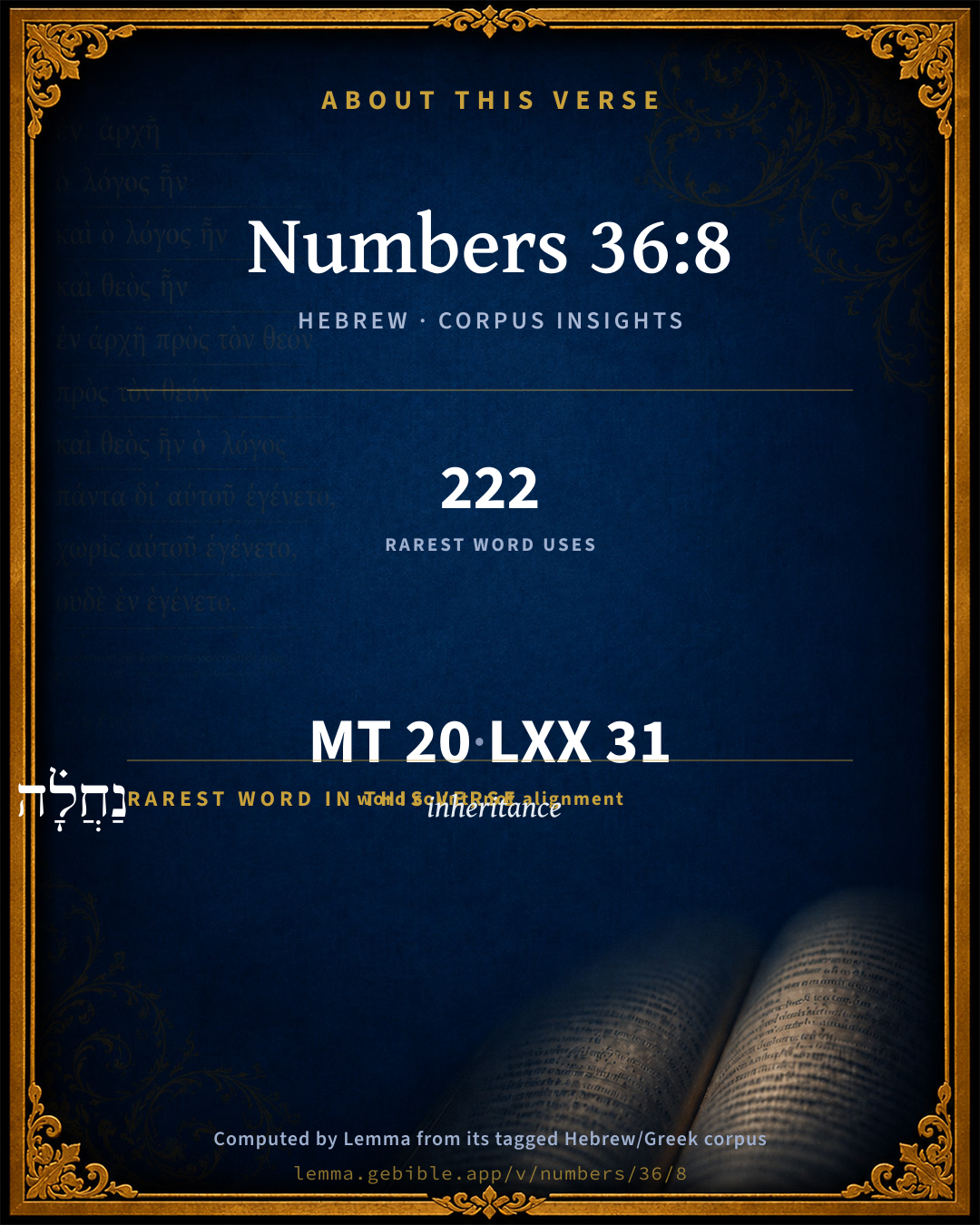
20
words
14
distinct lemmas
Pentateuch
section

Grammatical profile

  • 3 verbs
  • 15 nouns
  • 1 adjective
  • 1 preposition

Verb forms

  • יֹרֶ֣שֶׁת Qal · Participle Active
  • תִּהְיֶ֣ה Qal · Imperfect
  • יִֽירְשׁוּ֙ Qal · Imperfect

Repetition

Words recur within this verse — often emphatic in Hebrew:

  • יֹרֶ֣שֶׁת to inherit H3423 ×2
  • נַחֲלָ֗ה inheritance H5159 ×2
  • מִמַּטּוֹת֮ staff H4294 ×2
  • בְּנֵ֣י son H1121 ×2
  • יִשְׂרָאֵל֒ Israel H3478 ×2
  • אָבִ֖יהָ father H1 ×2

Hebrew & Septuagint length

In English translation the verse runs 42 words from the Hebrew and 41 from the Septuagint (LXX English) — closely comparable.

A rough comparison of the two English renderings, which tokenize alike — not a word-level alignment.

Word counts can differ between the Hebrew and the Greek without any difference in meaning — e.g. the Hebrew direct-object marker אֵת has no separate Greek word, and Greek often adds the article ὁ.

In the original languages it is 20 Hebrew tokens and 31 Greek tokens — but the two are counted differently (Hebrew bundles its prefixes and suffixes into one token; the Greek is in lemma form), so that isn’t a like-for-like length.

Cross-references

1

Topical passages linked to Numbers 36:8 in the Treasury of Scripture Knowledge — connected by theme and wording, ordered by reader-vote popularity; previews shown in the World English Bible.

  • 1 Chronicles 23:22 Eleazar died, and had no sons, but daughters only: and their brothers the sons of Kish took them [to wife].

Cross-references courtesy of OpenBible.info (CC BY 4.0).

Hebrew and Greek witnesses Masoretic Hebrew ↔ Greek Septuagint

The same verse in the two great witnesses to the Old Testament, shown verse-for-verse.

These are two independent witnesses, not word-aligned to each other, and the Septuagint is shown in lemma (dictionary) form.

Hebrew Numbers 36:8 Masoretic · Westminster Leningrad Codex

וְכָל בַּ֞ת יֹרֶ֣שֶׁת נַחֲלָ֗ה מִמַּטּוֹת֮ בְּנֵ֣י יִשְׂרָאֵל֒ לְאֶחָ֗ד מִמִּשְׁפַּ֛חַת מַטֵּ֥ה אָבִ֖יהָ תִּהְיֶ֣ה לְאִשָּׁ֑ה לְמַ֗עַן יִֽירְשׁוּ֙ בְּנֵ֣י יִשְׂרָאֵ֔ל אִ֖ישׁ נַחֲלַ֥ת אֲבֹתָֽיו

Every daughter, who possesses an inheritance in any tribe of the children of Israel, shall be wife to one of the family of the tribe of her father, that the children of Israel may possess every man the inheritance of his fathers.

World English Bible · Public Domain

Greek LXX Numbers 36:8 Septuagint · lemma form

καί πᾶς θυγάτηρ ἀγχιστεύω κληρονομία ἐκ ὁ φυλή υἱός ἰσραήλ εἷς ὁ ἐκ ὁ δῆμος ὁ πατήρ αὐτός εἰμί γυνή ἵνα ἀγχιστεύω ὁ υἱός ἰσραήλ ἕκαστος ὁ κληρονομία ὁ πατρικός αὐτός

And whatever daughter is heiress to a property of the tribes of the children Israel, such women shall be married each to one of her father's tribe, that the sons of Israel may each inherit the property of his father's tribe.

LXX2012 (modern English Septuagint) · Public Domain

Hebrew: Westminster Leningrad Codex (CC BY 4.0). Greek: Septuagint (public domain); English from LXX2012 (modern English Septuagint) (Public Domain). How the Septuagint differs from the Hebrew →

Targum (Aramaic paraphrase)

2

The Targum is the ancient Jewish Aramaic paraphrase of the Hebrew Scriptures — an interpretive translation, not the Hebrew text itself. Onkelos (literal) and Pseudo-Jonathan (expansive) render the Torah, and Jonathan the Prophets. Coverage is partial: where no permissively-licensed English translation exists for a verse, only the Aramaic is shown. This is verse-level text, not a word-by-word alignment to the Hebrew.

  1. Targum Onkelos Torah (Genesis–Deuteronomy)
    וְכָל בְּרַתָּא יַרְתַת אַחֲסָנָא מִשִׁבְטַּיָא דִבְנֵי יִשְׂרָאֵל לְחַד מִזַרְעִית שִׁבְטָא דַאֲבוּהָא תְּהֵי לְאִנְתּוּ בְּדִיל דְיֵרְתוּן בְּנֵי יִשְׂרָאֵל גְבַר אַחֲסָנַת אֲבָהָתוֹהִי

    (no public-domain English translation for this verse)

    Targum Onkelos — Aramaic: “Onkelos Genesis” (public domain); “Onkelos Exodus” (public domain); “Onkelos Leviticus” (public domain); “Onkelos Numbers” (public domain); “Onkelos Deuteronomy” (public domain). English: “Sefaria Community Translation” (CC0 1.0 (public-domain dedication)); “J.W. Etheridge. The Targums of Onkelos and Jonathan Ben Uzziel on the Pentateuch. London: Longmans, Green, 1862” (public domain). Text via Sefaria.

  2. Targum Pseudo-Jonathan Torah (Genesis–Deuteronomy)
    וְכָל בְּרַתָּא יַרְתַת אַחְסָנָא מִשִׁבְטָא דִבְנֵי יִשְרָאֵל לְחַד מִזַרְעִית שִׁבְטָא דַאֲבוּהָא תְּהֵי לְאִנְתּוּ בְּדִיל דְיֵרְתוּן בְּנֵי יִשְרָאֵל גְבַר אַחְסָנַת אַבְהָתוֹהִי

    (no public-domain English translation for this verse)

    Targum Pseudo-Jonathan — Aramaic: “Targum Jonathan on Genesis” (public domain); “Targum Jonathan on Exodus” (public domain); “Targum Jonathan on Leviticus” (public domain); “Targum Jonathan on Numbers” (public domain); “Targum Jonathan on Deuteronomy” (public domain). English: “The Targum of Jonathan ben Uzziel, trans. J. W. Etheridge, London, 1862” (public domain). Text via Sefaria.

Commentary

Notes on Numbers 36:8 from classic Christian and Jewish commentators (each source and its license shown beneath its notes). The classic Christian expositions comment on the surrounding passage and are grouped to its opening verse, so a note may address several verses; the Jewish commentaries on the Tanakh (Rashi and others) are per-verse, so they appear only where the commentator wrote on this verse.

Lemma curates 59 commentaries, every one of them public domain or Creative Commons licensed, each selected and text-cleaned for this edition rather than reprinted as found. About our sources →

Joseph Benson's Commentary

Num 36:8. The inheritance of his fathers — This law was not general, to forbid every woman to marry into another tribe, as may be reasonably concluded from the practice of so many patriarchs, kings, priests, and other holy men, who have married women of other tribes, yea, sometimes of other nations; but restrained to heiresses, or such as were likely to be so. But if they had brethren they were free to marry into any tribe, yet so that, if their brethren died, the inheritance went from them to the next akin of their father’s tribe and family. And the principal reason why God was solicitous to preserve tribes and families unmixed was, that the tribe, and family too, out of which the Messiah was to come, and by which he should be known, might be evident and unquestionable.

Joseph Benson's Commentary on the Old and New Testaments (1811–1818) — public domain. Text from a community e-Sword module.

Geneva Bible (1599)

Geneva Bible translators

When there is no male to inherit.

Geneva Bible (1599) marginal notes — public domain. Text via Bolls.life.

Adam Clarke's Commentary

Verse 8. Every daughter that possesseth an inheritance] This law affected none but heiresses; all others were at liberty to marry into any of the other tribes. The priests and Levites, who could have no inheritance, were exempt from the operation of this law. Jehoiada had the king of Judah's daughter to wife, 2Ch 22:11. And another priest had for wife one of the daughters of Barzillai the Gileadite, Ezr 2:61. "By reason of such marriages," says Mr. Ainsworth, "there might be kindred between Elisabeth, the mother of John the Baptist, who was of the daughters of Aaron, and Mary the virgin, the mother of our Lord, who was of the lineage of David, and tribe of Judah;" Lu 1:5; Lu 1:36; Lu 3:23-31.

Adam Clarke's Commentary on the Bible (1810–1826) — public domain. Text from a community e-Sword/MySword module.

Ellicott's Commentary for English Readers

(8, 9) And every daughter, that possesseth an inheritance . . . —The particular direction which was given in the case of the daughters of Zelophehad is extended in these verses into a general and permanent law that no heiress in Israel should marry out of her father’s tribe, in order that the inheritance might not be transferred from one tribe to another, and thus, in process of time, the division of the land amongst the tribes, which was made under Divine direction, be materially changed.

A Bible Commentary for English Readers, edited by Charles John Ellicott (1878–1897) — public domain. Text from a community e-Sword module.

John Gill's Exposition

And every daughter that possesseth an inheritance in any tribe if the children of Israel,.... For the same law which gave the daughters of Zelophehad right to their father's inheritance, gave every other daughter in Israel a right to inherit where there were no sons, Num 27:8 and every such daughter, according to this law:

shall be wife unto one of the family of the tribe of her father; marry into her father's tribe and family; by which it appears that such who were not heiresses might marry persons of another family, and even of another tribe:

that the children of Israel may enjoy every man the inheritance of his fathers; of his father's brethren, or of those that are near akin to him.

John Gill's Exposition of the Whole Bible (1746–1763) — public domain (CC PDM 1.0). Text via the HelloAO Bible API.

Haydock's Catholic Bible Commentary

Women. Hebrew, "every daughter that possesseth an inheritance....shall be wife to one of the family of the tribe of her father." Commonly the females were debarred from inheriting land, when they had any brothers. The Levites were not concerned in these regulations, as they had no inheritance; and hence, we need not be surprised to find that St. Elizabeth, of the daughters of Aaron, (Luke i. 26,) was related to the blessed Virgin, who was of the family of David. The mother of St. Elizabeth might be of the tribe of Juda; or a maternal ancestor of the blessed Virgin might spring from the tribe of Levi. (Calmet) --- Tradition determined the lawfulness of such marriages, and in this case, St. Augustine (Consens. Ev. ii. 23) admires the providence of God, in causing his beloved Son, the great anointed, to be born both of the regal and priestly tribes, in which an unction was required, before the priests and kings were put in possession of their respective offices. Thus Christ was both priest and king, and such were anointed in the law of Moses. (Worthington)

George Leo Haydock (1774–1849), Haydock's Catholic Family Bible and Commentary, 1859 edition — public domain. Excludes Psalms (Douay-Rheims chapter numbering differs from Protestant) and Deuterocanonical books (Catholic canon only).

Matthew Poole's English Annotations

By which clause it seems that this law was not general to forbid every woman to marry into another tribe, (as may be reasonably concluded from the practice of so many patriarchs, kings, priests, and other holy men, who have married women of other tribes, yea, sometimes of other nations, which it is not likely they would have done, if this had been a transgression of God’s law,) but restrained to heiresses, or such as were likely to be so. See 1Ch 23:22. But if they had brethren, it is probable they were free to marry into any tribe, yet so that, if their brethren died, their punishment was, that the inheritance went from them to the next akin of their father’s tribe and family. And the principal reason why God was solicitous to preserve tribes and families unmixed was, that the tribe and family too out of which the Messiah was to come, and by which he should be known, might be evident and unquestionable.

Matthew Poole's English Annotations on the Holy Bible (1683–1685) — public domain. Text from a community e-Sword/MySword module.

Whedon's Commentary on the Bible

Daniel D. Whedon

8. Every daughter, that possesseth an inheritance — This does not command marriage, but only restricts a voluntary institution. The woman might decline matrimony perpetually, an act rare indeed in the Orient. In case of marriage she must marry in her own tribe.

Daniel D. Whedon (gen. ed.), Commentary on the Old and New Testaments (1874–1909) — public domain. Text from a community e-Sword module.

John Wesley's Explanatory Notes

The inheritance of his fathers - This law was not general to forbid every woman to marry into another tribe, as may be reasonably concluded from the practice of so many patriarchs, kings, priests, and other holy men, who have married women of other tribes, yea sometimes of other nations, but restrained to heiresses, or such as were likely to be so. But if they had brethren, they were free to marry into any tribe, yet so that, if their brethren died, the inheritance went from them to the next a-kin of their father's tribe and family. And the principal reason why God was solicitous to preserve tribes and families unmixed was, that the tribe and family too, out of which the Messiah was to come, and by which he should be known, might be evident and unquestionable.

John Wesley, Explanatory Notes Upon the Whole Bible (1754–1765) — public domain. Text via the GEBible commentary corpus.

unfoldingWord translationNotes

Door43 World Missions Community

who owns a share in her tribe

"who owns a share of land in her tribe"

may own an inheritance

The land that each clan possesses is spoken of as if it were an inheritance that they received. (See: Metaphor)

No share may change hands from one tribe to another

Transferring ownership from one tribe to another is spoken of as if the property passed from one person's hands to another person's hands. AT: "No one may transfer the ownership of any share of land from one tribe to another" (See: Metaphor)

translationWords

clan

inherit

hand

unfoldingWord translationNotes — © Distant Shores Media and the Door43 World Missions Community, licensed CC BY-SA 4.0. Source: git.door43.org/Door43/en_tn.

Rashi

Rabbi Shlomo Yitzchaki (Rashi)

וכל בת ירשת נחלה AND EVERY DAUGHTER THAT INHERITS A POSSESSION because her father had no son, [SHALL BE WIFE, etc.]

Rashi on the Tanakh — English translations: “The Judaica Press complete Tanach with Rashi, translated by A. J. Rosenberg” (CC BY 4.0); “Pentateuch with Rashi's commentary by M. Rosenbaum and A.M. Silbermann, 1929-1934” (public domain); “The Metsudah Tanach series, Lakewood, N.J” (CC BY 4.0); and “The Book of Joshua, Metsudah Publications, 1997” (CC BY 4.0). Text via Sefaria.

Lesson kit

Teaching starters — assembled from the data on this page, not authored interpretation. Every prompt links to the verse data it draws on. Edit before teaching.

Numbers, in the Pentateuch, opens this verse with 20 words (14 distinct Hebrew lemmas). Its most distinctive word is nachălâh (“inheritance”). A historical commentator’s framing appears above. Read the whole chapter for the surrounding context.

Discussion questions

  1. The word nachălâh carries the sense “inheritance.” How does it shape the verse?
  2. How does 1 Chronicles 23:22, which shares this passage’s theme, read alongside this verse?
  3. What does the repetition of “to inherit” (2× in this one verse) do in this verse?
  4. These translations render this verse differently; the difference is in the English rendering, not the original. What questions does that raise?
  5. «יֹרֶ֣שֶׁת» is a Qal Participle Active verb. How does that grammatical form shape the action described?
  6. Compare how Joseph Benson's Commentary and Geneva Bible (1599) read this verse. Where do they agree or differ?

Things to notice

Reading settings

Reading text

Shown beneath each verse's original-language words.

Old Testament
Old Testament edition

Read the OT as the Masoretic Hebrew (MT) or the Greek Septuagint (LXX).

English shown for the Greek Septuagint (in the Hebrew ↔ Greek comparison).

Comparing translations? Open the Compare panel on any verse page to stack up to four side by side.