Numbers 36:5

Hebrew (Westminster Leningrad Codex) Numbers 36:5 appears in the Hebrew Old Testament. The text above is from the Westminster Leningrad Codex. Each word links to its Strong’s number, a concise gloss, and parsing drawn from the Open Scriptures Hebrew Bible morphology. Click any word for its full Brown-Driver-Briggs (BDB) entry.
Download image
Cite this verse

Numbers 36:5 (World English Bible). Public Domain. Lemma interlinear Bible study tool, https://lemma.gebible.app/v/numbers/36/5.

Show BibTeX & RIS
BibTeX
RIS
English Translation
Moses commanded the children of Israel according to the word of Yahweh, saying, The tribe of the sons of Joseph speaks right.
World English Bible · Public Domain
Download a study sheet

One document with this verse’s original text, its word-by-word gloss line, the meaning frame, cross-references with their text, attributed commentary, and full source and license credits — printable, and it pastes into notes with its structure intact.

This verse Autodidact and up

Study sheet (.html) Plain text (.txt)

A passage Seminary Student

Up to 50 verses in one chapter. A passage sheet keeps up to 6 commentary sources and 12 cross-references per verse, in the order this page ranks them, and says so on the sheet whenever that leaves anything out. Ask for a single verse and you get the Autodidact verse sheet above.

Everything on this page stays free to read, with no account — the sheet is a download of what is already on screen, not access to it.

Want to remove ads? Support Godless Engineer
Compare translations 3

The same verse in 3 English versions, stacked beneath the original-language interlinear above. Click any original word for its lexicon entry.

Each is an independent rendering of the whole verse — the interlinear is not word-aligned to these translations.

Highlighted words mark where these versions differ — a whole-verse word diff, not a word-by-word alignment.

  • World English Bible Public Domain
    Moses commanded the children of Israel according to the word of Yahweh, saying, The tribe of the sons of Joseph speaks right.
  • King James Version Public Domain
    And Moses commanded the children of Israel according to the word of the LORD, saying, The tribe of the sons of Joseph hath said well.
  • unfoldingWord Literal Text CC BY-SA 4.0
    And Moses commanded the sons of Israel in accordance with the mouth of Yahweh, saying, “What the tribe of the sons of Joseph is speaking is right.

unfoldingWord Literal Text — © unfoldingWord, licensed CC BY-SA 4.0. Word-aligned USFM3 via Door43 (git.door43.org/unfoldingWord/en_ult).

Versions to compare (up to 4)

3 of 4 selected

Show all 18 translations

Every available English version of this verse, each an independent rendering of the whole verse.

  • World English Bible Public Domain
    Moses commanded the children of Israel according to the word of Yahweh, saying, The tribe of the sons of Joseph speaks right.
  • Berean Standard Bible Public Domain
    So at the word of the LORD, Moses commanded the Israelites: “The tribe of the sons of Joseph speaks correctly.
  • Majority Standard Bible Public Domain
    So at the word of the LORD, Moses commanded the Israelites: “The tribe of the sons of Joseph speaks correctly.
  • King James Version Public Domain
    And Moses commanded the children of Israel according to the word of the LORD, saying, The tribe of the sons of Joseph hath said well.
  • American Standard Version (1901) Public Domain
    And Moses commanded the children of Israel according to the word of Jehovah, saying, The tribe of the sons of Joseph speaketh right.
  • Revised Version (1885) Public Domain
    And Moses commanded the children of Israel according to the word of the LORD, saying, The tribe of the sons of Joseph speaketh right.
  • Geneva Bible (1599) Public Domain
    Then Moses commanded the children of Israel, according to the word of the Lord, saying, The tribe of the sonnes of Ioseph haue said well.
  • Douay-Rheims (1899) Public Domain
    Moses answered the children of Israel, and said by the command of the Lord: The tribe of the children of Joseph hath spoken rightly.
  • Young's Literal Translation Public Domain
    And Moses commandeth the sons of Israel, by the command of Jehovah, saying, `Rightly are the tribe of the sons of Joseph speaking;
  • Literal Standard Version CC BY-SA 4.0
    And Moses commands the sons of Israel by the command of YHWH, saying, “The tribe of the sons of Joseph is speaking correctly;
  • Unlocked Literal Bible CC BY-SA 4.0
    So Moses gave a command to the people of Israel, at Yahweh's word. He said, “What the tribe of Joseph's descendants says is right.
  • unfoldingWord Literal Text CC BY-SA 4.0
    And Moses commanded the sons of Israel in accordance with the mouth of Yahweh, saying, “What the tribe of the sons of Joseph is speaking is right.
  • Darby Bible Public Domain
    And Moses commanded the children of Israel according to the word of Jehovah, saying, The tribe of the sons of Joseph hath said well.
  • World Messianic Bible Public Domain
    Moses commanded the children of Israel according to the LORD’s word, saying, “The tribe of the sons of Joseph speak what is right.
  • Webster's Bible Public Domain
    And Moses commanded the children of Israel according to the word of the LORD, saying, The tribe of the sons of Joseph hath said well.
  • Free Bible Version CC BY-SA 4.0
    Following what the Lord told him, Moses gave these orders to the Israelites, “What the tribe of the sons of Joseph says is right.
  • Bible in Basic English Public Domain
    So by the direction of the Lord, Moses gave orders to the children of Israel, saying, What the tribe of the sons of Joseph have said is right.
  • JPS Tanakh (1917) Public Domain
    And Moses commanded the children of Israel according to the word of the LORD, saying: 'The tribe of the sons of Joseph speaketh right.

Literal Standard Version (2020), Covenant Press — licensed CC BY-SA 4.0. Text via the HelloAO Bible API (eBible.org). Unlocked Literal Bible (unfoldingWord) — licensed CC BY-SA 4.0. Text via the HelloAO Bible API (eBible.org). unfoldingWord Literal Text — © unfoldingWord, licensed CC BY-SA 4.0. Word-aligned USFM3 via Door43 (git.door43.org/unfoldingWord/en_ult). Free Bible Version, Dr. Jonathan Gallagher — licensed CC BY-SA 4.0. Text via the HelloAO Bible API (eBible.org).

Word by word

More ways to search: Search by grammar → Find every occurrence → Compare this word →

Practice this passage: Drill this verse → Learn its vocabulary →

יוֹסֵ֖ף
Yôwçêph
H3130
“Joseph”
Noun, Proper
Part of Speech
Noun
Type
Proper
Full BDB Definition

Origin: future of H3254

TWOT: None

Joseph = "Jehovah has added" - the eldest son of Jacob by Rachel - father of Igal, who represented the tribe of Issachar among the spies - a son of Asaph - a man who took a foreign wife in the time of Ezra - a priest of the family of Shebaniah in the time of Nehemiah
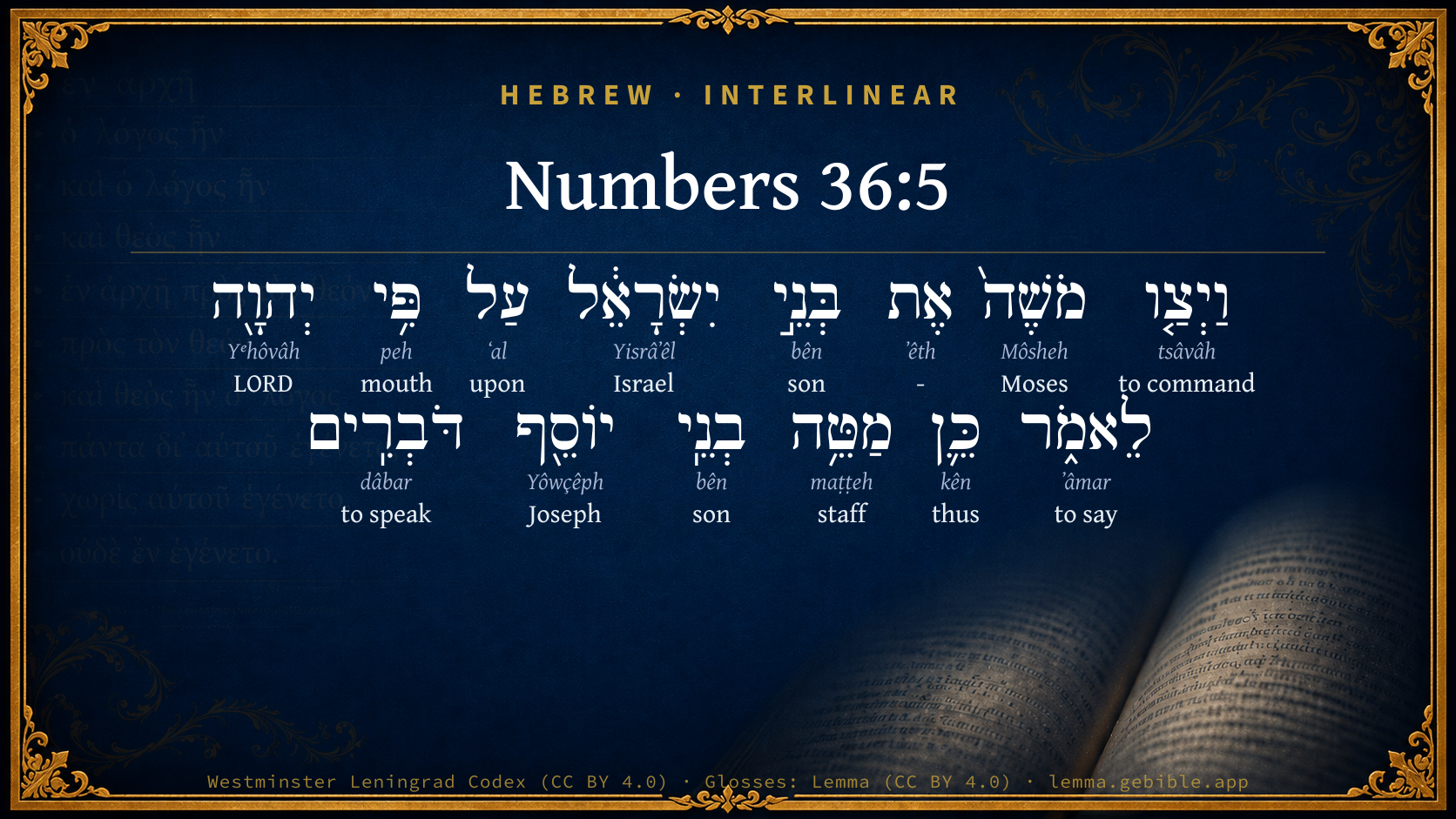
  1. וַיְצַ֤ו tsâvâh H6680 “and · to command” Conjunction + Verb, Piel, Sequential Imperfect, 3rd Person, Masculine, Singular
  2. מֹשֶׁה֙ Môsheh H4872 “Moses” Noun, Proper
  3. אֶת ʼêth H853 “-” Particle, Direct Object
  4. בְּנֵ֣י bên H1121 “sons of” Noun, Common, Masculine, Plural, Construct
  5. יִשְׂרָאֵ֔ל Yisrâʼêl H3478 “Israel” Noun, Proper
  6. עַל ʻal H5921 “upon” Preposition
  7. פִּ֥י peh H6310 “mouth of” Noun, Common, Masculine, Singular, Construct
  8. יְהוָ֖ה Yᵉhôvâh H3068 “LORD” Noun, Proper
  9. לֵאמֹ֑ר ʼâmar H559 “to say” Preposition + Verb, Qal, Infinitive Construct
  10. כֵּ֛ן kên H3651 “thus” Particle, Demonstrative
  11. מַטֵּ֥ה maṭṭeh H4294 “staff of” Noun, Common, Masculine, Singular, Construct
  12. בְנֵֽי bên H1121 “sons of” Noun, Common, Masculine, Plural, Construct
  13. דֹּבְרִֽים dâbar H1696 “speaking” Verb, Qal, Participle Active, Masculine, Plural, Absolute

About this verse

These counts appear in no published source. They are computed here, from the morphology-tagged text and Lemma’s own curated glosses. What Lemma adds →

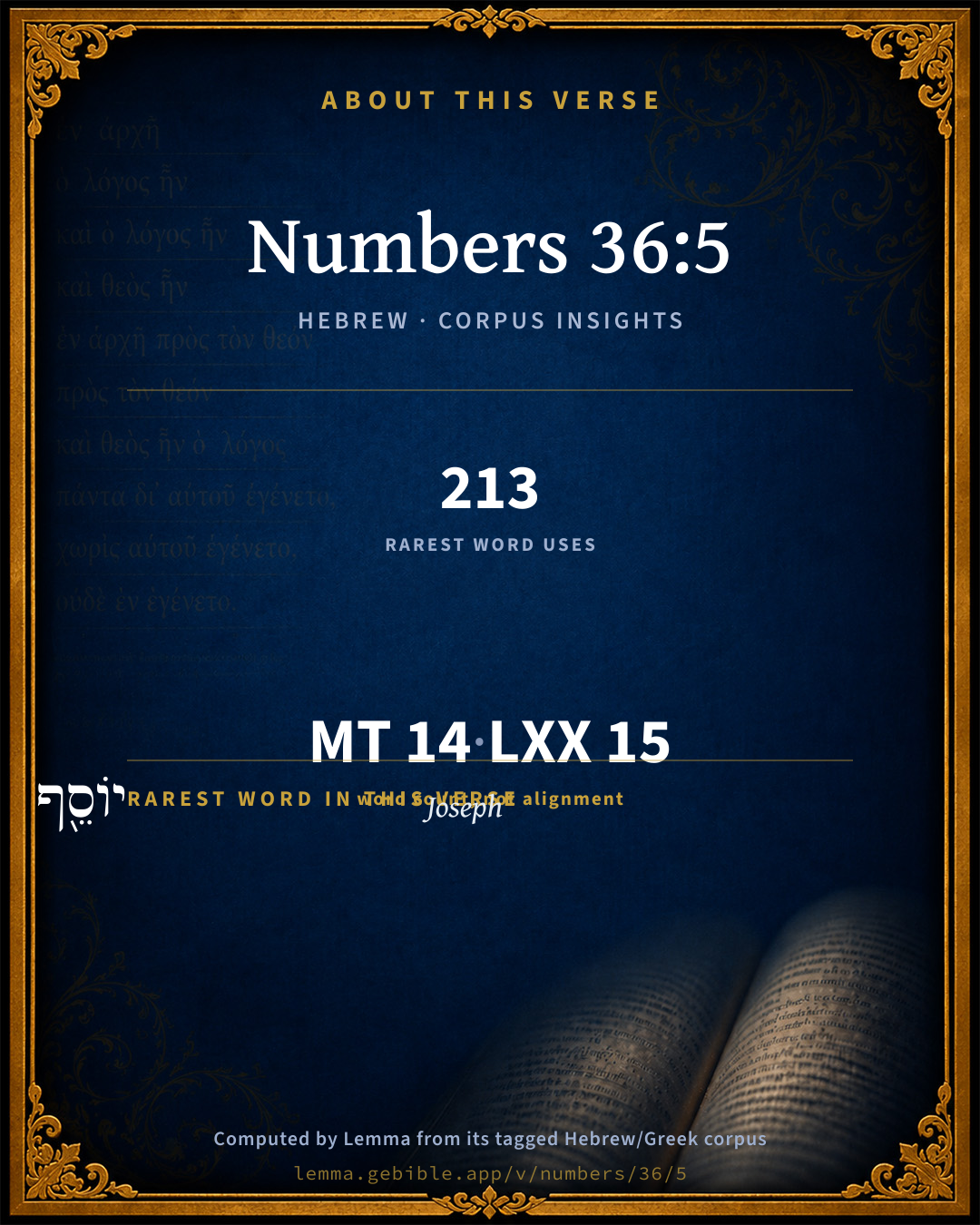
14
words
13
distinct lemmas
Pentateuch
section

Grammatical profile

  • 3 verbs
  • 8 nouns
  • 1 preposition
  • 2 particles

Verb forms

  • וַיְצַ֤ו Piel · Sequential Imperfect
  • לֵאמֹ֑ר Qal · Infinitive Construct
  • דֹּבְרִֽים Qal · Participle Active

Repetition

A word recurs within this verse — often emphatic in Hebrew:

  • בְּנֵ֣י son H1121 ×2

Hebrew & Septuagint length

In English translation the verse runs 22 words from the Hebrew and 23 from the Septuagint (LXX English) — closely comparable.

A rough comparison of the two English renderings, which tokenize alike — not a word-level alignment.

Word counts can differ between the Hebrew and the Greek without any difference in meaning — e.g. the Hebrew direct-object marker אֵת has no separate Greek word, and Greek often adds the article ὁ.

In the original languages it is 14 Hebrew tokens and 15 Greek tokens — but the two are counted differently (Hebrew bundles its prefixes and suffixes into one token; the Greek is in lemma form), so that isn’t a like-for-like length.

Cross-references

2

Topical passages linked to Numbers 36:5 in the Treasury of Scripture Knowledge — connected by theme and wording, ordered by reader-vote popularity; previews shown in the World English Bible.

  • Numbers 27:7 The daughters of Zelophehad speak right: you shall surely give them a possession of an inheritance among their father's brothers; and you shall cause the inheritance of their father to pass to them.
  • Deuteronomy 5:28 Yahweh heard the voice of your words, when you spoke to me; and Yahweh said to me, I have heard the voice of the words of this people, which they have spoken to you: they have well said all that they have spoken.

Cross-references courtesy of OpenBible.info (CC BY 4.0).

Hebrew and Greek witnesses Masoretic Hebrew ↔ Greek Septuagint

The same verse in the two great witnesses to the Old Testament, shown verse-for-verse.

These are two independent witnesses, not word-aligned to each other, and the Septuagint is shown in lemma (dictionary) form.

Hebrew Numbers 36:5 Masoretic · Westminster Leningrad Codex

וַיְצַ֤ו מֹשֶׁה֙ אֶת בְּנֵ֣י יִשְׂרָאֵ֔ל עַל פִּ֥י יְהוָ֖ה לֵאמֹ֑ר כֵּ֛ן מַטֵּ֥ה בְנֵֽי יוֹסֵ֖ף דֹּבְרִֽים

Moses commanded the children of Israel according to the word of Yahweh, saying, The tribe of the sons of Joseph speaks right.

World English Bible · Public Domain

Greek LXX Numbers 36:5 Septuagint · lemma form

καί ἐντέλλομαι μωυσῆς ὁ υἱός ἰσραήλ διά πρόσταγμα κύριος λέγω οὕτως φυλή υἱός ιωσηφ λέγω

And Moses charged the children of Israel by the commandment of the Lord, saying, Thus says the tribe of the children of Joseph.

LXX2012 (modern English Septuagint) · Public Domain

Hebrew: Westminster Leningrad Codex (CC BY 4.0). Greek: Septuagint (public domain); English from LXX2012 (modern English Septuagint) (Public Domain). How the Septuagint differs from the Hebrew →

Targum (Aramaic paraphrase)

2

The Targum is the ancient Jewish Aramaic paraphrase of the Hebrew Scriptures — an interpretive translation, not the Hebrew text itself. Onkelos (literal) and Pseudo-Jonathan (expansive) render the Torah, and Jonathan the Prophets. Coverage is partial: where no permissively-licensed English translation exists for a verse, only the Aramaic is shown. This is verse-level text, not a word-by-word alignment to the Hebrew.

  1. Targum Onkelos Torah (Genesis–Deuteronomy)
    וּפַקִיד משֶׁה יָת בְּנֵי יִשְׂרָאֵל עַל מֵימְרָא דַיְיָ לְמֵימָר יָאוּת שִׁבְטָא דִבְנֵי יוֹסֵף מְמַלְלִין

    (no public-domain English translation for this verse)

    Targum Onkelos — Aramaic: “Onkelos Genesis” (public domain); “Onkelos Exodus” (public domain); “Onkelos Leviticus” (public domain); “Onkelos Numbers” (public domain); “Onkelos Deuteronomy” (public domain). English: “Sefaria Community Translation” (CC0 1.0 (public-domain dedication)); “J.W. Etheridge. The Targums of Onkelos and Jonathan Ben Uzziel on the Pentateuch. London: Longmans, Green, 1862” (public domain). Text via Sefaria.

  2. Targum Pseudo-Jonathan Torah (Genesis–Deuteronomy)
    וּפַקֵיד משֶׁה יַת בְּנֵי יִשְרָאֵל עַל מֵימְרָא דַיְיָ לְמֵימָר יָאוּת שִׁבְטָא דִבְנֵי יוֹסֵף מְמַלְלִין

    Then Mosheh commanded the children of Israel by the Word of the Lord, saying: The tribe of the Beni Joseph have said well.

    Targum Pseudo-Jonathan — Aramaic: “Targum Jonathan on Genesis” (public domain); “Targum Jonathan on Exodus” (public domain); “Targum Jonathan on Leviticus” (public domain); “Targum Jonathan on Numbers” (public domain); “Targum Jonathan on Deuteronomy” (public domain). English: “The Targum of Jonathan ben Uzziel, trans. J. W. Etheridge, London, 1862” (public domain). Text via Sefaria.

Commentary

Notes on Numbers 36:5 from classic Christian and Jewish commentators (each source and its license shown beneath its notes). The classic Christian expositions comment on the surrounding passage and are grouped to its opening verse, so a note may address several verses; the Jewish commentaries on the Tanakh (Rashi and others) are per-verse, so they appear only where the commentator wrote on this verse.

Lemma curates 59 commentaries, every one of them public domain or Creative Commons licensed, each selected and text-cleaned for this edition rather than reprinted as found. About our sources →

Matthew Henry's Commentary

Here is, I. The matter settled by express order from God between the daughters of Zelophehad and the rest of the tribe of Manasseh. The petition is assented to, and care taken to prevent the inconvenience feared: The tribe of the sons of Joseph hath said well, Num 36:5. Thus those that consult the oracles of God concerning the making of their heavenly inheritance sure shall not only be directed what to do, but their enquiries shall be graciously accepted, and they shall have not only their well done, but their well said, good and faithful servant. Now the matter is thus accommodated: these heiresses must be obliged to marry, not only within their own tribe of Manasseh, but within the particular family of the Hepherites, to which they did belong. 1. They are not determined to any particular persons; there was choice enough in the family of their father: Let them marry to whom they think best. As children must preserve the authority of their parents, and not marry against their minds, so parents must consult the affections of their children in disposing of them, and not compel them to marry such as they cannot love. Forced marriages are not likely to prove blessings. 2. Yet they are confined to their own relations, that their inheritance may not go to another family. God would have them know that the land being to be divided by lot, the disposal whereof was of the Lord, they could not mend, and therefore should not alter, his appointment. The inheritances must not remove from tribe to tribe (Num 36:7), lest there should be confusion among them, their estates entangled, and their genealogies perplexed. God would not have one tribe to be enriched by the straitening and impoverishing of another, since they were all alike the seed of Abraham his friend.

II. The law, in this particular case, was made perpetual, and to be observed whenever hereafter the like case should happen, Num 36:8. Those that were not heiresses might marry into what tribe they pleased (though we may suppose that, ordinarily, they kept within their own tribe), but those that were must either quit their claim to the inheritance or marry one of their own family, that each of the tribes might keep to its own inheritance, and one tribe might not encroach upon another, but throughout their generations there might remain immovable the ancient landmarks, set, not by their fathers, but by the God of their fathers.

III. The submission of the daughters of Zelophehad to this appointment. How could they but marry well, and to their satisfaction, when God himself directed them? They married their father's brothers' sons, Num 36:10-12. By this it appears, 1. That the marriage of cousin-germans is not in itself unlawful, nor within the degrees prohibited, for then God would not have countenanced these marriages. But, 2. That ordinarily it is not advisable; for, if there had not been a particular reason for it (which cannot hold in any case now, inheritances being not disposed of as then by the special designation of Heaven), they would not have married such near relations. The world is wide, and he that walks uprightly will endeavour to walk surely.

IV. The conclusion of this whole book, referring to the latter part of it: These are the judgments which the Lord commanded in the plains of Moab (Num 36:13), these foregoing, ever since ch. 26, most of which related to their settlement in Canaan, into which they were now entering. Whatever new condition God is by his providence bringing us into, we must beg of him to teach us the duty of it, and to enable us to do it, that we may do the work of the day in its day, of the place in its place.

Matthew Henry's Commentary on the Whole Bible (1708–1710) — public domain (CC PDM 1.0). Text via the HelloAO Bible API.

Tyndale Open Study Notes

Tyndale Open Resources

36:5 The Lord readily provided the justice that the men of the tribe of Joseph (i.e., of the tribe of Manasseh, the son of Joseph) sought in their petition.

Tyndale Open Study Notes — © Tyndale Open Resources, licensed CC BY-SA 4.0. Text via the HelloAO Bible API.

Geneva Bible (1599)

Geneva Bible translators

For the tribe could not have continued, if the inheritance which was the maintenance thereof should have been alienated to others.

Geneva Bible (1599) marginal notes — public domain. Text via Bolls.life.

Jamieson, Fausset & Brown

Robert Jamieson, A. R. Fausset & David Brown

Moses commanded the children of Israel according to the word of the Lord--The plea appeared just and reasonable; and, accordingly an enactment was made by which the daughters of Zelophehad, while left to the free choice of their husbands, were restricted to marry not only within their own tribe, but within the family of their father's tribe--that is, one of their cousins. This restriction, however, was imposed only on those who were heiresses. The law was not applicable to daughters in different circumstances (Ch1 23:22) --for they might marry into another tribe; but if they did so, they were liable to forfeit their patrimonial inheritance, which, on the death of their father or brothers, went to the nearest of the family kinsmen. Here was an instance of progressive legislation (see also Exo 18:27) in Israel, the enactments made being suggested by circumstances. But it is deserving of special notice that those additions to, or modifications of, the law were confined to civil affairs; while the slightest change was inadmissible in the laws relating to worship or the maintenance of religion.

Jamieson, Fausset & Brown — Commentary Critical and Explanatory on the Whole Bible (1871) — public domain (CC PDM 1.0). Text via the HelloAO Bible API.

Ellicott's Commentary for English Readers

(5) And Moses commanded the children of Israel according to the word of the Lord.—In regard to the application made by the daughters of Zelophehad to Moses and Eleazar and the princes, it is said that “Moses brought their cause before the Lord” (Num_27:5). In the present case there is no express declaration made to the same effect; but there can be no doubt that the statement contained in this verse, that Moses commanded the children of Israel “according to the word of the Lord,” and that contained in Num_36:6, “This is the thing which the Lord doth command,” imply that Moses had committed this cause also to the Lord, and that he had received direction from Him.

A Bible Commentary for English Readers, edited by Charles John Ellicott (1878–1897) — public domain. Text from a community e-Sword module.

John Gill's Exposition

And Moses commanded the children of Israel,.... Even all the tribes of Israel, whom the following law concerned, as well as the tribe of Manasseh:

according to the word of the Lord; whom no doubt he consulted on this occasion, as he did when the daughters of Zelophehad applied unto him about the inheritance of their father:

saying, the tribe of the sons of Joseph hath said well; in showing such a concern for the welfare of their tribe; the consideration of which would be of service to them all, and therefore was worthy of notice. Aben Ezra observes, that the heads of the fathers spoke for the sake of every tribe, what was for the good of them all, and therefore was well spoken.

John Gill's Exposition of the Whole Bible (1746–1763) — public domain (CC PDM 1.0). Text via the HelloAO Bible API.

Matthew Poole's English Annotations

Their plea is just and reasonable. God did not take particular care about every occurrence that happened, or might happen, but left divers things to be found out by human prudence, which being his own gift, it was meet there should be opportunities left for the exercise of it; and God thought fit to approve and ratify the prudent and profitable inventions of men by his own law or sanction; as in the case of Jethro, Exo 18, of Zelophehad’s daughter, Num 27, and here of their brethren. But it is observable, that God allowed this only in civil affairs, but never in the matters of his worship, where he utterly forbids it.

Matthew Poole's English Annotations on the Holy Bible (1683–1685) — public domain. Text from a community e-Sword/MySword module.

Whedon's Commentary on the Bible

Daniel D. Whedon

5. Tribe of the sons of Joseph — Nominally there was no tribe of Joseph, but really two tribes, Ephraim and Manasseh; so that Joseph was treated as the firstborn, so far as the inheritance was concerned. Gen_48:5; 1Ch_5:2, note. The text specially refers to the tribe of Manasseh, to which these heiresses belonged.

Daniel D. Whedon (gen. ed.), Commentary on the Old and New Testaments (1874–1909) — public domain. Text from a community e-Sword module.

The Pulpit Commentary

The tribe of the sons of Joseph. "The tribe (matteh) of the Beni-Joseph." There were two, or rather in effect three, tribes of the Beni-Joseph; Moses referred, of course, to the one which had come before him.

The Pulpit Commentary (1880–1919), ed. H.D.M. Spence-Jones & Joseph S. Exell — public domain. Text from a community e-Sword module.

Kretzmann's Popular Commentary

Paul E. Kretzmann

The Regulation

v. 5. And Moses commanded the children of Israel according to the word of the Lord, which he had meanwhile received, saying, The tribe of the sons of Joseph hath said well.

v. 6. This is the thing which the Lord doth command concerning the daughters of Zeiophehad, saying, Let them marry, become wives, to whom they think best; only to the family of the tribe of their father shall they marry, that was the restriction to which they were bound. Moreover, this was to be a general rule.

v. 7. So shall not the inheritance of the children of Israel remove from tribe to tribe, not be transferred by marriages of this kind; for every one of the children of Israel shall keep himself to the inheritance of the tribe of his fathers, to avoid confusion.

v. 8. And every daughter that possesseth an inheritance in any tribe of the children of Israel, in the form of land or real estate, shall be wife unto one of the family of the tribe of her father, that the children of Israel may enjoy every man the inheritance of his fathers.

v. 9. Neither shall the inheritance remove from one tribe to another tribe; but every one of the tribes of the children of Israel shall keep himself to his own inheritance.

v. 10. Even as the Lord commanded Moses, so did the daughters of Zeiophehad;

v. 11. for Mahlah, Tirzah, and Hoglah, and Milcah, and Noah, the daughters of Zeiophehad, were married unto their father’s brothers’ sons, to their cousins, unless the Hebrew term is used in the wider sense.

v. 12. And they were married into the families, and thus also by marriage became members of the families, of the sons of Manasseh, the son of Joseph, and their inheritance remained in the tribe of the family of their father.

v. 13. These are the commandments and the judgments, the ordinances or statutes, which the Lord commanded by the hand of Moses unto the children of Israel in the Plains of Moab by Jordan, near Jericho. Thus Moses put his signature to the law-giving of the Plains of Moab, "though without in any way implying that the explanation, further development, and hortatory enforcement of the Law and its statutes and judgments, which follow in Deuteronomy, are not of Mosaic origin. " (Keil. )

Paul E. Kretzmann, Popular Commentary of the Bible (1921–1924) — public domain. Text from a community e-Sword module.

unfoldingWord translationNotes

Door43 World Missions Community

at Yahweh's word

"according to what Yahweh said"

Let them be married to whom they think best

This can be stated in active form. AT: "Let them marry whom they want" (See: Active or Passive)

they must marry only within the family of their father's tribe

This can be stated in active form. AT: "but they may only marry someone from their father's tribe" (See: Active or Passive)

translationWords

word

unfoldingWord translationNotes — © Distant Shores Media and the Door43 World Missions Community, licensed CC BY-SA 4.0. Source: git.door43.org/Door43/en_tn.

Lesson kit

Teaching starters — assembled from the data on this page, not authored interpretation. Every prompt links to the verse data it draws on. Edit before teaching.

Numbers, in the Pentateuch, opens this verse with 14 words (13 distinct Hebrew lemmas). Its most distinctive word is Yôwçêph (“Joseph”). A historical commentator’s framing appears above. Read the whole chapter for the surrounding context.

Discussion questions

  1. What does “Joseph” (Yôwçêph) contribute to the verse as a whole?
  2. Numbers 27:7 shares this passage’s theme. How do the two illuminate each other?
  3. “son” occurs 2× in this one verse. What is the effect of the repetition?
  4. These translations render this verse differently; the difference is in the English rendering, not the original. What questions does that raise?
  5. The verb «וַיְצַ֤ו» is Piel Sequential Imperfect. How does its form color the action?
  6. Reading how Matthew Henry's Commentary and Tyndale Open Study Notes read this verse, where do the two commentators agree and where do they part?

Things to notice

Reading settings

Reading text

Shown beneath each verse's original-language words.

Old Testament
Old Testament edition

Read the OT as the Masoretic Hebrew (MT) or the Greek Septuagint (LXX).

English shown for the Greek Septuagint (in the Hebrew ↔ Greek comparison).

Comparing translations? Open the Compare panel on any verse page to stack up to four side by side.