Numbers 17:9

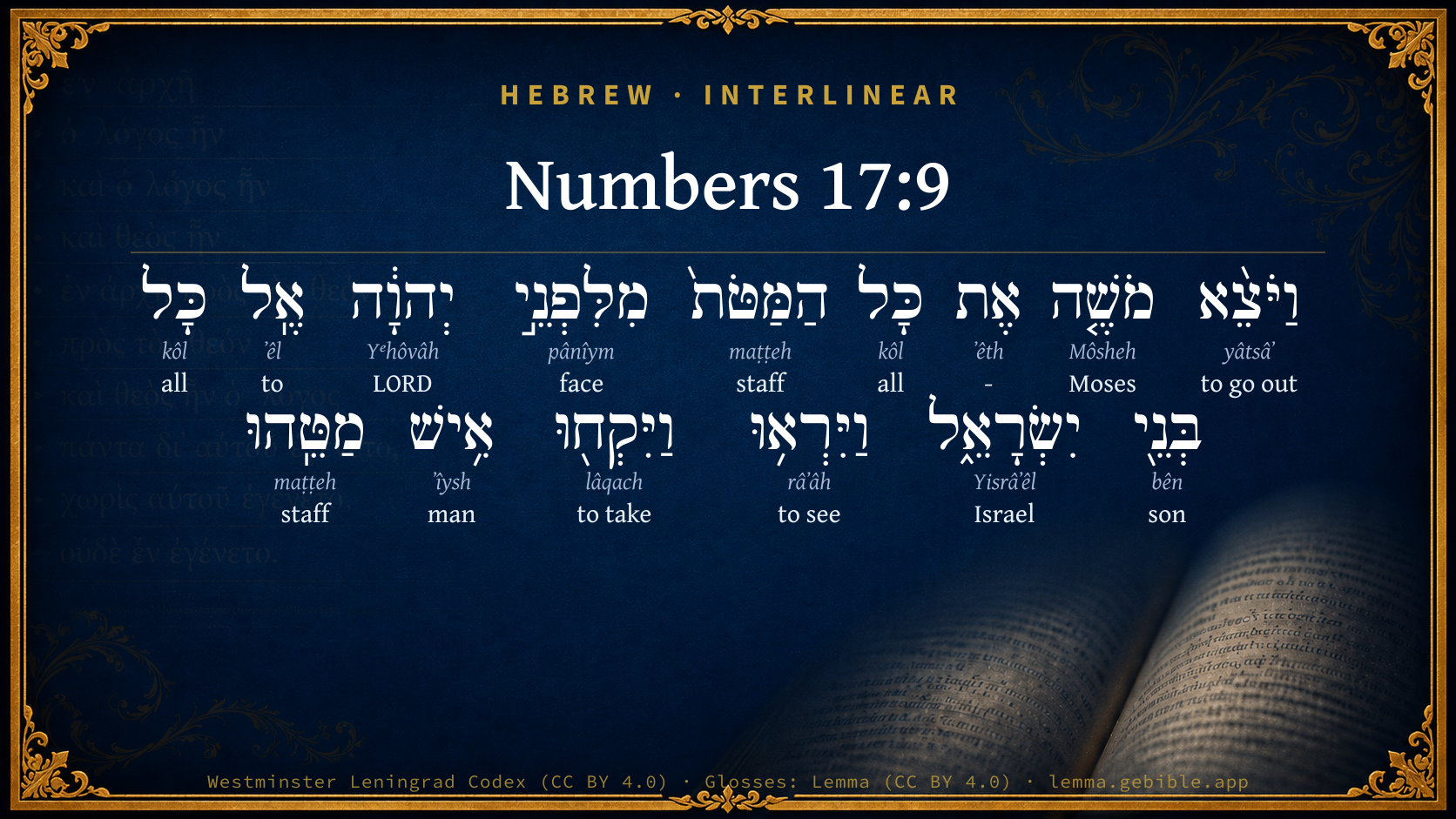
Hebrew (Westminster Leningrad Codex) Numbers 17:9 appears in the Hebrew Old Testament. The text above is from the Westminster Leningrad Codex. Each word links to its Strong’s number, a concise gloss, and parsing drawn from the Open Scriptures Hebrew Bible morphology. Click any word for its full Brown-Driver-Briggs (BDB) entry.
Download image
Cite this verse

Numbers 17:9 (World English Bible). Public Domain. Lemma interlinear Bible study tool, https://lemma.gebible.app/v/numbers/17/9.

Show BibTeX & RIS
BibTeX
RIS
English Translation
Moses brought out all the rods from before Yahweh to all the children of Israel: and they looked, and took every man his rod.
World English Bible · Public Domain
Download a study sheet

One document with this verse’s original text, its word-by-word gloss line, the meaning frame, cross-references with their text, attributed commentary, and full source and license credits — printable, and it pastes into notes with its structure intact.

This verse Autodidact and up

Study sheet (.html) Plain text (.txt)

A passage Seminary Student

Up to 50 verses in one chapter. A passage sheet keeps up to 6 commentary sources and 12 cross-references per verse, in the order this page ranks them, and says so on the sheet whenever that leaves anything out. Ask for a single verse and you get the Autodidact verse sheet above.

Everything on this page stays free to read, with no account — the sheet is a download of what is already on screen, not access to it.

Want to remove ads? Support Godless Engineer
Compare translations 3

The same verse in 3 English versions, stacked beneath the original-language interlinear above. Click any original word for its lexicon entry.

Each is an independent rendering of the whole verse — the interlinear is not word-aligned to these translations.

Highlighted words mark where these versions differ — a whole-verse word diff, not a word-by-word alignment.

  • World English Bible Public Domain
    Moses brought out all the rods from before Yahweh to all the children of Israel: and they looked, and took every man his rod.
  • King James Version Public Domain
    And Moses brought out all the rods from before the LORD unto all the children of Israel: and they looked, and took every man his rod.
  • unfoldingWord Literal Text CC BY-SA 4.0
    And Moses brought out all the staffs from to the face of Yahweh to all the sons of Israel. And they saw, and they took, a man his staff.

unfoldingWord Literal Text — © unfoldingWord, licensed CC BY-SA 4.0. Word-aligned USFM3 via Door43 (git.door43.org/unfoldingWord/en_ult).

Versions to compare (up to 4)

3 of 4 selected

Show all 18 translations

Every available English version of this verse, each an independent rendering of the whole verse.

  • World English Bible Public Domain
    Moses brought out all the rods from before Yahweh to all the children of Israel: and they looked, and took every man his rod.
  • Berean Standard Bible Public Domain
    Then Moses brought out all the staffs from the LORD’s presence to all the Israelites. They saw them, and each man took his own staff.
  • Majority Standard Bible Public Domain
    Then Moses brought out all the staffs from the LORD’s presence to all the Israelites. They saw them, and each man took his own staff.
  • King James Version Public Domain
    And Moses brought out all the rods from before the LORD unto all the children of Israel: and they looked, and took every man his rod.
  • American Standard Version (1901) Public Domain
    And Moses brought out all the rods from before Jehovah unto all the children of Israel: and they looked, and took every man his rod.
  • Revised Version (1885) Public Domain
    And Moses brought out all the rods from before the LORD unto all the children of Israel: and they looked, and took every man his rod.
  • Geneva Bible (1599) Public Domain
    Then Moses brought out all the rods from before the Lord vnto all the children of Israel: and they looked vpon them, and tooke euery man his rodde.
  • Douay-Rheims (1899) Public Domain
    Moses therefore brought out all the rods from before the Lord to all the children of Israel: and they saw, and every one received their rods.
  • Young's Literal Translation Public Domain
    and Moses bringeth out all the rods from before Jehovah, unto all the sons of Israel, and they look, and take each his rod.
  • Literal Standard Version CC BY-SA 4.0
    and Moses brings out all the rods from before YHWH to all the sons of Israel, and they look, and each takes his rod.
  • Unlocked Literal Bible CC BY-SA 4.0
    Moses brought out all the staffs from before Yahweh to all the people of Israel, and each man took his staff.
  • unfoldingWord Literal Text CC BY-SA 4.0
    And Moses brought out all the staffs from to the face of Yahweh to all the sons of Israel. And they saw, and they took, a man his staff.
  • Darby Bible Public Domain
    And Moses brought out all the staves from before Jehovah to all the children of Israel, and they looked and took each one his staff.
  • World Messianic Bible Public Domain
    Moses brought out all the rods from before the LORD to all the children of Israel. They looked, and each man took his rod.
  • Webster's Bible Public Domain
    And Moses brought out all the rods from before the LORD to all the children of Israel: and they looked, and took every man his rod.
  • Free Bible Version CC BY-SA 4.0
    Moses took all the walking sticks from the presence of the Lord and showed them to all the Israelites. They saw them, and each man collected his own walking stick.
  • Bible in Basic English Public Domain
    Then Moses took out all the rods from before the Lord, and gave them back to the children of Israel: and they saw them, and every man took his rod.
  • JPS Tanakh (1917) Public Domain
    (17-24) And Moses brought out all the rods from before the LORD unto all the children of Israel; and they looked, and took every man his rod.

Literal Standard Version (2020), Covenant Press — licensed CC BY-SA 4.0. Text via the HelloAO Bible API (eBible.org). Unlocked Literal Bible (unfoldingWord) — licensed CC BY-SA 4.0. Text via the HelloAO Bible API (eBible.org). unfoldingWord Literal Text — © unfoldingWord, licensed CC BY-SA 4.0. Word-aligned USFM3 via Door43 (git.door43.org/unfoldingWord/en_ult). Free Bible Version, Dr. Jonathan Gallagher — licensed CC BY-SA 4.0. Text via the HelloAO Bible API (eBible.org).

Word by word

More ways to search: Search by grammar → Find every occurrence → Compare this word →

Practice this passage: Drill this verse → Learn its vocabulary →

הַמַּטֹּת֙
maṭṭeh
H4294
“the · staffs”
Particle, Definite Article + Noun, Common, Masculine, Plural, Absolute
Part of Speech
Particle + Noun
Type
Common
Gender
Masculine
Number
Plural
State
Absolute
Full BDB Definition

Origin: from H5186

TWOT: 1352b

staff, branch, tribe - staff, rod, shaft - branch (of vine) - tribe - company led by chief with staff (originally)
  1. וַיֹּצֵ֨א yâtsâʼ H3318 “and · to go out” Conjunction + Verb, Hiphil, Sequential Imperfect, 3rd Person, Masculine, Singular
  2. מֹשֶׁ֤ה Môsheh H4872 “Moses” Noun, Proper
  3. אֶת ʼêth H853 “-” Particle, Direct Object
  4. כָּל kôl H3605 “all of” Noun, Common, Masculine, Singular, Construct
  5. מִלִּפְנֵ֣י pânîym H6440 “from · to/for · face(s) of” Preposition + Preposition + Noun, Common, Both, Plural, Construct
  6. יְהוָ֔ה Yᵉhôvâh H3068 “LORD” Noun, Proper
  7. אֶֽל ʼêl H413 “to” Preposition
  8. כָּל kôl H3605 “all of” Noun, Common, Masculine, Singular, Construct
  9. בְּנֵ֖י bên H1121 “sons of” Noun, Common, Masculine, Plural, Construct
  10. יִשְׂרָאֵ֑ל Yisrâʼêl H3478 “Israel” Noun, Proper
  11. וַיִּרְא֥וּ râʼâh H7200 “and · to see” Conjunction + Verb, Qal, Sequential Imperfect, 3rd Person, Masculine, Plural
  12. וַיִּקְח֖וּ lâqach H3947 “and · to take” Conjunction + Verb, Qal, Sequential Imperfect, 3rd Person, Masculine, Plural
  13. אִ֥ישׁ ʼîysh H376 “man” Noun, Common, Masculine, Singular, Absolute
  14. מַטֵּֽהוּ maṭṭeh H4294 “staff · his” Noun, Common, Masculine, Singular, Construct + Suffix, Personal, 3rd Person, Masculine, Singular

About this verse

These counts appear in no published source. They are computed here, from the morphology-tagged text and Lemma’s own curated glosses. What Lemma adds →

15
words
13
distinct lemmas
Pentateuch
section

Grammatical profile

  • 3 verbs
  • 10 nouns
  • 1 preposition
  • 1 particle

Verb forms

  • וַיֹּצֵ֨א Hiphil · Sequential Imperfect
  • וַיִּרְא֥וּ Qal · Sequential Imperfect
  • וַיִּקְח֖וּ Qal · Sequential Imperfect

Repetition

Words recur within this verse — often emphatic in Hebrew:

  • כָּל all H3605 ×2
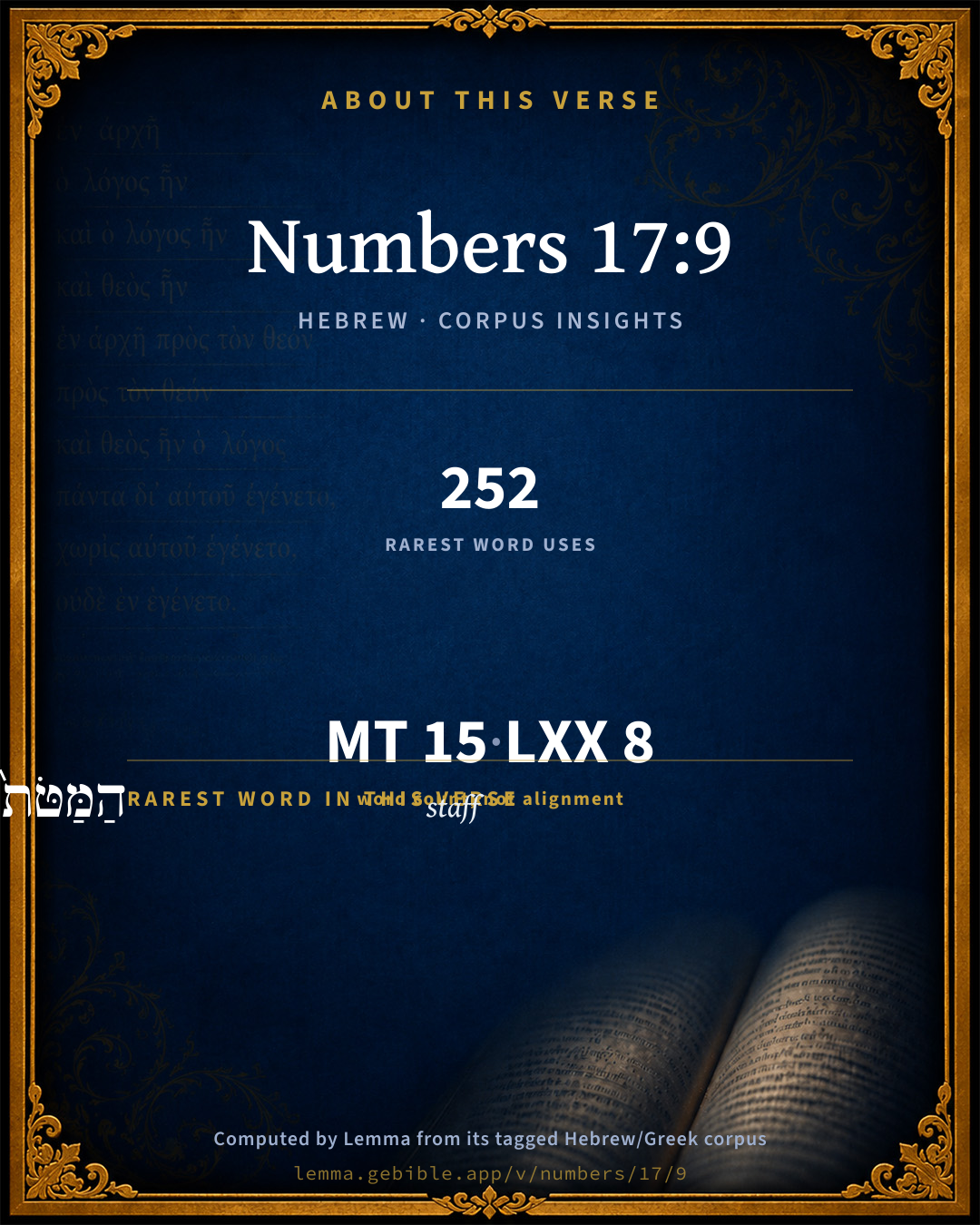
  • הַמַּטֹּת֙ staff H4294 ×2

Hebrew & Septuagint length

In English translation the verse runs 24 words from the Hebrew and 26 from the Septuagint (LXX English) — closely comparable.

A rough comparison of the two English renderings, which tokenize alike — not a word-level alignment.

Word counts can differ between the Hebrew and the Greek without any difference in meaning — e.g. the Hebrew direct-object marker אֵת has no separate Greek word, and Greek often adds the article ὁ.

In the original languages it is 15 Hebrew tokens and 8 Greek tokens — but the two are counted differently (Hebrew bundles its prefixes and suffixes into one token; the Greek is in lemma form), so that isn’t a like-for-like length.

Hebrew and Greek witnesses Masoretic Hebrew ↔ Greek Septuagint

The same verse in the two great witnesses to the Old Testament, shown verse-for-verse.

These are two independent witnesses, not word-aligned to each other, and the Septuagint is shown in lemma (dictionary) form.

Hebrew Numbers 17:9 Masoretic · Westminster Leningrad Codex

וַיֹּצֵ֨א מֹשֶׁ֤ה אֶת כָּל הַמַּטֹּת֙ מִלִּפְנֵ֣י יְהוָ֔ה אֶֽל כָּל בְּנֵ֖י יִשְׂרָאֵ֑ל וַיִּרְא֥וּ וַיִּקְח֖וּ אִ֥ישׁ מַטֵּֽהוּ

Moses brought out all the rods from before Yahweh to all the children of Israel: and they looked, and took every man his rod.

World English Bible · Public Domain

Greek LXX Numbers 17:9 Septuagint · lemma form

καί λαλέω κύριος πρός μωυσῆς καί ἀαρών λέγω

And Moses brought forth all the rods from before the Lord to all the sons of Israel; and they looked, and each one took his rod.

LXX2012 (modern English Septuagint) · Public Domain

Hebrew: Westminster Leningrad Codex (CC BY 4.0). Greek: Septuagint (public domain); English from LXX2012 (modern English Septuagint) (Public Domain). How the Septuagint differs from the Hebrew →

Targum (Aramaic paraphrase)

2

The Targum is the ancient Jewish Aramaic paraphrase of the Hebrew Scriptures — an interpretive translation, not the Hebrew text itself. Onkelos (literal) and Pseudo-Jonathan (expansive) render the Torah, and Jonathan the Prophets. Coverage is partial: where no permissively-licensed English translation exists for a verse, only the Aramaic is shown. This is verse-level text, not a word-by-word alignment to the Hebrew.

  1. Targum Onkelos Torah (Genesis–Deuteronomy)
    וּמַלֵיל יְיָ עִם משֶׁה לְמֵימָר

    (no public-domain English translation for this verse)

    Targum Onkelos — Aramaic: “Onkelos Genesis” (public domain); “Onkelos Exodus” (public domain); “Onkelos Leviticus” (public domain); “Onkelos Numbers” (public domain); “Onkelos Deuteronomy” (public domain). English: “Sefaria Community Translation” (CC0 1.0 (public-domain dedication)); “J.W. Etheridge. The Targums of Onkelos and Jonathan Ben Uzziel on the Pentateuch. London: Longmans, Green, 1862” (public domain). Text via Sefaria.

  2. Targum Pseudo-Jonathan Torah (Genesis–Deuteronomy)
    וּמַלֵיל יְיָ עִם משֶׁה לְמֵימָר

    And the Lord spake with Mosheh, saying:

    Targum Pseudo-Jonathan — Aramaic: “Targum Jonathan on Genesis” (public domain); “Targum Jonathan on Exodus” (public domain); “Targum Jonathan on Leviticus” (public domain); “Targum Jonathan on Numbers” (public domain); “Targum Jonathan on Deuteronomy” (public domain). English: “The Targum of Jonathan ben Uzziel, trans. J. W. Etheridge, London, 1862” (public domain). Text via Sefaria.

Commentary

Notes on Numbers 17:9 from classic Christian and Jewish commentators (each source and its license shown beneath its notes). The classic Christian expositions comment on the surrounding passage and are grouped to its opening verse, so a note may address several verses; the Jewish commentaries on the Tanakh (Rashi and others) are per-verse, so they appear only where the commentator wrote on this verse.

Lemma curates 59 commentaries, every one of them public domain or Creative Commons licensed, each selected and text-cleaned for this edition rather than reprinted as found. About our sources →

Tyndale Open Study Notes

Tyndale Open Resources

17:9-11 After each tribal leader claimed his own staff, it was clear that Aaron’s deserved special treatment. It was placed permanently before the Ark to warn potential rebels and to deter Israelites who complained about the Lord and his appointed leaders. The Ark eventually contained this staff, a jar of manna, and the stone tablets of the law (cp. Heb 9:4) to remind the Israelites of their wilderness wanderings.

Tyndale Open Study Notes — © Tyndale Open Resources, licensed CC BY-SA 4.0. Text via the HelloAO Bible API.

John Gill's Exposition

And the Lord said unto Moses,.... After the rods had been viewed, and every prince took his rod, and full satisfaction was given that the priesthood belonged to Aaron, by the budding and blossoming of his rod, when the rest remained as they were:

bring Aaron's rod again before the testimony; before the ark, in which the testimony or law was; here it was placed and continued, but how long cannot be said with certainty; no doubt for many ages; which increases the wonder, that it should, as it probably did, continue with its buds, blossoms, and fruit on it: the apostle speaks of it, as in the holy of holies, with the ark, the pot of manna, and the tables of the covenant, Heb 9:4; the Jews say (f), that when Josiah the king ordered the ark to be laid up in that place which Solomon had built, that it might not be carried with the captives into captivity, as it is said, Ch2 35:3, "put the holy ark", &c. they hid with the ark the rod of Aaron, and the pot of manna, and the anointing oil, and which were not in the second temple; and they say (g), particularly of Aaron's rod, that at the time it was laid up by Josiah it had its buds and almonds: now this was ordered to be put in the most holy place before the ark:

to be kept for a token against the rebels; to be a token of their sin and wickedness in rebelling against God, his ordinance and ministers; which occasioned this miracle to be wrought, for the confirmation of the priesthood in Aaron's family, which they opposed, and to be a caution to others not to attempt anything against it for the future; so Christ and the Gospel ministry will be swift witnesses against the opposers of him and that; see Mal 3:5,

and thou shalt quite take away their murmurings from me, that they die not; quite silence all the murmurings of the people with respect to the priesthood being so fully convinced by this miracle of the divine authority Aaron and his family had to exercise the priestly office, and they only, and so such destruction of the people be prevented as had been lately made.

(f) Kimchi in 2 Chron. xxxv. 3. Maimon. Hilchot. Beth Habechirah, c. 4. sect. 1. (g) T. Hieros. Shekalim, c. 6. fol. 49. 3.

John Gill's Exposition of the Whole Bible (1746–1763) — public domain (CC PDM 1.0). Text via the HelloAO Bible API.

The Pulpit Commentary

And took every man his rod. So that they saw for themselves that their rods remained dry and barren as they were by nature, while Aaron"s had been made to live.

The Pulpit Commentary (1880–1919), ed. H.D.M. Spence-Jones & Joseph S. Exell — public domain. Text from a community e-Sword module.

Lesson kit

Teaching starters — assembled from the data on this page, not authored interpretation. Every prompt links to the verse data it draws on. Edit before teaching.

Numbers, in the Pentateuch, opens this verse with 15 words (13 distinct Hebrew lemmas). Its most distinctive word is maṭṭeh (“staff”). A historical commentator’s framing appears above. Read the whole chapter for the surrounding context.

Discussion questions

  1. How does “staff” (maṭṭeh) shape what this verse is saying?
  2. What does the repetition of “all” (2× in this one verse) do in this verse?
  3. The translations on this page render this verse differently — a whole-verse word diff, not a word-by-word alignment. What might account for the different wordings?
  4. «וַיֹּצֵ֨א» is a Hiphil Sequential Imperfect verb. How does that grammatical form shape the action described?
  5. Compare how Tyndale Open Study Notes and John Gill's Exposition read this verse. Where do they agree or differ?

Things to notice

Reading settings

Reading text

Shown beneath each verse's original-language words.

Old Testament
Old Testament edition

Read the OT as the Masoretic Hebrew (MT) or the Greek Septuagint (LXX).

English shown for the Greek Septuagint (in the Hebrew ↔ Greek comparison).

Comparing translations? Open the Compare panel on any verse page to stack up to four side by side.