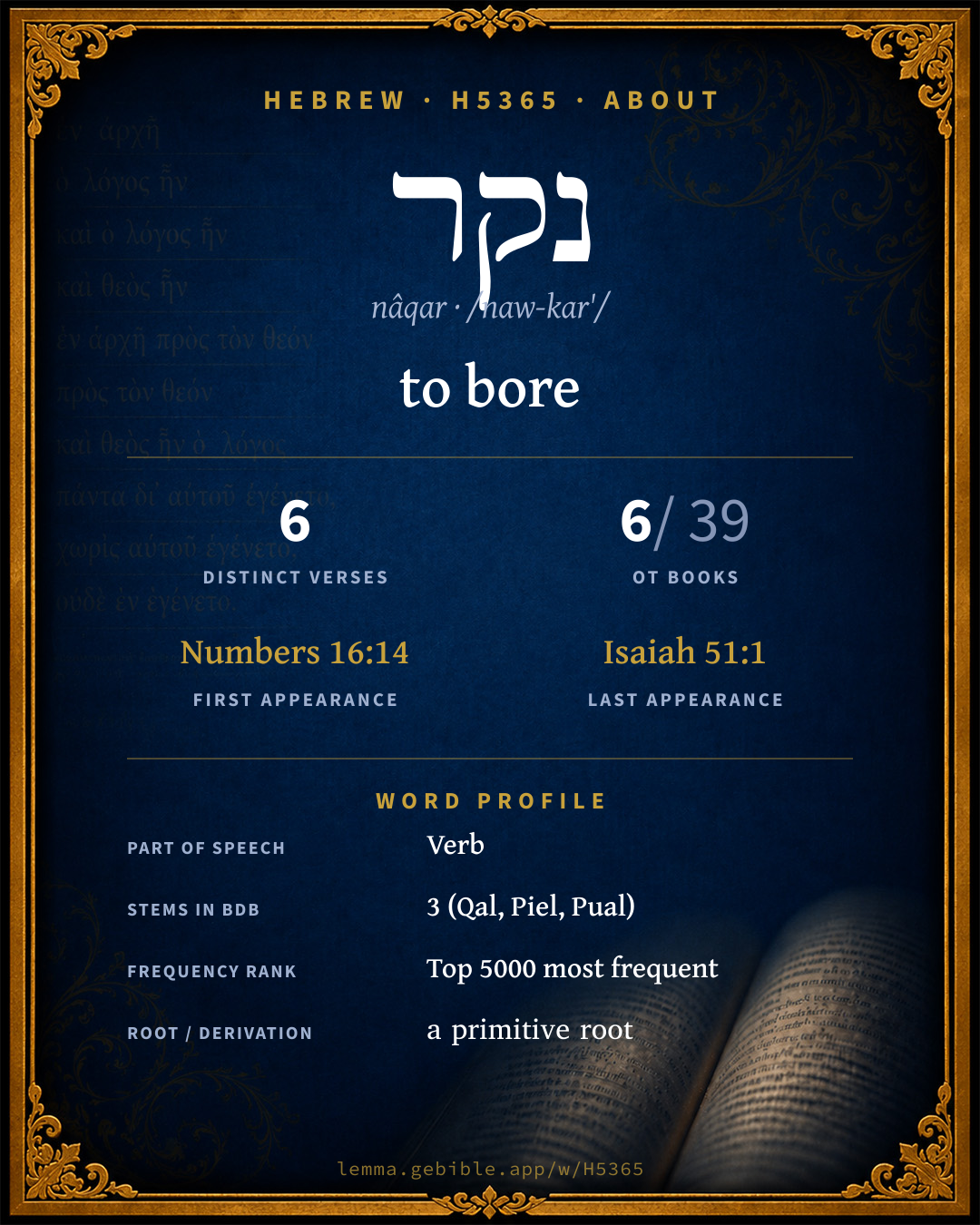
נָקַר
to bore
also: pick, dig, pick out fuller range ↓
Full lexicon entry — Brown-Driver-Briggs (BDB)
From Brown-Driver-Briggs (BDB)
Where this word appears
See every Piel verb in the Hebrew Bible →
Grammar key — what these labels mean
Part of speech
- Verb
- An action or state-of-being word.
Stem
- Piel
- An intensive or resultative active stem.
- Qal
- The basic, simple active stem — the plain form of the verb (“he wrote”).
- Pual
- The passive counterpart of the Piel.
Form
- Sequential Imperfect
- An imperfect with prefixed waw — the standard past-narrative form (waw-consecutive imperfect).
- Infinitive Construct
- A bound verbal noun, frequently with prepositions (“to write / in writing”).
- Perfect
- A completed action or state — Hebrew marks aspect (completeness) more than strict tense (“he wrote”).
- Imperfect
- An incomplete, ongoing, or future action (“he will / would write”).
Person
- 3rd Person
- The one spoken about (“he / she / it / they”).
- 2nd Person
- The one addressed (“you”).
Gender
- Masculine
- Grammatically masculine.
Number
- Plural
- More than one (in Hebrew, generally three or more).
- Singular
- One.
Grammatical forms
- Verb, Piel, Sequential Imperfect, 3rd Person, Masculine, Plural 1 time (17%)
- Verb, Qal, Infinitive Construct 1 time (17%)
- Verb, Pual, Perfect, 2nd Person, Masculine, Plural 1 time (17%)
- Verb, Piel, Imperfect, 2nd Person, Masculine, Singular 1 time (17%)
- Verb, Piel, Perfect, 3rd Person, Masculine, Singular 1 time (17%)
- Verb, Qal, Imperfect, 3rd Person, Masculine, Plural 1 time (17%)
Parsed forms decoded from the imported morphology (morphhb / Westminster Leningrad Codex — WLC text public domain, morphhb tagging CC BY 4.0), counted across 6 parsed occurrences — not distinct verses.
Every verse where H5365 appears — 6 distinct verses across 6 books. Click any verse to open its interlinear word-by-word view. Verse text shown in the World English Bible for context — . Each verse’s Hebrew form is shown with its reference; the English is not keyword-highlighted, since the data carries no word-level English alignment. Use “Compare translations” on any verse to read it across multiple English versions. This concordance covers the Hebrew Bible; Septuagint (Greek Old Testament) occurrences are not indexed here.
Numbers 1 verse
Judges 1 verse
1 Samuel 1 verse
Job 1 verse
Proverbs 1 verse
Isaiah 1 verse
About this entry
At a glance — auto-summarized from this page’s data, not written by a person. Every figure links to its source below. This summary describes the numbers; it doesn’t interpret them.
נקר — transliterated nâqar — is a Hebrew verb carrying the sense “to bore.” It first appears in Numbers 16:14. The Hebrew Bible uses it across 6 verses — uncommon. Across 3 stems, its meaning turns on the binyan (Qal, Piel). Related forms include נקרה. Each statement above links to its evidence; the full detail follows below.
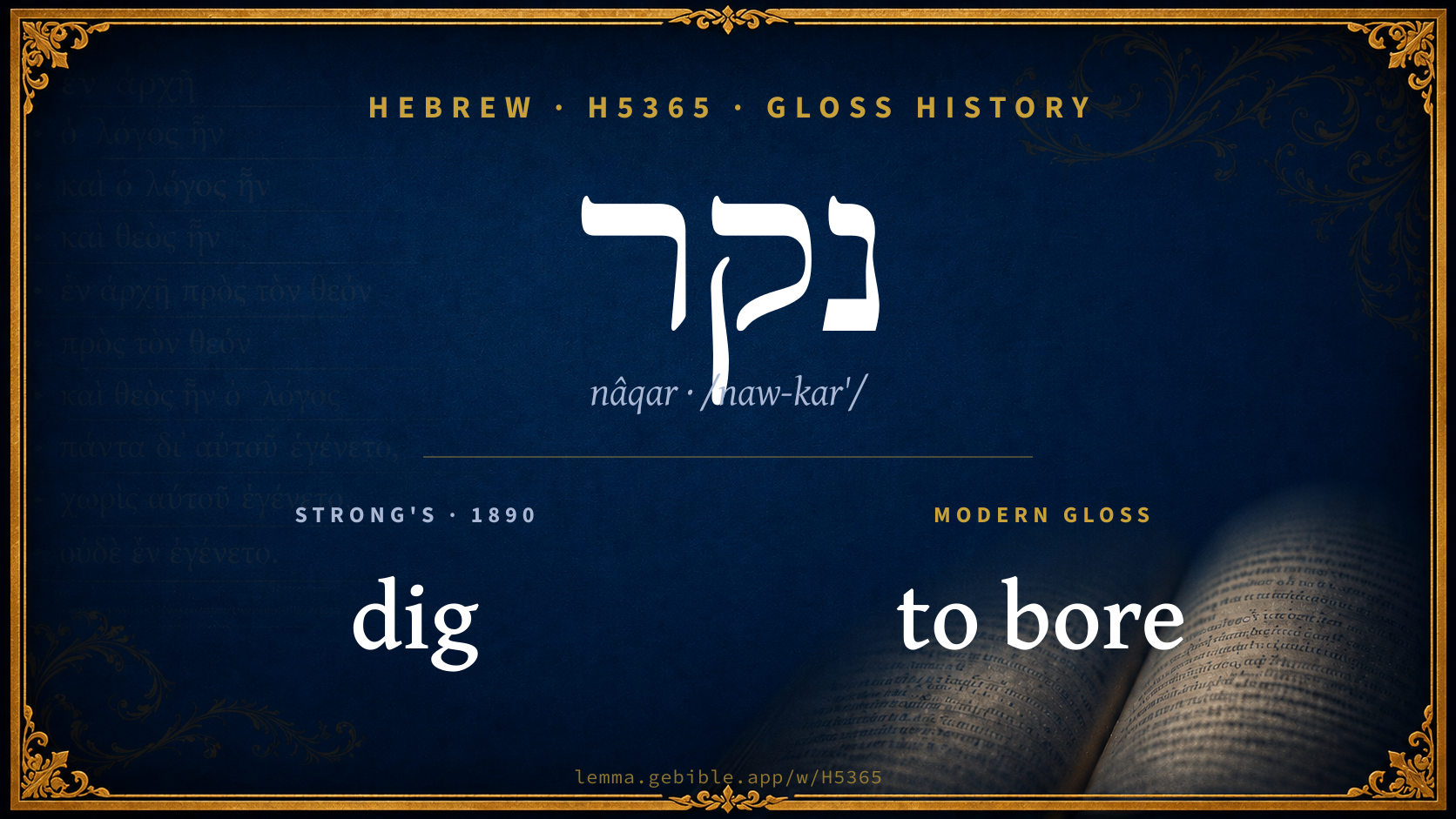
Gloss history
Strong's 1890 vs modern scholarship
About this word
Strong's H5365 catalogs a Hebrew word from the Hebrew Old Testament.
These counts are not copied from any lexicon or concordance. They are computed here, from the morphology-tagged Hebrew Old Testament. What Lemma adds →
- 6
- distinct verses
- The word appears in 6 distinct verses.
- 6 / 39
- OT books
- The word appears in 6 of 39 Old Testament books.
- #3,040
- by frequency
- Top 5000 most frequent Hebrew words (rank 3,040 of 8,640 Hebrew words by occurrence).
View all 6 occurrences in the concordance →
By section of the Old Testament
By traditional corpus
Conventional, traditional groupings — biblical authorship is debated, so this is a traditional corpus grouping, not an authorship claim. Each share is this word’s portion of its verses in that division of the Hebrew canon. Each figure is a share of the word’s 6 distinct verses.
- Prophets (Nevi'im) 3 verses · 50%
- Writings (Ketuvim) 2 verses · 33%
- Torah (Pentateuch) 1 verse · 17%
How translations render this word
Counts come from each version’s own published word-to-Strong’s tagging or interlinear alignment — an approximate guide to how each version renders this word, not a word-level alignment the data otherwise carries. Because each total is that version’s own tagged count, the per-version totals vary from one another and need not match the appearance or distinct-verse counts above. These counts may also differ from a printed concordance because Lemma counts each distinctly tagged rendering and does not collapse phrase taggings into a single head-word total. This is a fixed set of word-tagged versions (KJV, ASV, BSB, ULT) and does not change with the reading translation you choose elsewhere. Each version’s license is shown beside its name below (and on Sources).
- King James Version: Are pierced 1×, Covenant with you that i may thrust out 1×, Put out 1×
- American Standard Version: Are pierced 1×, Be put out 1×, Hold on him 1×
- Berean Standard Bible: Gouged out 1×, I may put out 1×, Pierces 1×
- unfoldingWord Literal Text: Gouged out 1×, Gouging of 1×, Pierces 1×
King James Version Public Domain
Renders H5365 across 6 tagged occurrences — most commonly:
American Standard Version Public Domain
Renders H5365 across 6 tagged occurrences — most commonly:
Berean Standard Bible Public Domain
Renders H5365 across 6 tagged occurrences — most commonly:
unfoldingWord Literal Text CC BY-SA 4.0
Renders H5365 across 6 tagged occurrences — most commonly:
Senses in the full BDB
Hebrew verbs can shift meaning by stem (binyan): Qal is the basic action, Niphal is often passive or reflexive, Piel often intensifies or makes it factitive, and Hiphil is typically causative. The senses below are grouped under the stem BDB assigns to each. This entry also uses Pual (the passive of Piel).
What do BDB’s symbols mean?
BDB uses these scholarly abbreviations:
| Symbol | Meaning |
|---|---|
| 𝔊 | the Septuagint (the ancient Greek translation, LXX) |
| 𝔙 | the Vulgate (the Latin translation) |
| 𝔖 | the Syriac version (the Peshitta) |
| 𝔗 | the Targum (the Aramaic translation) |
| ψ | the Psalms |
| √ | root (the underlying root or stem) |
| ‖ | parallel passage (a synonymous or contrasted parallel) |
| † | the dagger: every passage where the word occurs is cited |
The 3 senses and sub-senses the full Brown-Driver-Briggs lexicon distinguishes for this word, in lexicon order (not ranked by frequency), with BDB’s own verbatim wording and sub-sense lettering. Shown in Hebrew script with BDB’s own scholarly abbreviations. The condensed entry is in the Lexicon Entry tab. See also the Forms in the corpus table below.
Qal
- Impf. 3 mpl. sf. יִקְּרוּהָ Pr 30:17; Inf. נְקוֹר 1 S 11:2, both of boring, or picking out eye (acc.). e.g. Proverbs 30:17
Piel
- Impf. 2 ms. תְּנַקֵּר Nu 16:14 (JE), 3 mpl. וַיְנַקְּרוּ Ju 16:21 both of boring out eyes (acc.); Pf. 3 ms. נִקַּר Jb 30:17 he (or it, i.e. the night) boreth my bones מֵעָלָ֑י (of effects of elephantiasis; Bu reads נֻקַּר). e.g. Numbers 16:14
Pual
- Pf. 2 mpl. נֻקַּרְתֶּם Is 51:1 the quarry (from wh.) ye were digged. e.g. Isaiah 51:1
Senses from the full Brown-Driver-Briggs lexicon (Brown, Driver, Briggs; Oxford 1906 — public domain), digitized via Sefaria, supplemented by the OpenScriptures HebrewLexicon (CC BY 4.0). Full attribution on Sources.
Word origin
vb. bore, pick, dig (NH id., Aramaic נְקַר, ܢܩܰܪ id.; Arabic نَقَرَ perforate, bore out, hollow out Lane2838; Ethiopic ነቈረ be one-eyed Di645);—
— Brown-Driver-Briggs (Oxford 1906, public domain), digitized via Sefaria, supplemented by the OpenScriptures HebrewLexicon (CC BY 4.0). See Sources.
Origin: a primitive root
Jastrow Dictionary
A second Hebrew/Aramaic lexicon for comparison, covering Aramaic and post-biblical (Talmudic, Targumic, Midrashic) usage that the biblical-Hebrew BDB does not. Matched by lemma rather than by Strong’s number, so a lemma may carry more than one Jastrow headword (shown separately below), and the entries cover usage well beyond the Bible.
נָקַר I
- 1. to dig, chisel, esp. to whet a millstone. M. Kat. 10ᵃ נוֹקְרִין ריחים וכ׳ you may roughen a millstone during the festive week. Sot. 46ᵇ ולִנְקוֹר, v. infra.
- 2. to bore, perforate; to put out. Sabb. 130ᵃ יִקְּרוּ את מוחו they shall perforate (or put out) his brain. Sot. I, 8 נָקְרוּ פלשתים וכ׳ (or נִקְּרוּ) the Philistines put out his eyes; a. e.
- 3. (of birds, mice, serpents &c.) to pick, gnaw at. Tosef. Ter. VII, 17. Y. ib. III, beg. 42ᵃ בשראו אותו נוֹקֵר when they saw the bird pick; a. fr.—[Y. Yeb. X, 11ᵃ top לבי נוקריני, v. נָקַד I.]—Part. pass. נָקוּר; pl. נְקוּרִים, נְקוּרִין. Y. Ter. l. c. Tosef. l. c. שמא נ׳ היו may be they were already picked at (by birds); a. e.
- same. M. Kat. l. c. מְנַקֵּר ריחים, v. supra. Sot. IX, 5 ולנַקֵּר שם וכ׳ (ib. 46ᵇ ולנקור) and to chisel stones there.—Pes. 8ᵇ תרנגולתך מְנַקֶּרֶת וכ׳ (not מנקר) thy hen shall be picking in the dunghill &c. Toh. IV, 3 היו מְנַקְּרִין בהן וכ׳ if they have been picking them (the pieces of carrion) on the ground; a. e.
- to be picked at. Y. Ter. VIII, 45ᶜ top תאנים שנִיקְּרוּ … figs or grapes which have been picked at.
נְקַר
- Targ. Y. Num. XXI, 35. Targ. I Sam. XI, 2 מִיקַּר (ed. Wil. מֵיקַר); a. e.—Yalk. Prov. 963 דין נָקֵיר וכ׳ the one (the raven) picks the eye out, and the other (the eagle) eats it; Midr. Sam. ch. VII נָאקֵר.—Pesik. B’shall., p. 93ᵇ one worm דעתידא דנַקְרָא וכ׳ which shall bite me behind the ear.—Y. Sabb. XII, beg. 13ᶜ ההן דנ׳ כיפין וכ׳ he who chisels stones, columns, millstones &c.; a. e.—Part. pass. נְקִיר. Kidd. 80ᵇ אם איתא דנ׳ וכ׳ if it had been picked at (by the hens after drinking of a red liquid), it would have been noticeable.
- same. Y. Ter. VIII, 45ᶜ top הוה מְנַקְּרָא בתאינייא a serpent had been biting at figs.—M. Kat. 10ᵃ דקא מְנַקֵּר ריחיא (Ms. M. נְקַרִ) whetted millstones &c.
נָקַר II
- (interch. with נָקַד; cmp. נָקָה) to be clean. [Sifra Aḥăré, Par. 9, ch. XIII שלא תִנְקוֹר ‘Rabad’, be not foppish in dress in order to attract the admiration of women; v., however, נָחַשׁ.]
- to keep clean. Ḥull. 41ᵇ הרוצה לנַקֵּר וכ׳ (Ar. לוַקֵּד) he who wishes to keep his court clean.
- to cleanse. Sot. 11ᵇ מנְקִיר, v. נָקָה.
נְקַר ²
- ; Ithpa. אִתְנַקֵּר, Ithpe. אִתְנְקִיר, אִינְּ׳ to be cleansed. Targ. Ez. XVI, 4 ed. Lag. לאִתְנַקָּדָא (Var. לאִתְנַקָּרָא; ed. Wil. לאתנקאה; h. text למשעי).—B. Mets. 103ᵇ בעינא דתִינְּקַּר ארעאי (Ar. דתִינְּקִיד) I desire that my field be clear (of stubble).
נֶקֶר
- (נָקַר I) bite, trace of a bite. Tosef. Ter. VII, 16 נ׳ בתאינה וכ׳ if there was a bite to be seen in a fig, and it shrivelled (v. גְּרוֹגֶרֶת,—which is an indication that it was not a serpent’s bite). Y. ib. VIII, 46ᵃ top מקום הנ׳ אכלו they (the birds) ate from a spot which had been bitten at (by a serpent); a. e.—V. נִיקּוּר.
A Dictionary of the Targumim, the Talmud Babli and Yerushalmi, and the Midrashic Literature (Marcus Jastrow; London, Luzac, 1903) — Public Domain. Digitized via Sefaria. Digitized via Sefaria. Full attribution on Sources.
Forms in the corpus
The 6 distinct written forms H5365 takes in the Hebrew Bible, most frequent first — each parse links to that stem’s occurrences in the concordance. Hebrew forms include their vowel points and cantillation, so a single lemma takes many written forms.
| Form | Parsing | Example | Uses |
|---|---|---|---|
| בִּ/נְק֥וֹר | Verb, Qal, Infinitive Construct | 1 Samuel 11:2 | 1 |
| וַֽ/יְנַקְּר֖וּ | Verb, Piel, Sequential Imperfect, 3rd Person, Masculine, Plural | Judges 16:21 | 1 |
| יִקְּר֥וּ/הָ | Verb, Qal, Imperfect, 3rd Person, Masculine, Plural | Proverbs 30:17 | 1 |
| נִקַּ֣ר | Verb, Piel, Perfect, 3rd Person, Masculine, Singular | Job 30:17 | 1 |
| נֻקַּרְתֶּֽם | Verb, Pual, Perfect, 2nd Person, Masculine, Plural | Isaiah 51:1 | 1 |
| תְּנַקֵּ֖ר | Verb, Piel, Imperfect, 2nd Person, Masculine, Singular | Numbers 16:14 | 1 |
Same root — word family
Other BDB entries built from the same root as H5365, grouped by Strong’s listed origin. These share a root / origin per the lexicon — not necessarily a shared meaning. Each links to that word’s own entry.
Derived from this word
Compare all same-root words → They share a root, not necessarily a meaning.
Septuagint verse parallels
This word appears in 6 verses that also exist in the Greek Old Testament (Septuagint), out of the 6 Hebrew verses it occurs in. You can read those verses in Greek by switching the Old Testament edition to the Septuagint.
Read these verses in the Septuagint
This is a verse-level parallel only — the same verses exist in both the Hebrew and Greek Old Testaments. No word-level Hebrew↔Greek correspondence is claimed: the data carries no such alignment, so no Greek word is shown as this Hebrew word’s translation. Coverage is not total — the Septuagint omits the deuterocanon and renumbers the Psalms, so some Hebrew verses have no direct Greek parallel.