
Numbers 14:26

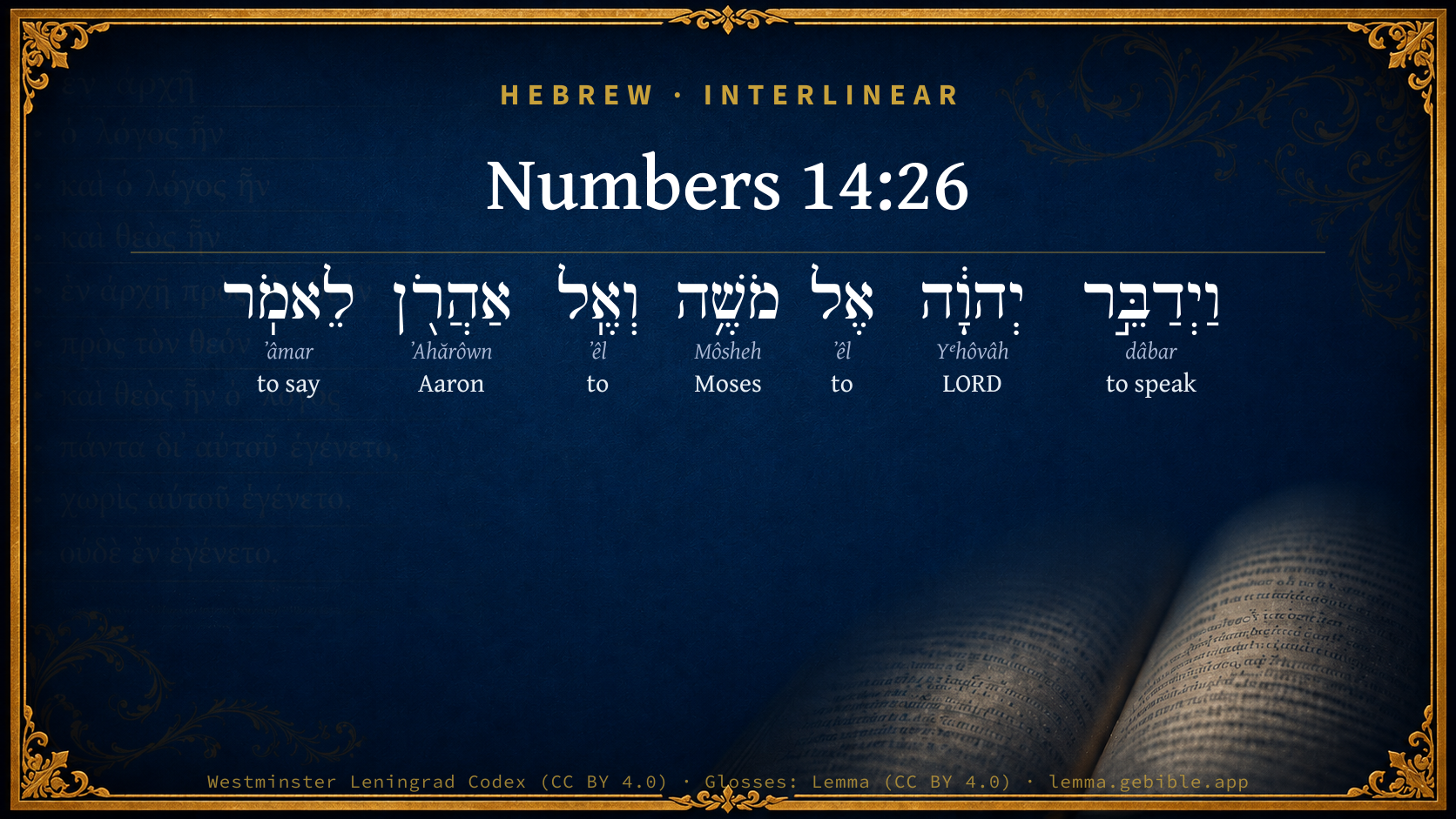
Hebrew (Westminster Leningrad Codex) Numbers 14:26 appears in the Hebrew Old Testament. The text above is from the Westminster Leningrad Codex. Each word links to its Strong’s number, a concise gloss, and parsing drawn from the Open Scriptures Hebrew Bible morphology. Click any word for its full Brown-Driver-Briggs (BDB) entry.
Download image
Cite this verse

Numbers 14:26 (World English Bible). Public Domain. Lemma interlinear Bible study tool, https://lemma.gebible.app/v/numbers/14/26.

Show BibTeX & RIS
BibTeX
RIS
English Translation
Yahweh spoke to Moses and to Aaron, saying,
World English Bible · Public Domain
Download a study sheet

One document with this verse’s original text, its word-by-word gloss line, the meaning frame, cross-references with their text, attributed commentary, and full source and license credits — printable, and it pastes into notes with its structure intact.

This verse Autodidact and up

Study sheet (.html) Plain text (.txt)

A passage Seminary Student

Up to 50 verses in one chapter. A passage sheet keeps up to 6 commentary sources and 12 cross-references per verse, in the order this page ranks them, and says so on the sheet whenever that leaves anything out. Ask for a single verse and you get the Autodidact verse sheet above.

Everything on this page stays free to read, with no account — the sheet is a download of what is already on screen, not access to it.

Want to remove ads? Support Godless Engineer
Compare translations 3

The same verse in 3 English versions, stacked beneath the original-language interlinear above. Click any original word for its lexicon entry.

Each is an independent rendering of the whole verse — the interlinear is not word-aligned to these translations.

Highlighted words mark where these versions differ — a whole-verse word diff, not a word-by-word alignment.

  • World English Bible Public Domain
    Yahweh spoke to Moses and to Aaron, saying,
  • King James Version Public Domain
    And the LORD spake unto Moses and unto Aaron, saying,
  • unfoldingWord Literal Text CC BY-SA 4.0
    And Yahweh spoke to Moses and to Aaron, saying,

unfoldingWord Literal Text — © unfoldingWord, licensed CC BY-SA 4.0. Word-aligned USFM3 via Door43 (git.door43.org/unfoldingWord/en_ult).

Versions to compare (up to 4)

3 of 4 selected

Show all 18 translations

Every available English version of this verse, each an independent rendering of the whole verse.

  • World English Bible Public Domain
    Yahweh spoke to Moses and to Aaron, saying,
  • Berean Standard Bible Public Domain
    Then the LORD said to Moses and Aaron,
  • Majority Standard Bible Public Domain
    Then the LORD said to Moses and Aaron,
  • King James Version Public Domain
    And the LORD spake unto Moses and unto Aaron, saying,
  • American Standard Version (1901) Public Domain
    And Jehovah spake unto Moses and unto Aaron, saying,
  • Revised Version (1885) Public Domain
    And the LORD spake unto Moses and unto Aaron, saying,
  • Geneva Bible (1599) Public Domain
    After, the Lord spake vnto Moses and to Aaron, saying,
  • Douay-Rheims (1899) Public Domain
    And the Lord spoke to Moses and Aaron, saying:
  • Young's Literal Translation Public Domain
    And Jehovah speaketh unto Moses, and unto Aaron, saying,
  • Literal Standard Version CC BY-SA 4.0
    And YHWH speaks to Moses and to Aaron, saying,
  • Unlocked Literal Bible CC BY-SA 4.0
    Yahweh spoke to Moses and to Aaron. He said,
  • unfoldingWord Literal Text CC BY-SA 4.0
    And Yahweh spoke to Moses and to Aaron, saying,
  • Darby Bible Public Domain
    And Jehovah spoke to Moses and to Aaron, saying,
  • World Messianic Bible Public Domain
    The LORD spoke to Moses and to Aaron, saying,
  • Webster's Bible Public Domain
    And the LORD spoke to Moses and to Aaron, saying,
  • Free Bible Version CC BY-SA 4.0
    The Lord told Moses and Aaron,
  • Bible in Basic English Public Domain
    Then the Lord said to Moses and Aaron,
  • JPS Tanakh (1917) Public Domain
    And the LORD spoke unto Moses and unto Aaron, saying:

Literal Standard Version (2020), Covenant Press — licensed CC BY-SA 4.0. Text via the HelloAO Bible API (eBible.org). Unlocked Literal Bible (unfoldingWord) — licensed CC BY-SA 4.0. Text via the HelloAO Bible API (eBible.org). unfoldingWord Literal Text — © unfoldingWord, licensed CC BY-SA 4.0. Word-aligned USFM3 via Door43 (git.door43.org/unfoldingWord/en_ult). Free Bible Version, Dr. Jonathan Gallagher — licensed CC BY-SA 4.0. Text via the HelloAO Bible API (eBible.org).

Word by word

More ways to search: Search by grammar → Find every occurrence → Compare this word →

Practice this passage: Drill this verse → Learn its vocabulary →

About this verse

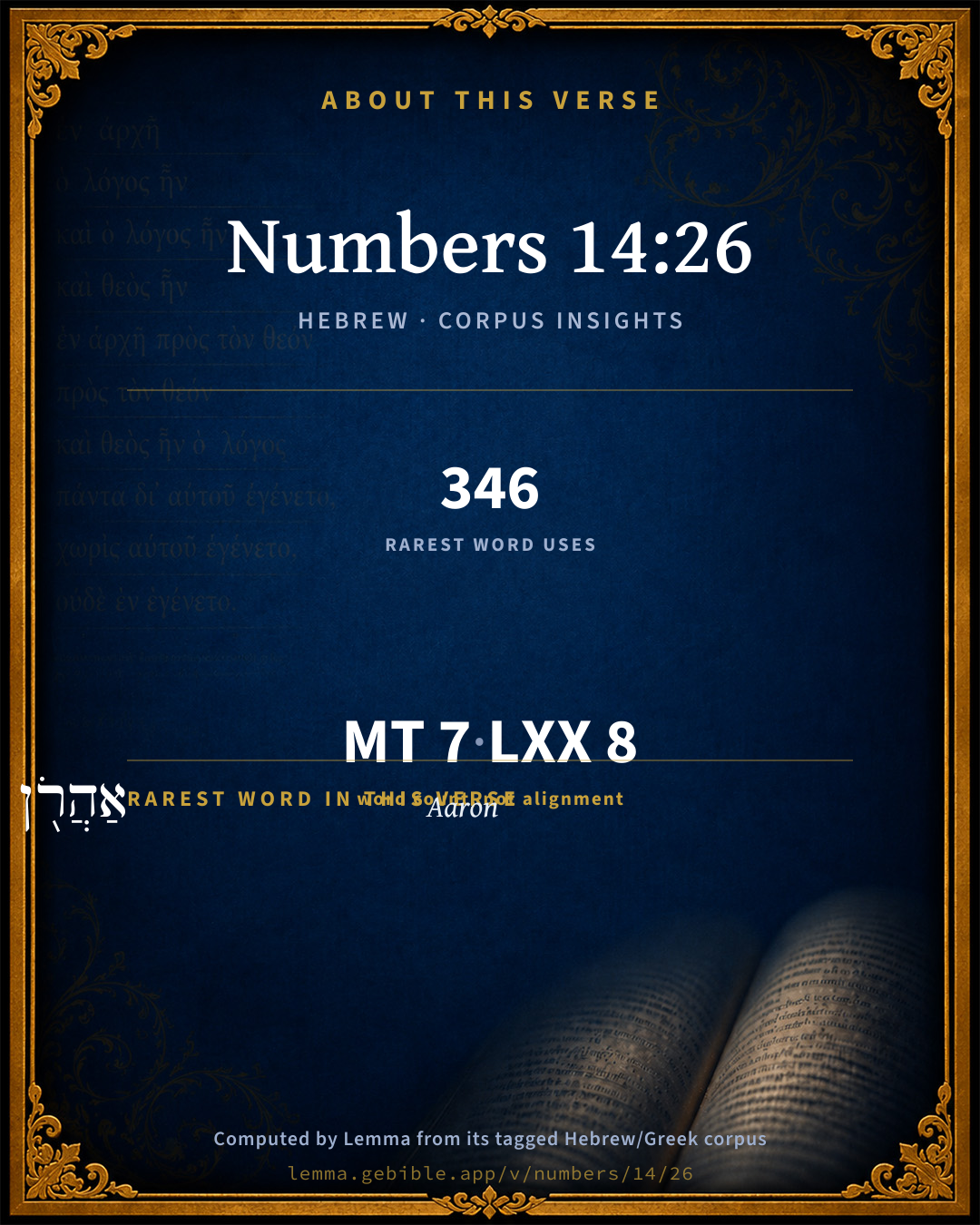
These counts appear in no published source. They are computed here, from the morphology-tagged text and Lemma’s own curated glosses. What Lemma adds →

7
words
6
distinct lemmas
Pentateuch
section

Grammatical profile

  • 2 verbs
  • 3 nouns
  • 2 prepositions

Verb forms

  • וַיְדַבֵּ֣ר Piel · Sequential Imperfect
  • לֵאמֹֽר Qal · Infinitive Construct

Repetition

A word recurs within this verse — often emphatic in Hebrew:

  • אֶל to H413 ×2

Hebrew & Septuagint length

In English translation the verse runs 8 words from the Hebrew and 9 from the Septuagint (LXX English) — closely comparable.

A rough comparison of the two English renderings, which tokenize alike — not a word-level alignment.

Word counts can differ between the Hebrew and the Greek without any difference in meaning — e.g. the Hebrew direct-object marker אֵת has no separate Greek word, and Greek often adds the article ὁ.

In the original languages it is 7 Hebrew tokens and 8 Greek tokens — but the two are counted differently (Hebrew bundles its prefixes and suffixes into one token; the Greek is in lemma form), so that isn’t a like-for-like length.

Hebrew and Greek witnesses Masoretic Hebrew ↔ Greek Septuagint

The same verse in the two great witnesses to the Old Testament, shown verse-for-verse.

These are two independent witnesses, not word-aligned to each other, and the Septuagint is shown in lemma (dictionary) form.

Hebrew Numbers 14:26 Masoretic · Westminster Leningrad Codex

וַיְדַבֵּ֣ר יְהוָ֔ה אֶל מֹשֶׁ֥ה וְאֶֽל אַהֲרֹ֖ן לֵאמֹֽר

Yahweh spoke to Moses and to Aaron, saying,

World English Bible · Public Domain

Greek LXX Numbers 14:26 Septuagint · lemma form

καί εἶπον κύριος πρός μωυσῆς καί ἀαρών λέγω

And the Lord spoke to Moses and Aaron, saying,

LXX2012 (modern English Septuagint) · Public Domain

Hebrew: Westminster Leningrad Codex (CC BY 4.0). Greek: Septuagint (public domain); English from LXX2012 (modern English Septuagint) (Public Domain). How the Septuagint differs from the Hebrew →

Targum (Aramaic paraphrase)

2

The Targum is the ancient Jewish Aramaic paraphrase of the Hebrew Scriptures — an interpretive translation, not the Hebrew text itself. Onkelos (literal) and Pseudo-Jonathan (expansive) render the Torah, and Jonathan the Prophets. Coverage is partial: where no permissively-licensed English translation exists for a verse, only the Aramaic is shown. This is verse-level text, not a word-by-word alignment to the Hebrew.

  1. Targum Onkelos Torah (Genesis–Deuteronomy)
    וּמַלִיל יְיָ עִם משֶׁה וְעִם אַהֲרֹן לְמֵימָר

    (no public-domain English translation for this verse)

    Targum Onkelos — Aramaic: “Onkelos Genesis” (public domain); “Onkelos Exodus” (public domain); “Onkelos Leviticus” (public domain); “Onkelos Numbers” (public domain); “Onkelos Deuteronomy” (public domain). English: “Sefaria Community Translation” (CC0 1.0 (public-domain dedication)); “J.W. Etheridge. The Targums of Onkelos and Jonathan Ben Uzziel on the Pentateuch. London: Longmans, Green, 1862” (public domain). Text via Sefaria.

  2. Targum Pseudo-Jonathan Torah (Genesis–Deuteronomy)
    וּמַלֵיל יְיָ עִם משֶׁה וְעִם אַהֲרן לְמֵימָר

    And the Lord spake with Mosheh and Aharon, saying:

    Targum Pseudo-Jonathan — Aramaic: “Targum Jonathan on Genesis” (public domain); “Targum Jonathan on Exodus” (public domain); “Targum Jonathan on Leviticus” (public domain); “Targum Jonathan on Numbers” (public domain); “Targum Jonathan on Deuteronomy” (public domain). English: “The Targum of Jonathan ben Uzziel, trans. J. W. Etheridge, London, 1862” (public domain). Text via Sefaria.

Commentary

Notes on Numbers 14:26 from classic Christian and Jewish commentators (each source and its license shown beneath its notes). The classic Christian expositions comment on the surrounding passage and are grouped to its opening verse, so a note may address several verses; the Jewish commentaries on the Tanakh (Rashi and others) are per-verse, so they appear only where the commentator wrote on this verse.

Lemma curates 59 commentaries, every one of them public domain or Creative Commons licensed, each selected and text-cleaned for this edition rather than reprinted as found. About our sources →

The Biblical Illustrator

Joseph S. Exell

Num_14:26-29

I have heard the murmurings.

Base murmuring

Murmuring is not a simple sin, but involves--

1. Presumption.

2. Ingratitude.

3. Rebellion.

I. Murmuring without any cause.

II. Murmuring against the best being.

1. Think who and what He is--the Supremely Wise and Good, &c.

2. Think of what He had done for the Israelites, and what He has done for us--redeemed, guarded, sustained, &c.

3. Think of what He had promised to them, and what He has promised to us. How base to murmur against our great Benefactor!

III. Murmuring of long continuance. There are many to-day who are habitual grumblers; murmuring is not occasional. How great is their sin l how great, also, is the patience of God with them!

IV. Murmurings known to god. God hears every bitter complaint; He perceives every unthankful and rebellious mood.

V. Murmuring punished by god. These Israelite murmurers were excluded from the Promised Land. The murmurer excludes himself from the Canaan of joy, and peace, and contentment. Murmuring is a self-punishing sin. God has made it so. (W. Jones.)

Your carcases shall fall in this wilderness.--

The sentence of God upon the sinful people

I. The sentence. Was conspicuously just. Its justice is manifest.

1. In the correspondence between the nature of the sin and the nature of the punishment.

2. In the correspondence between the duration of the unbelieving exploration and the duration of the punishment.

3. In the correspondence between the different degrees of guilt and the different severities of punishment.

II. The sentence was utterly irreversible.

III. The sentence caused great sorrow.

1. Their sorrow had a real and sufficient cause.

2. Their sorrow was not that of repentance, but of selfishness. (W. Jones.)

Verses 31. Your little ones . . . will I bring in.

The duty of parents to their children

I. I propose to extract from our text some permanent and root principles with respect to the relations between parents and children, that God would have us pay special heed to; and then from these root principles I shall endeavour to draw a few practical instructions for our conduct with our children at home.

1. Our first thought is--how completely Almighty God recognises the sense of preciousness which all parents with a spark of heart in them attach to their children, their little children especially; and how God turns the instinct of affection in parents to their children to the parents condemnation, if they will not use their affection in the direction of securing eternal life for those whom they love.

2. That children in the providence of God, and according to the rules of Gods government, do, in a certain degree, share their parents privileges, suffer their parents penalties, nay, even sin with their parents sin.

3. That although, in a certain degree, the children share the privileges, the penalty, and the sin of their parents, yet there is mercy, ay, and there is justice also.

4. That the great cause why the children of Israel refused to go up to the land of Canaan was a want of faith. So the great reason why so-called Christian parents do not take the trouble to prepare their children for eternity is that their own personal belief about the things of eternity is not as strong as it ought to be.

II. Now let me put these principles into a practical shape for our instruction. What is the way in which our great God and Father, who has put us into the responsible and blessed position of parents towards children whom we love, would have us fulfil that responsibility? First of all, He would have us fulfil it in careful, and exact, and regular instruction concerning the things of God. Do not be content to leave this duty to others, but ascertain for yourselves what your children are actually learning about their Lord and Saviour, how far they feel it and know it. And then about example. It is a very good thing to teach your children out of the Word of God; but it is as good to teach them in your own daily life and conversation. There is one thing more--prayer. (Bp. Thorold.)

The Biblical Illustrator, edited by Joseph S. Exell (c. 1880s–1900s) — public domain. Text from a community e-Sword module.

The Cambridge Bible for Schools and Colleges

gen. ed. J. J. S. Perowne

26. And Jehovah spake] This is P’s immediate sequel to the appearance of Jehovah’s glory in the Tent (Num_14:10).

26–39. All the people above twenty years old, except Joshua and Caleb, were condemned to wander for forty years and die in the desert. The spies who brought an evil report died by a plague. The greater part of this section has been assigned to P , but elements from early tradition have been incorporated in it. The ‘forty years’ is alluded to as early as Amos (Num_2:10, Num_5:25), and the wandering in the wilderness in Hos_2:14.

The Cambridge Bible for Schools and Colleges (gen. ed. J. J. S. Perowne; Cambridge University Press, 1878–1918) — public domain. Text from a community e-Sword module.

John Gill's Exposition

How long shall I bear with this evil congregation, which murmur against me?.... Bear with their murmurings, spare them, and not cut them off? how long must sparing mercy be extended to them? the Lord speaks as one weary of forbearing, so frequent and aggravated were their murmurings. The Jews understand this not of the whole congregation of Israel, but of the ten spies, from whence they gather, that ten make a congregation; and they interpret the phrase, "which murmur against me", transitively, "which cause to murmur against me"; made the children of Israel murmur against him, so Jarchi; but rather all the people are meant, as appears from Num 14:28, and from the following clause:

I have heard the murmurings of the children of Israel, which they murmur against me; for their murmurings were not only against Moses and Aaron, but against the Lord himself, Num 14:2.

John Gill's Exposition of the Whole Bible (1746–1763) — public domain (CC PDM 1.0). Text via the HelloAO Bible API.

The Pulpit Commentary

And the Lord spake unto Moses and unto Aaron. This communication is clearly by way of continuation and amplification of the sentence briefly pronounced above. It is markedly distinguished from the latter, as being

(1) spoken to Aaron as well as to Moses;

(2) addressed through them to the people at large.

The one was the Divine answer to the effectual pleading of the mediator; the other the Divine reply to the rebellious cries of the people. The two are blended together in the narrative of Deuteronomy 1.

Vers. 26-35. God"s decision repeated as a message.

What God has already said to Moses by way of answer to his intercession is now amplified in a solemn message to the people. The punitive aspect of the decision is made to appear still more distinctly. Cf. verses 11 and 27. In the first he asks how long the people mean to pursue their unbelieving conduct; in the second, how long shall he bear with them. The time has come for God himself to decide, and make his decision known in the clearest manner.

I THIS GENERATION WAS NOT ALLOWED TO GO ITS OWN WAY. It was not to die at once, neither was it to enter the land; and perhaps some may then have anticipated dismissal altogether, like a disbanded army, that each might be free to take his own path. In reality, all was to go on as before, save that the promise was taken away. They were to continue in the wilderness, and die there. No relaxation is intimated as to the service of the tabernacle and the duties of the comp. We do not escape God"s constraints because our hearts have rejected him. He spared Israel, but he did not let it go back to Egypt. Men may congratulate themselves on being free from the restrictions of a godly life, and talk wildly of those who shut themselves up in the service of Christ, yet they know very well that they are themselves under restraint. Anything like license and recklessness brings suffering on them very quickly. God takes care even now that if men will not serve him, neither shall they please themselves. The fruits of evildoing sometimes ripen with wonderful rapidity.

II IT WAS NOT LEFT TO ITS OWN RESOURCES. It is not expressly said that the manna would be continued, but doubtless all was continued that was not formally revoked. This doomed generation, which could neither go its own way, nor entirely in God"s way, nevertheless had something to do for God which could be done by the ordinary provisions of nature. A generation mostly born in the wilderness had to be brought up to manhood. The lot was, therefore, to some extent mitigated by the continuance of family life, with all its affections, occupations, and enjoyments. In the course of time, as the first bitterness of their doom passed away, parents might even find a certain pleasure in the thought that their children would enjoy the land from which by their own folly they had been excluded.

III No ROOM WAS LEFT FOR A MORE HOPEFUL PROSPECT WITH RESPECT TO THEMSELVES. They had said in their haste, "Would God we had died in this wilderness!" (verse 2). And now through their own folly what they hastily wished has become a necessity. All who had been numbered (Nu 1) are to die, as not being fit to fight the Lord"s battles. No less than four times does the Lord refer to this doom, with variety of expression, which only makes more certain the identity of meaning. Are any of them saying that this very doom is a change of purpose, and therefore they may hope that in a short time God will gladden their ears with the words, "Arise, enter, and possess "? He closes the door against such a hope by giving the long term of forty years to exhaust the doomed generation. This stretch of time would bring even the youngest of them to be a man of sixty, and thus, though the wearing away might be very gradual, yet it would be none the less certain. The rule is made more express and rigorous by the very exceptions in Caleb and Joshua.

IV THOUGH THEY THEMSELVES WERE DOOMED, CLEAR INDICATION IS GIVEN TO THEM THAT GOD"S PURPOSES WOULD BE ACCOMPLISHED. Forty years, and they would be gone! and what then? Why they themselves would be the instruments, and that to a large extent unconsciously, of fulfilling the very purpose which once they seemed to have imperiled. Their little ones God would bring into the land. "Your little ones, which ye said should be a prey." Men are fearful when they ought to be bold, and bold when they ought to be fearful. Israel was alarmed for its tender offspring, but not afraid to rebel against God, and treat his servants with contempt. And now God says that in the exercise of his providence and the carrying out of his extensive plans, these very children, these infants, helpless on the mother"s breast, shall enter and conquer where their fathers were afraid to go. Another generation would arise, not knowing Egypt except at second hand, and which could not very well lust after things it had never tasted. The delay in accomplishing God"s purposes was more apparent than real. The loss was chiefly a loss to the disobedient themselves. God can take the most adverse things, the most determined outbreaks of the wicked, and work them in with his own purposes.

V AN ILLUSTRATION IS FURNISHED OF THE TRUTH THAT CHILDREN HAVE TO BEAR THE SINS OF THE PARENTS (verse 33). A dreadful name, and only too frequent in his after-dealings with Israel, does the Lord give to these sins he calls them. The generations of men are so interwoven that the blow which falls on the parent cannot be entirely averted from the child. Not only was the punished generation unfit for entrance, but its children had to wait in consequence. The children born on this very day of sentence would be well on in manhood when they entered the land. Sinners should well consider how their sin includes others in its consequences. The Israelites thought they were doing a good thing for their little ones when they rebelled; but the real result was the detention of them forty years in the wilderness. If the fathers had been believing, they could have entered at once, and brought up their children in the land flowing with milk and honey. As it was, they had to nourish them in the wilderness, and on the manna they so much despised.

VI THERE IS SOMETHING THROUGH ALL THESE FORTY YEARS TO REMIND THEM OF THEIR SIN AND ITS PUNISHMENT. As the unbelievers died off one by one, and as each succeeding year began, and whenever Caleb and Joshua appeared, there was something to remind of God"s chastising hand. Y.

The Pulpit Commentary (1880–1919), ed. H.D.M. Spence-Jones & Joseph S. Exell — public domain. Text from a community e-Sword module.

Keil & Delitzsch

C. F. Keil & F. Delitzsch

Sentence upon the Murmuring Congregation. - After the Lord had thus declared to Moses in general terms His resolution to punish the incorrigible people, and not suffer them to come to Canaan, He proceeded to tell him what announcement he was to make to the people.

Num 14:27

This announcement commences in a tone of anger, with an aposiopesis, "How long this evil congregation" (sc., "shall I forgive it," the simplest plan being to supply אשּׂא, as Rosenmller suggests, from Num 14:18), "that they murmur against Me?"

Num 14:28-31

Jehovah swore that it should happen to the murmurers as they had spoken. Their corpses should fall in the desert, even all who had been numbered, from twenty years old and upwards: they should not see the land into which Jehovah had lifted up His hand (see at Exo 6:8) to lead them, with the sole exception of Caleb and Joshua. But their children, who, as they said, would be a prey (Num 14:3), them Jehovah would bring, and they should learn to know the land which the others had despised.

Num 14:32-33

"As for you, your carcases will fall in this wilderness. But your sons will be pasturing (i.e., will lead a restless shepherd life) in the desert forty years, and bear your whoredom (i.e., endure the consequences of your faithless apostasy; see Exo 34:16), until your corpses are finished in the desert," i.e., till you have all passed away.

Num 14:34

"After the number of the forty days that he have searched the land, shall ye bear your iniquity, (reckoning) a day for a year, and know My turning away from you," or תּנוּאה, abalienatio, from נוא (Num 32:7).

Num 14:35

As surely as Jehovah had spoken this, would He do it to that evil congregation, to those who had allied themselves against Him (נועד, to bind themselves together, to conspire; Num 16:11; Num 27:3). There is no ground whatever for questioning the correctness of the statement, that the spies had travelled through Canaan for forty days, or regarding this as a so-called round number - that is to say, as unhistorical. And if this number is firmly established, there is also no ground for disputing the forty years' sojourn of the people in the wilderness, although the period during which the rebellious generation, consisting of those who were numbered at Sinai, died out, was actually thirty-eight years, reaching from the autumn of the second year after their departure from Egypt to the middle of the fortieth year of their wanderings, and terminating with the fresh numbering (ch. 26) that was undertaken after the death of Aaron, and took place on the first of the fifth month of the fortieth year (Num 20:23., compared with Num 33:38). Instead of these thirty-eight years, the forty years of the sojourn in the desert are placed in connection with the forty days of the spies, because the people had frequently fallen away from God, and been punished in consequence, even during the year and a half before their rejection; and in this respect the year and a half could be combined with the thirty-eight years which followed into one continuous period, during which they bore their iniquity, to set distinctly before the minds of the disobedient people the contrast between that peaceful dwelling in the promised land which they had forfeited, and the restless wandering in the desert, which had been imposed upon them as a punishment, and to impress upon them the causal connection between sin and suffering. "Every year that passed, and was deducted from the forty years of punishment, was a new and solemn exhortation to repent, as it called to mind the occasion of their rejection" (Kurtz). When Knobel observes, on the other hand, that "it is utterly improbable that all who came out of Egypt (that is to say, all who were twenty years old and upward when they came out) should have fallen in the desert, with the exception of two, and that there should have been no men found among the Israelites when they entered Canaan who were more than sixty years of age," the express statement, that on the second numbering there was not a man among those that were numbered who had been included in the numbering at Sinai, except Joshua and Caleb (Num 26:64.), is amply sufficient to overthrow this "improbability" as an unfounded fancy. Nor is this statement rendered at all questionable by the fact, that "Aaron's son Eleazar, who entered Canaan with Joshua" (Jos 14:1, etc.), was most likely more than twenty years old at the time of his consecration at Sinai, as the Levites were not qualified for service till their thirtieth or twenty-fifth year. For, in the first place, the regulation concerning the Levites' age of service is not to be applied without reserve to the priests also, so that we could infer from this that the sons of Aaron must have been at least twenty-five or thirty years old when they were consecrated; and besides this, the priests do not enter into the question at all, for the tribe of Levi was excepted from the numbering in ch. 1, and therefore Aaron's sons were not included among the persons numbered, who were sentenced to die in the wilderness. Still less does it follow from Jos 24:7 and Jdg 2:7, where it is stated that, after the conquest of Canaan, there were many still alive who had been eye-witnesses of the wonders of God in Egypt, that they must have been more than twenty years old when they came out of Egypt; for youths from ten to nineteen years of age would certainly have been able to remember such miracles as these, even after the lapse of forty or fifty years.

Num 14:36-38

But for the purpose of giving to the whole congregation a practical proof of the solemnity of the divine threatening of punishment, the spies who had induced the congregation to revolt, through their evil report concerning the inhabitants of Canaan, were smitten by a "stroke before Jehovah," i.e., by a sudden death, which proceeded in a visible manner from Jehovah Himself, whilst Joshua and Caleb remained alive.

Keil & Delitzsch — Biblical Commentary on the Old Testament (1861–1891) — public domain (CC PDM 1.0). Text via the HelloAO Bible API. (Old Testament only.)

Kretzmann's Popular Commentary

Paul E. Kretzmann

The Judgment Pronounced

v. 26. And the Lord spake unto Moses and unto Aaron, saying,

v. 27. How long shall I bear with this evil congregation which murmur against Me? being incorrigible in their dissatisfied opposition to the ways of the Lord’s dispensation. I have heard the murmurings of the children of Israel which they murmur against Me, for they were continually engaged in grumbling of this kind.

v. 28. Say unto them, As truly as I live, saith the Lord, as ye have spoken in Mine ears, so will I do to you, Cf v. 2:

v. 29. your carcasses shall fall in this wilderness; literally, "in this very wilderness shall fall your dead bodies"; and all that were numbered of you, according to your whole number, from twenty years old and upward, which have murmured against Me,

v. 30. doubtless ye shall not come into the land concerning which I sware, by a solemn lifting up of the hand, to make you dwell therein, save Caleb, the son of Jephunneh, and Joshua, the son of Nun. They would see for themselves whether the oath which the Lord had now sworn by His own life would be fulfilled; they would find out whether a single one of the dissatisfied murmurers would reach the Land of Promise.

v. 31. But your little ones, which ye said should be a prey,

v. 3. them will I bring in, and they shall know the land which ye have despised.

v. 32. But as for you, as the Lord here repeats for the sake of emphasis, your carcasses, they shall fall in this wilderness.

v. 33. And your children shall wander in the wilderness forty years, sustaining themselves as nomads with their herds in the wastes of the Sinaitic Peninsula, and bear your whoredoms, to expiate, in a way, the spiritual unfaithfulness of their fathers, until your carcasses be wasted in the wilderness, until the desert had consumed even the last of them.

v. 34. After the number of the days in which ye searched the land, even forty days, Num 13:25, each day for a year, shall ye bear your iniquities, even forty years, and ye shall know My breach of promise; they would experience what it means when the Lord turns from a people in anger, being obliged to withdraw or to change His original promise.

v. 35. I, the Lord, have said, I will surely do it unto all this evil congregation that are gathered together against Me; in this wilderness they shall be consumed, and there they shall die.

v. 36. And the men which Moses sent to search the land, who" returned and made all the congregation to murmur against him, by bringing up a slander upon the land, by misrepresenting the facts about Canaan and exaggerating the difficulties of conquering its people,

v. 37. even those men that did bring up the evil report upon the land, died by the plague before the Lord; the punishment struck them very suddenly, and struck them down as the first among the rebellious people.

v. 38. But Joshua, the son of Nun, and Caleb, the son of Jephunneh, which were of the men that went to search the land, lived still, their preservation, in the circumstances, being all the more remarkable, and substantiating the word of the Lord. The judgment upon such as were leaders in the Church and abused the trust placed in them by leading their people astray, will be especially harsh.

Paul E. Kretzmann, Popular Commentary of the Bible (1921–1924) — public domain. Text from a community e-Sword module.

unfoldingWord translationNotes

Door43 World Missions Community

How long must I tolerate this evil community that criticizes me?

Yahweh asks this question because he has lost patience with the people. It can be translated as a statement. AT: "I have tolerated this evil community who has criticized me long enough." (See: Rhetorical Question)

I have heard the complaining of the people of Israel

The word "complaining," an abstract noun, can be expressed as a verb. AT: "I have heard the people of Israel complain" (See: Abstract Nouns)

translationWords

Yahweh

Moses

Aaron

evil

Israel

unfoldingWord translationNotes — © Distant Shores Media and the Door43 World Missions Community, licensed CC BY-SA 4.0. Source: git.door43.org/Door43/en_tn.

Lesson kit

Teaching starters — assembled from the data on this page, not authored interpretation. Every prompt links to the verse data it draws on. Edit before teaching.

Numbers, in the Pentateuch, opens this verse with 7 words (6 distinct Hebrew lemmas). Its most distinctive word is ʼAhărôwn (“Aaron”). A historical commentator’s framing appears above. Read the whole chapter for the surrounding context.

Discussion questions

  1. The word ʼAhărôwn carries the sense “Aaron.” How does it shape the verse?
  2. What does the repetition of “to” (2× in this one verse) do in this verse?
  3. These translations render this verse differently. What is at stake in choosing one wording over another?
  4. «וַיְדַבֵּ֣ר» is a Piel Sequential Imperfect verb. How does that grammatical form shape the action described?
  5. Compare how The Biblical Illustrator and The Cambridge Bible for Schools and Colleges read this verse. Where do they agree or differ?

Things to notice

Reading settings

Reading text

Shown beneath each verse's original-language words.

Old Testament
Old Testament edition

Read the OT as the Masoretic Hebrew (MT) or the Greek Septuagint (LXX).

English shown for the Greek Septuagint (in the Hebrew ↔ Greek comparison).

Comparing translations? Open the Compare panel on any verse page to stack up to four side by side.