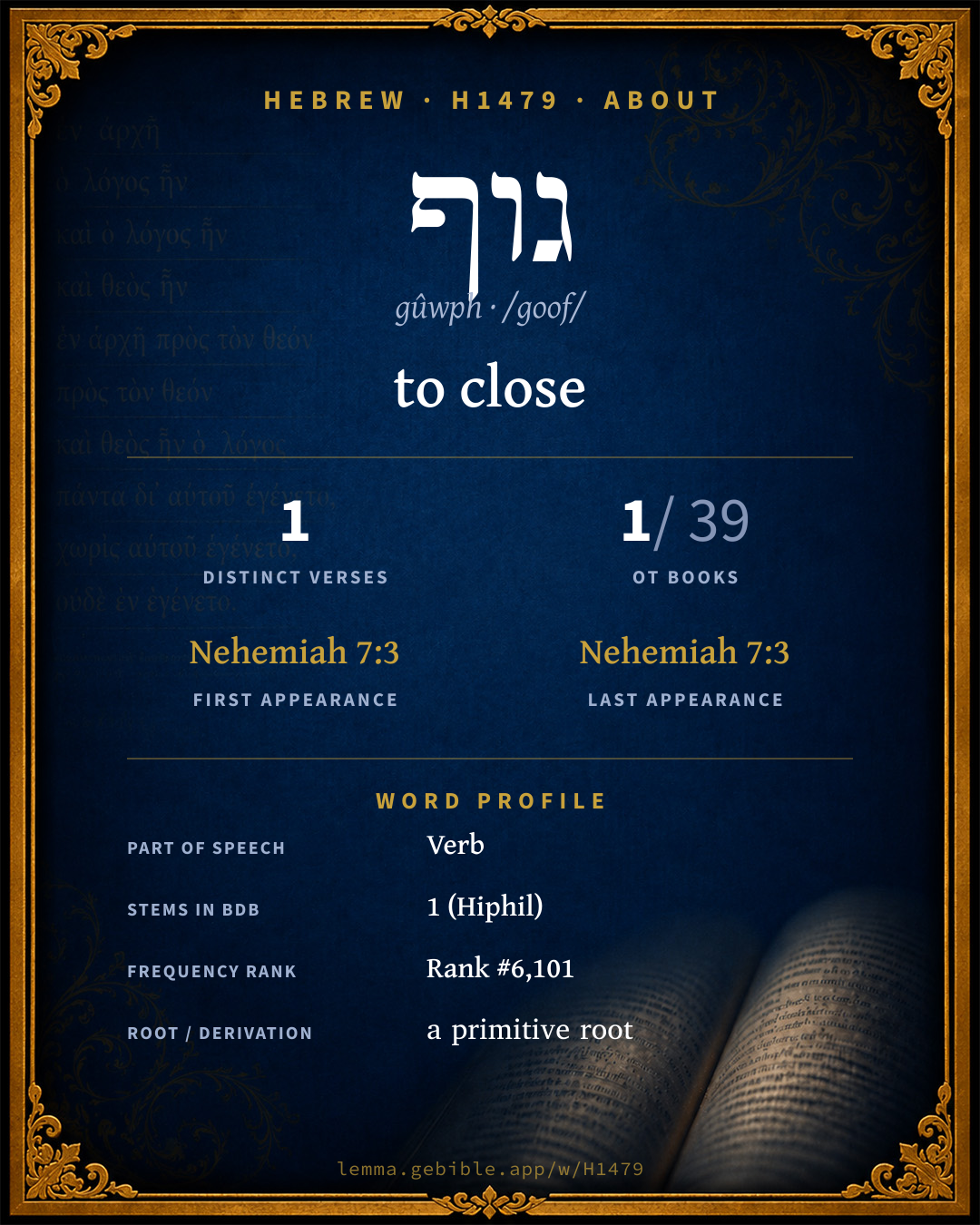
גּוּף
to close
‘to close’ is one of 2 main senses fuller range ↓
Full lexicon entry — Brown-Driver-Briggs (BDB)
From Brown-Driver-Briggs (BDB)
Where this word appears
Grammar key — what these labels mean
Part of speech
- Verb
- An action or state-of-being word.
Stem
- Hiphil
- The causative active stem (“he caused / brought about”).
Form
- Imperfect
- An incomplete, ongoing, or future action (“he will / would write”).
Person
- 3rd Person
- The one spoken about (“he / she / it / they”).
Gender
- Masculine
- Grammatically masculine.
Number
- Plural
- More than one (in Hebrew, generally three or more).
Every verse where H1479 appears — 1 distinct verse across 1 book. Click any verse to open its interlinear word-by-word view. Verse text shown in the World English Bible for context — . Each verse’s Hebrew form is shown with its reference; the English is not keyword-highlighted, since the data carries no word-level English alignment. Use “Compare translations” on any verse to read it across multiple English versions. This concordance covers the Hebrew Bible; Septuagint (Greek Old Testament) occurrences are not indexed here.
Nehemiah 1 verse
About this entry
At a glance — auto-summarized from this page’s data, not written by a person. Every figure links to its source below. This summary describes the numbers; it doesn’t interpret them.
גוף — transliterated gûwph — is a Hebrew verb carrying the sense “to close.” The Hebrew Bible uses it only 1 verse. More than three-quarters of its appearances fall in Nehemiah. Its lone occurrence is Nehemiah 7:3. It is not a single-sense word — see its full sense range. See the sense tree, 1-verse concordance, and the renderings breakdown below.
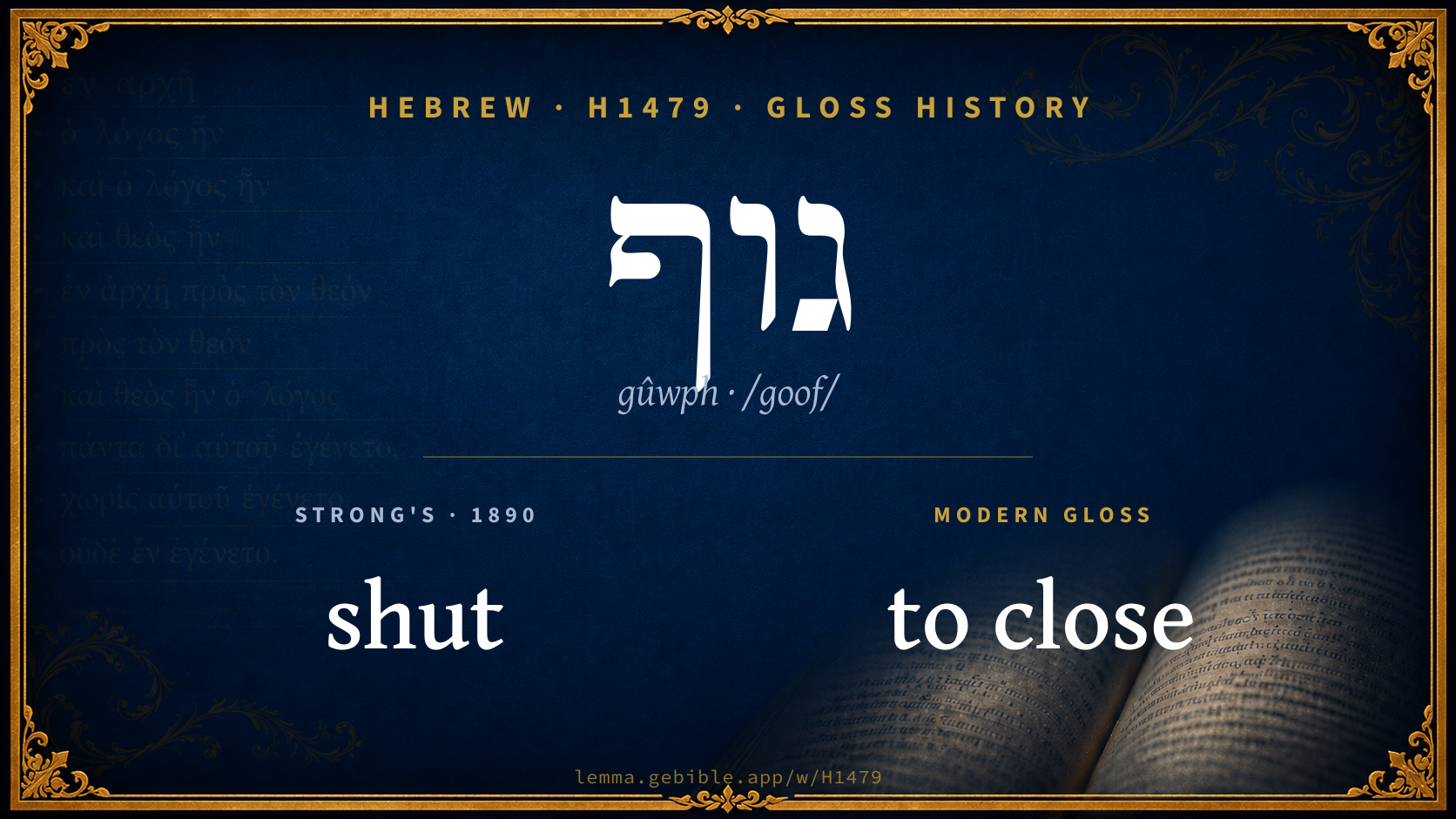
Gloss history
Strong's 1890 vs modern scholarship
About this word
Strong's H1479 catalogs a Hebrew word from the Hebrew Old Testament.
These counts are not copied from any lexicon or concordance. They are computed here, from the morphology-tagged Hebrew Old Testament. What Lemma adds →
- 1
- distinct verses
- The word appears in 1 distinct verse.
- 1 / 39
- OT books
- The word appears in 1 of 39 Old Testament books.
- #6,101
- by frequency
- Rank #6,101 (rank 6,101 of 8,640 Hebrew words by occurrence).
View all 1 occurrence in the concordance →
Most concentrated in
- Nehemiah 1 verse 100%
By section of the Old Testament
By traditional corpus
Conventional, traditional groupings — biblical authorship is debated, so this is a traditional corpus grouping, not an authorship claim. Each share is this word’s portion of its verses in that division of the Hebrew canon. Each figure is a share of the word’s 1 distinct verse.
- Writings (Ketuvim) 1 verse · 100%
How translations render this word
Counts come from each version’s own published word-to-Strong’s tagging or interlinear alignment — an approximate guide to how each version renders this word, not a word-level alignment the data otherwise carries. Because each total is that version’s own tagged count, the per-version totals vary from one another and need not match the appearance or distinct-verse counts above. These counts may also differ from a printed concordance because Lemma counts each distinctly tagged rendering and does not collapse phrase taggings into a single head-word total. This is a fixed set of word-tagged versions (KJV, ASV, BSB, ULT) and does not change with the reading translation you choose elsewhere. Each version’s license is shown beside its name below (and on Sources).
- King James Version: Let them shut 1×
- American Standard Version: Let them shut 1×
- Berean Standard Bible: Shut 1×
- unfoldingWord Literal Text: Let them shut 1×
King James Version Public Domain
Renders H1479 across 1 tagged occurrence — most commonly:
American Standard Version Public Domain
Renders H1479 across 1 tagged occurrence — most commonly:
Berean Standard Bible Public Domain
Renders H1479 across 1 tagged occurrence — most commonly:
unfoldingWord Literal Text CC BY-SA 4.0
Renders H1479 across 1 tagged occurrence — most commonly:
Senses in the full BDB
What do BDB’s symbols mean?
BDB uses these scholarly abbreviations:
| Symbol | Meaning |
|---|---|
| 𝔊 | the Septuagint (the ancient Greek translation, LXX) |
| 𝔙 | the Vulgate (the Latin translation) |
| 𝔖 | the Syriac version (the Peshitta) |
| 𝔗 | the Targum (the Aramaic translation) |
| ψ | the Psalms |
| √ | root (the underlying root or stem) |
| ‖ | parallel passage (a synonymous or contrasted parallel) |
| † | the dagger: every passage where the word occurs is cited |
The 1 sense the full Brown-Driver-Briggs lexicon distinguishes for this word, in lexicon order (not ranked by frequency), with BDB’s own verbatim wording and sub-sense lettering. Shown in Hebrew script with BDB’s own scholarly abbreviations. The condensed entry is in the Lexicon Entry tab.
Hiphil
- . Ne 7:3 close (doors). e.g. Nehemiah 7:3
Senses from the full Brown-Driver-Briggs lexicon (Brown, Driver, Briggs; Oxford 1906 — public domain), digitized via Sefaria, supplemented by the OpenScriptures HebrewLexicon (CC BY 4.0). Full attribution on Sources.
Word origin
[ גּוּף ] vb. shut, close
— Brown-Driver-Briggs (Oxford 1906, public domain), digitized via Sefaria, supplemented by the OpenScriptures HebrewLexicon (CC BY 4.0). See Sources.
Origin: a primitive root
Jastrow Dictionary
A second Hebrew/Aramaic lexicon for comparison, covering Aramaic and post-biblical (Talmudic, Targumic, Midrashic) usage that the biblical-Hebrew BDB does not. Matched by lemma rather than by Strong’s number, so a lemma may carry more than one Jastrow headword (shown separately below), and the entries cover usage well beyond the Bible.
גּוּף I
- , perf. a. part. גָּף (= גָּפַף) [to join body to body,] to squeeze, cork, bung. Nidd. 6ᵇ היתה גָּפָה וכ׳ was corking (pitching) wine jugs. M. Kat. 11ᵇ כדו לָגוֹף we take for the mourner his wine jug for corking. [Ib. Mish. ib. II, 1 וגף, omitted in Ms. M., v. Rabb. D. S. a. l. note.] Maas. Sh. III, 12 אע"פ שגָּפָן; Tosef. ib. II, 18 שגָּפָם (Var. גֹּופָם fr. גָּפָה) though he corked them; a. e.
- to embrace, hug. Y. Yoma III, 41ᵃ גִּיְּיפוֹ he put his arms around it.
- (Neh. VII, 3) to fill up (a hole), close (a door), fasten. Par. VI, 1. Ohol. XIII, 3 הֵגִיפָהּ ולא וכ׳ he filled the hole out but not entirely. Zab. III, 2 מֵגִיפִין או פותחין if both close or open a door simultaneously. Tosef. Ohol. XIV, 1; a. e.—Part. pass. מוּגָף fastened. Y. Keth. VII, 31ᶜ מ׳ צריכה if the door (behind the suspected couple) was closed (but not locked), it is doubtful (whether the woman is to be considered a Sotah, v. סוֹטָה). e.g. Nehemiah 7:3
גּוּף
- 1. to close. Targ. Mal. I, 10; a. e.
- 2. [to embrace,] to have illegitimate intercourse, to commit adultery with. Targ. O. Lev. XX, 10 (Y. גוּר); a. e.—Part. גָּיֵף, גָּיְיפָא. Targ. Hos. IV, 2; 13; a. e.—Lev. R. s. 3; Koh. R. to IV, 6 (prov.) ג׳ בחזורין וכ׳ (Ar. גָּיְרָא) she prostitutes herself for apples and distributes them among the sick (sinning and doing charity).
- , אָגֵף to close. Targ. II Sam. XIII, 17 אִיגוֹף ed. Lag. (ed. אָגֵיף) close thou &c. Ib. 18 אגף (ed. Lagarde (ed. אגיף); a. e.—B. Kam. 105ᵃ אגף חצייה he closed half of the opening.
- as Pe. 2. Targ. Hos. IV, 14 מְגַיְּ׳ (ed. Lag. גייפן).—V. גְּפַף a. גּוּר II
גּוּף II
- 1. body, person, self. Kidd. 20ᵃ (expl. b’gappo Ex. XXI, 3) בגוּפוֹ נכנס וכ׳ of himself he entered, of himself he shall go out (free, in the seventh year) but not, like a gentile slave, on losing a limb. Snh. 91ᵃ ג׳ ונשמה וכ׳ the body and the soul may try to escape judgment (shifting the responsibility one on the other). Kidd. 37ᵃ, a. fr. חובת הג׳ personal duty, contrad. to ה׳ קרקע laws connected with the (Palestinean) soil. Y. Taan. I, 64ᵈ top, a. e. אותו הג׳ הקדוש that holy body (saint). R. Hash. 17ᵃ בגוּפָן by defiling their bodies. Ab. IV, 6 גּוּפוֹ מכובד וכ׳ will himself be honored by men.—Trnsf. Guf, the fictitious storehouse of souls in heaven. Yeb. 62ᵃ, a. e. the son of David shall not come עד שיכלו … שֶׁבַּגּ׳ before all souls in the Guf are exhausted (i.e. sent to live on earth). e.g. Exodus 21:3
- 2. essence, substance. Y. Ber. I, 3ᶜ גּוּפָהּ של שמע an integral portion of the Sh’ma (confession of faith). Y. Sabb. II, 5ᵃ top גופה של פתילה the wick itself. Gitt. IX, 3 גּוּפוֹ של גט וכ׳ the essential formula of a letter of divorce is &c. Yoma 74ᵇ גופו של מעשה the deed (of sexual gratification) itself; a. fr.—Pes. 112ᵇ מצוה וגוף גדול עושה פירות ולו שכר (Ar. a. Ms. M. 2 a. O., ed. ולא) a charity and at the same time a good investment is the act of him who helps to produce fruits, while he has the reward (e.g. one who loans money to a husbandman on security, allowing payment in small instalments); מצוה וג׳ טהור וכ׳ a religious act by which one preserves his body pure does he perform who marries a wife &c.—Pl. גּוּפִין, constr. גּוּפֵי. Gen. R. s. 31.—Y. Sabb. II, 5ᵇ bot. ג׳ הלכות; Tosef. ib. II, 10 ג׳ תורה essential parts of the Law; Ab. III, 18; Ḥag. I, 8 (10ᵃ); 11ᵇ
- 3. membrum. Lev. R. s. 25, end.
- 4. surface, color (cmp. גַּוָּון). Men. 44ᵃ top גופו דומה וכ׳ its color resembles that of the Sea, contrad. to ברייה shape; Mass. Tsitsith ed. Kirchheim p. 23.
A Dictionary of the Targumim, the Talmud Babli and Yerushalmi, and the Midrashic Literature (Marcus Jastrow; London, Luzac, 1903) — Public Domain. Digitized via Sefaria. Digitized via Sefaria. Full attribution on Sources.
Same root — word family
Other BDB entries built from the same root as H1479, grouped by Strong’s listed origin. These share a root / origin per the lexicon — not necessarily a shared meaning. Each links to that word’s own entry.
Derived from this word
Proper names from this root
People and places named from this root — a name, not an additional meaning of the word.
Compare all same-root words → 1 of the same-root words is a proper name (a person or place). They share a root, not necessarily a meaning.