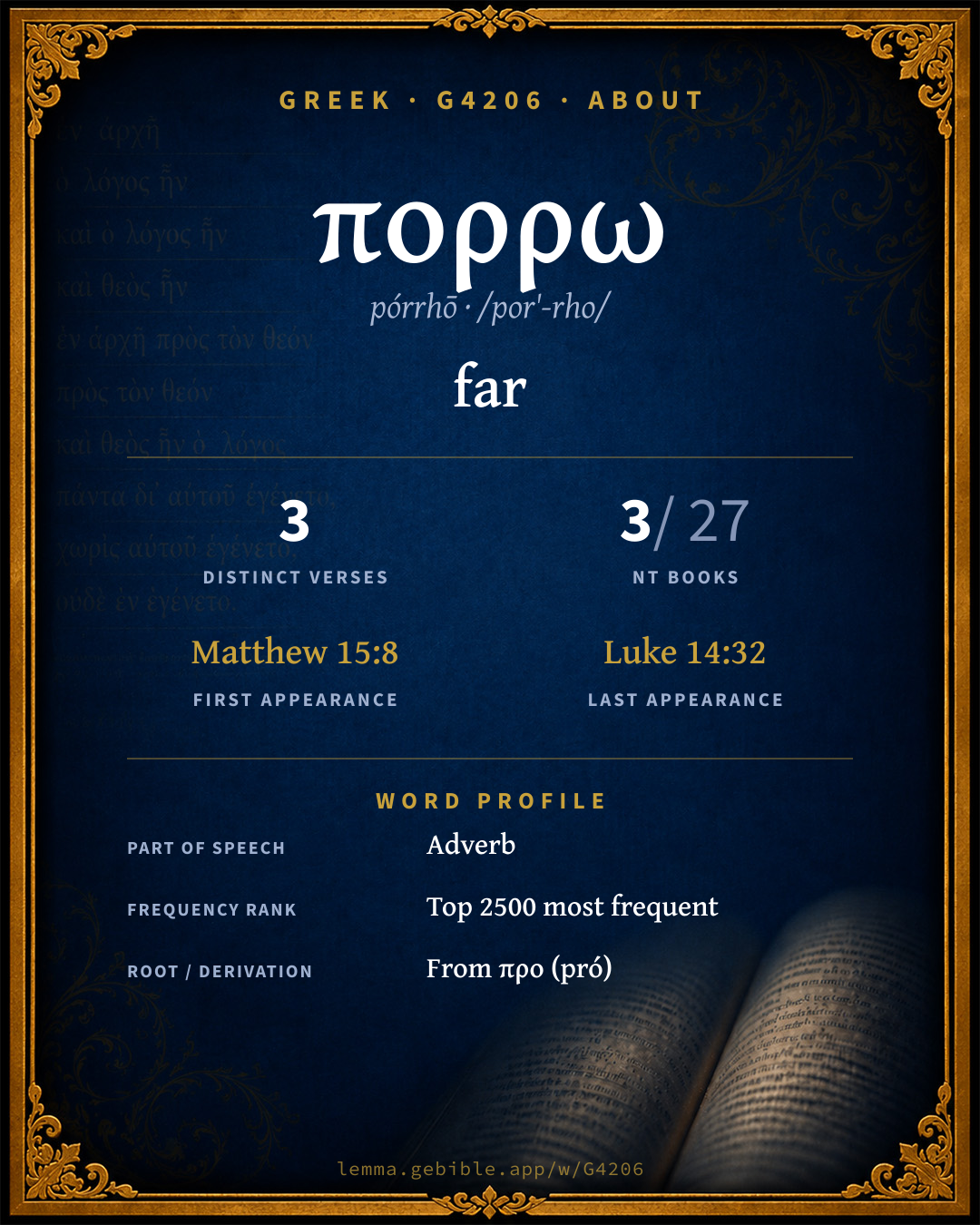
πόῤῥω
far
Full lexicon entry — Thayer's Greek Lexicon
From Thayer's Greek Lexicon
Where this word appears
Grammar key — what these labels mean
Part of speech
- Adverb
- A word that modifies a verb, adjective, or other adverb.
Every verse where G4206 appears — 3 distinct verses across 3 books. Click any verse to open its interlinear word-by-word view. Verse text shown in the World English Bible for context — . Each verse’s Greek form is shown with its reference; the English is not keyword-highlighted, since the data carries no word-level English alignment. Use “Compare translations” on any verse to read it across multiple English versions. This concordance covers the Greek New Testament; Septuagint (Greek Old Testament) occurrences of this word are not indexed here.
Matthew 1 verse
Mark 1 verse
Luke 1 verse
About this entry
At a glance — auto-summarized from this page’s data, not written by a person. Every figure links to its source below. This summary describes the numbers; it doesn’t interpret them.
πορρω — transliterated pórrhō — is a Greek verb carrying the sense “far.” It occurs a mere 3 verses across Scripture. More than a third of its appearances fall in Matthew. Debuting at Matthew 15:8, it then recurs through the corpus. It shares a root with προ, πρηνης and πριν. Each statement above links to its evidence; the full detail follows below.
Gloss history
Strong's 1890 vs modern scholarship

About this word
Strong's G4206 catalogs a Greek word from the Greek New Testament.
These counts are not copied from any lexicon or concordance. They are computed here, from the morphology-tagged Greek New Testament. What Lemma adds →
- 3
- distinct verses
- The word appears in 3 distinct verses.
- 3 / 27
- NT books
- The word appears in 3 of 27 New Testament books.
- #2,203
- by frequency
- Top 2500 most frequent Greek words (rank 2,203 of 5,347 Greek words by occurrence).
View all 3 occurrences in the concordance →
By section of the New Testament
By traditional corpus
Conventional, traditional groupings — biblical authorship is debated, so this is a traditional corpus grouping, not an authorship claim. Some books belong to more than one corpus (Luke is in both the Gospels and the Lukan corpus, and so on), so these shares overlap and need not total 100%. Each figure is a share of the word’s 3 distinct verses.
- Gospels 3 verses · 100%
- Lukan (Luke–Acts) 1 verse · 33%
How translations render this word
Counts come from each version’s own published word-to-Strong’s tagging or interlinear alignment — an approximate guide to how each version renders this word, not a word-level alignment the data otherwise carries. Because each total is that version’s own tagged count, the per-version totals vary from one another and need not match the appearance or distinct-verse counts above. These counts may also differ from a printed concordance because Lemma counts each distinctly tagged rendering and does not collapse phrase taggings into a single head-word total. This is a fixed set of word-tagged versions (KJV, ASV, BSB, ULT) and does not change with the reading translation you choose elsewhere. Each version’s license is shown beside its name below (and on Sources).
- King James Version: Far 2×
- American Standard Version: Far 2×
- Berean Standard Bible: Far 1×, Far off 1×, Farther 1×
- unfoldingWord Literal Text: Is far away 2×
King James Version Public Domain
Renders G4206 across 3 tagged occurrences — most commonly:
Plus 1 rendering that appears only once — usually multi-word phrases or single function words the recovered tagging swept in, not distinct renderings.
American Standard Version Public Domain
Renders G4206 across 3 tagged occurrences — most commonly:
Plus 1 rendering that appears only once — usually multi-word phrases or single function words the recovered tagging swept in, not distinct renderings.
Berean Standard Bible Public Domain
Renders G4206 across 3 tagged occurrences — most commonly:
Not rendered by a distinct English word in 1 further occurrence.
unfoldingWord Literal Text CC BY-SA 4.0
Renders G4206 across 3 tagged occurrences — most commonly:
Plus 1 rendering that appears only once — usually multi-word phrases or single function words the recovered tagging swept in, not distinct renderings.
Senses in Thayer's
The 1 sense Thayer's distinguishes for this word, in lexicon order (not ranked by frequency or importance). The full entry — with sub-senses — is in the Lexicon Entry tab.
- far, at a distance, a great way off
Word origin
Derived from προ (pró) (G4253) — before.
Same root — word family
Other Thayer's entries built from the same root as G4206, grouped by Strong’s listed origin. These share a root / origin per the lexicon — not necessarily a shared meaning. Each links to that word’s own entry.
Derives from
Shares the same root
- πρηνης prēnḗs G4248 headlong
- πριν prín G4250 before
- προαγω proágō G4254 to lead forward
- προαιρεομαι proairéomai G4255 to choose before
- προαιτιαομαι proaitiáomai G4256 to charge previously
- προακουω proakoúō G4257 to hear before
- προαμαρτανω proamartánō G4258 to sin before
- προαυλιον proaúlion G4259 porch
- προβαινω probaínō G4260 to go forward
- προβαλλω probállō G4261 to throw forward
- προβιβαζω probibázō G4264 to drag forward
- προβλεπω problépō G4265 to foresee
- προγινομαι progínomai G4266 to come before
- προγινωσκω proginṓskō G4267 to foreknow
- προγραφω prográphō G4270 to write before
- προδηλος pródēlos G4271 manifest
- προδιδωμι prodídōmi G4272 to give before
- προειδω proeídō G4275 to foresee
- προελπιζω proelpízō G4276 to hope before
- προεπω proépō G4277 to say before
- προεναρχομαι proenárchomai G4278 to begin before
- προεπαγγελλομαι proepangéllomai G4279 to promise before
- προερεω proeréō G4280 to say before
- προερχομαι proérchomai G4281 to go before
+47 more words share this root (not shown).
Derived from this word
Proper names from this root
People and places named from this root — a name, not an additional meaning of the word.
Compare all same-root words → Showing 4 of 76 — not the complete family. 1 of the same-root words is a proper name (a person or place). They share a root, not necessarily a meaning.
Septuagint usage
The same Greek word πορρω appears 13 times in the Greek Old Testament (Septuagint), across 13 verses in 4 books.
- 13
- LXX occurrences
- Tagged occurrences of this Greek word in the Septuagint.
- 13
- verses
- Distinct Septuagint verses containing this word.
- 4 / 39
- OT books
- The word appears in 4 of the 39 Old Testament books.
Sample Septuagint occurrences
- 2 Chronicles 26:15 πόρρω
- Job 5:4 πόρρω
- Isaiah 17:13 πόρρω
- Jeremiah 12:2 πόρρω
Septuagint occurrences (same lexeme)
Every verse where the same Strong’s number (G4206) appears in the Greek Septuagint. Verse text shown in the World English Bible for context; the Greek form is the matched word — the English is not keyword-highlighted.
- 2 Chronicles 26:15 πόρρω He made in Jerusalem engines, invented by skillful men, to be on the towers and on the battlements, with which to shoot arrows and great stones. His name spread far abroad; for he was marvelously helped, until he was strong.
- Job 5:4 πόρρω His children are far from safety, They are crushed in the gate. Neither is there any to deliver them,
- Job 11:14 πόρρω If iniquity is in your hand, put it far away, Don't let unrighteousness dwell in your tents.
- Job 22:18 πόρρω Yet he filled their houses with good things, But the counsel of the wicked is far from me.
- Job 22:23 πόρρω If you return to the Almighty, you shall be built up, If you put away unrighteousness far from your tents.
- Isaiah 17:13 πόρρω The nations shall rush like the rushing of many waters: but he shall rebuke them, and they shall flee far off, and shall be chased as the chaff of the mountains before the wind, and like the whirling dust before the storm.
- Isaiah 22:3 πόρρω All your rulers fled away together, they were bound by the archers; all who were found of you were bound together; they fled afar off.
- Isaiah 29:13 πόρρω The Lord said, Because this people draw near [to me], and with their mouth and with their lips to honor me, but have removed their heart far from me, and their fear of me is a commandment of men which has been taught [them];
- Isaiah 65:5 πόρρω who say, Stand by yourself, don't come near to me, for I am holier than you. These are a smoke in my nose, a fire that burns all the day.
- Isaiah 66:19 πόρρω I will set a sign among them, and I will send such as escape of them to the nations, to Tarshish, Pul, and Lud, who draw the bow, to Tubal and Javan, to the isles afar off, who have not heard my fame, neither have seen my glory; and they shall declare my glory among the nations.
- Jeremiah 12:2 πόρρω You have planted them, yes, they have taken root; they grow, yes, they bring forth fruit: you are near in their mouth, and far from their heart.
- Jeremiah 31:24 πόρρω Judah and all the cities of it shall dwell therein together, the farmers, and those who go about with flocks.
- Jeremiah 32:13 πόρρω I charged Baruch before them, saying,
These are occurrences of the same Greek lexeme (G4206) in the Septuagint — not a translation of any one Hebrew word. The store carries no word-level Hebrew↔Greek alignment, so no Hebrew original is asserted here. Counts come from the recovered LXX Strong's tagging — high-frequency vocabulary is well covered, while rare or late forms may be untagged — so they reflect tagged occurrences and may slightly undercount.