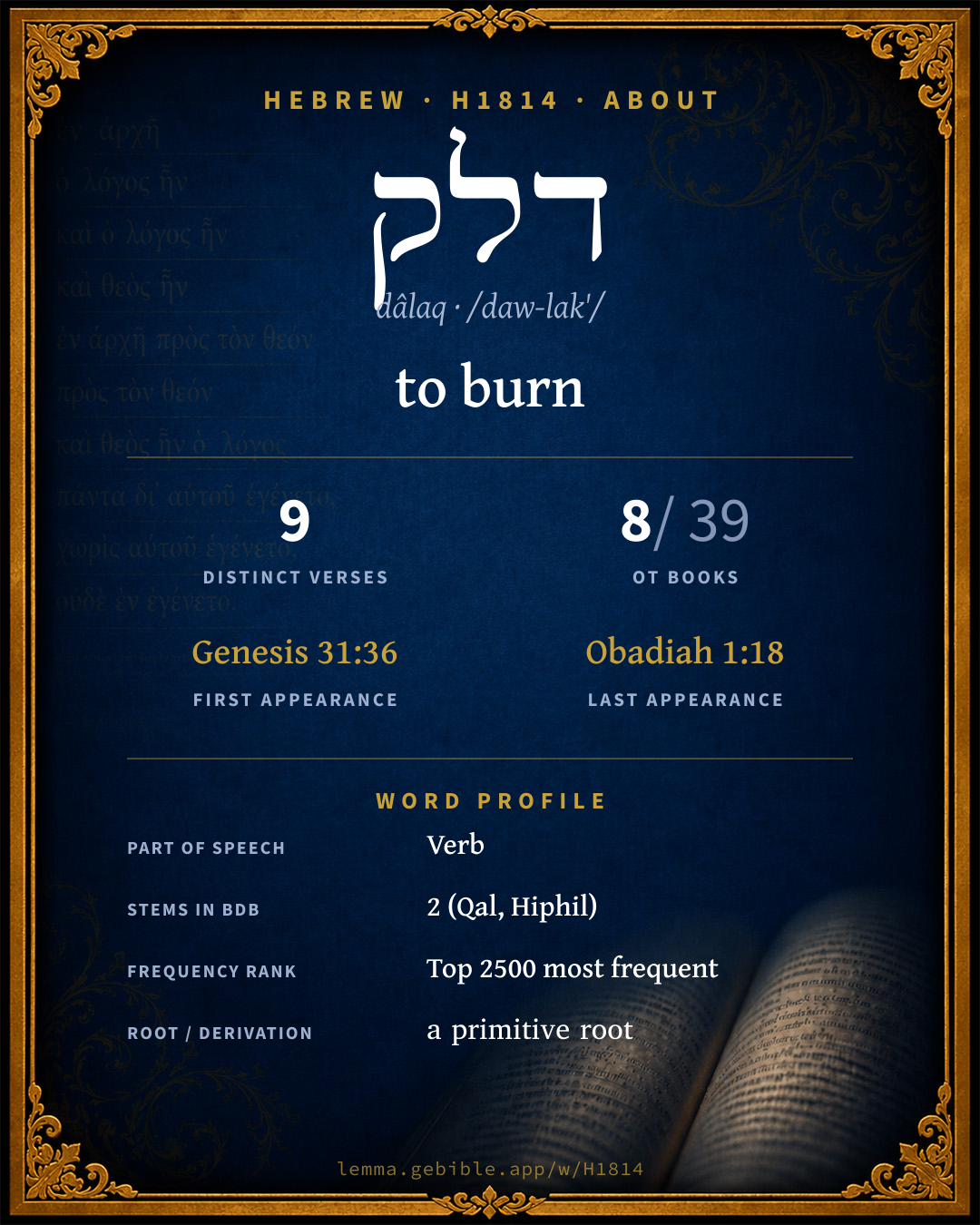
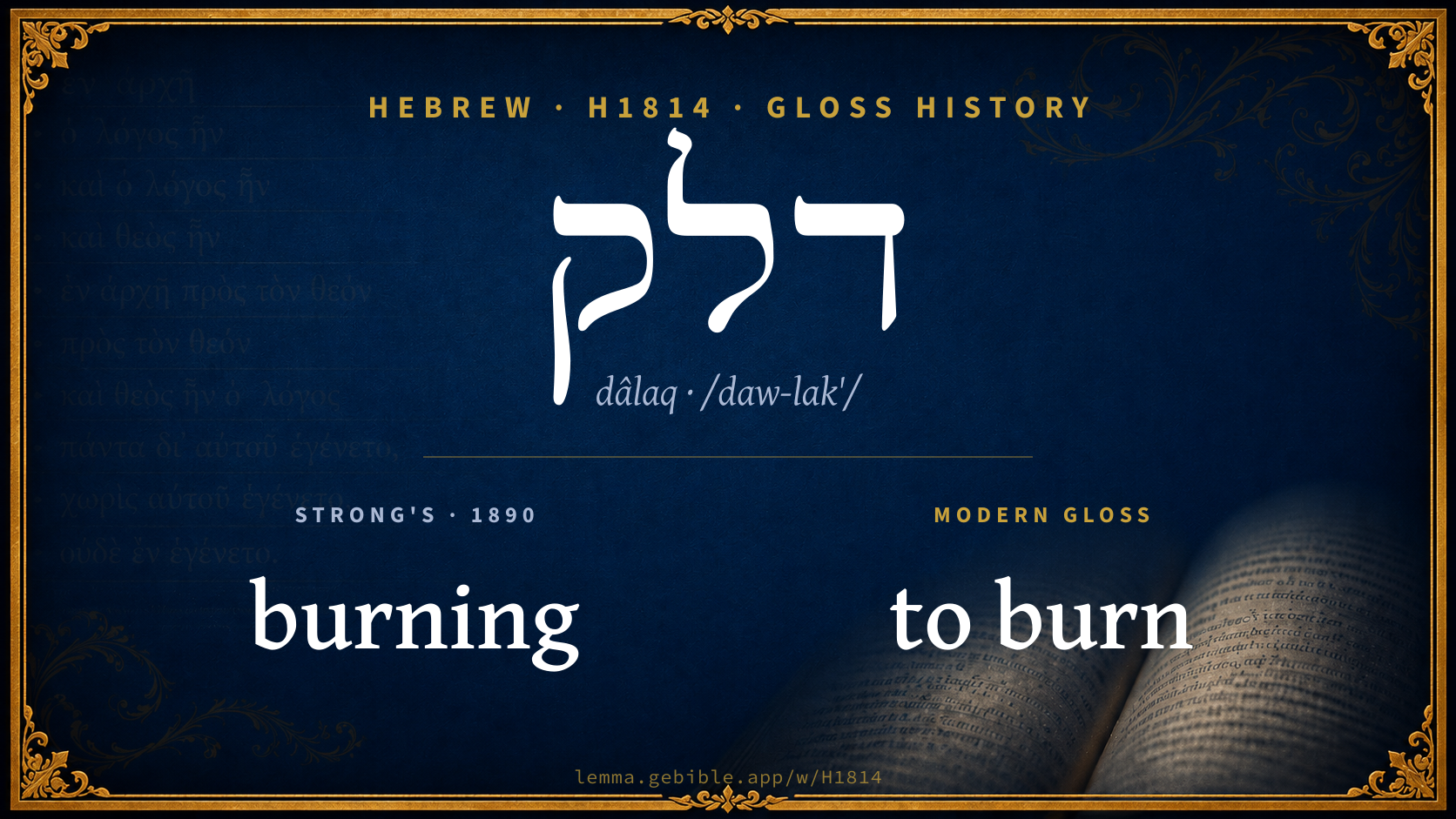
דָּלַק
to burn
‘to burn’ is one of 5 main senses fuller range ↓
Full lexicon entry — Brown-Driver-Briggs (BDB)
From Brown-Driver-Briggs (BDB)
Where this word appears
See every Qal verb in the Hebrew Bible →
Grammar key — what these labels mean
Part of speech
- Verb
- An action or state-of-being word.
Stem
- Qal
- The basic, simple active stem — the plain form of the verb (“he wrote”). Here: ‘burn’
- Hiphil
- The causative active stem (“he caused / brought about”).
Form
- Sequential Perfect
- A perfect with prefixed waw continuing a preceding imperfect or command (waw-consecutive perfect).
- Infinitive Construct
- A bound verbal noun, frequently with prepositions (“to write / in writing”).
- Participle Active
- A verbal adjective expressing ongoing or characteristic action (“writing / one who writes”).
- Imperfect
- An incomplete, ongoing, or future action (“he will / would write”).
- Imperative
- A direct command (“write!”).
- Perfect
- A completed action or state — Hebrew marks aspect (completeness) more than strict tense (“he wrote”).
State
- Absolute
- The independent form of a noun, not bound to a following word.
Person
- 3rd Person
- The one spoken about (“he / she / it / they”).
- 2nd Person
- The one addressed (“you”).
Gender
- Common
- Either gender — not distinguished for this form.
- Masculine
- Grammatically masculine.
Number
- Plural
- More than one (in Hebrew, generally three or more).
- Singular
- One.
Grammatical forms
- Verb, Qal, Participle Active, Masculine, Plural, Absolute 2 times (22%)
- Verb, Qal, Sequential Perfect, 3rd Person, Common, Plural 1 time (11%)
- Verb, Qal, Infinitive Construct 1 time (11%)
- Verb, Hiphil, Imperfect, 3rd Person, Masculine, Singular 1 time (11%)
- Verb, Hiphil, Imperative, 2nd Person, Masculine, Singular 1 time (11%)
- Verb, Qal, Imperfect, 3rd Person, Masculine, Singular 1 time (11%)
- Verb, Qal, Perfect, 2nd Person, Masculine, Singular 1 time (11%)
- Verb, Qal, Perfect, 3rd Person, Common, Plural 1 time (11%)
Parsed forms decoded from the imported morphology (morphhb / Westminster Leningrad Codex — WLC text public domain, morphhb tagging CC BY 4.0), counted across 9 parsed occurrences — not distinct verses.
Every verse where H1814 appears — 9 distinct verses across 8 books. Click any verse to open its interlinear word-by-word view. Verse text shown in the World English Bible for context — . Each verse’s Hebrew form is shown with its reference; the English is not keyword-highlighted, since the data carries no word-level English alignment. Use “Compare translations” on any verse to read it across multiple English versions. This concordance covers the Hebrew Bible; Septuagint (Greek Old Testament) occurrences are not indexed here.
Genesis 1 verse
1 Samuel 1 verse
Psalms 2 verses
Proverbs 1 verse
Isaiah 1 verse
Lamentations 1 verse
Ezekiel 1 verse
Obadiah 1 verse
About this entry
At a glance — auto-summarized from this page’s data, not written by a person. Every figure links to its source below. This summary describes the numbers; it doesn’t interpret them.
At its core, דלק (dâlaq) means “to burn.” Scripture first uses it in Genesis 31:36. It turns up in 9 verses across 8 books, an uncommon footprint. Read the stem: it spans 2 stems, including Qal and Hiphil. It shares a root with דלק and דלקת. Dig into 9-verse concordance and the renderings breakdown below.
Gloss history
Strong's 1890 vs modern scholarship
About this word
Strong's H1814 catalogs a Hebrew word from the Hebrew Old Testament.
These counts are not copied from any lexicon or concordance. They are computed here, from the morphology-tagged Hebrew Old Testament. What Lemma adds →
- 9
- distinct verses
- The word appears in 9 distinct verses.
- 8 / 39
- OT books
- The word appears in 8 of 39 Old Testament books.
- #2,481
- by frequency
- Top 2500 most frequent Hebrew words (rank 2,481 of 8,640 Hebrew words by occurrence).
View all 9 occurrences in the concordance →
By section of the Old Testament
By traditional corpus
Conventional, traditional groupings — biblical authorship is debated, so this is a traditional corpus grouping, not an authorship claim. Each share is this word’s portion of its verses in that division of the Hebrew canon. Each figure is a share of the word’s 9 distinct verses.
- Prophets (Nevi'im) 4 verses · 44%
- Writings (Ketuvim) 4 verses · 44%
- Torah (Pentateuch) 1 verse · 11%
How translations render this word
Counts come from each version’s own published word-to-Strong’s tagging or interlinear alignment — an approximate guide to how each version renders this word, not a word-level alignment the data otherwise carries. Because each total is that version’s own tagged count, the per-version totals vary from one another and need not match the appearance or distinct-verse counts above. These counts may also differ from a printed concordance because Lemma counts each distinctly tagged rendering and does not collapse phrase taggings into a single head-word total. This is a fixed set of word-tagged versions (KJV, ASV, BSB, ULT) and does not change with the reading translation you choose elsewhere. Each version’s license is shown beside its name below (and on Sources).
- King James Version: Against the persecutors 1×, Burning 1×, Chasing 1×
- American Standard Version: Chasing 1×, Fervent 1×, Fiery shafts 1×
- Berean Standard Bible: Are burning 1×, Be inflamed 1×, Fire 1×
- unfoldingWord Literal Text: Burning 2×
King James Version Public Domain
Renders H1814 across 9 tagged occurrences — most commonly:
American Standard Version Public Domain
Renders H1814 across 9 tagged occurrences — most commonly:
Berean Standard Bible Public Domain
Renders H1814 across 9 tagged occurrences — most commonly:
unfoldingWord Literal Text CC BY-SA 4.0
Renders H1814 across 10 tagged occurrences — most commonly:
Plus 8 renderings that appear only once — usually multi-word phrases or single function words the recovered tagging swept in, not distinct renderings.
Senses in the full BDB
Hebrew verbs can shift meaning by stem (binyan): Qal is the basic action, Niphal is often passive or reflexive, Piel often intensifies or makes it factitive, and Hiphil is typically causative. The senses below are grouped under the stem BDB assigns to each.
What do BDB’s symbols mean?
BDB uses these scholarly abbreviations:
| Symbol | Meaning |
|---|---|
| 𝔊 | the Septuagint (the ancient Greek translation, LXX) |
| 𝔙 | the Vulgate (the Latin translation) |
| 𝔖 | the Syriac version (the Peshitta) |
| 𝔗 | the Targum (the Aramaic translation) |
| ψ | the Psalms |
| √ | root (the underlying root or stem) |
| ‖ | parallel passage (a synonymous or contrasted parallel) |
| † | the dagger: every passage where the word occurs is cited |
The 4 senses and sub-senses the full Brown-Driver-Briggs lexicon distinguishes for this word, in lexicon order (not ranked by frequency), with BDB’s own verbatim wording and sub-sense lettering. Shown in Hebrew script with BDB’s own scholarly abbreviations. The condensed entry is in the Lexicon Entry tab. See also the Forms in the corpus table below.
Qal
- Pf. 2 ms. דָּלַקְתָּ Gn 31:36; 3 mpl. וְדָֽלְקוּ consec. Ob 18; sf. דְּלָקֻנוּ La 4:19; Impf. יִדְלַק ψ 10:2; Inf. cstr. דְּלֹק 1 S 17:53; Pt. act. pl. דֹּלְקִים Pr 26:23;— e.g. Genesis 31:36
- 1. burn, וְדָֽלְקוּ בָהֶם Ob 18 (fig. of Isr. ravaging among Edomites, ‖ וַאֲכָלוּם; on construction c. בְּ cf. 2 K 17:25); also in חִצָּיו לְדֹלְקִים יִפְעָ֑ל ψ 7:14 his arrows he maketh burning ones (subj. God) RV De Che al.; & שְׂפָתַיִם דֹּלְקִים Pr 26:23 burning (fervent) lips (opp. לֵב רָ֑ע). e.g. Obadiah 1:18
- 2. hotly pursue Gn 31:36 (E; sq. אַחֲרֵי 1 S 17:53 (sq. id.); ψ 10:2; La 4:19 (both sq. acc.) e.g. Genesis 31:36
Hiphil
- Impf. sf. יַדְלִיקֵם Is 5:11; Imv. הַדְלֵק Ez 24:10;—inflame, c. acc., subj. wine Is 5:11; kindle obj. הָאֵשׁ Ez 24:10. e.g. Isaiah 5:11
Senses from the full Brown-Driver-Briggs lexicon (Brown, Driver, Briggs; Oxford 1906 — public domain), digitized via Sefaria, supplemented by the OpenScriptures HebrewLexicon (CC BY 4.0). Full attribution on Sources.
Word origin
vb. burn (intrans.), hotly pursue (NH id. Aramaic דְּלַק, ܕܠܰܩ all intrans. burn, kindle; Hiph., Aph. transitive)—
— Brown-Driver-Briggs (Oxford 1906, public domain), digitized via Sefaria, supplemented by the OpenScriptures HebrewLexicon (CC BY 4.0). See Sources.
Origin: a primitive root
Jastrow Dictionary
A second Hebrew/Aramaic lexicon for comparison, covering Aramaic and post-biblical (Talmudic, Targumic, Midrashic) usage that the biblical-Hebrew BDB does not. Matched by lemma rather than by Strong’s number, so a lemma may carry more than one Jastrow headword (shown separately below), and the entries cover usage well beyond the Bible.
דָּלַק
- (b. h.)
- 1. to burn; to be illumined. Gen. R. s. 39 saw a castle דּוֹלֶקֶת lighted. B. Kam. VI, 5 ודָלְקוּ and they caught fire. Y. Sabb. II, beg. 4ᶜ והיא דְלֵיקָה והולכת that it may continue to burn. Ib.ᵈ דְּלֵיקִין are burning.—Part. pass. דָּלוּק enkindled, burning. Gen. R. s. 11 מצאתי אותו דָ׳ (Yalk. ib. 16 דּוֹלֵק) I found it still burning. Midr. Till. to Ps. VII, 14 (ref. to לדלקים ib.) שלבם דָּ׳ עליהם (Yalk. a. l. דולק) whose hearts within them are burning (with lust).—Lam. R. to IV, 19 [read:] שהיו דולקין אחריהם מַעֲבִיּוֹת (Koh. R. to V, 2 שמשליכין דֶּלֶק אחריהם) they (the Romans) sent fire after them from their engines (tormenta), v. עָבִית.
- 2. to pursue eagerly. Lam. R. l. c. דּוֹלְקֵיהֶם של ישראל (Koh. R. l. c. רודפ׳; Midr. Till. l. c. שונאין) Israel’s persecutors.
- to be burnt, destroyed by fire. Orl. III, 1 יִדָּלֵק; יִּדָּלְקוּ must be burnt. Ib. 2 sq.; a. fr.—Y. B. Kam. IV, 5ᶜ top דרכן לִידָּלֵק liable to take fire.
- to kindle, light. Sabb. II, 1 במה מַדְלִיקִין what material may be used for the Sabbath lights? Ib. 7 הַדְלִיקיּ וכ׳ light the lamps. Y. ib. II, 4ᶜ bot.; Y. Ter. XI, 48ᵇ top באה להַדְלִיק וכ׳ she came to get a light from a priest’s wife; a. fr.—V. הַדְלָקָה.
דְּלַק
- 1. to burn. Targ. Am. V, 6; a. e.—Meg. 12ᵇ דַּלְקָה ביה חמתיה Ms. M. (v. Rabb. D. S. a. l.) = חמתו בערה בו (Esth. I, 12).—2) to pursue, v. infra. e.g. Esther 1:12
- 1. to kindle a light, start a fire. Targ. Num. VIII, 2. Targ. Ex. XXII, 5; a. e.—Sabb. 22ᵇ ואַדְלוּקֵי and kindle (the chip). Ib. bot. לצורכו הוא דאַדְלְקָהּ he lighted it for his use. Ib. 23ᵃ מַדְלִיקֵי עלי וכ׳ they light the Ḥanuckah lamps in my behalf at home; a. e.
- 2. to pursue. Targ. Lam. IV, 19. [Ib. III, 66 תַּדְלוֹק׳, read תִּדְלוֹק׳ or תַּדְלִיק׳.]
דֶּלֶק
- (preced.) light, burning material, wick, wood &c. Y. Sabb. II, beg., 4ᶜ לא הוצת האור ברוב הד׳ the larger portion of the burning material was not enkindled (on the entrance of the Sabbath). Midd. I, 4 שער הד׳ the Temple gate by which the burning material was brought in. Koh. R. to V, 2, v. דָּלַק.
A Dictionary of the Targumim, the Talmud Babli and Yerushalmi, and the Midrashic Literature (Marcus Jastrow; London, Luzac, 1903) — Public Domain. Digitized via Sefaria. Digitized via Sefaria. Full attribution on Sources.
Forms in the corpus
The 9 distinct written forms H1814 takes in the Hebrew Bible, most frequent first — each parse links to that stem’s occurrences in the concordance. Hebrew forms include their vowel points and cantillation, so a single lemma takes many written forms.
| Form | Parsing | Example | Uses |
|---|---|---|---|
| דָלַ֖קְתָּ | Verb, Qal, Perfect, 2nd Person, Masculine, Singular | Genesis 31:36 | 1 |
| דְּלָקֻ֔/נוּ | Verb, Qal, Perfect, 3rd Person, Common, Plural | Lamentations 4:19 | 1 |
| דֹּלְקִ֣ים | Verb, Qal, Participle Active, Masculine, Plural, Absolute | Proverbs 26:23 | 1 |
| הַדְלֵ֣ק | Verb, Hiphil, Imperative, 2nd Person, Masculine, Singular | Ezekiel 24:10 | 1 |
| וְ/דָלְק֥וּ | Verb, Qal, Sequential Perfect, 3rd Person, Common, Plural | Obadiah 1:18 | 1 |
| יִדְלַ֣ק | Verb, Qal, Imperfect, 3rd Person, Masculine, Singular | Psalms 10:2 | 1 |
| יַדְלִיקֵֽ/ם | Verb, Hiphil, Imperfect, 3rd Person, Masculine, Singular | Isaiah 5:11 | 1 |
| לְֽ/דֹלְקִ֥ים | Verb, Qal, Participle Active, Masculine, Plural, Absolute | Psalms 7:13 | 1 |
| מִ/דְּלֹ֖ק | Verb, Qal, Infinitive Construct | 1 Samuel 17:53 | 1 |
Same root — word family
Other BDB entries built from the same root as H1814, grouped by Strong’s listed origin. These share a root / origin per the lexicon — not necessarily a shared meaning. Each links to that word’s own entry.
Derived from this word
Compare all same-root words → They share a root, not necessarily a meaning.
Septuagint verse parallels
This word appears in 8 verses that also exist in the Greek Old Testament (Septuagint), out of the 9 Hebrew verses it occurs in. You can read those verses in Greek by switching the Old Testament edition to the Septuagint.
Read these verses in the Septuagint
This is a verse-level parallel only — the same verses exist in both the Hebrew and Greek Old Testaments. No word-level Hebrew↔Greek correspondence is claimed: the data carries no such alignment, so no Greek word is shown as this Hebrew word’s translation. Coverage is not total — the Septuagint omits the deuterocanon and renumbers the Psalms, so some Hebrew verses have no direct Greek parallel.