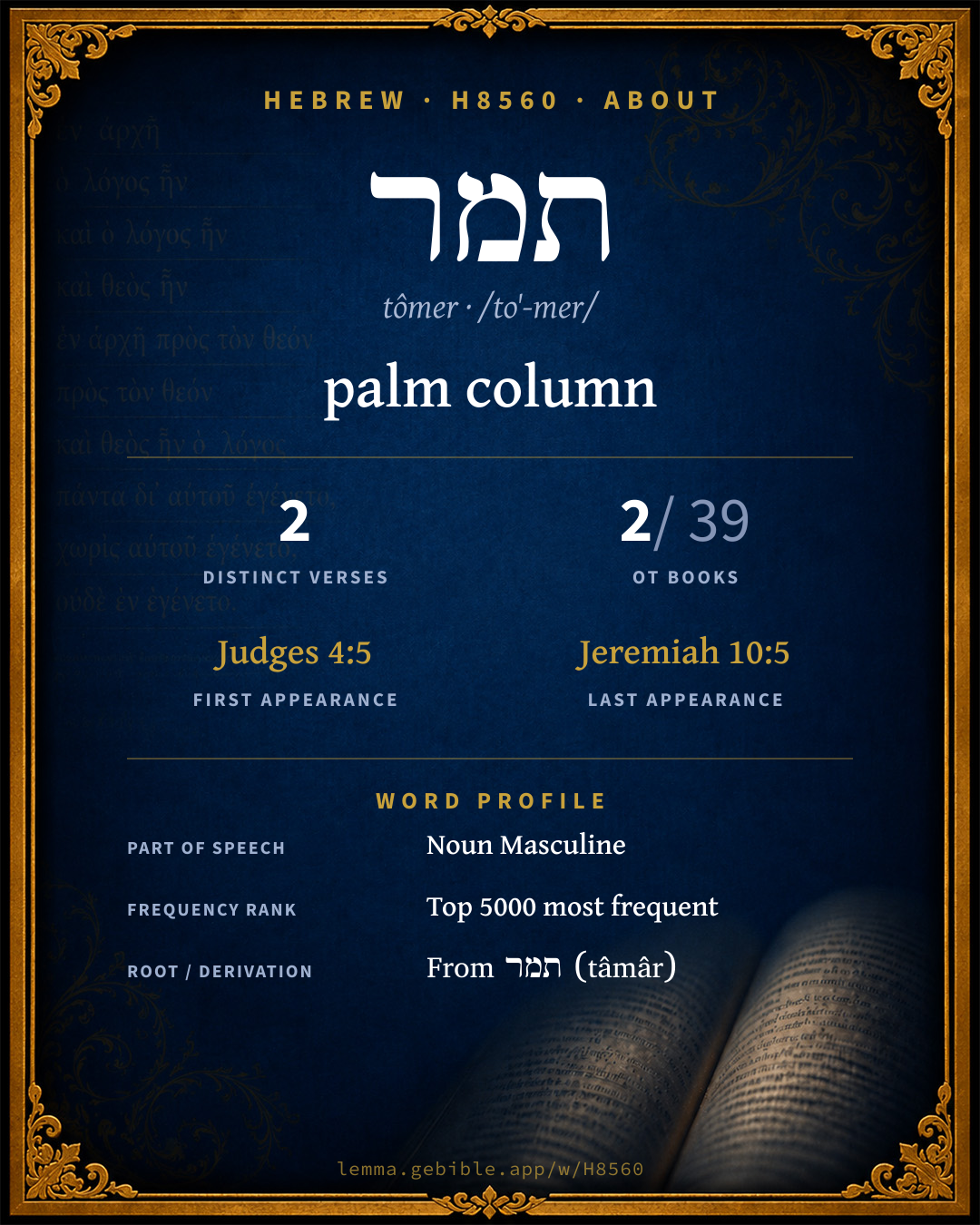
תֹּ֫מֶר
palm column
Full lexicon entry — Brown-Driver-Briggs (BDB)
From Brown-Driver-Briggs (BDB)
Where this word appears
Grammar key — what these labels mean
Part of speech
- Noun
- A naming word — a person, place, thing, or idea.
Noun type
- Common
- A common noun — a general class of person, place, or thing (“king,” “city,” “water”), not a specific name.
State
- Construct
- A noun bound to a following noun in a possessive / “of” relationship (the construct chain).
Gender
- Masculine
- Grammatically masculine.
Number
- Singular
- One.
Every verse where H8560 appears — 2 distinct verses across 2 books. Click any verse to open its interlinear word-by-word view. Verse text shown in the World English Bible for context — . Each verse’s Hebrew form is shown with its reference; the English is not keyword-highlighted, since the data carries no word-level English alignment. Use “Compare translations” on any verse to read it across multiple English versions. This concordance covers the Hebrew Bible; Septuagint (Greek Old Testament) occurrences are not indexed here.
Judges 1 verse
Jeremiah 1 verse
About this entry
At a glance — auto-summarized from this page’s data, not written by a person. Every figure links to its source below. This summary describes the numbers; it doesn’t interpret them.
תמר — transliterated tômer — is a Hebrew noun carrying the sense “palm column.” With only 2 verses it sits in the long tail of Hebrew Bible vocabulary. More than half of its appearances fall in Judges. Debuting at Judges 4:5, it then recurs through the corpus. It shares a root with תמר, תימרה and תמר. See the sense tree, 2-verse concordance, and the renderings breakdown below.
Gloss history
Strong's 1890 vs modern scholarship
About this word
Strong's H8560 catalogs a Hebrew word from the Hebrew Old Testament.
These counts are not copied from any lexicon or concordance. They are computed here, from the morphology-tagged Hebrew Old Testament. What Lemma adds →
- 2
- distinct verses
- The word appears in 2 distinct verses.
- 2 / 39
- OT books
- The word appears in 2 of 39 Old Testament books.
- #4,807
- by frequency
- Top 5000 most frequent Hebrew words (rank 4,807 of 8,640 Hebrew words by occurrence).
View all 2 occurrences in the concordance →
By traditional corpus
Conventional, traditional groupings — biblical authorship is debated, so this is a traditional corpus grouping, not an authorship claim. Each share is this word’s portion of its verses in that division of the Hebrew canon. Each figure is a share of the word’s 2 distinct verses.
- Prophets (Nevi'im) 2 verses · 100%
How translations render this word
Counts come from each version’s own published word-to-Strong’s tagging or interlinear alignment — an approximate guide to how each version renders this word, not a word-level alignment the data otherwise carries. Because each total is that version’s own tagged count, the per-version totals vary from one another and need not match the appearance or distinct-verse counts above. These counts may also differ from a printed concordance because Lemma counts each distinctly tagged rendering and does not collapse phrase taggings into a single head-word total. This is a fixed set of word-tagged versions (KJV, ASV, BSB, ULT) and does not change with the reading translation you choose elsewhere. Each version’s license is shown beside its name below (and on Sources).
- King James Version: Palm tree 1×, Under the palm tree 1×
- American Standard Version: Palm-tree 1×, Under the palm-tree 1×
- Berean Standard Bible: Like scarecrows 1×, Palm 1×
- unfoldingWord Literal Text: Like scarecrows of 1×, Palm tree of 1×
King James Version Public Domain
Renders H8560 across 2 tagged occurrences — most commonly:
American Standard Version Public Domain
Renders H8560 across 2 tagged occurrences — most commonly:
Berean Standard Bible Public Domain
Renders H8560 across 2 tagged occurrences — most commonly:
unfoldingWord Literal Text CC BY-SA 4.0
Renders H8560 across 2 tagged occurrences — most commonly:
Senses in BDB
The 1 sense BDB distinguishes for this word, in lexicon order (not ranked by frequency or importance). The full entry — with sub-senses — is in the Lexicon Entry tab.
- palm tree, post, column
Word origin
n.m. palm-tree, post;—cstr. ת׳דְּבוֹרָה Ju 4:5 palm-tree of Deborah; כְּת׳ מִקְשָׁה Je 10:5 like a post (i.e. a scare-crow cf. Bar 6:70) in a cucumber field (sim. of idol).
— Brown-Driver-Briggs (Oxford 1906, public domain), digitized via Sefaria, supplemented by the OpenScriptures HebrewLexicon (CC BY 4.0). See Sources.
Derived from תמר (tâmâr) (H8558) — palm tree.
Jastrow Dictionary
A second Hebrew/Aramaic lexicon for comparison, covering Aramaic and post-biblical (Talmudic, Targumic, Midrashic) usage that the biblical-Hebrew BDB does not. Matched by lemma rather than by Strong’s number, so a lemma may carry more than one Jastrow headword (shown separately below), and the entries cover usage well beyond the Bible.
תָּמַר
- , Pi. תִּמֵּר (denom. of תָּמָר) to rise straight up. Yoma 28ᵇ תימור של לבנה מְתַמֵּר ועולה כמקל the light-column of the moon rises straight up like a stick; opp. מפציע (v. פָּצַע); Y. ib. III, beg. 40ᵇ. Bab. ib. 38ᵃ של הללו מתמר וכ׳ the smoke of the frankincense prepared by those (of the house of Abṭinas) went straight up &c.; Cant. R. to I, 14 מְתַמֶּרֶת; Y. Shek. V, 49ᵃ top; Tosef. Yoma II, 6. Tanḥ. T’tsav. 15 כשהיה ענן הקטרת מתמר וכ׳ when (on the Day of Atonement) the cloud of the incense rose straight up …, he knew that Israel’s sins were forgiven. Gen. R. s. 45 קוצין … אליהם יוצאים ומְתַמְּרִים וכ׳ thorns are not sown …, but grow forth of themselves and rise high up, but wheat &c.; Yalk. ib. 79 (corr. acc.). Keth. 111ᵇ עתידה חטה שתְּתַמֵּר כדקל וכ׳ in the latter days wheat shall sprout forth and rise like palms on mountain tops; a. e.
תָּמָר I
- (b. h.) pr. n. f. Tamar,
- 1. Judah’s daughter-in-law. Meg. IV, 10 (25ᵃ) מעשה ת׳ נקרא ומיתרגם the story of Tamar (Gen. XXXVIII) is read (in the synagogue) and translated. Gen. R. s. 92 (ref. to Gen. XLIV, 16) מה נאמר לאדני במעשה ת׳ וכ׳ what have we to say to my lord (for our justification) about the story of Tamar, what to speak about the story of Bilhah (Gen. XXXV, 22) ? Gen. R. s. 85; a. fr.— Absalom’s sister. Meg. 25ᵇ מעשה אמנון ות׳ וכ׳ the story of Amnon and Tamar (II Sam. XIII) may be read and translated. Ab. V, 16 אהבת אמנון ות׳ Amnon’s love of T. Snh. 21ᵃ; a. e. e.g. Genesis 38:24
- 3. a woman that informed against the Rabbis before Roman authorities. Y. Meg. III, 74ᵃ bot., v. תַּמְרוּרִים
תָּמָר II
- palm; date-palm; fruit of the date-palm, date. Succ. 45ᵇ; Meg. 14ᵃ, v. לֵב. Ib. (ref. to Jud. IV, 5) מאי שנא תחת תּוֹמֶר why did she hold her sessions under a palm-tree? Midr. Till. to Ps. XCII, 16 (ref. to ib. 13) מה הת׳ והארז וכ׳ as the palm and the cedar are higher than all other trees, so Israel is &c.; אי מה הת׳ וכ׳ you may think, as the palm and the cedar when uprooted from their places (transplanted) do not grow new shoots, so Israel does &c.; a. fr.—Pl. תְּמָרִים dates. Ter. XI, 2 דבש ת׳ date honey. Ib. 3; a. fr. e.g. Judges 4:5
תָּמָר
- Targ. Cant. II, 12.—Lev. R. s. 12; a. e.—Pl. תְּמָרַיָּא, תַּמְרִין, תַּמְרֵי, תּוּמְ׳. Targ. II Chr. XXXI, 5. Targ. Y. Deut. VIII, 8.—Ber. 38ᵃ דובשא דת׳ date-honey. [Ib. האי תמרי של תרומה, read with Ms. M. תמרים של תרומה.] Y. Ab. Zar. II, 40ᵈ גרעינין דתו׳ date-stones. Sabb. 110ᵇ ת׳ פרסייתא (fem.) Persian dates; a. fr.—בר תמרי pr. n. m. Bar-Tamré. Ḥull. 110ᵃ רמי בר ת׳ וכ׳ Rami bar Tamré, also called Bar-Diḳḳulé (cmp. דִּיקּוּלָא).—Cant. R. to VII, 9 אבון בר ת׳ quot. in Levy Talm. Dict. (ed. חסדי).
A Dictionary of the Targumim, the Talmud Babli and Yerushalmi, and the Midrashic Literature (Marcus Jastrow; London, Luzac, 1903) — Public Domain. Digitized via Sefaria. Digitized via Sefaria. Full attribution on Sources.
Forms in the corpus
The 2 distinct written forms H8560 takes in the Hebrew Bible, most frequent first — each parse links to that state’s occurrences in the concordance. Hebrew forms include their vowel points and cantillation, so a single lemma takes many written forms.
| Form | Parsing | Example | Uses |
|---|---|---|---|
| כְּ/תֹ֨מֶר | Noun, Common, Masculine, Singular, Construct | Jeremiah 10:5 | 1 |
| תֹּ֜מֶר | Noun, Common, Masculine, Singular, Construct | Judges 4:5 | 1 |
Same root — word family
Other BDB entries built from the same root as H8560, grouped by Strong’s listed origin. These share a root / origin per the lexicon — not necessarily a shared meaning. Each links to that word’s own entry.
Derives from
Shares the same root
Proper names from this root
People and places named from this root — a name, not an additional meaning of the word.
Compare all same-root words → Showing 4 of 7 — not the complete family. 2 of the same-root words are proper names (people or places). They share a root, not necessarily a meaning.
Septuagint verse parallels
This word appears in 1 verse that also exists in the Greek Old Testament (Septuagint), out of the 2 Hebrew verses it occurs in. You can read those verses in Greek by switching the Old Testament edition to the Septuagint.
Read these verses in the Septuagint
This is a verse-level parallel only — the same verses exist in both the Hebrew and Greek Old Testaments. No word-level Hebrew↔Greek correspondence is claimed: the data carries no such alignment, so no Greek word is shown as this Hebrew word’s translation. Coverage is not total — the Septuagint omits the deuterocanon and renumbers the Psalms, so some Hebrew verses have no direct Greek parallel.