
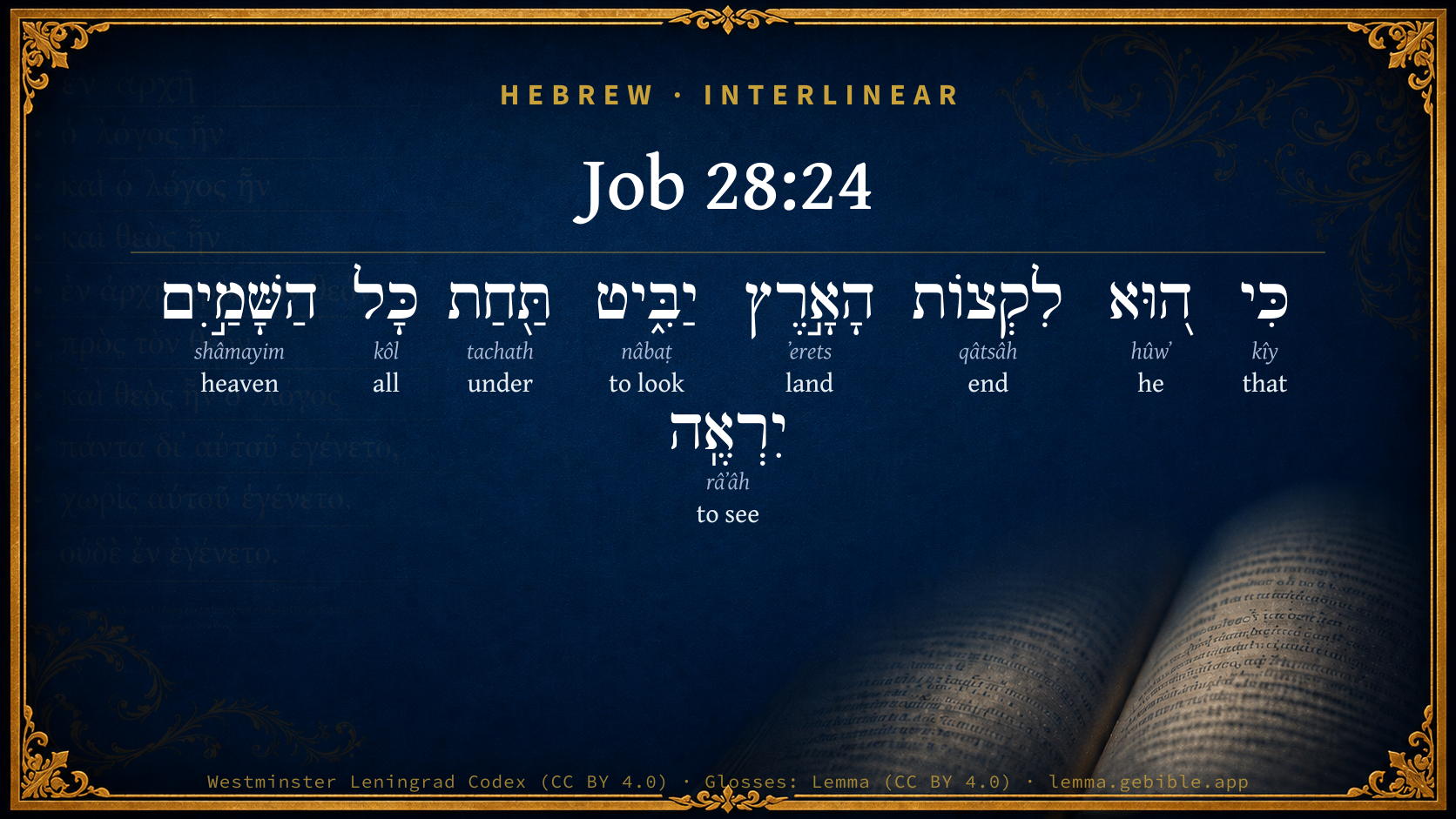
Job 28:24

Hebrew (Westminster Leningrad Codex) Job 28:24 appears in the Hebrew Old Testament. The text above is from the Westminster Leningrad Codex. Each word links to its Strong’s number, a concise gloss, and parsing drawn from the Open Scriptures Hebrew Bible morphology. Click any word for its full Brown-Driver-Briggs (BDB) entry.
Download image
Cite this verse

Job 28:24 (World English Bible). Public Domain. Lemma interlinear Bible study tool, https://lemma.gebible.app/v/job/28/24.

Show BibTeX & RIS
BibTeX
RIS
English Translation
For he looks to the ends of the earth, And sees under the whole sky.
World English Bible · Public Domain
Download a study sheet

One document with this verse’s original text, its word-by-word gloss line, the meaning frame, cross-references with their text, attributed commentary, and full source and license credits — printable, and it pastes into notes with its structure intact.

This verse Autodidact and up

Study sheet (.html) Plain text (.txt)

A passage Seminary Student

Up to 50 verses in one chapter. A passage sheet keeps up to 6 commentary sources and 12 cross-references per verse, in the order this page ranks them, and says so on the sheet whenever that leaves anything out. Ask for a single verse and you get the Autodidact verse sheet above.

Everything on this page stays free to read, with no account — the sheet is a download of what is already on screen, not access to it.

Want to remove ads? Support Godless Engineer
Compare translations 3

The same verse in 3 English versions, stacked beneath the original-language interlinear above. Click any original word for its lexicon entry.

Each is an independent rendering of the whole verse — the interlinear is not word-aligned to these translations.

Highlighted words mark where these versions differ — a whole-verse word diff, not a word-by-word alignment.

  • World English Bible Public Domain
    For he looks to the ends of the earth, And sees under the whole sky.
  • King James Version Public Domain
    For he looketh to the ends of the earth, and seeth under the whole heaven;
  • unfoldingWord Literal Text CC BY-SA 4.0
    For he looks to the ends of the earth; he sees beneath all of the heavens.

unfoldingWord Literal Text — © unfoldingWord, licensed CC BY-SA 4.0. Word-aligned USFM3 via Door43 (git.door43.org/unfoldingWord/en_ult).

Versions to compare (up to 4)

3 of 4 selected

Show all 18 translations

Every available English version of this verse, each an independent rendering of the whole verse.

  • World English Bible Public Domain
    For he looks to the ends of the earth, And sees under the whole sky.
  • Berean Standard Bible Public Domain
    For He looks to the ends of the earth and sees everything under the heavens.
  • Majority Standard Bible Public Domain
    For He looks to the ends of the earth and sees everything under the heavens.
  • King James Version Public Domain
    For he looketh to the ends of the earth, and seeth under the whole heaven;
  • American Standard Version (1901) Public Domain
    For he looketh to the ends of the earth, And seeth under the whole heaven;
  • Revised Version (1885) Public Domain
    For he looketh to the ends of the earth, and seeth under the whole heaven;
  • Geneva Bible (1599) Public Domain
    For he beholdeth the endes of the world, and seeth all that is vnder heauen,
  • Douay-Rheims (1899) Public Domain
    For he beholdeth the ends of the world: and looketh on all things that are under heaven.
  • Young's Literal Translation Public Domain
    For He to the ends of the earth doth look, Under the whole heavens He doth see,
  • Literal Standard Version CC BY-SA 4.0
    For He looks to the ends of the earth, || He sees under the whole heavens,
  • Unlocked Literal Bible CC BY-SA 4.0
    For he looks to the very ends of the earth and sees under all the heavens.
  • unfoldingWord Literal Text CC BY-SA 4.0
    For he looks to the ends of the earth; he sees beneath all of the heavens.
  • Darby Bible Public Domain
    For he looketh to the ends of the earth, he seeth under the whole heaven.
  • World Messianic Bible Public Domain
    For he looks to the ends of the earth, and sees under the whole sky.
  • Webster's Bible Public Domain
    For he looketh to the ends of the earth, and seeth under the whole heaven;
  • Free Bible Version CC BY-SA 4.0
    For he looks to the very end of the earth; he sees everything under heaven.
  • Bible in Basic English Public Domain
    For his eyes go to the ends of the earth, and he sees everything under heaven.
  • JPS Tanakh (1917) Public Domain
    For He looketh to the ends of the earth, and seeth under the whole heaven;

Literal Standard Version (2020), Covenant Press — licensed CC BY-SA 4.0. Text via the HelloAO Bible API (eBible.org). Unlocked Literal Bible (unfoldingWord) — licensed CC BY-SA 4.0. Text via the HelloAO Bible API (eBible.org). unfoldingWord Literal Text — © unfoldingWord, licensed CC BY-SA 4.0. Word-aligned USFM3 via Door43 (git.door43.org/unfoldingWord/en_ult). Free Bible Version, Dr. Jonathan Gallagher — licensed CC BY-SA 4.0. Text via the HelloAO Bible API (eBible.org).

Word by word

More ways to search: Search by grammar → Find every occurrence → Compare this word →

Practice this passage: Drill this verse → Learn its vocabulary →

About this verse

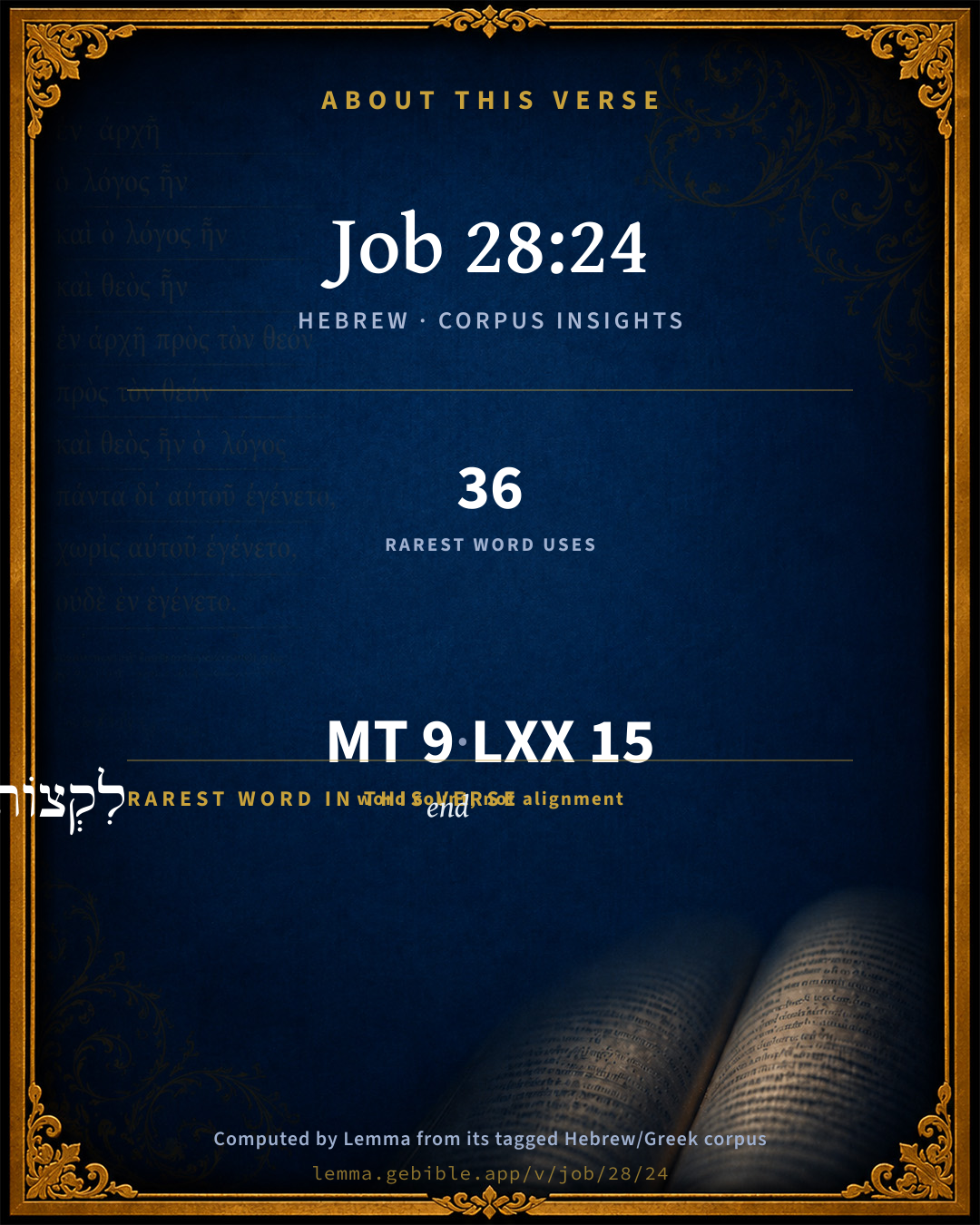
These counts appear in no published source. They are computed here, from the morphology-tagged text and Lemma’s own curated glosses. What Lemma adds →

9
words
9
distinct lemmas
Wisdom
section

Shared distinctive vocabulary

לִקְצוֹת end H7098 occurs in 31 verses of the Hebrew Bible. Also found in:

Grammatical profile

  • 2 verbs
  • 4 nouns
  • 1 pronoun
  • 1 preposition
  • 1 conjunction

Verb forms

  • יַבִּ֑יט Hiphil · Imperfect
  • יִרְאֶֽה Qal · Imperfect

Hebrew & Septuagint length

In English translation the verse runs 15 words from the Hebrew and 14 from the Septuagint (LXX English) — closely comparable.

A rough comparison of the two English renderings, which tokenize alike — not a word-level alignment.

Word counts can differ between the Hebrew and the Greek without any difference in meaning — e.g. the Hebrew direct-object marker אֵת has no separate Greek word, and Greek often adds the article ὁ.

In the original languages it is 9 Hebrew tokens and 15 Greek tokens — but the two are counted differently (Hebrew bundles its prefixes and suffixes into one token; the Greek is in lemma form), so that isn’t a like-for-like length.

Cross-references

5

Topical passages linked to Job 28:24 in the Treasury of Scripture Knowledge — connected by theme and wording, ordered by reader-vote popularity; previews shown in the World English Bible.

  • Proverbs 15:3 Yahweh's eyes are everywhere, Keeping watch on the evil and the good.
  • Zechariah 4:10 Indeed, who despises the day of small things? For these seven shall rejoice, and shall see the plumb line in the hand of Zerubbabel. These are the eyes of Yahweh, which run back and forth through the whole earth."
  • 2 Chronicles 16:9 For the eyes of Yahweh run back and forth throughout the whole earth, to show himself strong in the behalf of them whose heart is perfect toward him. Herein you have done foolishly; for from henceforth you shall have wars.
  • Psalms 33:13–14 Yahweh looks from heaven. He sees all the sons of men.
  • Revelation 5:6 I saw in the midst of the throne and of the four living creatures, and in the midst of the elders, a Lamb standing, as though it had been slain, having seven horns, and seven eyes, which are the seven Spirits of God, sent out into all the earth.

Cross-references courtesy of OpenBible.info (CC BY 4.0).

Hebrew and Greek witnesses Masoretic Hebrew ↔ Greek Septuagint

The same verse in the two great witnesses to the Old Testament, shown verse-for-verse.

These are two independent witnesses, not word-aligned to each other, and the Septuagint is shown in lemma (dictionary) form.

Hebrew Job 28:24 Masoretic · Westminster Leningrad Codex

כִּי ה֭וּא לִקְצוֹת הָאָ֣רֶץ יַבִּ֑יט תַּ֖חַת כָּל הַשָּׁמַ֣יִם יִרְאֶֽה

For he looks to the ends of the earth, And sees under the whole sky.

World English Bible · Public Domain

Greek LXX Job 28:24 Septuagint · lemma form

αὐτός γάρ ὁ ὑπό οὐρανός πᾶς ἐπιὁράω οἶδα ὁ ἐν ὁ γῆ πᾶς ὅς ποιέω

For he surveys the whole earth under heaven, knowing the things in the earth:

LXX2012 (modern English Septuagint) · Public Domain

Hebrew: Westminster Leningrad Codex (CC BY 4.0). Greek: Septuagint (public domain); English from LXX2012 (modern English Septuagint) (Public Domain). How the Septuagint differs from the Hebrew →

Commentary

Notes on Job 28:24 from classic Christian and Jewish commentators (each source and its license shown beneath its notes). The classic Christian expositions comment on the surrounding passage and are grouped to its opening verse, so a note may address several verses; the Jewish commentaries on the Tanakh (Rashi and others) are per-verse, so they appear only where the commentator wrote on this verse.

Lemma curates 59 commentaries, every one of them public domain or Creative Commons licensed, each selected and text-cleaned for this edition rather than reprinted as found. About our sources →

Trapp's Complete Commentary

John Trapp

Job 28:24 For he looketh to the ends of the earth, [and] seeth under the whole heaven;

Ver. 24. For he looketh to the ends of the earth] He is ολοφθαλμος, all eye (Basil); so that together and at once he beholdeth all things in the whole course of nature, and under the whole of heaven. "His eyes behold, his eyelids try, the children of men," Psa 11:4. Where the former pointeth out God’s knowledge, the latter his judgments, his critical descant, saith one. And surely this all seeing eye of God, saith another interpreter, should keep us within the compass of obedience as much as anything; since he who is our judge is a constant eye witness of our cogitations, communication, and whole conversation. Cave, spectat Cato, Take heed, Cato seeth you, was an old watchword among the Romans, and a retentive from vice. How much more should this be among Christians! Ne pecces, Deus ipse videt, Be advised, God beholdeth you. Think not that he who is invisible cannot see, or that because he is the high and lofty one that inhabiteth eternity, therefore he cannot see so far as earth; for he looketh to the ends and extremities of the earth, his eyes run to and fro, they are in every place beholding the evil and the good, Pro 15:3. The world is to him as a sea of glass, Rev 4:6. He seeth through it, and every man before him is all window; he seeth the very entrails of the soul, the heart of the heart, "All things are naked and open before him," saith the apostle, Heb 4:13. Naked for the outside, and open for the inside of them; the word signifieth dissected, quartered, and, as it were, cleft through the back bone. He searcheth the reins, those seats of lust and most abstruse parts of the body, so wrapped up in fat and flesh, as if no eye should come at them.

And seeth under the whole heaven] His providence, like a well drawn picture, looketh every way, and extendeth to every the least and lightest occurrence; governing all things wisely and powerfully, and ordering the disorders of the world to his own glory. Epicures and atheists would shut him up in heaven, as hath been before noted, as if he did neither know nor do anything here below; but they will find it otherwise.

John Trapp, A Commentary or Exposition upon All the Books of the Old and New Testament (1647–1656) — public domain. Text from a community e-Sword module.

Jamieson, Fausset & Brown

Robert Jamieson, A. R. Fausset & David Brown

"Seeth (all that is) under," &c.

Jamieson, Fausset & Brown — Commentary Critical and Explanatory on the Whole Bible (1871) — public domain (CC PDM 1.0). Text via the HelloAO Bible API.

Adam Clarke's Commentary

Verse 24. For he looketh to the ends of the earth] His knowledge is unlimited, and his power infinite.

Adam Clarke's Commentary on the Bible (1810–1826) — public domain. Text from a community e-Sword/MySword module.

The Cambridge Bible for Schools and Colleges

gen. ed. J. J. S. Perowne

24. God is in possession of Wisdom for He is the upholder and creator of the world.

for he looketh to the ends of the earth] His glance as creator and ruler of all extends over all, to the ends of the earth and to all that lies under the whole heavens.

The Cambridge Bible for Schools and Colleges (gen. ed. J. J. S. Perowne; Cambridge University Press, 1878–1918) — public domain. Text from a community e-Sword module.

John Gill's Exposition

To make the weight for the wind,.... He indeed makes the wind itself, holds it in his fists, and brings it forth out of his treasures, and lets it go, or restrains it, at his pleasure; he gives it an inclination to this or that or the other point of the heavens, and a force to blow with, greater or lesser, as he pleases, either for the good and benefit of men, or for the punishment of them; he raises the stormy wind, which fulfils his word and his will; and he makes it subside and become a calm when he thinks fit; he can make it heavier or lighter, add to or take from its weight, so that it becomes more or less pressing on bodies it meets with; he can make a rough wind, and stay that in the day of his east wind; he can make the rain in some sense a weight to it; he can wet its wings with it, and bear it down and cause it to rest and be still; and he that knows from whence it comes, and whither it goes, though we do not, being wholly under his direction, must know the way and place of wisdom:

and he weigheth the waters by measure; or, "in a measure" (k); in the hollow of his hand, where he poises them; see Isa 40:12; some, because there is a seeming impropriety in weighing by, or with a measure, render it "out of a measure" (l) Mr. Broughton translates the words, "and held the waters in a measure"; in his hand, as before, or in the sea; weight and measure being both applied to the waters, may denote the perfect and exact knowledge God has of them, and of his great and diligent concern in Providence about them, he ordering and disposing of them according to his will; and which is greatly the sense of the word used for weighing; and so the Targum paraphrases it,

"the waters he prepares (orders or disposes of) by measure.''

These waters, as they seem to be distinguished from rain in Job 28:26, may design the waters of the sea and rivers; with these the earth at first was covered, which being ordered off of it, and a place provided for them, they were gathered into it, and measured and bounded in it by shores and sand, that they might not overflow the earth; which is a wonderful instance of the providence of God, in weighing and measuring the waters; of which also there was a singular instance at the general deluge, when the windows of heaven were opened, and the fountains of the great deep broke up, which overflowed the whole earth, and the highest mountains in it; and after a time went off at the command of God, and the earth was dry as before: the tides, the ebbing and flowing of the sea, and the flux and reflux of rivers, from and to the same place, are surprising things, and wholly owing to the power and providence of God; the causes and reasons of which are unknown to us, but are well known to him, who weighs and measures the waters, which flow in a regular course; and who therefore must know the way and place of wisdom and understanding.

(k) "in mensura", V. L. Pagninus, Montanus, Bolducius, Beza. (l) "Ex mensura", Junius & Tremellius, Piscator, Mercerus.

John Gill's Exposition of the Whole Bible (1746–1763) — public domain (CC PDM 1.0). Text via the HelloAO Bible API.

Albert Barnes' Notes on the Bible

For he looketh to the ends of the earth - That is, God sees and knows everything. He looks upon the whole universe. Man sees objects dimly; he sees but a few, and he little understands the bearing of one thing or another.

Albert Barnes' Notes on the Bible (1834–1885) — public domain. Text from a community e-Sword/MySword module.

Matthew Poole's English Annotations

He, and he only, knows it, because his providence, and that only, is infinite and universal, reaching to all places, and times, and things, past, present, and to come; whereas the most acute and knowing men have narrow understandings, and see but very few things and small parcels of the works of God, and therefore are very unfit to pass a judgment upon them, because the wisdom, and justice, and beauty of God’s works is not clearly nor fully seen till all the parts of them be laid together.

Matthew Poole's English Annotations on the Holy Bible (1683–1685) — public domain. Text from a community e-Sword/MySword module.

The Pulpit Commentary

For he looketh to the ends of the earth. Man is conditioned. God is unconditioned. Man"s knowledge has strict and narrow limits. God "looketh unto the ends of the earth. " It is the universality of God"s knowledge that makes each item of it perfect. Where knowledge is circumscribed, it is impossible to be sure that some truth outside the circle of the person"s cognizance has not a bearing on that which is within his cognizance a bearing, which, if he were aware of it, would give the truth a different aspect. With God alone there are no such limits, everything being within his cognizance. And seeth under the whole heaven. As his knowledge of earthly things is unlimited, so is his knowledge of heavenly things also; and not only of heavenly things in a material sense, as of sun, moon, stars, comets, planets, nebulae, etc., but also of causes, principles, ends, laws, and the like, whereby both material and immaterial things are governed, ordered, and maintained in being. Of matters of this kind and character man can only say, "Such knowledge is too wonderful for me; I cannot attain unto it". (Psa_139:6)

The Pulpit Commentary (1880–1919), ed. H.D.M. Spence-Jones & Joseph S. Exell — public domain. Text from a community e-Sword module.

John Wesley's Explanatory Notes

For - He, and he only knows it, because his providence, is infinite and universal, reaching to all places, and times, past, present, and to come; whereas the most knowing men have narrow understandings, and the wisdom, and justice, and beauty of God's works are not fully seen 'till all the parts of them be laid together.

John Wesley, Explanatory Notes Upon the Whole Bible (1754–1765) — public domain. Text via the GEBible commentary corpus.

Rashi

Rabbi Shlomo Yitzchaki (Rashi)

For He looks to the ends of the earth how He should build them and create them, and under all the heavens He saw in it the needs of their creation.

Rashi on the Tanakh — English translations: “The Judaica Press complete Tanach with Rashi, translated by A. J. Rosenberg” (CC BY 4.0); “Pentateuch with Rashi's commentary by M. Rosenbaum and A.M. Silbermann, 1929-1934” (public domain); “The Metsudah Tanach series, Lakewood, N.J” (CC BY 4.0); and “The Book of Joshua, Metsudah Publications, 1997” (CC BY 4.0). Text via Sefaria.

Lesson kit

Teaching starters — assembled from the data on this page, not authored interpretation. Every prompt links to the verse data it draws on. Edit before teaching.

Job, in the Wisdom, opens this verse with 9 words (9 distinct Hebrew lemmas). Its most distinctive word is qâtsâh (“end”). A historical commentator’s framing appears above. Read the whole chapter for the surrounding context.

Discussion questions

  1. What does “end” (qâtsâh) contribute to the verse as a whole?
  2. How does Exodus 25:18, which shares the word «end», read alongside this verse?
  3. These translations render this verse differently; the difference is in the English rendering, not the original. What questions does that raise?
  4. «יַבִּ֑יט» is a Hiphil Imperfect verb. How does that grammatical form shape the action described?
  5. Compare how Trapp's Complete Commentary and Jamieson, Fausset & Brown read this verse. Where do they agree or differ?

Things to notice

Reading settings

Reading text

Shown beneath each verse's original-language words.

Old Testament
Old Testament edition

Read the OT as the Masoretic Hebrew (MT) or the Greek Septuagint (LXX).

English shown for the Greek Septuagint (in the Hebrew ↔ Greek comparison).

Comparing translations? Open the Compare panel on any verse page to stack up to four side by side.