
Job 22:25

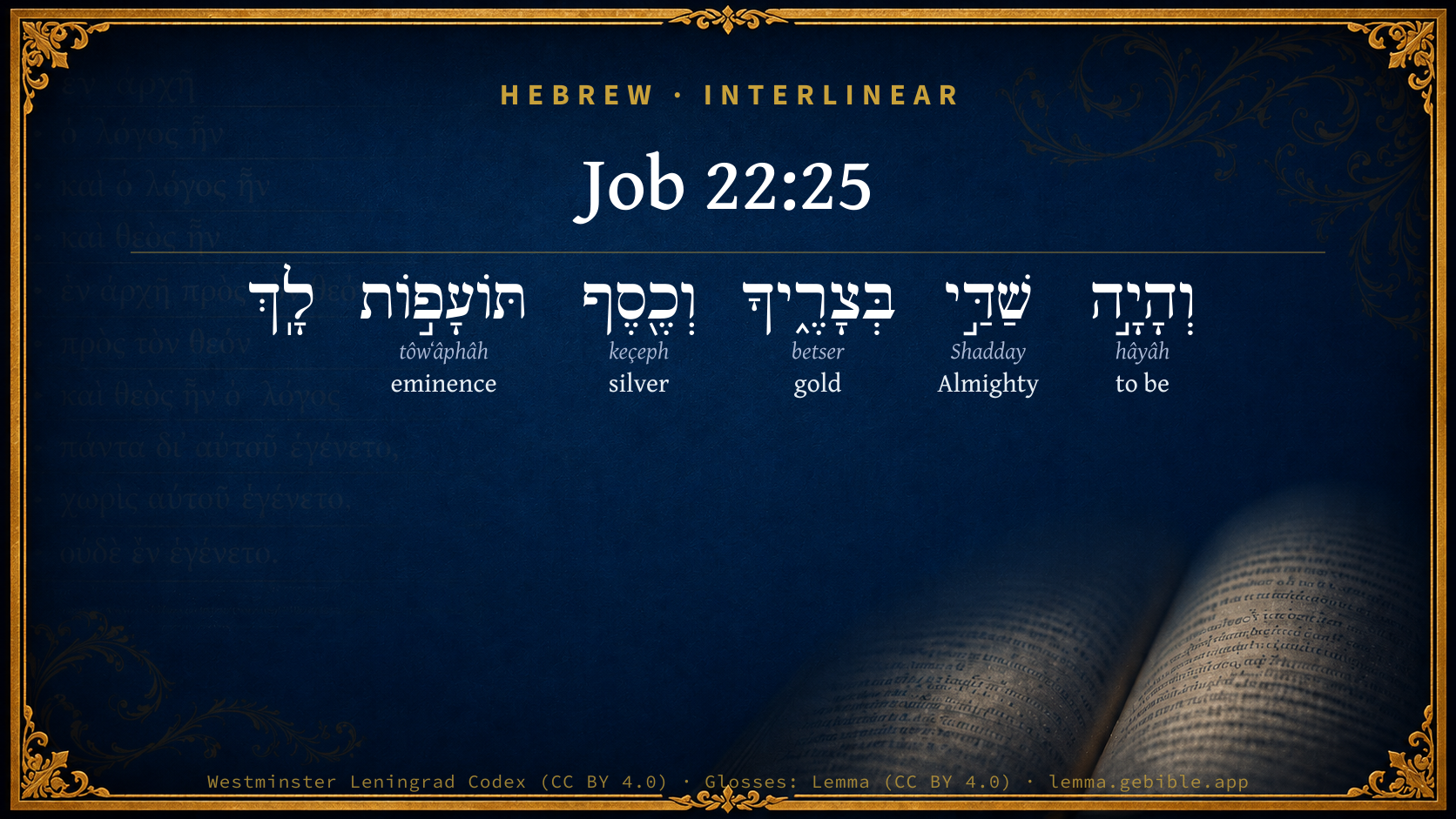
Hebrew (Westminster Leningrad Codex) Job 22:25 appears in the Hebrew Old Testament. The text above is from the Westminster Leningrad Codex. Each word links to its Strong’s number, a concise gloss, and parsing drawn from the Open Scriptures Hebrew Bible morphology. Click any word for its full Brown-Driver-Briggs (BDB) entry.
Download image
Cite this verse

Job 22:25 (World English Bible). Public Domain. Lemma interlinear Bible study tool, https://lemma.gebible.app/v/job/22/25.

Show BibTeX & RIS
BibTeX
RIS
English Translation
The Almighty will be your treasure, Precious silver to you.
World English Bible · Public Domain
Download a study sheet

One document with this verse’s original text, its word-by-word gloss line, the meaning frame, cross-references with their text, attributed commentary, and full source and license credits — printable, and it pastes into notes with its structure intact.

This verse Autodidact and up

Study sheet (.html) Plain text (.txt)

A passage Seminary Student

Up to 50 verses in one chapter. A passage sheet keeps up to 6 commentary sources and 12 cross-references per verse, in the order this page ranks them, and says so on the sheet whenever that leaves anything out. Ask for a single verse and you get the Autodidact verse sheet above.

Everything on this page stays free to read, with no account — the sheet is a download of what is already on screen, not access to it.

Want to remove ads? Support Godless Engineer
Compare translations 3

The same verse in 3 English versions, stacked beneath the original-language interlinear above. Click any original word for its lexicon entry.

Each is an independent rendering of the whole verse — the interlinear is not word-aligned to these translations.

Highlighted words mark where these versions differ — a whole-verse word diff, not a word-by-word alignment.

  • World English Bible Public Domain
    The Almighty will be your treasure, Precious silver to you.
  • King James Version Public Domain
    Yea, the Almighty shall be thy defence, and thou shalt have plenty of silver.
  • unfoldingWord Literal Text CC BY-SA 4.0
    then the Almighty will be your golds and silver of heights to you.

unfoldingWord Literal Text — © unfoldingWord, licensed CC BY-SA 4.0. Word-aligned USFM3 via Door43 (git.door43.org/unfoldingWord/en_ult).

Versions to compare (up to 4)

3 of 4 selected

Show all 18 translations

Every available English version of this verse, each an independent rendering of the whole verse.

  • World English Bible Public Domain
    The Almighty will be your treasure, Precious silver to you.
  • Berean Standard Bible Public Domain
    then the Almighty will be your gold and the finest silver for you.
  • Majority Standard Bible Public Domain
    then the Almighty will be your gold and the finest silver for you.
  • King James Version Public Domain
    Yea, the Almighty shall be thy defence, and thou shalt have plenty of silver.
  • American Standard Version (1901) Public Domain
    And the Almighty will be thy treasure, And precious silver unto thee.
  • Revised Version (1885) Public Domain
    And the Almighty shall be thy treasure, and precious silver unto thee.
  • Geneva Bible (1599) Public Domain
    Yea, the Almightie shalbe thy defence, and thou shalt haue plentie of siluer.
  • Douay-Rheims (1899) Public Domain
    And the Almighty shall be against thy enemies, and silver shall be heaped together for thee.
  • Young's Literal Translation Public Domain
    And the Mighty hath been thy defence, And silver `is' strength to thee.
  • Literal Standard Version CC BY-SA 4.0
    And the Mighty has been your defense, || And silver [is] strength to you.
  • Unlocked Literal Bible CC BY-SA 4.0
    and the Almighty will be your treasure, precious silver to you.
  • unfoldingWord Literal Text CC BY-SA 4.0
    then the Almighty will be your golds and silver of heights to you.
  • Darby Bible Public Domain
    Then the Almighty will be thy precious ore, and silver heaped up unto thee;
  • World Messianic Bible Public Domain
    The Almighty will be your treasure, and precious silver to you.
  • Webster's Bible Public Domain
    Yea, the Almighty shall be thy defense and thou shalt have plenty of silver.
  • Free Bible Version CC BY-SA 4.0
    then the Almighty will be your gold and your precious silver.
  • Bible in Basic English Public Domain
    Then the Ruler of all will be your gold, and his teaching will be your silver;
  • JPS Tanakh (1917) Public Domain
    And the Almighty be thy treasure, and precious silver unto thee;

Literal Standard Version (2020), Covenant Press — licensed CC BY-SA 4.0. Text via the HelloAO Bible API (eBible.org). Unlocked Literal Bible (unfoldingWord) — licensed CC BY-SA 4.0. Text via the HelloAO Bible API (eBible.org). unfoldingWord Literal Text — © unfoldingWord, licensed CC BY-SA 4.0. Word-aligned USFM3 via Door43 (git.door43.org/unfoldingWord/en_ult). Free Bible Version, Dr. Jonathan Gallagher — licensed CC BY-SA 4.0. Text via the HelloAO Bible API (eBible.org).

Word by word

More ways to search: Search by grammar → Find every occurrence → Compare this word →

Practice this passage: Drill this verse → Learn its vocabulary →

About this verse

These counts appear in no published source. They are computed here, from the morphology-tagged text and Lemma’s own curated glosses. What Lemma adds →

6
words
5
distinct lemmas
Wisdom
section

Notable vocabulary

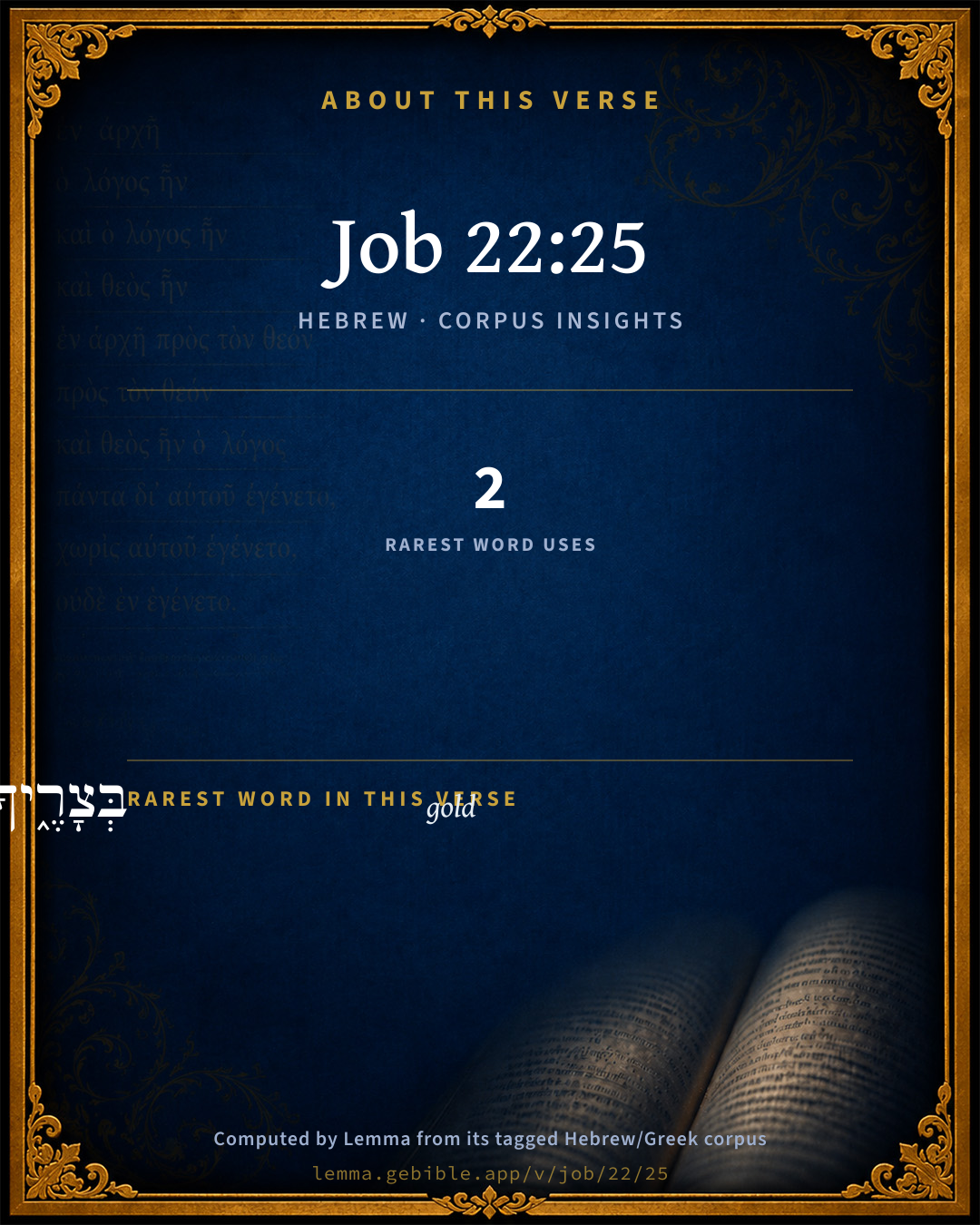
The rarest word here is בְּצָרֶ֑יךָ gold H1220 — appearing just 2 times in the whole Hebrew Bible.

Shared distinctive vocabulary

בְּצָרֶ֑יךָ gold H1220 occurs in 2 verses of the Hebrew Bible. Also found in:

Grammatical profile

  • 1 verb
  • 4 nouns
  • 1 preposition

Verb forms

  • וְהָיָ֣ה Qal · Sequential Perfect

Hebrew & Septuagint length

In English translation the verse runs 10 words from the Hebrew and 24 from the Septuagint (LXX English) — the Septuagint runs noticeably longer here. See the side-by-side →

A rough comparison of the two English renderings, which tokenize alike — not a word-level alignment.

Word counts can differ between the Hebrew and the Greek without any difference in meaning — e.g. the Hebrew direct-object marker אֵת has no separate Greek word, and Greek often adds the article ὁ.

Cross-references

9

Topical passages linked to Job 22:25 in the Treasury of Scripture Knowledge — connected by theme and wording, ordered by reader-vote popularity; previews shown in the World English Bible.

  • Psalms 16:5–6 Yahweh assigned my portion and my cup. You made my lot secure.
  • Isaiah 33:6 There shall be stability in your times, abundance of salvation, wisdom, and knowledge: the fear of Yahweh is your treasure.
  • Genesis 15:1 After these things the word of Yahweh came to Abram in a vision, saying, "Don't be afraid, Abram. I am your shield, your exceedingly great reward."
  • Psalms 18:2 Yahweh is my rock, my fortress, and my deliverer; My God, my rock, in whom I take refuge; My shield, and the horn of my salvation, my high tower.
  • Psalms 84:11 For Yahweh God is a sun and a shield. Yahweh will give grace and glory. He withholds no good thing from those who walk blamelessly.
  • Isaiah 41:10 Don't you be afraid, for I am with you; don't be dismayed, for I am your God; I will strengthen you; yes, I will help you; yes, I will uphold you with the right hand of my righteousness.
  • James 2:5 Listen, my beloved brothers. Didn't God choose those who are poor in this world to be rich in faith, and heirs of the Kingdom which he promised to those who love him?
  • Romans 8:31 What then shall we say about these things? If God is for us, who can be against us?
  • 2 Corinthians 6:10 as sorrowful, yet always rejoicing; as poor, yet making many rich; as having nothing, and yet possessing all things.

Cross-references courtesy of OpenBible.info (CC BY 4.0).

Hebrew and Greek witnesses Masoretic Hebrew ↔ Greek Septuagint

The same verse in the two great witnesses to the Old Testament, shown verse-for-verse.

Here the Septuagint runs noticeably longer than the Hebrew — LXX2012 (modern English Septuagint) 24 words vs World English Bible 10. A rough length comparison of the two English translations, not a word-level alignment — read both below.

These are two independent witnesses, not word-aligned to each other, and the Septuagint is shown in lemma (dictionary) form.

Hebrew Job 22:25 Masoretic · Westminster Leningrad Codex

וְהָיָ֣ה שַׁדַּ֣י בְּצָרֶ֑יךָ וְכֶ֖סֶף תּוֹעָפ֣וֹת לָֽךְ

The Almighty will be your treasure, Precious silver to you.

World English Bible · Public Domain

Greek LXX Job 22:25 Septuagint · lemma form

εἰμί οὖν σύ ὁ παντοκράτωρ βοηθός ἀπό ἐχθρός καθαρός δέ ἀποδίδωμι σύ ὥσπερ ἀργύριον πυρόω

So the Almighty shall be your helper from enemies, and he shall bring you forth pure as silver that has been tried by fire.

LXX2012 (modern English Septuagint) · Public Domain

On this verse, Haydock's Catholic Bible Commentary discusses the Septuagint’s reading. Read the note in Commentary ↓

Hebrew: Westminster Leningrad Codex (CC BY 4.0). Greek: Septuagint (public domain); English from LXX2012 (modern English Septuagint) (Public Domain). How the Septuagint differs from the Hebrew →

Commentary

Notes on Job 22:25 from classic Christian and Jewish commentators (each source and its license shown beneath its notes). The classic Christian expositions comment on the surrounding passage and are grouped to its opening verse, so a note may address several verses; the Jewish commentaries on the Tanakh (Rashi and others) are per-verse, so they appear only where the commentator wrote on this verse.

Lemma curates 59 commentaries, every one of them public domain or Creative Commons licensed, each selected and text-cleaned for this edition rather than reprinted as found. About our sources →

Trapp's Complete Commentary

John Trapp

Job 22:25 Yea, the Almighty shall be thy defence, and thou shalt have plenty of silver.

Ver. 25. Yea, the Almighty shall be thy defence] Or, thy gold, for the same word signifieth both, Job 36:19, because gold is the worldly man’s defence, Pro 18:11, though but a sorry one, Zep 1:18 Pro 11:4 Eze 7:19. It is as if he should say, Either thou shalt have gold gods plenty; or else, thou shalt have that which is better than gold, viz. God the maker and master of all the world, saith Junius, who rendereth the text thus, And the Almighty shall be thy choicest gold, and silver, and strength to thee. He shall be all that heart can wish or need require. A friend of Cyrus, in Xenophon, being asked where his treasure was? answered, οπου Kυρος φιλος, Where Cyrus is my friend. Let us answer, οπου Kυριος φιλος, Where God is my friend. When David had said, "The Lord is my portion," he subjoined in the next verse, "The lines are fallen unto me in pleasant places; yea, I have a goodly heritage," Psa 16:5-6. When God had said to Abraham, I am thy shield, he easily slighted the king of Sodom’s rich offers.

And thou shalt have plenty of silver] Heb. Silver of strengths or of heights; that is, as the Vulgate interpreteth it, argentum coacervabitur tibi, thou shalt have high heaps of silver, store of money. Godliness hath the promise of both lives; and if godly men are not always rich men, it is that godliness may be admired for itself. And they must know, that what they lack in temporals shall be made up in spirituals, according to that which followeth.

John Trapp, A Commentary or Exposition upon All the Books of the Old and New Testament (1647–1656) — public domain. Text from a community e-Sword module.

Tyndale Open Study Notes

Tyndale Open Resources

22:25 God promises to be his people’s treasure (Ps 16:5; Isa 33:6; Matt 19:21; Mark 10:21); although they possess nothing, they will be rich (2 Cor 6:10; Jas 2:5).

Tyndale Open Study Notes — © Tyndale Open Resources, licensed CC BY-SA 4.0. Text via the HelloAO Bible API.

Jamieson, Fausset & Brown

Robert Jamieson, A. R. Fausset & David Brown

Apodosis.

Yea--rather, Then shall the Almighty be, &c.

defence--rather, as the same Hebrew means in Job 22:24 (see on Job 22:24) --Thy precious metals; God will be to thee in the place of riches.

plenty of silver--rather, "And shall be to thee in the place of laboriously-obtained treasures of silver" [GESENIUS]. Elegantly implying, it is less labor to find God than the hidden metals; at least to the humble seeker (Job 28:12-28). But [MAURER] "the shining silver."

Jamieson, Fausset & Brown — Commentary Critical and Explanatory on the Whole Bible (1871) — public domain (CC PDM 1.0). Text via the HelloAO Bible API.

Adam Clarke's Commentary

Verse 25. Thou shalt have plenty of silver.] Here again the versions and critics vary. The critics may disagree; but the doctrine of Eliphaz is sufficiently plain: "To those whom God loves best he gives the most earthly good. The rich and the great are his high favorites: the poor and the distressed he holds for his enemies."

In the above verses there seems to be a reference to the mode of obtaining the precious metals:

1. Gold in dust;

2. Gold in streams from the hills and mountains;

3. Silver in mines; כסף תועפות keseph toaphoth, "silver of giddiness," of mines so deep as to make one giddy by looking into them. See Mr. Good.

Adam Clarke's Commentary on the Bible (1810–1826) — public domain. Text from a community e-Sword/MySword module.

Ellicott's Commentary for English Readers

(25) The Almighty shall be thy defence.—Rather, And the Almighty shall be thy treasure, and precious silver unto thee. The word thus qualifying silver occurs only three other times in the Bible: Psa_95:4, “The strength of the hills”; Num_22:23-24, “the strength of a unicorn.” Its original idea is probably brightness or splendour.

A Bible Commentary for English Readers, edited by Charles John Ellicott (1878–1897) — public domain. Text from a community e-Sword module.

John Gill's Exposition

For then shall thou have thy delight in the Almighty,.... In the perfections of his nature, in the works of his hands, in his word and worship, in communion with him, and in the relation he stands in to his people as their covenant God and Father; this would be the case when Job should be more and better acquainted with God, and with the law or doctrine his month, and the words of his lips, and should return unto him with his whole heart; and when his affections should be taken off of all earthly riches; when he should look upon gold as dust, and the gold of Ophir as the stones of the brook, and God should be to him his gold and his silver; then, and not till then, could he have true delight and complacency in God:

and shalt lift up thy face unto God; in prayer, as Sephorno interprets it, with an holy confidence, boldness, and cheerfulness; as a believer in Christ may, having on his righteousness, and having his heart sprinkled from an evil conscience by his blood; such an one can appear before God, and lift up his face to him, as without spot, so without confusion, shame, and blushing, without a load of guilt upon him, without fear of wrath or punishment, and of being repulsed; see Job 11:15.

John Gill's Exposition of the Whole Bible (1746–1763) — public domain (CC PDM 1.0). Text via the HelloAO Bible API.

Albert Barnes' Notes on the Bible

Yea, the Almighty shall be - Or, rather, “then the Almighty shall be” - והיה yehâyâh. The meaning is, that if he would return to God, and cast off his anxiety for gold, “then” the Almighty would be his real treasure, and would impart to him solid happiness.

Thy defense - Margin, “gold.” The margin is the more correct translation. The word is the same which occurs in the previous verse בצר betser, and there rendered “gold.” The word may have the sense of “defense,” as the verb בצר bâtsar is often used with such a reference; Num 13:28; Deu 1:28; Deu 3:5; Deu 9:1, et al. The meaning of such places, where the word is applied to walled towns or fortified places, is, that the enemy was, by means of walls, “cut off” from approach. Here, however, the idea of “gold” or “treasure” better suits the connection, and the meaning is, that “God” would be to him an invaluable “treasure” or source of happiness.

And thou shalt have plenty of silver - Margin, “silver of strength.” The correct idea, however, is, “and the Almighty shall be treasures of silver unto thee;” that is, he shall be better to you than an abundance of the precious metals. The Hebrew is literally, “And silver of treasures unto thee.”

Albert Barnes' Notes on the Bible (1834–1885) — public domain. Text from a community e-Sword/MySword module.

Haydock's Catholic Bible Commentary

Silver. Septuagint, "But he shall purify thee, as silver, which has passed the fire." (Haydock)

George Leo Haydock (1774–1849), Haydock's Catholic Family Bible and Commentary, 1859 edition — public domain. Excludes Psalms (Douay-Rheims chapter numbering differs from Protestant) and Deuterocanonical books (Catholic canon only).

Matthew Poole's English Annotations

God by his special and watchful providence shall protect thee from all dangers and calamities. Heb.

thy defences, or munitions. One God shall keep thee as safely as many munitions.

Plenty of silver, Heb. silver of strength, i.e. which by God’s blessing shall be thy defence, Ecc 7:12. Or, silver of heights, i.e. high and heaped up like a mountain.

Matthew Poole's English Annotations on the Holy Bible (1683–1685) — public domain. Text from a community e-Sword/MySword module.

Whedon's Commentary on the Bible

Daniel D. Whedon

25. Plenty of silver — Literally, bars of silver, (Hitzig:) silver of excellencies or splendours, (Ewald;) and heaps of silver, (Dillmann;) or better, silver of labours, (Gesenius,) that is, obtained by great labour. The word appears in Psa_95:4, “the strength [labours] of the hills;” one of the prime meanings of the verbal root being “to become weary.” Gold and silver have ever been the bright and alluring symbols of worldly good. God thus early uses them in figure to set forth the desirableness of himself and his glory. He who, like the Levite, gives up all for God, finds his treasure in God. God becomes his Ophir, the Almighty his precious ores. A just estimate of this world’s treasures becomes a golden round in the heavenly ladder.

Daniel D. Whedon (gen. ed.), Commentary on the Old and New Testaments (1874–1909) — public domain. Text from a community e-Sword module.

The Pulpit Commentary

Yea, the Almighty shall be thy defense; rather, thy treasure. The word is the same as that used in the first clause of ver. 24, It properly signifies "ore." The general meaning of the passage seems to be, "However rich thou mayest be in the precious metals, thy true treasure that which thou wilt value most will be the Almighty himself." And thou shalt have plenty of silver; or, and he shall be previous silver unto thee (see the Revised Version).

The Pulpit Commentary (1880–1919), ed. H.D.M. Spence-Jones & Joseph S. Exell — public domain. Text from a community e-Sword module.

Rashi

Rabbi Shlomo Yitzchaki (Rashi)

And the Almighty shall be of your adversaries Heb. והיה שד-י בצריך. If this word is holy [i.e., is a reference to the Almighty], I am bewildered at its interpretation, because its meaning is a curse, that He will be counted with his enemies, as in (Jud. 11:35), “and you have become one of those who trouble me (בעכרי),” with those who trouble me. By necessity, we will adjudge it as one of the elliptical verses, [meaning: And the Almighty shall be the Judge over your adversaries. But if we can interpret it as profane, as an expression of a judge and of strength, the following is its interpretation:] And your fortifications (בצריך) shall be strong (שד-י), like “Then you shall make a fortification (בצר) on the earth.” That is, powerful wealth will be fortified, and according to the context, that is indeed its interpretation, as evidenced by the end of the verse, “and you shall have abundant (תועפות) silver,” an expression of strength, like (Num. 23:22), “his is like the power of (כתועפות) a wild ox.”

Rashi on the Tanakh — English translations: “The Judaica Press complete Tanach with Rashi, translated by A. J. Rosenberg” (CC BY 4.0); “Pentateuch with Rashi's commentary by M. Rosenbaum and A.M. Silbermann, 1929-1934” (public domain); “The Metsudah Tanach series, Lakewood, N.J” (CC BY 4.0); and “The Book of Joshua, Metsudah Publications, 1997” (CC BY 4.0). Text via Sefaria.

Lesson kit

Teaching starters — assembled from the data on this page, not authored interpretation. Every prompt links to the verse data it draws on. Edit before teaching.

Job, in the Wisdom, opens this verse with 6 words (5 distinct Hebrew lemmas). Its most distinctive word is betser (“gold”). The Greek Septuagint runs longer here. A historical commentator’s framing appears above. Read the whole chapter for the surrounding context.

Discussion questions

  1. What does “gold” (betser) contribute to the verse as a whole?
  2. Job 22:24 shares the word «gold» with this verse. How do the two illuminate each other?
  3. Compared with the Hebrew, the Septuagint runs longer here. What questions does that raise?
  4. These translations render this verse differently; the difference is in the English rendering, not the original. What questions does that raise?
  5. The verb «וְהָיָ֣ה» is Qal Sequential Perfect. How does its form color the action?
  6. Reading how Trapp's Complete Commentary and Tyndale Open Study Notes read this verse, where do the two commentators agree and where do they part?

Things to notice

Reading settings

Reading text

Shown beneath each verse's original-language words.

Old Testament
Old Testament edition

Read the OT as the Masoretic Hebrew (MT) or the Greek Septuagint (LXX).

English shown for the Greek Septuagint (in the Hebrew ↔ Greek comparison).

Comparing translations? Open the Compare panel on any verse page to stack up to four side by side.