
1 Chronicles 17:3

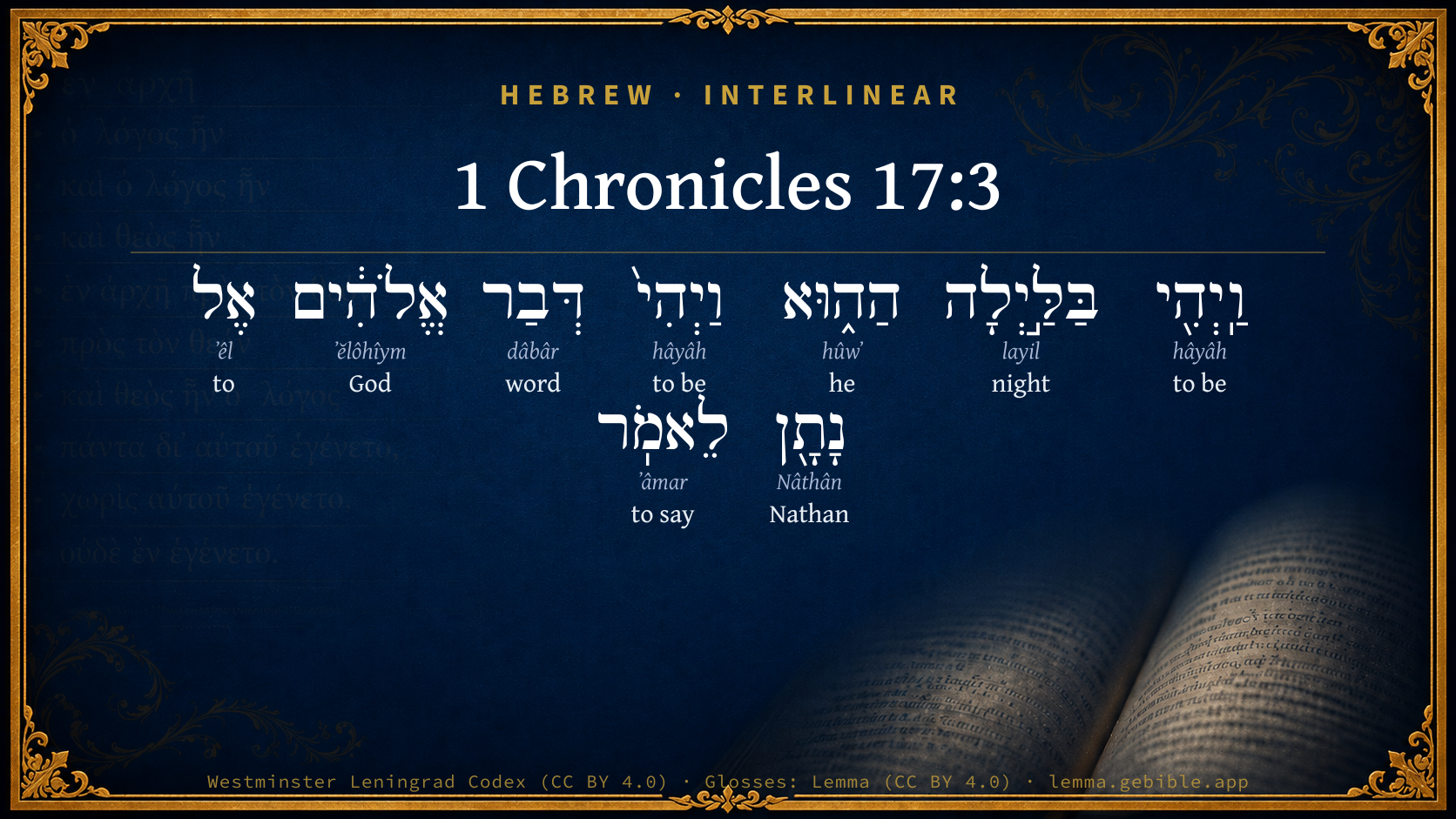
Hebrew (Westminster Leningrad Codex) 1 Chronicles 17:3 appears in the Hebrew Old Testament. The text above is from the Westminster Leningrad Codex. Each word links to its Strong’s number, a concise gloss, and parsing drawn from the Open Scriptures Hebrew Bible morphology. Click any word for its full Brown-Driver-Briggs (BDB) entry.
Download image
Cite this verse

1 Chronicles 17:3 (World English Bible). Public Domain. Lemma interlinear Bible study tool, https://lemma.gebible.app/v/1-chronicles/17/3.

Show BibTeX & RIS
BibTeX
RIS
English Translation
It happened the same night, that the word of God came to Nathan, saying,
World English Bible · Public Domain
Download a study sheet

One document with this verse’s original text, its word-by-word gloss line, the meaning frame, cross-references with their text, attributed commentary, and full source and license credits — printable, and it pastes into notes with its structure intact.

This verse Autodidact and up

Study sheet (.html) Plain text (.txt)

A passage Seminary Student

Up to 50 verses in one chapter. A passage sheet keeps up to 6 commentary sources and 12 cross-references per verse, in the order this page ranks them, and says so on the sheet whenever that leaves anything out. Ask for a single verse and you get the Autodidact verse sheet above.

Everything on this page stays free to read, with no account — the sheet is a download of what is already on screen, not access to it.

Want to remove ads? Support Godless Engineer
Compare translations 3

The same verse in 3 English versions, stacked beneath the original-language interlinear above. Click any original word for its lexicon entry.

Each is an independent rendering of the whole verse — the interlinear is not word-aligned to these translations.

Highlighted words mark where these versions differ — a whole-verse word diff, not a word-by-word alignment.

  • World English Bible Public Domain
    It happened the same night, that the word of God came to Nathan, saying,
  • King James Version Public Domain
    And it came to pass the same night, that the word of God came to Nathan, saying,
  • unfoldingWord Literal Text CC BY-SA 4.0
    But it happened in that night that the word of God was to Nathan, saying,

unfoldingWord Literal Text — © unfoldingWord, licensed CC BY-SA 4.0. Word-aligned USFM3 via Door43 (git.door43.org/unfoldingWord/en_ult).

Versions to compare (up to 4)

3 of 4 selected

Show all 18 translations

Every available English version of this verse, each an independent rendering of the whole verse.

  • World English Bible Public Domain
    It happened the same night, that the word of God came to Nathan, saying,
  • Berean Standard Bible Public Domain
    But that night the word of God came to Nathan, saying,
  • Majority Standard Bible Public Domain
    But that night the word of God came to Nathan, saying,
  • King James Version Public Domain
    And it came to pass the same night, that the word of God came to Nathan, saying,
  • American Standard Version (1901) Public Domain
    And it came to pass the same night, that the word of God came to Nathan, saying,
  • Revised Version (1885) Public Domain
    And it came to pass the same night, that the word of God came to Nathan, saying,
  • Geneva Bible (1599) Public Domain
    And the same night euen the word of God came to Nathan, saying,
  • Douay-Rheims (1899) Public Domain
    Now that night the word of God came to Nathan, saying:
  • Young's Literal Translation Public Domain
    And it cometh to pass on that night that a word of God is unto Nathan, saying,
  • Literal Standard Version CC BY-SA 4.0
    And it comes to pass on that night that a word of God is to Nathan, saying,
  • Unlocked Literal Bible CC BY-SA 4.0
    But that same night the word of God came to Nathan, saying,
  • unfoldingWord Literal Text CC BY-SA 4.0
    But it happened in that night that the word of God was to Nathan, saying,
  • Darby Bible Public Domain
    And it came to pass that night that the word of God came to Nathan saying,
  • World Messianic Bible Public Domain
    That same night, the word of God came to Nathan, saying,
  • Webster's Bible Public Domain
    And it came to pass the same night, that the word of God came to Nathan, saying,
  • Free Bible Version CC BY-SA 4.0
    But that night God told Nathan,
  • Bible in Basic English Public Domain
    But that same night, the word of God came to Nathan, saying,
  • JPS Tanakh (1917) Public Domain
    And it came to pass the same night, that the word of God came to Nathan, saying:

Literal Standard Version (2020), Covenant Press — licensed CC BY-SA 4.0. Text via the HelloAO Bible API (eBible.org). Unlocked Literal Bible (unfoldingWord) — licensed CC BY-SA 4.0. Text via the HelloAO Bible API (eBible.org). unfoldingWord Literal Text — © unfoldingWord, licensed CC BY-SA 4.0. Word-aligned USFM3 via Door43 (git.door43.org/unfoldingWord/en_ult). Free Bible Version, Dr. Jonathan Gallagher — licensed CC BY-SA 4.0. Text via the HelloAO Bible API (eBible.org).

Word by word

More ways to search: Search by grammar → Find every occurrence → Compare this word →

Practice this passage: Drill this verse → Learn its vocabulary →

נָתָ֖ן
Nâthân
H5416
“Nathan”
Noun, Proper
Part of Speech
Noun
Type
Proper
Full BDB Definition

Origin: from H5414

TWOT: None

Nathan = "giver" - a son of David by Bathsheba - the eminent prophet in the time of David and Solomon - a man of Zobah, father of one of David's mighty warriors - father of Azariah who was over the officers of Solomon - son of Attai and father of Zabad of the tribe of Judah - brother of Joel of the tribe of Judah - one of the head men who returned from Babylon with Ezra - a man with a foreign wife in the time of Ezra - head of a family of Israel who shall mourn when they look on Him whom they pierced
  1. וַֽיְהִ֖י hâyâh H1961 “and · to be” Conjunction + Verb, Qal, Sequential Imperfect, 3rd Person, Masculine, Singular
  2. בַּלַּ֣יְלָה layil H3915 “in/at the · night” Preposition, Determined + Noun, Common, Masculine, Singular, Absolute
  3. הַה֑וּא hûwʼ H1931 “the · he” Particle, Definite Article + Pronoun, Personal, 3rd Person, Masculine, Singular
  4. וַיְהִי֙ hâyâh H1961 “and · to be” Conjunction + Verb, Qal, Sequential Imperfect, 3rd Person, Masculine, Singular
  5. דְּבַר dâbâr H1697 “word of” Noun, Common, Masculine, Singular, Construct
  6. אֱלֹהִ֔ים ʼĕlôhîym H430 “God(s)” Noun, Common, Masculine, Plural, Absolute
  7. אֶל ʼêl H413 “to” Preposition
  8. לֵאמֹֽר ʼâmar H559 “to say” Preposition + Verb, Qal, Infinitive Construct

About this verse

These counts appear in no published source. They are computed here, from the morphology-tagged text and Lemma’s own curated glosses. What Lemma adds →

9
words
8
distinct lemmas
Historical
section

Shared distinctive vocabulary

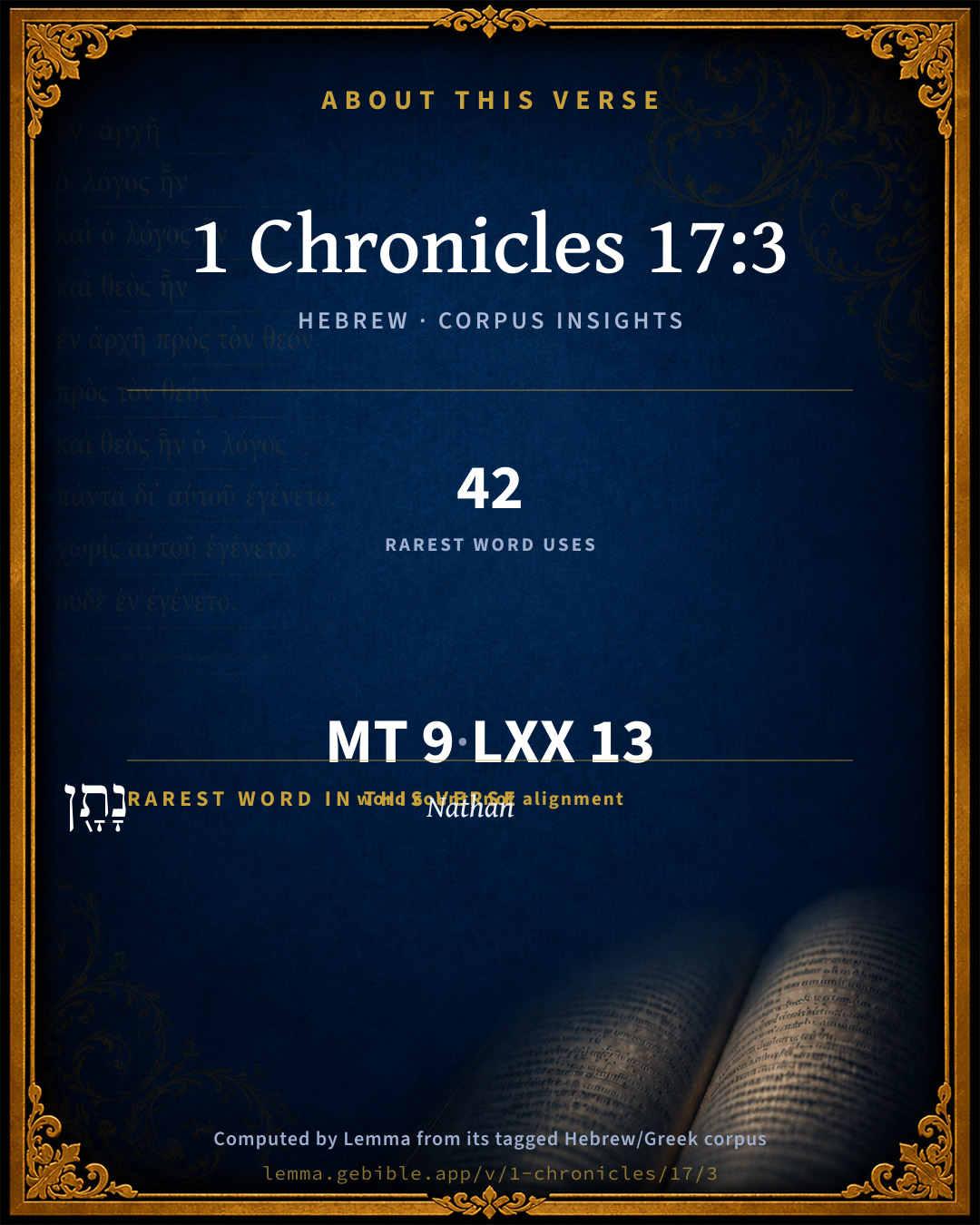
נָתָ֖ן Nathan H5416 occurs in 39 verses of the Hebrew Bible. Also found in:

Grammatical profile

  • 3 verbs
  • 4 nouns
  • 1 pronoun
  • 1 preposition

Verb forms

  • וַֽיְהִ֖י Qal · Sequential Imperfect
  • וַיְהִי֙ Qal · Sequential Imperfect
  • לֵאמֹֽר Qal · Infinitive Construct

Repetition

A word recurs within this verse — often emphatic in Hebrew:

  • וַֽיְהִ֖י to be H1961 ×2

Hebrew & Septuagint length

In English translation the verse runs 14 words from the Hebrew and 18 from the Septuagint (LXX English) — closely comparable.

A rough comparison of the two English renderings, which tokenize alike — not a word-level alignment.

Word counts can differ between the Hebrew and the Greek without any difference in meaning — e.g. the Hebrew direct-object marker אֵת has no separate Greek word, and Greek often adds the article ὁ.

In the original languages it is 9 Hebrew tokens and 13 Greek tokens — but the two are counted differently (Hebrew bundles its prefixes and suffixes into one token; the Greek is in lemma form), so that isn’t a like-for-like length.

Cross-references

4

Topical passages linked to 1 Chronicles 17:3 in the Treasury of Scripture Knowledge — connected by theme and wording, ordered by reader-vote popularity; previews shown in the World English Bible.

  • Isaiah 30:21 and your ears shall hear a word behind you, saying, This is the way, walk you in it; when you turn to the right hand, and when you turn to the left.
  • Amos 3:7 Surely the Lord Yahweh will do nothing, Unless he reveals his secret to his servants the prophets.
  • Numbers 12:6 He said, Hear now my words: if there be a prophet among you, I Yahweh will make myself known to him in a vision, I will speak with him in a dream.
  • 2 Kings 20:1–5 In those days was Hezekiah sick to death. Isaiah the prophet the son of Amoz came to him, and said to him, Thus says Yahweh, Set your house in order: for you shall die, and not live.

Cross-references courtesy of OpenBible.info (CC BY 4.0).

Hebrew and Greek witnesses Masoretic Hebrew ↔ Greek Septuagint

The same verse in the two great witnesses to the Old Testament, shown verse-for-verse.

These are two independent witnesses, not word-aligned to each other, and the Septuagint is shown in lemma (dictionary) form.

Hebrew 1 Chronicles 17:3 Masoretic · Westminster Leningrad Codex

וַֽיְהִ֖י בַּלַּ֣יְלָה הַה֑וּא וַיְהִי֙ דְּבַר אֱלֹהִ֔ים אֶל נָתָ֖ן לֵאמֹֽר

It happened the same night, that the word of God came to Nathan, saying,

World English Bible · Public Domain

Greek LXX 1 Chronicles 17:3 Septuagint · lemma form

καί γίγνομαι ἐν ὁ νύξ ἐκεῖνος καί γίγνομαι λόγος κύριος πρός ναθαν λέγω

And it came to pass in that night, that the word of the Lord came to Nathan, saying,

LXX2012 (modern English Septuagint) · Public Domain

Hebrew: Westminster Leningrad Codex (CC BY 4.0). Greek: Septuagint (public domain); English from LXX2012 (modern English Septuagint) (Public Domain). How the Septuagint differs from the Hebrew →

Commentary

Notes on 1 Chronicles 17:3 from classic Christian and Jewish commentators (each source and its license shown beneath its notes). The classic Christian expositions comment on the surrounding passage and are grouped to its opening verse, so a note may address several verses; the Jewish commentaries on the Tanakh (Rashi and others) are per-verse, so they appear only where the commentator wrote on this verse.

Lemma curates 59 commentaries, every one of them public domain or Creative Commons licensed, each selected and text-cleaned for this edition rather than reprinted as found. About our sources →

Geneva Bible (1599)

Geneva Bible translators

After that Nathan had spoken to David.

Geneva Bible (1599) marginal notes — public domain. Text via Bolls.life.

Ellicott's Commentary for English Readers

(3) The same night.—The words indicate a dream as the method of communication (Job_4:13; 1Sa_27:6).

A Bible Commentary for English Readers, edited by Charles John Ellicott (1878–1897) — public domain. Text from a community e-Sword module.

The Cambridge Bible for Schools and Colleges

gen. ed. J. J. S. Perowne

3. the same night] Gen_20:3; 1Sa_3:2-3; 1Ki_3:5; Job_4:12-13.

The Cambridge Bible for Schools and Colleges (gen. ed. J. J. S. Perowne; Cambridge University Press, 1878–1918) — public domain. Text from a community e-Sword module.

The Pulpit Commentary

The express word of God came, however, that same night. It proved to be an overruling word. But it brought with it the point of a fresh and most welcome new departure for David. We might glean here by the way a suggestion of the beneficent operation of express revelation, superseding the thought, the method, the reason of man.

Vers. 3-15.

God"s message to David.

Though David was not to build the house of the Lord, God gives him "great and precious promises" with respect to his posterity and to the future glory of his people Israel. We see here that there is one thing nearer to the heart of our God than an outward building, however grand it may be. "I have not dwelt in a house since the day that I brought up Israel unto this day; but have gone from tent to tent, and from one tabernacle to another." The Lord loves to be identified with his children in all their circumstances, however lowly those circumstances may be. "I dwell with the humble and contrite heart." This is the joy of the Lord"s heart, and it comes infinitely before a grand house or a magnificent palace. Mark further the prophetical character of God"s message (see ver. 9). I will ordain a place for my people Israel, and will plant them, and they shall dwell in their place, and shall be moved no more; neither shall the children of wickedness waste them any more, as at the beginning." Israel has been "moved" and "wasted" since this promise was made, and is being "moved" and "wasted" at the present moment. It is clear, therefore, that this is an unfulfilled prophecy of blessing yet in store for wasted and scattered Israel. That time is at hand. When "the Lord shall set his hand the second time it was done the first time by Cyrus the Persian to recover the remnant of his people, which shall be left, from Assyria, and from Egypt, and from Pathros, and from Cush, and from Elam, and from Shinar, and from Hamath, and from the islands of the sea. And he shall set up an ensign for the nations, and shall assemble the outcasts of Israel, and gather together the dispersed of Judah from the four corners of the earth". (Isa_11:11, Isa_11:12) Mark another truth: "And it shall come to pass, when thy days be expired that thou must go to be with thy fathers. " Three thoughts are suggested by this passage.

1. Man lives by days, not by years. "As thy days, so shall thy strength be;" "Lo, I am with you always, even to the end of the days. " We speak of years and look forward to them. God would teach us that we have only days to count on, and should therefore use each one for him.

2. Thou must go." David was wanted in another world. There are places to fill there. Just as the stones that were to form the temple on Mount Zion were hewn, shaped, and polished in Lebanon, and were sent for just as they were wanted, so is it with the departure of every true child of God. What may be the nature of the employments we cannot tell; but of each one who is taken we may hear the Lord"s voice saying of him to the weeping ones left behind, "He must go" for he is wanted there.

3. "Thou must go to be with thy fathers. " It is a family gathering. In the Old Testament how frequently is this word used l It is not death. It is to join the family gathering." "Dead" is the Bible word for those out of Christ. "Asleep" is the word for God"s children. What a precious word! It is a striking contrast to our word "dead" which is always on the lips. It is like another word we use. A manufacturer looks upon his men and women in his employ and regards them as goods, and calls them "hands many hands." The Bible word is "souls souls he had gotten in Haran." How sadly men have departed from the spirit of patriarchal days! Vers. 12-14 are manifestly a reference to the Messiah, of whom Solomon was a type, and to the Messianic times of rest yet to come, of which his reign was a shadow. It is clear from David"s prayer (ver. 17) that he so understood them, especially when he speaks of God having regarded him "according to the estate of a man of high degree. W.

The Pulpit Commentary (1880–1919), ed. H.D.M. Spence-Jones & Joseph S. Exell — public domain. Text from a community e-Sword module.

unfoldingWord translationNotes

Door43 World Missions Community

the word of God came to Nathan, saying, "Go

The idiom "the word of God came to" is used to introduce a special message from God. AT: "God gave a message to Nathan. He said, 'Go" or "God spoke this message to Nathan: 'Go" (See: Idiom)

saying, "Go and tell David my servant, 'This is what Yahweh says: You will not build me a house in which to live

This has quotations within quotations. It may be necessary to translate them as indirect quotations. AT: "saying, 'Go and tell David my servant that he will not be the one to build a house in which I will live" (See: Quotes Within Quotes and Direct and Indirect Quotations)

build me a house

Here "house" means a temple. In 1 Chronicles 17:10 Yahweh will say that he will build a house for David. There "house" means a family. If your language has a word that can express both ideas, use it here and in 1Ch 17:10.

that I brought up Israel

The implied information is that this refers to God bringing up Israel out of the land of Egypt. AT: "that I brought the Israelites to the promised land from the land of Egypt" (See: Assumed Knowledge and Implicit Information)

a tent, a tabernacle

Both the words "tent" and "tabernacle" describe the same thing and emphasize that he had lived in a place that was not a permanent building. (See: Doublet)

did I ever say anything to any of Israel's leaders whom I appointed to shepherd my people, saying, "Why have you not built me a house of cedar?"

This has a quotation within a quotation. The direct quotation can be stated as an indirect quotation. AT: "did I ever ask any of Israel's leaders, whom I appointed to shepherd my people, why they had not built me a house of cedar?" (See: Quotes Within Quotes and Direct and Indirect Quotations)

did I ever say anything to any of Israel's leaders

Yahweh uses a question to emphasize that he never asked any of Israel's leaders to build him a house. AT: "I never said anything to any of Israel's leaders" (See: Rhetorical Question)

whom I appointed to shepherd my people

Those who are leaders of the people of Israel are spoken of as if they were shepherds and the people were sheep. (See: Metaphor)

Why have you not built me a house of cedar?

If Yahweh had asked the leaders this question, he would have been using a question to scold them for not building him a house of cedar. But, Yahweh said previously that he did not ask them this question. AT: "You should have built me a house of cedar." (See: Rhetorical Question)

translationWords

word of God

servant

Israel

tabernacle

shepherd

people of God

unfoldingWord translationNotes — © Distant Shores Media and the Door43 World Missions Community, licensed CC BY-SA 4.0. Source: git.door43.org/Door43/en_tn.

Rashi

Rabbi Shlomo Yitzchaki (Rashi)

And it came to pass on that same night, etc. It is explained in the Midrash (Midrash Sam. 26: 1): “The Holy One, blessed be He, said to Nathan: This man to whom I am sending you is a vower. Go forth and tell him before he swears to build it: You shall not build Me the house for My dwelling.” Another explanation: The man to whom I am sending you is zealous. Go, tell him before he hires workers.

Rashi on the Tanakh — English translations: “The Judaica Press complete Tanach with Rashi, translated by A. J. Rosenberg” (CC BY 4.0); “Pentateuch with Rashi's commentary by M. Rosenbaum and A.M. Silbermann, 1929-1934” (public domain); “The Metsudah Tanach series, Lakewood, N.J” (CC BY 4.0); and “The Book of Joshua, Metsudah Publications, 1997” (CC BY 4.0). Text via Sefaria.

Lesson kit

Teaching starters — assembled from the data on this page, not authored interpretation. Every prompt links to the verse data it draws on. Edit before teaching.

1 Chronicles, in the Historical, opens this verse with 9 words (8 distinct Hebrew lemmas). Its most distinctive word is Nâthân (“Nathan”). A historical commentator’s framing appears above. Read the whole chapter for the surrounding context.

Discussion questions

  1. What does “Nathan” (Nâthân) contribute to the verse as a whole?
  2. 2 Samuel 5:14 shares the word «Nathan» with this verse. How do the two illuminate each other?
  3. “to be” occurs 2× in this one verse. What is the effect of the repetition?
  4. These translations render this verse differently; the difference is in the English rendering, not the original. What questions does that raise?
  5. The verb «וַֽיְהִ֖י» is Qal Sequential Imperfect. How does its form color the action?
  6. Reading how Geneva Bible (1599) and Ellicott's Commentary for English Readers read this verse, where do the two commentators agree and where do they part?

Things to notice

Reading settings

Reading text

Shown beneath each verse's original-language words.

Old Testament
Old Testament edition

Read the OT as the Masoretic Hebrew (MT) or the Greek Septuagint (LXX).

English shown for the Greek Septuagint (in the Hebrew ↔ Greek comparison).

Comparing translations? Open the Compare panel on any verse page to stack up to four side by side.