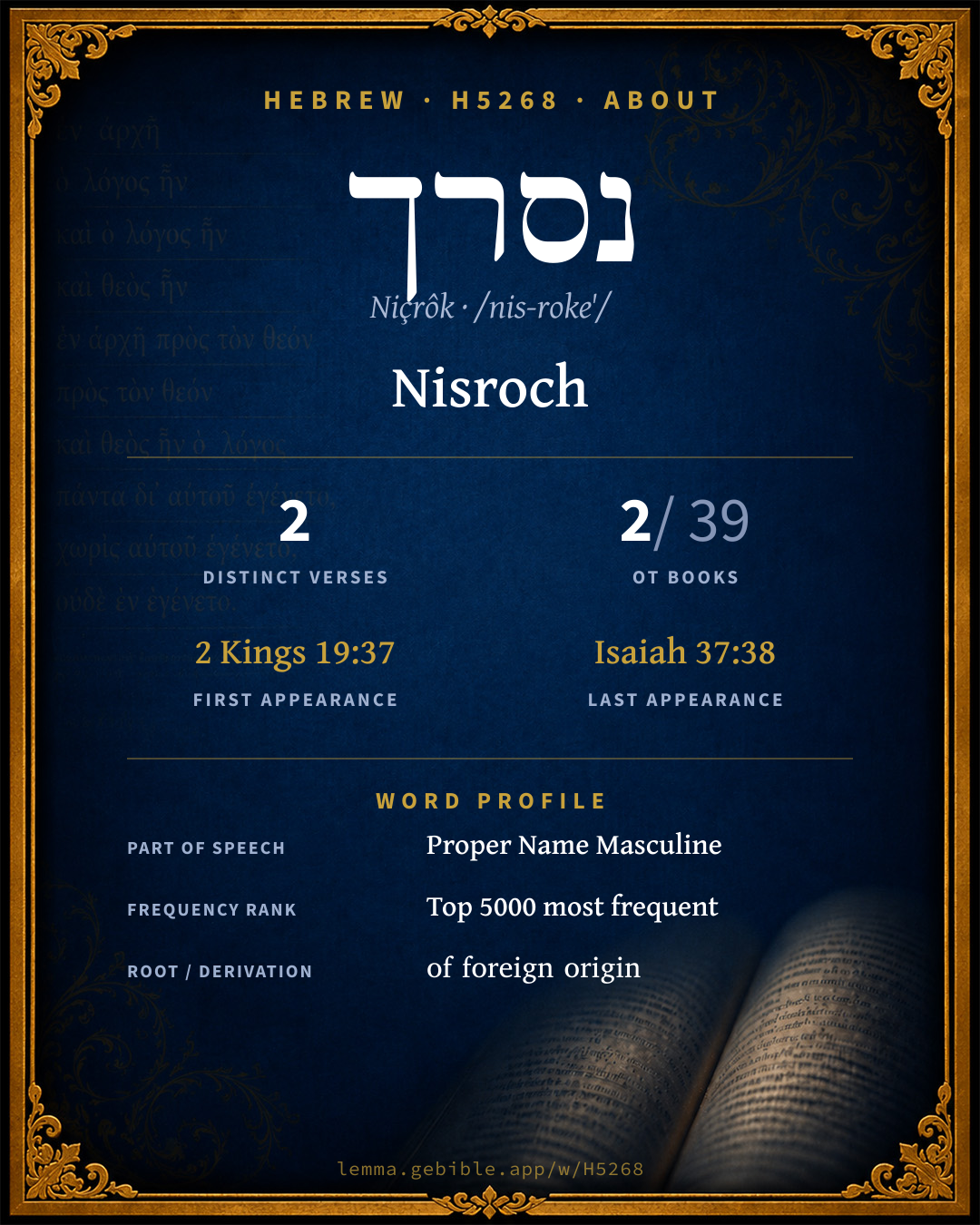
נִסְרֹךְ
Nisroch
BDB lists 2 entries for ‘Nisroch’ fuller range ↓
Full lexicon entry — Brown-Driver-Briggs (BDB)
From Brown-Driver-Briggs (BDB)
Where this word appears
Grammar key — what these labels mean
Part of speech
- Noun
- A naming word — a person, place, thing, or idea.
Noun type
- Proper
- A name of a specific person, place, or people (e.g. Abraham, Zion, Israel).
Every verse where H5268 appears — 2 distinct verses across 2 books. Click any verse to open its interlinear word-by-word view. Verse text shown in the World English Bible for context — . Each verse’s Hebrew form is shown with its reference; the English is not keyword-highlighted, since the data carries no word-level English alignment. Use “Compare translations” on any verse to read it across multiple English versions. This concordance covers the Hebrew Bible; Septuagint (Greek Old Testament) occurrences are not indexed here.
2 Kings 1 verse
Isaiah 1 verse
About this entry
At a glance — auto-summarized from this page’s data, not written by a person. Every figure links to its source below. This summary describes the numbers; it doesn’t interpret them.
נסרך (Niçrôk) is a Hebrew name most often rendered “Nisroch.” A scarce word — 2 verses in all of the Hebrew Bible. 2 Kings dominates its distribution — 1 of 2 verses. Scripture first uses it in 2 Kings 19:37. For the data behind this summary, explore 2-verse concordance and the renderings breakdown below.
Gloss history
Strong's 1890 vs modern scholarship
About this word
Strong's H5268 catalogs a Hebrew word from the Hebrew Old Testament.
These counts are not copied from any lexicon or concordance. They are computed here, from the morphology-tagged Hebrew Old Testament. What Lemma adds →
- 2
- distinct verses
- The word appears in 2 distinct verses.
- 2 / 39
- OT books
- The word appears in 2 of 39 Old Testament books.
- #4,807
- by frequency
- Top 5000 most frequent Hebrew words (rank 4,807 of 8,640 Hebrew words by occurrence).
View all 2 occurrences in the concordance →
By traditional corpus
Conventional, traditional groupings — biblical authorship is debated, so this is a traditional corpus grouping, not an authorship claim. Each share is this word’s portion of its verses in that division of the Hebrew canon. Each figure is a share of the word’s 2 distinct verses.
- Prophets (Nevi'im) 2 verses · 100%
How translations render this word
Counts come from each version’s own published word-to-Strong’s tagging or interlinear alignment — an approximate guide to how each version renders this word, not a word-level alignment the data otherwise carries. Because each total is that version’s own tagged count, the per-version totals vary from one another and need not match the appearance or distinct-verse counts above. These counts may also differ from a printed concordance because Lemma counts each distinctly tagged rendering and does not collapse phrase taggings into a single head-word total. This is a fixed set of word-tagged versions (KJV, ASV, BSB, ULT) and does not change with the reading translation you choose elsewhere. Each version’s license is shown beside its name below (and on Sources).
- King James Version: Nisroch 2×
- American Standard Version: Nisroch 2×
- Berean Standard Bible: Nisroch 2×
- unfoldingWord Literal Text: Nisroch 2×
King James Version Public Domain
Renders H5268 across 2 tagged occurrences — most commonly:
American Standard Version Public Domain
Renders H5268 across 2 tagged occurrences — most commonly:
Berean Standard Bible Public Domain
Renders H5268 across 2 tagged occurrences — most commonly:
unfoldingWord Literal Text CC BY-SA 4.0
Renders H5268 across 2 tagged occurrences — most commonly:
Senses in BDB
The 2 senses BDB distinguishes for this word, in lexicon order (not ranked by frequency or importance). The full entry — with sub-senses — is in the Lexicon Entry tab.
- Nisroch = "the great eagle"
- an idol of Nineveh worshipped by Sennacherib; symbolised by the eagle-headed human figure
Word origin
n.pr.div. Assyrian god, worshipped by Sennach., 2 K 19:37 = Is 37:38; 𝔊 Εσδραχ, A Εσθραχ, 𝔊L Ασραχ (K); 𝔊 Νασαραχ, א Ασαρακ, A Ασαραχ (Is); JosAnt. x. 1, 5 Αρασκη; no such god in cuneif. inscr.; see views in MeinhJesaiaerzählungen (1898) ad loc.; crpt. form of Nusku (= נסוך) according to HalJAs. xiii (1879), 387 = Mél. de Crit. 177 Muss-ArnoltJBL xi. 1 (1892), 86; Hbr. vii. 89 R. 17; Nusku is a solar deity, cf. JastrRel. Bab. 220 f.
— Brown-Driver-Briggs (Oxford 1906, public domain), digitized via Sefaria, supplemented by the OpenScriptures HebrewLexicon (CC BY 4.0). See Sources.
Origin: of foreign origin
Bible dictionary
Public-domain dictionary articles matched to this entry by name (Nisroch). A biblical name can be shared by more than one person or place, so an article may treat several.
Easton's Bible Dictionary · M. G. Easton, 1897
Probably connected with the Hebrew word nesher, an eagle. An Assyrian god, supposed to be that represented with the head of an eagle. Sennacherib was killed in the temple of this idol (2 Kings 19:37; Isa. 37:38).
Smith's Bible Dictionary · William Smith, 1863
(the great eagle) an idol of Nineveh, in whose temple Sennacherib was worshipping when assassinated by his sons, Adrammelech and Shizrezer. (2 Kings 19:37; Isaiah 37:38) This idol is identified with the eagle-headed human figure, which is one of the most prominent on the earliest Assyrian monuments, and is always represented as contending with and conquering the lion or the bull.
Hitchcock's Bible Names Dictionary · Roswell D. Hitchcock, 1869
flight; proof; temptation; delicate
Classic public-domain reference works; full attribution on Sources.
Septuagint verse parallels
This word appears in 2 verses that also exist in the Greek Old Testament (Septuagint), out of the 2 Hebrew verses it occurs in. You can read those verses in Greek by switching the Old Testament edition to the Septuagint.
Read these verses in the Septuagint
This is a verse-level parallel only — the same verses exist in both the Hebrew and Greek Old Testaments. No word-level Hebrew↔Greek correspondence is claimed: the data carries no such alignment, so no Greek word is shown as this Hebrew word’s translation. Coverage is not total — the Septuagint omits the deuterocanon and renumbers the Psalms, so some Hebrew verses have no direct Greek parallel.