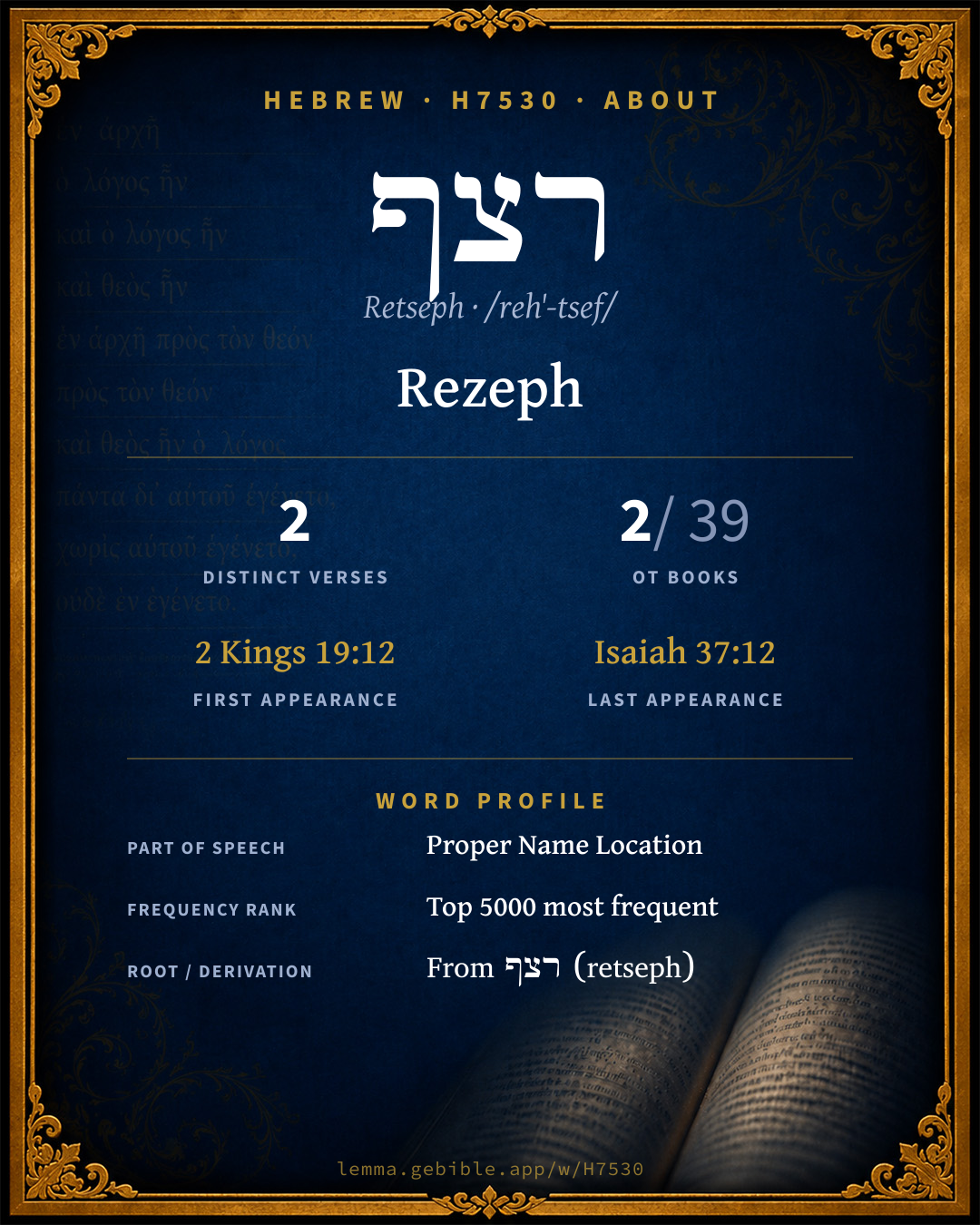
רֶ֫צֶף
Rezeph
BDB lists 2 entries for ‘Rezeph’ fuller range ↓
Full lexicon entry — Brown-Driver-Briggs (BDB)
From Brown-Driver-Briggs (BDB)
Where this word appears
Grammar key — what these labels mean
Noun type
- Proper
- A name of a specific person, place, or people (e.g. Abraham, Zion, Israel).
Every verse where H7530 appears — 2 distinct verses across 2 books. Click any verse to open its interlinear word-by-word view. Verse text shown in the World English Bible for context — . Each verse’s Hebrew form is shown with its reference; the English is not keyword-highlighted, since the data carries no word-level English alignment. Use “Compare translations” on any verse to read it across multiple English versions. This concordance covers the Hebrew Bible; Septuagint (Greek Old Testament) occurrences are not indexed here.
2 Kings 1 verse
Isaiah 1 verse
About this entry
At a glance — auto-summarized from this page’s data, not written by a person. Every figure links to its source below. This summary describes the numbers; it doesn’t interpret them.
The Hebrew name רצף centers on the idea of “Rezeph.” With only 2 verses it sits in the long tail of Hebrew Bible vocabulary. 2 Kings dominates its distribution — 1 of 2 verses. Debuting at 2 Kings 19:12, it then recurs through the corpus. For the data behind this summary, explore 2-verse concordance and the renderings breakdown below.
Gloss history
Strong's 1890 vs modern scholarship
About this word
Strong's H7530 catalogs a Hebrew word from the Hebrew Old Testament.
These counts are not copied from any lexicon or concordance. They are computed here, from the morphology-tagged Hebrew Old Testament. What Lemma adds →
- 2
- distinct verses
- The word appears in 2 distinct verses.
- 2 / 39
- OT books
- The word appears in 2 of 39 Old Testament books.
- #4,807
- by frequency
- Top 5000 most frequent Hebrew words (rank 4,807 of 8,640 Hebrew words by occurrence).
View all 2 occurrences in the concordance →
By traditional corpus
Conventional, traditional groupings — biblical authorship is debated, so this is a traditional corpus grouping, not an authorship claim. Each share is this word’s portion of its verses in that division of the Hebrew canon. Each figure is a share of the word’s 2 distinct verses.
- Prophets (Nevi'im) 2 verses · 100%
How translations render this word
Counts come from each version’s own published word-to-Strong’s tagging or interlinear alignment — an approximate guide to how each version renders this word, not a word-level alignment the data otherwise carries. Because each total is that version’s own tagged count, the per-version totals vary from one another and need not match the appearance or distinct-verse counts above. These counts may also differ from a printed concordance because Lemma counts each distinctly tagged rendering and does not collapse phrase taggings into a single head-word total. This is a fixed set of word-tagged versions (KJV, ASV, BSB, ULT) and does not change with the reading translation you choose elsewhere. Each version’s license is shown beside its name below (and on Sources).
- King James Version: Rezeph 2×
- American Standard Version: Rezeph 2×
- Berean Standard Bible: Rezeph 2×
- unfoldingWord Literal Text: Or rezeph 2×
King James Version Public Domain
Renders H7530 across 2 tagged occurrences — most commonly:
American Standard Version Public Domain
Renders H7530 across 2 tagged occurrences — most commonly:
Berean Standard Bible Public Domain
Renders H7530 across 2 tagged occurrences — most commonly:
unfoldingWord Literal Text CC BY-SA 4.0
Renders H7530 across 2 tagged occurrences — most commonly:
Senses in BDB
The 2 senses BDB distinguishes for this word, in lexicon order (not ranked by frequency or importance). The full entry — with sub-senses — is in the Lexicon Entry tab.
- Rezeph = "a hot stone"
- a place conquered by Assyria
Word origin
רֶ֫צֶף n.pr.loc. conquered by Assyr.
— Brown-Driver-Briggs (Oxford 1906, public domain), digitized via Sefaria, supplemented by the OpenScriptures HebrewLexicon (CC BY 4.0). See Sources.
Derived from רצף (retseph) (H7529) — hot stone.
Jastrow Dictionary
A second Hebrew/Aramaic lexicon for comparison, covering Aramaic and post-biblical (Talmudic, Targumic, Midrashic) usage that the biblical-Hebrew BDB does not. Matched by lemma rather than by Strong’s number, so a lemma may carry more than one Jastrow headword (shown separately below), and the entries cover usage well beyond the Bible.
רָצַף
- 1. to press, crush. Nidd. 14ᵃ שמש רְצָפָהּ the membrum may have crushed it.—Part. pass. רָצוּף; f. רְצוּפָה; pl. רְצוּפִים, רְצוּפִין; רְצוּפוֹת. Ib. מאכולת ר׳ a crushed louse.
- 2. (cmp. כָּתַת a. denom.) to join closely, to place in rows; to pave with blocks. Ohol. XVIII, 5 הרוֹצֵף … באבנים if one paves an unclean field (v. פְּרָס) with stones. Y. Orl. I, beg. 60ᶜ במשנה … לעצים ברוצף when he changes the usual order of planting; if he wants to use them for fuel, he plants the trees close together, &c., opp. משפה planting wide apart. Y. Kil. III, 28ᵈ bot. רוצף he who plants vegetables in a row, opp. עושה קלחים יחידים; a. e.—Part. pass. as ab. Esth. R. to I, 6 היה ביתו ר׳ וכ׳ his house was paved with precious stones and jewels. Neg. XI, 9 השתי אם היה ר׳ if the warp (on the loom) is close (the threads being properly arranged). B. Bath. 29ᵃ שלש … שאכלן ר׳ by the three years of which they speak is meant that he had the undisturbed usufruct for three years in succession, opp. מפוזרות. Ib. 37ᵇ אכלן ר׳ if he has had the usufruct of trees planted close together in rows (which shows that they were intended to be transplanted when grown older). Ib. מכרן ר׳ וכ׳ if he sold closely planted trees, the buyer cannot claim the soil. Y. M. Kat. I, 80ᶜ top, a. e. ר׳, opp. מרווחין, v. רָוַוח. Y. Gitt. VIII, end, 49ᵈ בר׳ when the signatures are close together, opp. מסורגין, v. סָרַג. Treat. Sof’rim I, 10, v. סָרַג; a. fr.—Trnsf. crowded, stuffed. Cant. R. to IV, 4; Gen. R. s. 32; a. fr., v. רֵיקָן.
- to be squeezed, crushed. Nidd. 25ᵇ, v. רָצַם. Bets. 28ᵇ שפוד שנ׳ (Ms. M. שנרצם, corr. acc.) a roasting spit which has been squeezed and bent, contrad. to נרצם.—[Tosef. M. Kat. I, 2 מרצפין ed. Zuck., read: מרבצין or מרביצין, v. רָבַץ.]
רְצַף
- 1. to join.—Part. pass. רָצִיף; pl. רְצִיפִין (Hebr. רְצוּ׳). Targ. Y. Lev. XII, 4, sq.
- 2. to weld by hammering. Zeb. 95ᵃ דרָצֵיף ליה מִירְּצַף Ms. M. (ed. דרציף מרציף) when he closes the hole up by hammering. Gen. R. s. 7 רְצוֹף רצפך וכ׳ hammer away thy hammering (strike me), for it is good for learning; [‘Rashi’: (the teacher saying to him that is punished) pave thy paving, i.e. lie down; v. רָצַף].
A Dictionary of the Targumim, the Talmud Babli and Yerushalmi, and the Midrashic Literature (Marcus Jastrow; London, Luzac, 1903) — Public Domain. Digitized via Sefaria. Digitized via Sefaria. Full attribution on Sources.
Same root — word family
Other BDB entries built from the same root as H7530, grouped by Strong’s listed origin. These share a root / origin per the lexicon — not necessarily a shared meaning. Each links to that word’s own entry.
Derives from
Shares the same root
Compare all same-root words → They share a root, not necessarily a meaning.
Bible dictionary
Public-domain dictionary articles matched to this entry by name (Rezeph). A biblical name can be shared by more than one person or place, so an article may treat several.
Easton's Bible Dictionary · M. G. Easton, 1897
Solid; a stone, (2 Kings 19:12; Isa. 37:12), a fortress near Haran, probably on the west of the Euphrates, conquered by Sennacherib.
Smith's Bible Dictionary · William Smith, 1863
(a hot stone), one of the places which Sennacherib mentions, in his taunting message to Hezekiah, as having been destroyed by his predecessor. (2 Kings 19:12; Isaiah 37:12)
Hitchcock's Bible Names Dictionary · Roswell D. Hitchcock, 1869
pavement; burning coal
Classic public-domain reference works; full attribution on Sources.
Septuagint verse parallels
This word appears in 2 verses that also exist in the Greek Old Testament (Septuagint), out of the 2 Hebrew verses it occurs in. You can read those verses in Greek by switching the Old Testament edition to the Septuagint.
Read these verses in the Septuagint
This is a verse-level parallel only — the same verses exist in both the Hebrew and Greek Old Testaments. No word-level Hebrew↔Greek correspondence is claimed: the data carries no such alignment, so no Greek word is shown as this Hebrew word’s translation. Coverage is not total — the Septuagint omits the deuterocanon and renumbers the Psalms, so some Hebrew verses have no direct Greek parallel.