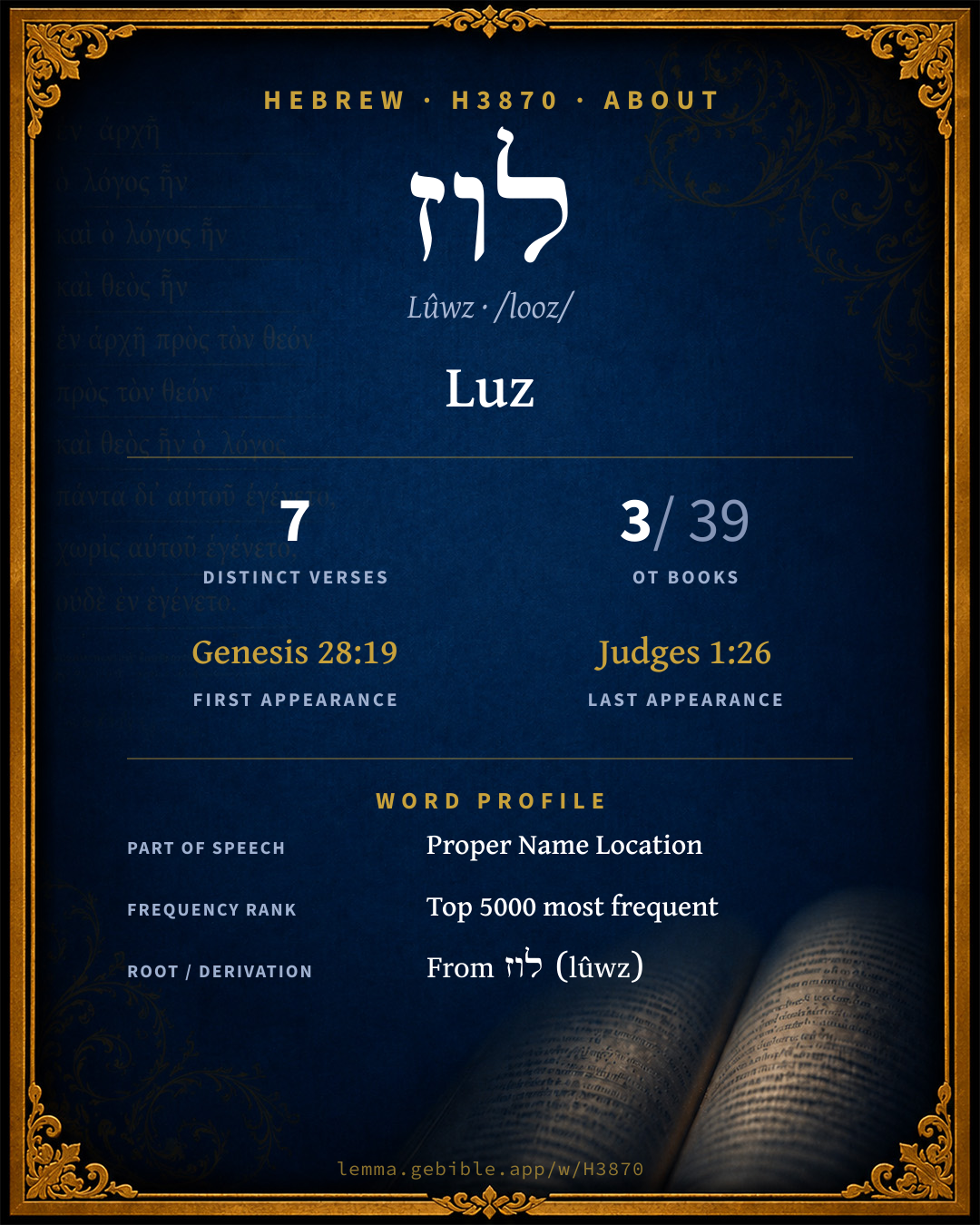
לוּז
Luz
BDB lists 3 entries for ‘Luz’ fuller range ↓
Full lexicon entry — Brown-Driver-Briggs (BDB)
From Brown-Driver-Briggs (BDB)
Where this word appears
Grammar key — what these labels mean
Part of speech
- Noun
- A naming word — a person, place, thing, or idea.
Noun type
- Proper
- A name of a specific person, place, or people (e.g. Abraham, Zion, Israel).
Every verse where H3870 appears — 7 distinct verses across 3 books. Click any verse to open its interlinear word-by-word view. Verse text shown in the World English Bible for context — . Each verse’s Hebrew form is shown with its reference; the English is not keyword-highlighted, since the data carries no word-level English alignment. Use “Compare translations” on any verse to read it across multiple English versions. This concordance covers the Hebrew Bible; Septuagint (Greek Old Testament) occurrences are not indexed here.
Genesis 3 verses
- Genesis 28:19 ל֥וּז n Proper He called the name of that place Bethel, but the name of the city was Luz at the first.
- Genesis 35:6 ל֗וּזָ/ה n Proper + sfx dem So Jacob came to Luz, which is in the land of Canaan (the same is Bethel), he and all the people who were with him.
- Genesis 48:3 בְּ/ל֖וּז prep + n Proper Jacob said to Joseph, "God Almighty appeared to me at Luz in the land of Canaan, and blessed me,
Joshua 2 verses
- Joshua 16:2 ל֑וּזָ/ה n Proper + sfx dem and it went out from Bethel to Luz, and passed along to the border of the Archites to Ataroth;
- Joshua 18:13 ל֗וּזָ/ה ל֨וּזָ/ה֙ n Proper + sfx dem n Proper + sfx dem The border passed along from there to Luz, to the side of Luz (the same is Bethel), southward; and the border went down to Ataroth Addar, by the mountain that lies on the south of Beth Horon the lower.
Judges 2 verses
About this entry
At a glance — auto-summarized from this page’s data, not written by a person. Every figure links to its source below. This summary describes the numbers; it doesn’t interpret them.
לוז — transliterated Lûwz — is a Hebrew name carrying the sense “Luz.” Debuting at Genesis 28:19, it then recurs through the corpus. Spanning 7 verses in 3 books, it ranks among the uncommon words of the Hebrew Bible. Its uses concentrate in Genesis (43% of all occurrences). See 7-verse concordance and the renderings breakdown below.
Gloss history
Strong's 1890 vs modern scholarship
About this word
Strong's H3870 catalogs a Hebrew word from the Hebrew Old Testament.
These counts are not copied from any lexicon or concordance. They are computed here, from the morphology-tagged Hebrew Old Testament. What Lemma adds →
- 7
- distinct verses
- The word appears in 7 distinct verses.
- 3 / 39
- OT books
- The word appears in 3 of 39 Old Testament books.
- #2,625
- by frequency
- Top 5000 most frequent Hebrew words (rank 2,625 of 8,640 Hebrew words by occurrence).
View all 7 occurrences in the concordance →
By section of the Old Testament
By traditional corpus
Conventional, traditional groupings — biblical authorship is debated, so this is a traditional corpus grouping, not an authorship claim. Each share is this word’s portion of its verses in that division of the Hebrew canon. Each figure is a share of the word’s 7 distinct verses.
- Prophets (Nevi'im) 4 verses · 57%
- Torah (Pentateuch) 3 verses · 43%
How translations render this word
Counts come from each version’s own published word-to-Strong’s tagging or interlinear alignment — an approximate guide to how each version renders this word, not a word-level alignment the data otherwise carries. Because each total is that version’s own tagged count, the per-version totals vary from one another and need not match the appearance or distinct-verse counts above. These counts may also differ from a printed concordance because Lemma counts each distinctly tagged rendering and does not collapse phrase taggings into a single head-word total. This is a fixed set of word-tagged versions (KJV, ASV, BSB, ULT) and does not change with the reading translation you choose elsewhere. Each version’s license is shown beside its name below (and on Sources).
BDB lists this Strong’s number as 3 distinct words (homographs). Each count above pools all of them and is not split by sense — see the Senses section below. A low-frequency rendering may belong to a different one of those words, not the primary meaning.
- King James Version†: Luz 4×
- American Standard Version†: Luz 4×, Was luz 2×
- Berean Standard Bible†: Luz 7×
- unfoldingWord Literal Text†: Luz 6×
King James Version Public Domain
Renders H3870 across 8† tagged occurrences — most commonly:
Plus 4 renderings that appear only once — usually multi-word phrases or single function words the recovered tagging swept in, not distinct renderings.
American Standard Version Public Domain
Renders H3870 across 8† tagged occurrences — most commonly:
Plus 2 renderings that appear only once — usually multi-word phrases or single function words the recovered tagging swept in, not distinct renderings.
Berean Standard Bible Public Domain
Renders H3870 across 7† tagged occurrences — most commonly:
Not rendered by a distinct English word in 1 further occurrence.
unfoldingWord Literal Text CC BY-SA 4.0
Renders H3870 across 8† tagged occurrences — most commonly:
Plus 2 renderings that appear only once — usually multi-word phrases or single function words the recovered tagging swept in, not distinct renderings.
Senses in the full BDB
Hebrew verbs can shift meaning by stem (binyan): Qal is the basic action, Niphal is often passive or reflexive, Piel often intensifies or makes it factitive, and Hiphil is typically causative. The senses below are grouped under the stem BDB assigns to each.
What do BDB’s symbols mean?
BDB uses these scholarly abbreviations:
| Symbol | Meaning |
|---|---|
| 𝔊 | the Septuagint (the ancient Greek translation, LXX) |
| 𝔙 | the Vulgate (the Latin translation) |
| 𝔖 | the Syriac version (the Peshitta) |
| 𝔗 | the Targum (the Aramaic translation) |
| ψ | the Psalms |
| √ | root (the underlying root or stem) |
| ‖ | parallel passage (a synonymous or contrasted parallel) |
| † | the dagger: every passage where the word occurs is cited |
The 5 senses and sub-senses the full Brown-Driver-Briggs lexicon distinguishes for this word, in lexicon order (not ranked by frequency), with BDB’s own verbatim wording and sub-sense lettering. Shown in Hebrew script with BDB’s own scholarly abbreviations. The condensed entry is in the Lexicon Entry tab. See also the Forms in the corpus table below.
לוז I (poet., mostly WsdLt) turn aside, depart (NH Niph., Hiph.
Qal
- Impf. אַל־יָלֻזוּ מֵעֵינֶ֑יךָ Pr 3:21 let them not (i.e. sound wisdom, etc., si vera l., cf. VB) depart from thine eyes (v. Hiph.). e.g. Proverbs 3:21
Niphal
- Pt. נָלוֹז Pr 3:32 Is 30:12; cstr. נְלוֹז Pr 14:2; pl. נְלוֹזִים 2:15;—fig., devious, crooked, נ׳ בְּמַעְגְּלֹתָם Pr 2:15 (‖ עִקְּשִׁים); נ׳ דְּרָכָיו 14:2; as subst. of pers. 3:32; of course of action Is 30:12 (‖ עֹשֶׁק), i.e. crookedness = craftiness, cunning, cf. De Che Di. e.g. Proverbs 3:32
Hiphil
- Impf. אַל־יַלִּיזוּ מֵעֵינֶיךָ Pr 4:21 (subj. דְּבָרַי) let them [my words] not depart (on form v. Ges§ 72 R. 9) from thine eyes (strictly, let them not practise, exhibit, deviation, direct causat., Köi. 205). e.g. Proverbs 4:21
לוז II [m.] almond-tree, almond-wood (NH id.
לוז III loc.
- 1. former name of Bethel Gn 28:19 (J), 35:6 (E), 48:3 (P), Jos 18:13(×2) (P), Ju 1:23; appar. distinct from B. מִבֵּית־אֵל לוּ֫זָה Jos 16:2 (JE; but ל׳ here perhaps explan. gloss, v. Di); 𝔊 Λουζα, Gn 28:19 [Ουλαμ]μαυς. e.g. Genesis 28:19
- 2. city in hands of Hittites Ju 1:26 (on conject. as to site v. GFM); 𝔊 Λουζα. e.g. Judges 1:26
Senses from the full Brown-Driver-Briggs lexicon (Brown, Driver, Briggs; Oxford 1906 — public domain), digitized via Sefaria, supplemented by the OpenScriptures HebrewLexicon (CC BY 4.0). Full attribution on Sources.
Word origin
I. vb. (poet., mostly WsdLt) turn aside, depart (NH Niph., Hiph.; Arabic لَاذَ have recourse to, take refuge in);—
II. n.[m.] almond-tree, almond-wood (NH id.; Aramaic לוּזָא, ܠܘܽܙܳܐ almond (LöwNo. 319), whence Arabic لَوْزٌ as loan-wd. (Frä145 LagBN 157 f.), Ethiopic ለውዝ );—Gn 30:37 (J; + לִבְנֶה, עַרְמוֹן לַח of rods stripped by Jacob.
— Brown-Driver-Briggs (Oxford 1906, public domain), digitized via Sefaria, supplemented by the OpenScriptures HebrewLexicon (CC BY 4.0). See Sources.
Derived from לוז (lûwz) (H3869) — almond.
Jastrow Dictionary
A second Hebrew/Aramaic lexicon for comparison, covering Aramaic and post-biblical (Talmudic, Targumic, Midrashic) usage that the biblical-Hebrew BDB does not. Matched by lemma rather than by Strong’s number, so a lemma may carry more than one Jastrow headword (shown separately below), and the entries cover usage well beyond the Bible.
לוּז I
- (b. h.) pr. n. pl.
- 1. Luz, in Palestine, identical with, or near, Bethel., in Palestine, identical with, or near, Bethel. Gen. R. s. 69, v. next w.; a. e.
- 2. Luz, in the land of the Hittites (Jud. I, 26), supposed to be Lizan in Kurdistan (v. Neub. Géogr., p. 394), a place, mentioned in the Talmud as still existing, from which the purple blue (תכלת) was imported. Snh. 12ᵃ (in a secret letter) דברים הנעשים בל׳ (not הנעשה) things manufactured in Luz (תכלת). Sot. 46ᵇ (ref. to Jud. l. c.) היא ל׳ שצובעין וכ׳ it is that Luz where they dye purple blue, which Sennaherib left undisturbed, and Nebucadnezar did not destroy, and where the angel of death has no permission to enter &c.; Gen. R. s. 69 (applied to Gen. XXVIII, 19). e.g. Judges 1:26
לוּז II
- (b. h.) nut, almond, hazel-nut; also nut-tree. Bekh. 8ᵃ וכנגדן באילן ל׳ corresponding to chickens (hatched in twenty one days) is the almond tree among trees; Y. Taan. IV, 68ᶜ bot. (ref. to שקד, Jer. I, 11) מה הל׳ הזה וכ׳ as the almond tree requires twenty one days from blossoming &c.; (Koh. R. to XII, 7 השקד). Gen. R. s. 69 (ref. to לוּז, v. preced.) מה ל׳ אין לו פה וכ׳ (some ed. לה, fem.) as the nut has no opening, so nobody could find the entrance to the town. Ib. ל׳ היה עומד וכ׳ a nut-tree stood before the entrance. Ib.; ib. s. 81 end, v. רָטַב; a. fr.—Pl. לוּזִים, לוּזִין. Y. Kil. I, 27ᵃ bot., v. בּוּטְמָא.—Trnsf. ל׳ של שדרה the nut of the spinal column, a hard vertebra, (Juden-knöchlein, v. Löw Pfl., p. 375 a. quot. ib. from Hyrtl, Das Arabische und Hebr. in der Anat., p. 165). Lev. R. s. 18; Koh. R. to XII, 5; a. e. e.g. Jeremiah 1:11
לוּז
- Targ. Gen. XXX, 37.—Pl. לוּזִין, לוּזַיָּא. Targ. Y. I Num. XVII, 23 (Y. II לוזין בר לוזיא; h. text שקדים). Targ. Y. Gen. XLIII, 11.
לוּז III
- (b. h.) to turn, bend, twist.
- to be perverse, v. infra.
- or הִלִּיז to turn. Kil. IX, 8 (play on נ̇ז̇ in שעטנז, v. נוּז) נָלוֹז ומֵלִיז הוא את אביו שבשמים עליו (or ומַלִּיז) he (who disregards the law of שַׁעטְנֵז) is perverse and turns his Father in heaven against him; [Comment. ‘and turns away (estranges) his Father … on his account’].
לוּז IV
- (v. לָעַז) to talk about, sneer, talk disrespectfully.
- same. Y. Dem. II, 22ᶜ bot. היו הכל מְלִיזִין עליו all people talked against him. Lev. R. s. 6, beg. Cant. R. to IV, 12 ושמע קול הבריות מליזין אחר וכ׳ heard the people talk evil of his daughters. Gen. R. s. 54 מליזין בארון spoke disrespectfully of the ark (v. Sot. 35ᵃ sq.); a. fr.—Y. Shek. V, 49ᵃ bot. מליזין (some Bab. ed. מַלְעִיזִין).
A Dictionary of the Targumim, the Talmud Babli and Yerushalmi, and the Midrashic Literature (Marcus Jastrow; London, Luzac, 1903) — Public Domain. Digitized via Sefaria. Digitized via Sefaria. Full attribution on Sources.
Forms in the corpus
The 7 distinct written forms H3870 takes in the Hebrew Bible, most frequent first — each parse links to that state’s occurrences in the concordance. Hebrew forms include their vowel points and cantillation, so a single lemma takes many written forms.
| Form | Parsing | Example | Uses |
|---|---|---|---|
| ל֗וּזָ/ה | Noun, Proper | Genesis 35:6 | 2 |
| בְּ/ל֖וּז | Noun, Proper | Genesis 48:3 | 1 |
| ל֑וּזָ/ה | Noun, Proper | Joshua 16:2 | 1 |
| ל֔וּז | Noun, Proper | Judges 1:26 | 1 |
| ל֥וּז | Noun, Proper | Genesis 28:19 | 1 |
| ל֨וּזָ/ה֙ | Noun, Proper | Joshua 18:13 | 1 |
| לֽוּז | Noun, Proper | Judges 1:23 | 1 |
Bible dictionary
Public-domain dictionary articles matched to this entry by name (Luz). A biblical name can be shared by more than one person or place, so an article may treat several.
Easton's Bible Dictionary · M. G. Easton, 1897
A nut-bearing tree, the almond. (1.) The ancient name of a royal Canaanitish city near the site of Bethel (Gen. 28:19; 35:6), on the border of Benjamin (Josh. 18:13). Here Jacob halted, and had a prophetic vision. (See BETHEL.)
(2.) A place in the land of the Hittites, founded (Judg. 1:26) by "a man who came forth out of the city of Luz." It is identified with Luweiziyeh, 4 miles north-west of Banias.
Smith's Bible Dictionary · William Smith, 1863
(almond tree). It seems impossible to discover with precision whether Luz and Bethel represent one and the same town--the former the Canannite, the latter the Hebrew, name--or whether they were distinct places, though in close proximity. The most probable conclusion is that the two places were, during the times preceding the conquest, distinct, Luz being the city and Bethel the pillar and altar of Jacob that after the destruction of Luz by the tribe of Ephraim the town of Bethel arose. When the original Luz was destroyed, through the treachery of one of its inhabitants, the man who had introduced the Israelites into the town went into the "land of the Hittites" and built a city which he named after the former one. (Judges 1:28) Its situation, as well as that of the land of the Hittites," has never been discovered, and is one of the favorable puzzles of Scripture geographers.
Hitchcock's Bible Names Dictionary · Roswell D. Hitchcock, 1869
separation; departure; an almond
Classic public-domain reference works; full attribution on Sources.
Septuagint verse parallels
This word appears in 7 verses that also exist in the Greek Old Testament (Septuagint), out of the 7 Hebrew verses it occurs in. You can read those verses in Greek by switching the Old Testament edition to the Septuagint.
Read these verses in the Septuagint
This is a verse-level parallel only — the same verses exist in both the Hebrew and Greek Old Testaments. No word-level Hebrew↔Greek correspondence is claimed: the data carries no such alignment, so no Greek word is shown as this Hebrew word’s translation. Coverage is not total — the Septuagint omits the deuterocanon and renumbers the Psalms, so some Hebrew verses have no direct Greek parallel.