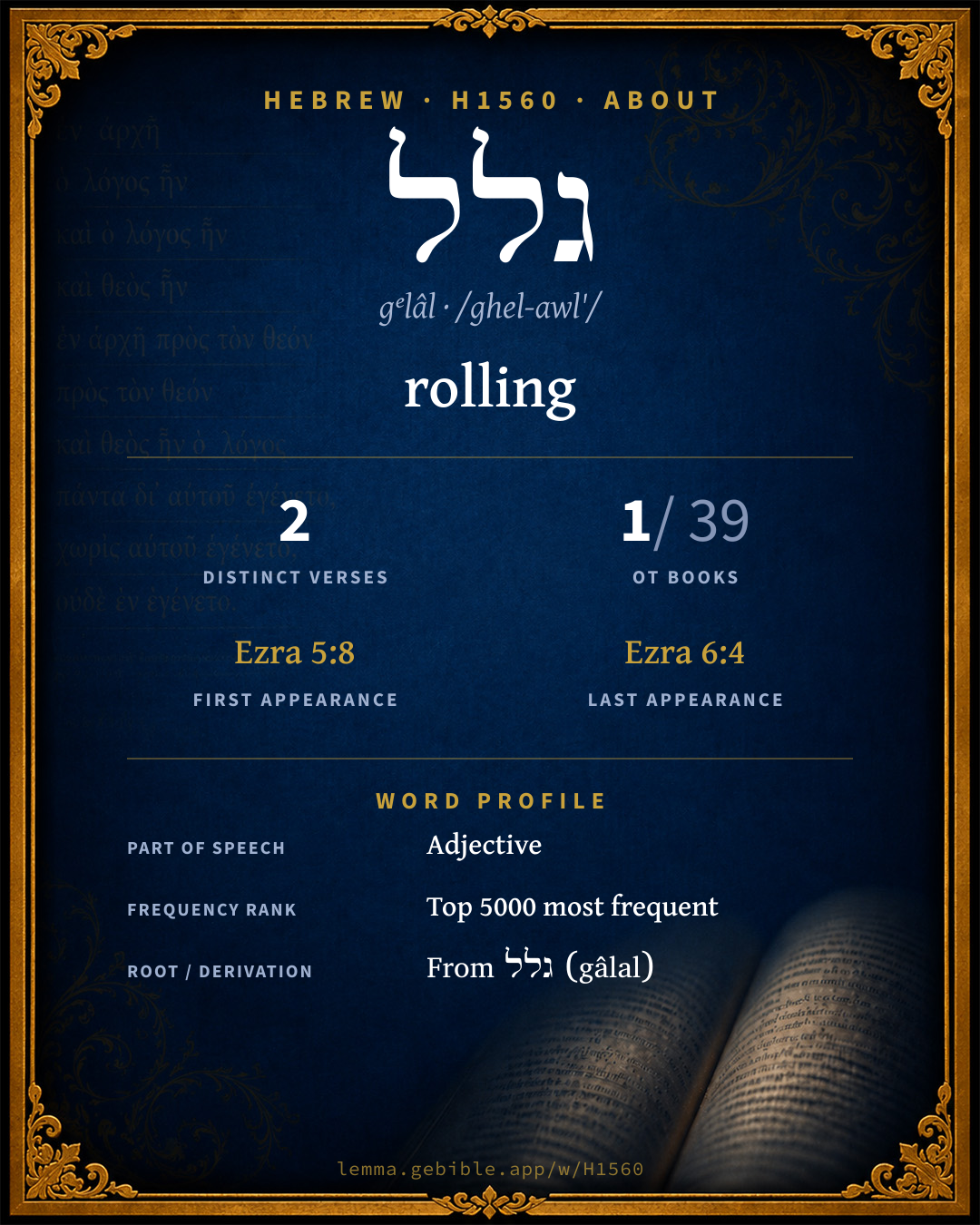
גְּלָל
rolling
Full lexicon entry — Brown-Driver-Briggs (BDB)
From Brown-Driver-Briggs (BDB)
Where this word appears
Grammar key — what these labels mean
Part of speech
- Noun
- A naming word — a person, place, thing, or idea.
Noun type
- Common
- A common noun — a general class of person, place, or thing (“king,” “city,” “water”), not a specific name.
State
- Absolute
- The independent form of a noun, not bound to a following word.
Gender
- Masculine
- Grammatically masculine.
Number
- Singular
- One.
Every verse where H1560 appears — 2 distinct verses across 1 book. Click any verse to open its interlinear word-by-word view. Verse text shown in the World English Bible for context — . Each verse’s Hebrew form is shown with its reference; the English is not keyword-highlighted, since the data carries no word-level English alignment. Use “Compare translations” on any verse to read it across multiple English versions. This concordance covers the Hebrew Bible; Septuagint (Greek Old Testament) occurrences are not indexed here.
Ezra 2 verses
- Ezra 5:8 גְּלָ֔ל n c ms Be it known to the king, that we went into the province of Judah, to the house of the great God, which is built with great stones, and timber is laid in the walls; and this work goes on with diligence and prospers in their hands.
- Ezra 6:4 גְּלָל֙ n c ms with three courses of great stones, and a course of new timber: and let the expenses be given out of the king's house.
About this entry
At a glance — auto-summarized from this page’s data, not written by a person. Every figure links to its source below. This summary describes the numbers; it doesn’t interpret them.
גלל (gᵉlâl) is a Hebrew adjective most often rendered “rolling.” It is rare — just 2 verses in the entire Hebrew Bible. It clusters heavily in Ezra, which alone accounts for 100% of its uses. First canonically at Ezra 5:8, it enters the text early. Related forms include גלל, גל and גל. See the sense tree, 2-verse concordance, and the renderings breakdown below.
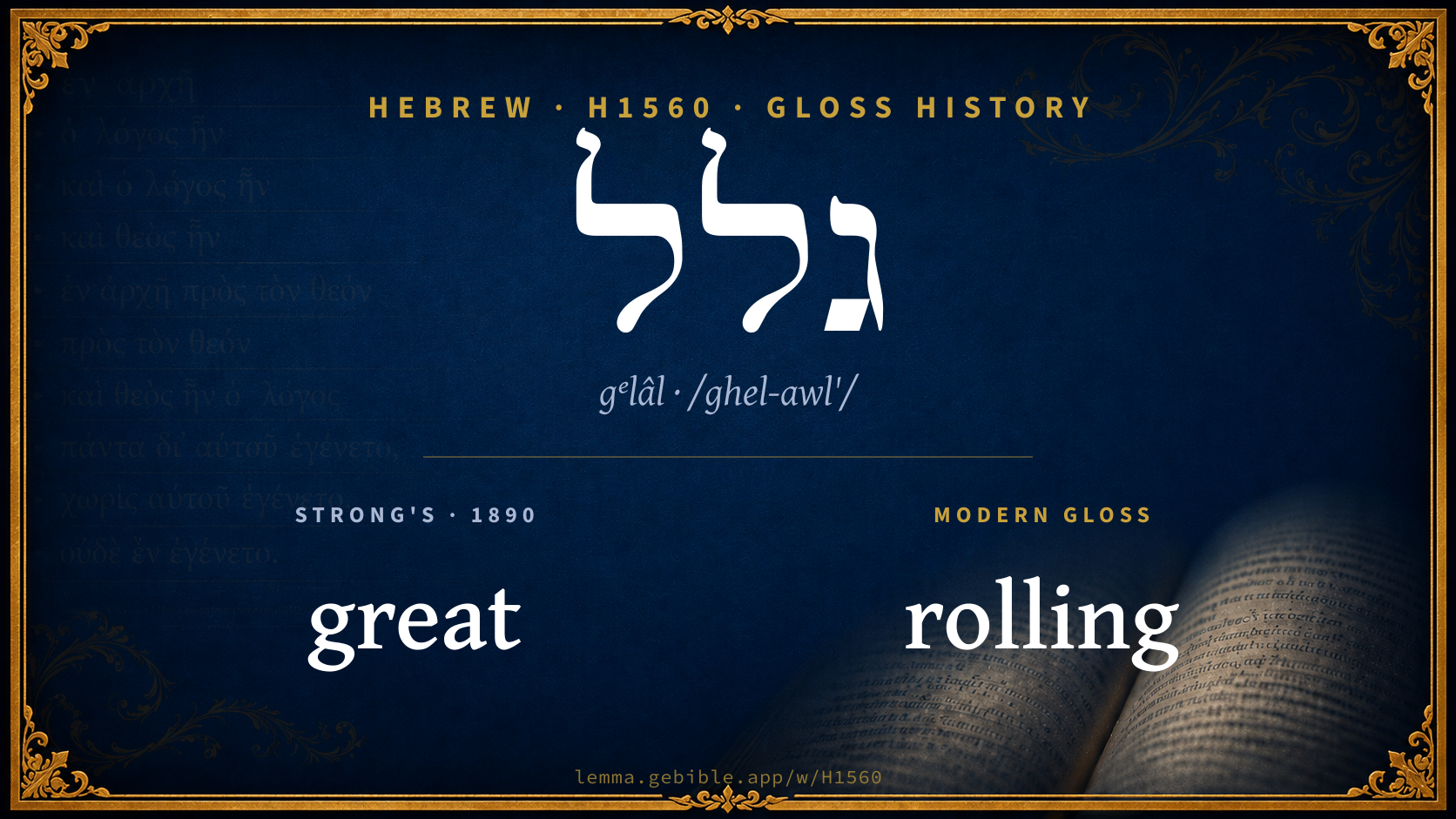
Gloss history
Strong's 1890 vs modern scholarship
About this word
Strong's H1560 catalogs a Hebrew word from the Hebrew Old Testament.
These counts are not copied from any lexicon or concordance. They are computed here, from the morphology-tagged Hebrew Old Testament. What Lemma adds →
- 2
- distinct verses
- The word appears in 2 distinct verses.
- 1 / 39
- OT books
- The word appears in 1 of 39 Old Testament books.
- #4,807
- by frequency
- Top 5000 most frequent Hebrew words (rank 4,807 of 8,640 Hebrew words by occurrence).
View all 2 occurrences in the concordance →
Most concentrated in
- Ezra 2 verses 100%
By section of the Old Testament
By traditional corpus
Conventional, traditional groupings — biblical authorship is debated, so this is a traditional corpus grouping, not an authorship claim. Each share is this word’s portion of its verses in that division of the Hebrew canon. Each figure is a share of the word’s 2 distinct verses.
- Writings (Ketuvim) 2 verses · 100%
How translations render this word
Counts come from each version’s own published word-to-Strong’s tagging or interlinear alignment — an approximate guide to how each version renders this word, not a word-level alignment the data otherwise carries. Because each total is that version’s own tagged count, the per-version totals vary from one another and need not match the appearance or distinct-verse counts above. These counts may also differ from a printed concordance because Lemma counts each distinctly tagged rendering and does not collapse phrase taggings into a single head-word total. This is a fixed set of word-tagged versions (KJV, ASV, BSB, ULT) and does not change with the reading translation you choose elsewhere. Each version’s license is shown beside its name below (and on Sources).
- King James Version: Great 2×
- American Standard Version: Great 2×
- Berean Standard Bible: not separately translated
- unfoldingWord Literal Text: Large 2×
King James Version Public Domain
Renders H1560 across 2 tagged occurrences — most commonly:
American Standard Version Public Domain
Renders H1560 across 2 tagged occurrences — most commonly:
Berean Standard Bible Public Domain
Does not render H1560 with a distinct English word (not separately translated in its 2 tagged occurrences).
unfoldingWord Literal Text CC BY-SA 4.0
Renders H1560 across 2 tagged occurrences — most commonly:
Senses in BDB
The 1 sense BDB distinguishes for this word, in lexicon order (not ranked by frequency or importance). The full entry — with sub-senses — is in the Lexicon Entry tab.
- rolling
Word origin
Derived from גלל (gâlal) (H1556) — to roll.
Jastrow Dictionary
A second Hebrew/Aramaic lexicon for comparison, covering Aramaic and post-biblical (Talmudic, Targumic, Midrashic) usage that the biblical-Hebrew BDB does not. Matched by lemma rather than by Strong’s number, so a lemma may carry more than one Jastrow headword (shown separately below), and the entries cover usage well beyond the Bible.
גָּלַל
- (b. h.)
- 1. to roll, unfold, fold. Meg. 32ᵃ he opens (the scroll), sees the place (to read from), גּוֹלֵל ומברך rolls it up again and says the benediction. Ib. הגּוֹלֵל ס"ת וכ׳ he who rolls the scrolls up (preparing the place to read from). B. Mets. II, 8 (29ᵇ) גוֹלְלָן he must roll the scrolls over (for the purpose of airing); a. fr.
- 2. (v. Gen. XXIX, 3) to roll off (one’s shoulders), disregard. Gen. R. s. 21 (play on גללו, Job XX, 7) על שג׳ מצוה וכ׳ because he disregarded a light command. e.g. Genesis 29:3
- to be rolled, folded. Cant. R. to V, 14 והיו נִגְלָלִין they could be folded up. Snh. 68ᵃ my two arms which are like two scrolls of the Law שנגללין rolled up (not unfolded, i.e. with me learning is buried which I was prevented from teaching).—Trnsf., with על, to be rolled on top of, to prevail. Ber. 7ᵃ יִגּוֹלּוּ רחמי על וכ׳ may my mercy prevail over my attributes (of justice &c.). Ib. יגולו רחמיך; v. גִּלְגֵּל.
- to be rolled up, folded. Taan. 21ᵇ; Men. 95ᵃ הוּגְלְלוּ הפרוכות when the curtains (of the Tabernacle) were folded up (for removing).
גְּלַל
- , to roll, unfold.—Part. pass. גְּלִיל unfolded, visible. Targ. Cant. V, 14.
- to roll off. Targ. Y. II, Gen. XXVIII, 10 (some ed. לִגְלָלָא Pe.).
- , v. גַּלְגֵּל, Ithpalp.
גָּלָל
- preced.)
- 1. rolling along with, appendage. Men. 15ᵃ; Pes. 13ᵇ לחם ג׳ תודה the bread is an appendage of the thank-offering; Men. 80ᵃ לִגְלַל תודה.—בִּגְלַל in consequence of, on account of, v. next w.
- 2. something rolled, rounded, ball, ordure, excrement, dung. B. Kam. III, 3 ההופך את הג׳ he who upturns (throws up) ordure into the street.—Pl. גְּלָלִים, גְּלָלִין. Sabb. 153ᵇ להטיל ג׳ to cast excrements (of animals). Lev. R. s. 16; Esth. R. to III, 1 מה הג׳ הללו וכ׳ as the dung is repulsive.
- 3. (with כְּלֵי) a material used for vessels, supposed to be baked ordure. Kel. X, 1. Par. V, 5. Mikv. IV, 1; Sabb. 16ᵇ. Men. 69ᵃ; 69ᵇ; a. fr. [Rashi to Sabb. l. c. expl. ג׳ = שייש, marble, to Men. l. c. = צפיעי בקר.]
גְּלָל
- 1. untrimmed stone, cobble (v. גְּוִיל). [Ezra V, 8.]—Ḥull. 63ᵃ אתא ג׳ a stone fell (from on high); Yalk. Zech. 578 גלאלא. Gitt. 47ᵃ Ar. (ed. גַּלְגַּלְתָּא). Ab. Zar. 22ᵇ, v. דַּגָּלָא. e.g. Ezra 5:8
- 2. lump.—Pl. גְּלָלֵי. Ḥull. 112ᵃ bot. תרי ג׳ דמלחא Rashi (ed. ג׳ מלחא) two lumps of salt.
- 3. ordure, v. גַּלָּא.—Pl. as supra. B. Kam. 92ᵇ (prov.) a dog in his hunger ג׳ מבלע (Ms. H. sing.) will swallow excrements (Rashi: stones).
- 4. wave, v. גַּלָּא.
- 5. consequence; בג׳ on account of, in order to. Targ. Ps. XL, 12 (Ms. ג׳ היכנא). Targ. II Chr. XXIV, 25; a. e.
A Dictionary of the Targumim, the Talmud Babli and Yerushalmi, and the Midrashic Literature (Marcus Jastrow; London, Luzac, 1903) — Public Domain. Digitized via Sefaria. Digitized via Sefaria. Full attribution on Sources.
Forms in the corpus
The 2 distinct written forms H1560 takes in the Hebrew Bible, most frequent first — each parse links to that state’s occurrences in the concordance. Hebrew forms include their vowel points and cantillation, so a single lemma takes many written forms.
| Form | Parsing | Example | Uses |
|---|---|---|---|
| גְּלָ֔ל | Noun, Common, Masculine, Singular, Absolute | Ezra 5:8 | 1 |
| גְּלָל֙ | Noun, Common, Masculine, Singular, Absolute | Ezra 6:4 | 1 |
Same root — word family
Other BDB entries built from the same root as H1560, grouped by Strong’s listed origin. These share a root / origin per the lexicon — not necessarily a shared meaning. Each links to that word’s own entry.
Derives from
Shares the same root
- גל gal H1530 wave
- גל gôl H1531 bowl, basin
- גלגל galgal H1534 whirlwind
- גלגלת gulgôleth H1538 skull
- גלה gullâh H1543 bowl
- גלול gillûwl H1544 idols
- גליל gâlîyl H1550 circuit
- גלל gâlâl H1557 dung
- גלל gâlâl H1558 on account of
- מגלה mᵉgillâh H4039 scroll
Proper names from this root
People and places named from this root — a name, not an additional meaning of the word.
Compare all same-root words → Showing 4 of 13 — not the complete family. 1 of the same-root words is a proper name (a person or place). They share a root, not necessarily a meaning.
Septuagint verse parallels
This word appears in 2 verses that also exist in the Greek Old Testament (Septuagint), out of the 2 Hebrew verses it occurs in. You can read those verses in Greek by switching the Old Testament edition to the Septuagint.
Read these verses in the Septuagint
This is a verse-level parallel only — the same verses exist in both the Hebrew and Greek Old Testaments. No word-level Hebrew↔Greek correspondence is claimed: the data carries no such alignment, so no Greek word is shown as this Hebrew word’s translation. Coverage is not total — the Septuagint omits the deuterocanon and renumbers the Psalms, so some Hebrew verses have no direct Greek parallel.