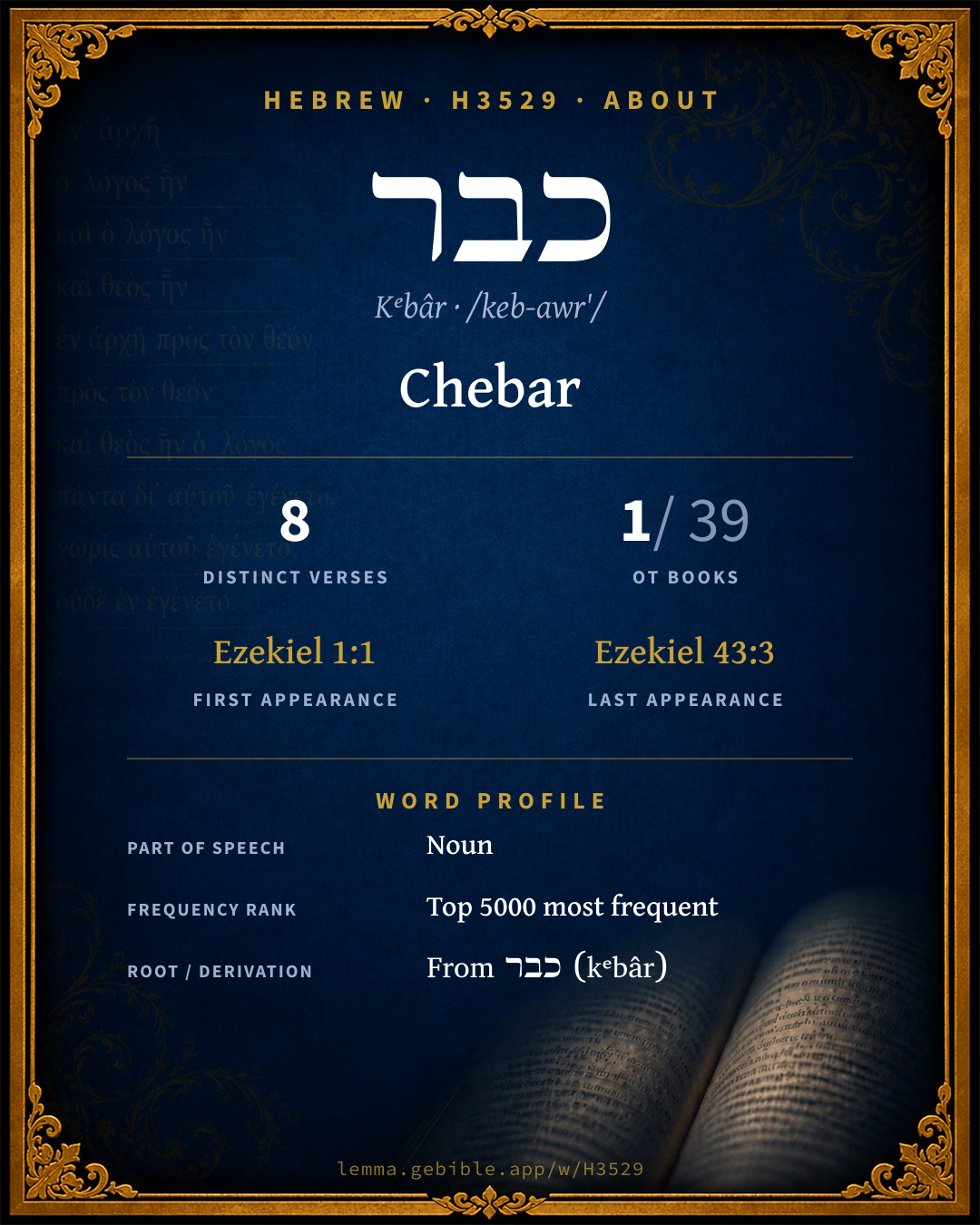
כְּבָר
Chebar
BDB lists 2 entries for ‘Chebar’ fuller range ↓
Full lexicon entry — Brown-Driver-Briggs (BDB)
From Brown-Driver-Briggs (BDB)
Where this word appears
Grammar key — what these labels mean
Part of speech
- Noun
- A naming word — a person, place, thing, or idea.
Noun type
- Proper
- A name of a specific person, place, or people (e.g. Abraham, Zion, Israel).
Every verse where H3529 appears — 8 distinct verses across 1 book. Click any verse to open its interlinear word-by-word view. Verse text shown in the World English Bible for context — . Each verse’s Hebrew form is shown with its reference; the English is not keyword-highlighted, since the data carries no word-level English alignment. Use “Compare translations” on any verse to read it across multiple English versions. This concordance covers the Hebrew Bible; Septuagint (Greek Old Testament) occurrences are not indexed here.
Ezekiel 8 verses
- Ezekiel 1:1 כְּבָ֑ר n Proper Now it happened in the thirtieth year, in the fourth [month], in the fifth [day] of the month, as I was among the captives by the river Chebar, that the heavens were opened, and I saw visions of God.
- Ezekiel 1:3 כְּבָ֑ר n Proper the word of Yahweh came expressly to Ezekiel the priest, the son of Buzi, in the land of the Chaldeans by the river Chebar; and the hand of Yahweh was there on him.
- Ezekiel 3:15 כְּבָר֙ n Proper Then I came to them of the captivity at Tel Aviv, that lived by the river Chebar, and to where they lived; and I sat there overwhelmed among them seven days.
- Ezekiel 3:23 כְּבָ֑ר n Proper Then I arose, and went forth into the plain: and, behold, the glory of Yahweh stood there, as the glory which I saw by the river Chebar; and I fell on my face.
- Ezekiel 10:15 כְּבָֽר n Proper The cherubim mounted up: this is the living creature that I saw by the river Chebar.
- Ezekiel 10:20 כְּבָ֑ר n Proper This is the living creature that I saw under the God of Israel by the river Chebar; and I knew that they were cherubim.
- Ezekiel 10:22 כְּבָ֔ר n Proper As for the likeness of their faces, they were the faces which I saw by the river Chebar, their appearances and themselves; they went every one straight forward.
- Ezekiel 43:3 כְּבָ֑ר n Proper It was according to the appearance of the vision which I saw, even according to the vision that I saw when I came to destroy the city; and the visions were like the vision that I saw by the river Chebar; and I fell on my face.
About this entry
At a glance — auto-summarized from this page’s data, not written by a person. Every figure links to its source below. This summary describes the numbers; it doesn’t interpret them.
“Chebar” is the headline sense of the Hebrew name כבר (Kᵉbâr). It clusters heavily in Ezekiel, which alone accounts for 100% of its uses. It turns up in 8 verses across 1 book, an uncommon footprint. First canonically at Ezekiel 1:1, it enters the text early. See 8-verse concordance and the renderings breakdown below.
Gloss history
Strong's 1890 vs modern scholarship
About this word
Strong's H3529 catalogs a Hebrew word from the Hebrew Old Testament.
These counts are not copied from any lexicon or concordance. They are computed here, from the morphology-tagged Hebrew Old Testament. What Lemma adds →
- 8
- distinct verses
- The word appears in 8 distinct verses.
- 1 / 39
- OT books
- The word appears in 1 of 39 Old Testament books.
- #2,625
- by frequency
- Top 5000 most frequent Hebrew words (rank 2,625 of 8,640 Hebrew words by occurrence).
View all 8 occurrences in the concordance →
Most concentrated in
- Ezekiel 8 verses 100%
By section of the Old Testament
By traditional corpus
Conventional, traditional groupings — biblical authorship is debated, so this is a traditional corpus grouping, not an authorship claim. Each share is this word’s portion of its verses in that division of the Hebrew canon. Each figure is a share of the word’s 8 distinct verses.
- Prophets (Nevi'im) 8 verses · 100%
How translations render this word
Counts come from each version’s own published word-to-Strong’s tagging or interlinear alignment — an approximate guide to how each version renders this word, not a word-level alignment the data otherwise carries. Because each total is that version’s own tagged count, the per-version totals vary from one another and need not match the appearance or distinct-verse counts above. These counts may also differ from a printed concordance because Lemma counts each distinctly tagged rendering and does not collapse phrase taggings into a single head-word total. This is a fixed set of word-tagged versions (KJV, ASV, BSB, ULT) and does not change with the reading translation you choose elsewhere. Each version’s license is shown beside its name below (and on Sources).
BDB lists this Strong’s number as 2 distinct words (homographs). Each count above pools all of them and is not split by sense — see the Senses section below. A low-frequency rendering may belong to a different one of those words, not the primary meaning.
- King James Version†: Chebar 8×
- American Standard Version†: Chebar 8×
- Berean Standard Bible†: Kebar 8×
- unfoldingWord Literal Text†: Kebar 8×
King James Version Public Domain
Renders H3529 across 8† tagged occurrences — most commonly:
American Standard Version Public Domain
Renders H3529 across 8† tagged occurrences — most commonly:
Berean Standard Bible Public Domain
Renders H3529 across 8† tagged occurrences — most commonly:
unfoldingWord Literal Text CC BY-SA 4.0
Renders H3529 across 8† tagged occurrences — most commonly:
Senses in the full BDB
What do BDB’s symbols mean?
BDB uses these scholarly abbreviations:
| Symbol | Meaning |
|---|---|
| 𝔊 | the Septuagint (the ancient Greek translation, LXX) |
| 𝔙 | the Vulgate (the Latin translation) |
| 𝔖 | the Syriac version (the Peshitta) |
| 𝔗 | the Targum (the Aramaic translation) |
| ψ | the Psalms |
| √ | root (the underlying root or stem) |
| ‖ | parallel passage (a synonymous or contrasted parallel) |
| † | the dagger: every passage where the word occurs is cited |
The 0 senses and sub-senses the full Brown-Driver-Briggs lexicon distinguishes for this word, in lexicon order (not ranked by frequency), with BDB’s own verbatim wording and sub-sense lettering. Shown in Hebrew script with BDB’s own scholarly abbreviations. The condensed entry is in the Lexicon Entry tab. See also the Forms in the corpus table below.
כבר I (late) already (freq. in Mish. and NH
כבר II fl. Kĕbār, a river (or perhaps a canal) of Babylonia, not at present identified, by wh. the exiles, among whom Ez. ministered, were settled
Senses from the full Brown-Driver-Briggs lexicon (Brown, Driver, Briggs; Oxford 1906 — public domain), digitized via Sefaria, supplemented by the OpenScriptures HebrewLexicon (CC BY 4.0). Full attribution on Sources.
Word origin
I. adv. (late) already (freq. in Mish. and NH; 𝔗 כבר (rare) Syriac ܟܒܰܪ usually perhaps, occas. already (Mt 11:21 Heb 1:1); Mand. כבאר already, NöM. p. 202. Der. uncertain, connexion with √ כבר being dub.)—already, Ec 1:10 כְּבָר הָיָה it hath already been, 2:12, 16; 3:15(×2); 4:2; 6:10; 9:6, 7.
II. n.pr.fl. Kĕbār, a river (or perhaps a canal) of Babylonia, not at present identified, by wh. the exiles, among whom Ez. ministered, were settled; always in the phr. נְהַר כְּבָר Ez 1:1, 3; 3:15, 23; 10:15, 20, 22; 43:3 (cf. Sm Ez 1:1 DelPar. 47f., 184).
— Brown-Driver-Briggs (Oxford 1906, public domain), digitized via Sefaria, supplemented by the OpenScriptures HebrewLexicon (CC BY 4.0). See Sources.
Derived from כבר (kᵉbâr) (H3528) — already.
Jastrow Dictionary
A second Hebrew/Aramaic lexicon for comparison, covering Aramaic and post-biblical (Talmudic, Targumic, Midrashic) usage that the biblical-Hebrew BDB does not. Matched by lemma rather than by Strong’s number, so a lemma may carry more than one Jastrow headword (shown separately below), and the entries cover usage well beyond the Bible.
כְּבָר I
- (b. h.) pr. n., נְהַר כ׳ river (or channel) K’bar (Chebar) in Babylonia. Gen. R. s. 16 הוא פרת הוא נ׳ כ׳ Euphrates and K. are the same. Ib. כ׳ בפני עצמו וכ׳ K. and Euphrates are different rivers. Ib. כ׳ שמימיו כלין it is called K’bar (v. next w.), because its waters give out; שפירותיו גסין ואינן יורדין בכברה because its fruits are large and go not into the basket; (Yalk. Gen. 22 שמימיו קַלִּין).
כְּבָר II
- (b. h.; = זמן כבר; כבר to be thick, strong, round) a long time since; long ago, already; once. Sabb. 51ᵃ, a. e. כ׳ הורה זקן it has already been decided by an authority. Ber. 63ᵃ bot. כ׳ בנית וכ׳ you have once built and can no more tear down, (having once praised me, you cannot now censure me). Y. Sabb. XIV, 14ᶜ bot. וכ׳ חלה וכ׳ and once when he was taken sick, and &c. Num. R. s. 3, end כ׳ נקדתי עליהם have I not put does upon them (to mark that the words are spurious)? [Ib. כ׳ אמחוק וכ׳, read: אוֹמַר I shall say, I will erase &c.]—Y. Gitt. VII, end, 49ᵃ מִכְּ׳ (retroactively) at once; a. fr.
כְּבַר I
- Targ. Koh. I, 10. Targ. Jer. XXXVIII, 9 כ׳ מית he would have been dead by this time; a. fr.—B. Bath. 167ᵃ, a. e. כ׳ קדמוך רבנן our rabbis have long preceded thee (have warned us before this); a. fr.
כָּבַר
- (denom. of כְּבָרָה) to sift. Gen. R. s. 4 אדם כּוֹבֵר בכברה … if one sifts wheat or straw in a sieve. Ohol. XVIII, 2 וכוֹבְרוֹ בשתי כברות and sifts it twice. Maasr. I, 6 הקיטניות משיִכְבּוֹר peas are subject to tithes from the time he sifts them. Ruth R., end וכ׳ את הצבר וכ׳ (not וכבד) and sifted one pile. Y. Ab. Zar. IV, 44ᵇ top … טוחנין כוללין, read כּוֹבְרִין; a. fr.—Part. pass. כָּבוּר. Y. Maasr. I, 49ᵃ bot. מן הכ׳ וכ׳ from the portion which has been sifted in behalf of that which has not.
- to be sifted. Tosef. Ter. X, 15 שדרכו לִיכָּבֵר (not לוכבד) which it is customary to sift.
כְּבַר II
- , Pa. כַּבֵּיר (denom. of כַּבָּרִיתָא) to fumigate with sulphur, to bleach. Ber. 27ᵇ לכַבָּרוּיֵי סלי to fumigate baskets. B. Kam. 93ᵇ דכַבְּרֵיה כברויי when he (in addition) bleached the wool with sulphur.
*כְּבַר III
- to be heavy, to grieve; Af. אַכְבִּיר to irritate, grieve, v. כְּבַד.
A Dictionary of the Targumim, the Talmud Babli and Yerushalmi, and the Midrashic Literature (Marcus Jastrow; London, Luzac, 1903) — Public Domain. Digitized via Sefaria. Digitized via Sefaria. Full attribution on Sources.
Forms in the corpus
The 4 distinct written forms H3529 takes in the Hebrew Bible, most frequent first — each parse links to that state’s occurrences in the concordance. Hebrew forms include their vowel points and cantillation, so a single lemma takes many written forms.
| Form | Parsing | Example | Uses |
|---|---|---|---|
| כְּבָ֑ר | Noun, Proper | Ezekiel 1:1 | 5 |
| כְּבָ֔ר | Noun, Proper | Ezekiel 10:22 | 1 |
| כְּבָֽר | Noun, Proper | Ezekiel 10:15 | 1 |
| כְּבָר֙ | Noun, Proper | Ezekiel 3:15 | 1 |
Same root — word family
Other BDB entries built from the same root as H3529, grouped by Strong’s listed origin. These share a root / origin per the lexicon — not necessarily a shared meaning. Each links to that word’s own entry.
Derives from
Shares the same root
Compare all same-root words → They share a root, not necessarily a meaning.
Bible dictionary
Public-domain dictionary articles matched to this entry by name (Chebar). A biblical name can be shared by more than one person or place, so an article may treat several.
Easton's Bible Dictionary · M. G. Easton, 1897
Length, a river in the "land of the Chaldeans" (Ezek. 1:3), on the banks of which were located some of the Jews of the Captivity (Ezek. 1:1; 3:15, 23; 10:15, 20, 22). It has been supposed to be identical with the river Habor, the Chaboras, or modern Khabour, which falls into the Euphrates at Circesium. To the banks of this river some of the Israelites were removed by the Assyrians (2 Kings 17:6). An opinion that has much to support it is that the "Chebar" was the royal canal of Nebuchadnezzar, the Nahr Malcha, the greatest in Mesopotamia, which connected the Tigris with the Euphrates, in the excavation of which the Jewish captives were probably employed.
Smith's Bible Dictionary · William Smith, 1863
(length), a river in the "land of the Chaldeans." (Ezekiel 1:3; 3:15,23) etc. It is commonly regarded as identical with the Habor, (2 Kings 17:6) and perhaps the Royal Canal of Nebuchadnezzar,--the greatest of all the cuttings in Mesopotamia.
Hitchcock's Bible Names Dictionary · Roswell D. Hitchcock, 1869
force or strength
Classic public-domain reference works; full attribution on Sources.
Septuagint verse parallels
This word appears in 8 verses that also exist in the Greek Old Testament (Septuagint), out of the 8 Hebrew verses it occurs in. You can read those verses in Greek by switching the Old Testament edition to the Septuagint.
Read these verses in the Septuagint
This is a verse-level parallel only — the same verses exist in both the Hebrew and Greek Old Testaments. No word-level Hebrew↔Greek correspondence is claimed: the data carries no such alignment, so no Greek word is shown as this Hebrew word’s translation. Coverage is not total — the Septuagint omits the deuterocanon and renumbers the Psalms, so some Hebrew verses have no direct Greek parallel.