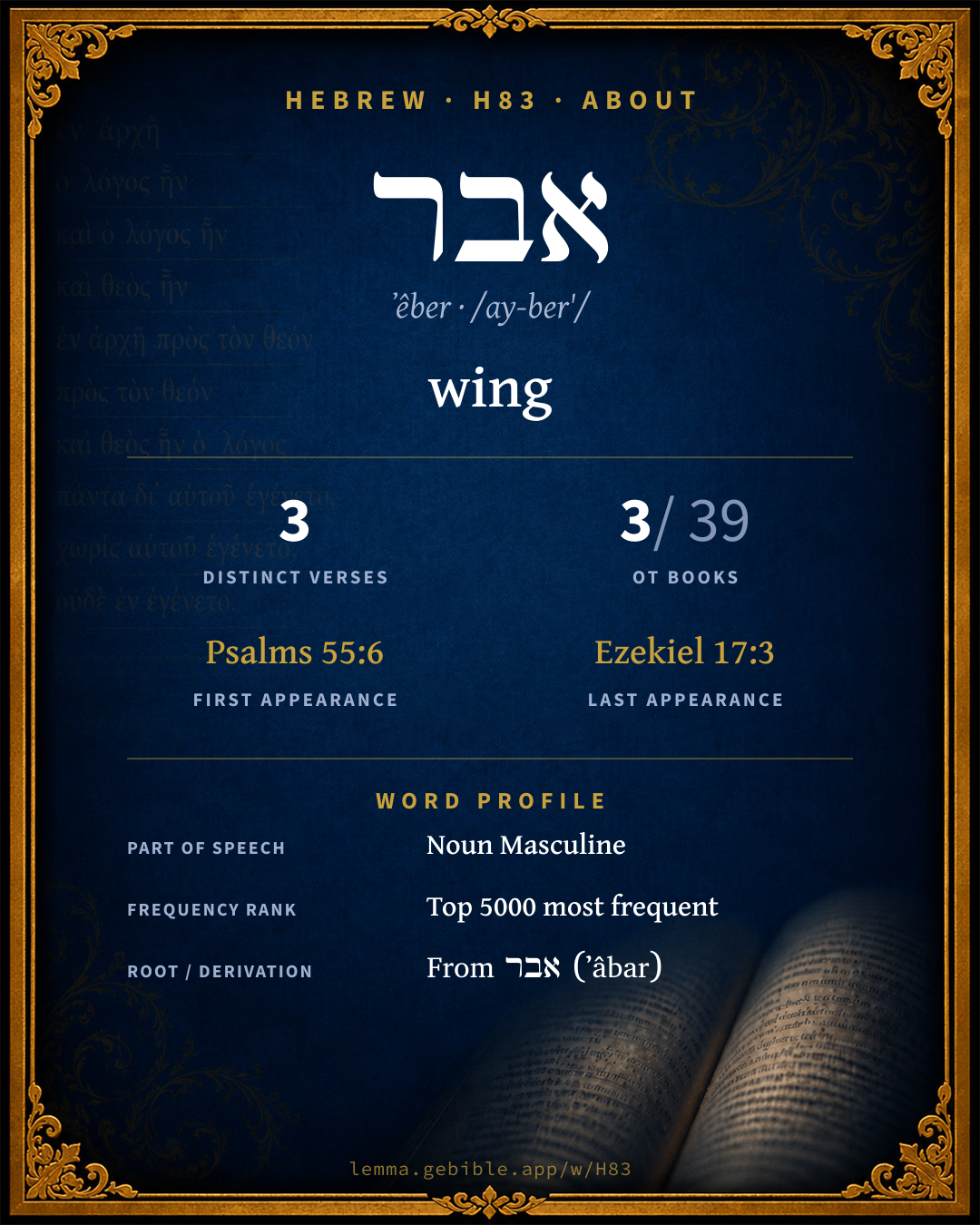
אֵ֫בֶר
wing
‘wing’ is one of 3 main senses fuller range ↓
Full lexicon entry — Brown-Driver-Briggs (BDB)
From Brown-Driver-Briggs (BDB)
Where this word appears
Grammar key — what these labels mean
Part of speech
- Noun
- A naming word — a person, place, thing, or idea.
Noun type
- Common
- A common noun — a general class of person, place, or thing (“king,” “city,” “water”), not a specific name.
State
- Absolute
- The independent form of a noun, not bound to a following word.
Gender
- Masculine
- Grammatically masculine.
Number
- Singular
- One.
Every verse where H83 appears — 3 distinct verses across 3 books. Click any verse to open its interlinear word-by-word view. Verse text shown in the World English Bible for context — . Each verse’s Hebrew form is shown with its reference; the English is not keyword-highlighted, since the data carries no word-level English alignment. Use “Compare translations” on any verse to read it across multiple English versions. This concordance covers the Hebrew Bible; Septuagint (Greek Old Testament) occurrences are not indexed here.
Psalms 1 verse
Isaiah 1 verse
Ezekiel 1 verse
About this entry
At a glance — auto-summarized from this page’s data, not written by a person. Every figure links to its source below. This summary describes the numbers; it doesn’t interpret them.
At its core, אבר (ʼêber) means “wing.” It is rare — just 3 verses in the entire Hebrew Bible. Its uses concentrate in Psalms (33% of all occurrences). First canonically at Psalms 55:6, it enters the text early. Catalogued under 3 senses, its meaning is not single-sense. Dig into 3-verse concordance and the renderings breakdown below.
Gloss history
Strong's 1890 vs modern scholarship
About this word
Strong's H83 catalogs a Hebrew word from the Hebrew Old Testament.
These counts are not copied from any lexicon or concordance. They are computed here, from the morphology-tagged Hebrew Old Testament. What Lemma adds →
- 3
- distinct verses
- The word appears in 3 distinct verses.
- 3 / 39
- OT books
- The word appears in 3 of 39 Old Testament books.
- #4,179
- by frequency
- Top 5000 most frequent Hebrew words (rank 4,179 of 8,640 Hebrew words by occurrence).
View all 3 occurrences in the concordance →
By section of the Old Testament
By traditional corpus
Conventional, traditional groupings — biblical authorship is debated, so this is a traditional corpus grouping, not an authorship claim. Each share is this word’s portion of its verses in that division of the Hebrew canon. Each figure is a share of the word’s 3 distinct verses.
- Prophets (Nevi'im) 2 verses · 67%
- Writings (Ketuvim) 1 verse · 33%
How translations render this word
Counts come from each version’s own published word-to-Strong’s tagging or interlinear alignment — an approximate guide to how each version renders this word, not a word-level alignment the data otherwise carries. Because each total is that version’s own tagged count, the per-version totals vary from one another and need not match the appearance or distinct-verse counts above. These counts may also differ from a printed concordance because Lemma counts each distinctly tagged rendering and does not collapse phrase taggings into a single head-word total. This is a fixed set of word-tagged versions (KJV, ASV, BSB, ULT) and does not change with the reading translation you choose elsewhere. Each version’s license is shown beside its name below (and on Sources).
- King James Version: I had wings 1×, Longwinged 1×, Wings 1×
- American Standard Version: I had wings 1×, Long pinions 1×, Wings 1×
- Berean Standard Bible: Wings 2×
- unfoldingWord Literal Text: Pinions 1×, Wing 1×, Wing of 1×
King James Version Public Domain
Renders H83 across 3 tagged occurrences — most commonly:
American Standard Version Public Domain
Renders H83 across 3 tagged occurrences — most commonly:
Berean Standard Bible Public Domain
Renders H83 across 3 tagged occurrences — most commonly:
Plus 1 rendering that appears only once — usually multi-word phrases or single function words the recovered tagging swept in, not distinct renderings.
unfoldingWord Literal Text CC BY-SA 4.0
Renders H83 across 3 tagged occurrences — most commonly:
Senses in BDB
The 3 senses BDB distinguishes for this word, in lexicon order (not ranked by frequency or importance). The full entry — with sub-senses — is in the Lexicon Entry tab.
- pinion, wing
- of bird (dove, eagle)
- of Babylonian king (figuratively)
Word origin
n.[m.] pinions (from strength, poet. & fig., pl. in sense) as of dove ψ 55:7; eagle Is 40:31; אֶרֶךְ הָא׳ of king, of Babyl. under fig. of eagle Ez 17:3 (‖ גְּדוֹל הַכְּנָפַיִם of broad, overshadowing wings).
— Brown-Driver-Briggs (Oxford 1906, public domain), digitized via Sefaria, supplemented by the OpenScriptures HebrewLexicon (CC BY 4.0). See Sources.
Derived from אבר (ʼâbar) (H82) — to fly.
Jastrow Dictionary
A second Hebrew/Aramaic lexicon for comparison, covering Aramaic and post-biblical (Talmudic, Targumic, Midrashic) usage that the biblical-Hebrew BDB does not. Matched by lemma rather than by Strong’s number, so a lemma may carry more than one Jastrow headword (shown separately below), and the entries cover usage well beyond the Bible.
אבר
- or יבר Hif. הוֹבִיר, v. בּוּר
אָבַר
- (√אב, v. אבב; cmp. גבר, חבר) to be bent, pressed, thick.
- 1. to strengthen, harden (cmp. אמץ). Snh. 109ᵇ (play on Abiram, Num. XVI, 1) שאִי׳ לבו מ׳ וכ׳ Ms. M. (Rashi לבבו, ed. עצמו) he hardened his heart against repentance. e.g. Numbers 16:1
- 2. (denom. of אֵבֶר) to measure wings, to define city limits, for Sabbath distances, in cases of wing-like projections beyond the line. Erub. V, 1 כיצד מְאַבְּרִין (accord. to Rab’s spelling, while Sam. read מְעַבְּרִין, v. Y. ib. 22ᵇ, Bab. ib. 53ᵃ) how do we measure outskirts of a city in order to draw the Sabbath line?; v. etymol. definit. Y. a. Babl. ll. cc. a. Y. Ber. VII, 12ᶜ top.
- 3. (b. h. Hif.) to soar, take wings. Gen. R. s. 42 (play on Shemeber, Gen. XIV, 2) שמְאַבֵּר וכ׳ Ar. s. v. שמאבר (ed. שהיה פורח) he took wings to fly and obtain wealth. e.g. Genesis 14:2
אֲבַר
- Ithpe. אִתְאֲבַר (v. next w. a. foreg.) to be winged, to soar. Targ. Job XXXIX, 29.
אֵבֶר
- wing, v. אָבַר; cmp. כַּף,
- 1. limb, part.—א׳ מן החי a part cut off from a living animal. Ḥull. 101ᵇ; a. fr.
- 2. membrum genitale. Snh. 107ᵃ. Y. Keth. V, 30ᵇ
- 3. town quarter, projecting outskirts (v. אָבַרPi. 2).—א׳ א׳ limb by limb; piecemeal. Sabb. 40ᵃ. Y. Yoma VI, 43ᵈ bot. Koh. R. to X, 15.—Pl. אֵבָרִים, אֵיבָרִים, אֵיבָרִין limbs, parts (of an animal). Shek. VII, 3 meat found אי׳ in entire limbs (opp. חתיכות cut slices). Sabb. 82ᵇ אינה מטמאה לא׳ Ms. M. (ed. לא׳ אינה) does not make unclean when dismembered. Kel. XVIII, 9 (parts of a bedstead).—א׳ א׳ as sing. Ḥull. 11ᵇ. Treat. S’maḥ. II, 12.—Ber. I, 1 the fat וא׳ and other pieces of the daily offerings. Ohol. I, 8 רמ"ח א׳ 248 limbs (joints).
- 4. balance of a load, ballast. Sabb. 154ᵇ, v. חֶבֶר.—Ch. אֵיבְרָא.
אֲבָר
- (v. אָבַר; b. h. lead. Snh. 52ᵃ פתילה של א׳ a string (bar) of lead. Ḥull. 8ᵃ א׳ מעיקרו lead directly from the mine (hot). Y. Sabb. VII, 10ᵇ bot. Kel. XIV, 5 הא׳ שבצד וכ׳ the lead hanging down from the neck of the animal (as ornament or mark). Git. 19ᵃ; Sabb. 104ᵇ כתבו בא׳ if he wrote the document with lead (solution); a. fr.
אֲבָר ²
- Targ. Ex. XV, 10. Targ. Y. Lev. XX, 14; a. e.—Snh. 64ᵃ שדיוהו וכ׳ cast ye him into a kettle (of lead) וכסיוהו וכ׳ and cover him with lead (or heavy load; ed. שדיוה incorr.; Ms. M. omits דאברא; oth. var. v. Rabb. D. S. a. l.). Git. 19ᵃ בא׳ (writing) with lead pencil, במיא דא׳ with a solution of lead.
A Dictionary of the Targumim, the Talmud Babli and Yerushalmi, and the Midrashic Literature (Marcus Jastrow; London, Luzac, 1903) — Public Domain. Digitized via Sefaria. Digitized via Sefaria. Full attribution on Sources.
Forms in the corpus
The 3 distinct written forms H83 takes in the Hebrew Bible, most frequent first — each parse links to that state’s occurrences in the concordance. Hebrew forms include their vowel points and cantillation, so a single lemma takes many written forms.
| Form | Parsing | Example | Uses |
|---|---|---|---|
| אֵ֖בֶר | Noun, Common, Masculine, Singular, Absolute | Isaiah 40:31 | 1 |
| אֵ֭בֶר | Noun, Common, Masculine, Singular, Absolute | Psalms 55:6 | 1 |
| הָ/אֵ֔בֶר | Noun, Common, Masculine, Singular, Absolute | Ezekiel 17:3 | 1 |
Same root — word family
Other BDB entries built from the same root as H83, grouped by Strong’s listed origin. These share a root / origin per the lexicon — not necessarily a shared meaning. Each links to that word’s own entry.
Derives from
Shares the same root
Derived from this word
Compare all same-root words → They share a root, not necessarily a meaning.
Septuagint verse parallels
This word appears in 3 verses that also exist in the Greek Old Testament (Septuagint), out of the 3 Hebrew verses it occurs in. You can read those verses in Greek by switching the Old Testament edition to the Septuagint.
Read these verses in the Septuagint
This is a verse-level parallel only — the same verses exist in both the Hebrew and Greek Old Testaments. No word-level Hebrew↔Greek correspondence is claimed: the data carries no such alignment, so no Greek word is shown as this Hebrew word’s translation. Coverage is not total — the Septuagint omits the deuterocanon and renumbers the Psalms, so some Hebrew verses have no direct Greek parallel.