
Job 28:18

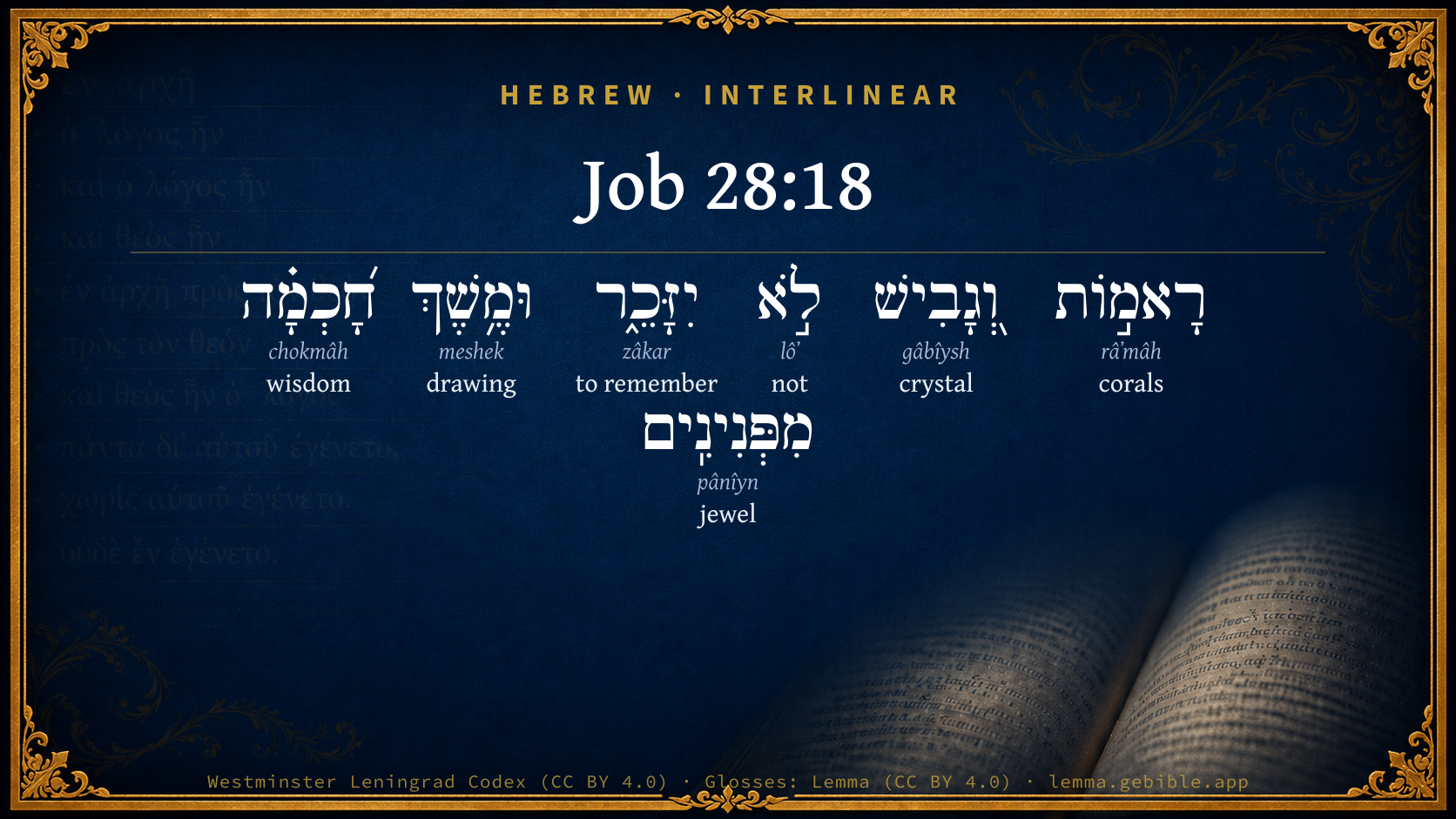
Hebrew (Westminster Leningrad Codex) Job 28:18 appears in the Hebrew Old Testament. The text above is from the Westminster Leningrad Codex. Each word links to its Strong’s number, a concise gloss, and parsing drawn from the Open Scriptures Hebrew Bible morphology. Click any word for its full Brown-Driver-Briggs (BDB) entry.
Download image
Cite this verse

Job 28:18 (World English Bible). Public Domain. Lemma interlinear Bible study tool, https://lemma.gebible.app/v/job/28/18.

Show BibTeX & RIS
BibTeX
RIS
English Translation
No mention shall be made of coral or of crystal: Yes, the price of wisdom is above rubies.
World English Bible · Public Domain
Highlights
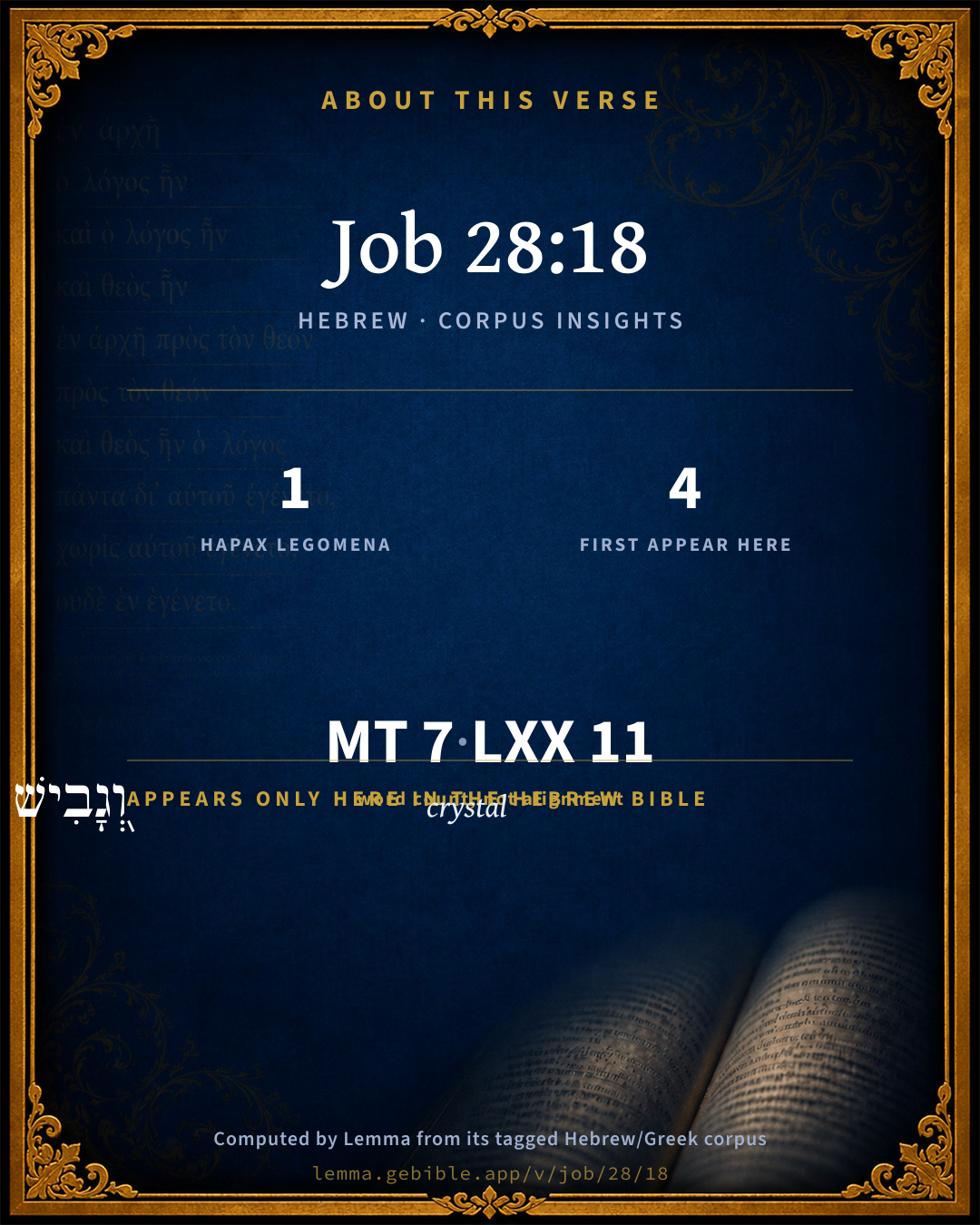
  • 1 hapax legomenon — only here in the Hebrew Bible
  • 4 first appearances in the Hebrew Bible
Full analysis ↓
Download a study sheet

One document with this verse’s original text, its word-by-word gloss line, the meaning frame, cross-references with their text, attributed commentary, and full source and license credits — printable, and it pastes into notes with its structure intact.

This verse Autodidact and up

Study sheet (.html) Plain text (.txt)

A passage Seminary Student

Up to 50 verses in one chapter. A passage sheet keeps up to 6 commentary sources and 12 cross-references per verse, in the order this page ranks them, and says so on the sheet whenever that leaves anything out. Ask for a single verse and you get the Autodidact verse sheet above.

Everything on this page stays free to read, with no account — the sheet is a download of what is already on screen, not access to it.

Want to remove ads? Support Godless Engineer
Compare translations 3

The same verse in 3 English versions, stacked beneath the original-language interlinear above. Click any original word for its lexicon entry.

Each is an independent rendering of the whole verse — the interlinear is not word-aligned to these translations.

Highlighted words mark where these versions differ — a whole-verse word diff, not a word-by-word alignment.

  • World English Bible Public Domain
    No mention shall be made of coral or of crystal: Yes, the price of wisdom is above rubies.
  • King James Version Public Domain
    No mention shall be made of coral, or of pearls: for the price of wisdom is above rubies.
  • unfoldingWord Literal Text CC BY-SA 4.0
    Coral and jasper are not mentioned; indeed, the price of wisdom more than rubies.

unfoldingWord Literal Text — © unfoldingWord, licensed CC BY-SA 4.0. Word-aligned USFM3 via Door43 (git.door43.org/unfoldingWord/en_ult).

Versions to compare (up to 4)

3 of 4 selected

Show all 18 translations

Every available English version of this verse, each an independent rendering of the whole verse.

  • World English Bible Public Domain
    No mention shall be made of coral or of crystal: Yes, the price of wisdom is above rubies.
  • Berean Standard Bible Public Domain
    Coral and quartz are unworthy of mention; the price of wisdom is beyond rubies.
  • Majority Standard Bible Public Domain
    Coral and quartz are unworthy of mention; the price of wisdom is beyond rubies.
  • King James Version Public Domain
    No mention shall be made of coral, or of pearls: for the price of wisdom is above rubies.
  • American Standard Version (1901) Public Domain
    No mention shall be made of coral or of crystal: Yea, the price of wisdom is above rubies.
  • Revised Version (1885) Public Domain
    No mention shall be made of coral or of crystal: yea, the price of wisdom is above rubies.
  • Geneva Bible (1599) Public Domain
    No mention shall be made of coral, nor of the gabish: for wisedome is more precious then pearles.
  • Douay-Rheims (1899) Public Domain
    High and eminent things shall not be mentioned in comparison of it: but wisdom is drawn out of secret places.
  • Young's Literal Translation Public Domain
    Corals and pearl are not remembered, The acquisition of wisdom `is' above rubies.
  • Literal Standard Version CC BY-SA 4.0
    Corals and pearl are not remembered, || The acquisition of wisdom [is] above rubies.
  • Unlocked Literal Bible CC BY-SA 4.0
    No mention is worth making of coral or jasper; indeed, the price of wisdom is more than rubies.
  • unfoldingWord Literal Text CC BY-SA 4.0
    Coral and jasper are not mentioned; indeed, the price of wisdom more than rubies.
  • Darby Bible Public Domain
    Corals and crystal are no more remembered; yea, the acquisition of wisdom is above rubies.
  • World Messianic Bible Public Domain
    No mention will be made of coral or of crystal. Yes, the price of wisdom is above rubies.
  • Webster's Bible Public Domain
    No mention shall be made of coral, or of pearls: for the price of wisdom is above rubies.
  • Free Bible Version CC BY-SA 4.0
    Coral and crystal are not worth mentioning; the price of wisdom is far above rubies.
  • Bible in Basic English Public Domain
    There is no need to say anything about coral or crystal; and the value of wisdom is greater than that of pearls.
  • JPS Tanakh (1917) Public Domain
    No mention shall be made of coral or of crystal; yea, the price of wisdom is above rubies.

Literal Standard Version (2020), Covenant Press — licensed CC BY-SA 4.0. Text via the HelloAO Bible API (eBible.org). Unlocked Literal Bible (unfoldingWord) — licensed CC BY-SA 4.0. Text via the HelloAO Bible API (eBible.org). unfoldingWord Literal Text — © unfoldingWord, licensed CC BY-SA 4.0. Word-aligned USFM3 via Door43 (git.door43.org/unfoldingWord/en_ult). Free Bible Version, Dr. Jonathan Gallagher — licensed CC BY-SA 4.0. Text via the HelloAO Bible API (eBible.org).

Word by word

More ways to search: Search by grammar → Find every occurrence → Compare this word →

Practice this passage: Drill this verse → Learn its vocabulary →

About this verse

These counts appear in no published source. They are computed here, from the morphology-tagged text and Lemma’s own curated glosses. What Lemma adds →

7
words
7
distinct lemmas
Wisdom
section

Notable vocabulary

1 hapax legomenon — a word that appears only here in the entire Hebrew Bible:

  • וְ֭גָבִישׁ crystal H1378

First appearance in Scripture

These words make their first canonical appearance in the Hebrew Bible here:

  • רָאמ֣וֹת corals H7215
  • וְ֭גָבִישׁ crystal H1378
  • וּמֶ֥שֶׁךְ drawing H4901
  • מִפְּנִינִֽים jewel H6443

Shared distinctive vocabulary

רָאמ֣וֹת corals H7215 occurs in 2 verses of the Hebrew Bible. Also found in:

Grammatical profile

  • 1 verb
  • 5 nouns
  • 1 particle

Verb forms

  • יִזָּכֵ֑ר Niphal · Imperfect

Hebrew & Septuagint length

In English translation the verse runs 18 words from the Hebrew and 18 from the Septuagint (LXX English) — the same length.

A rough comparison of the two English renderings, which tokenize alike — not a word-level alignment.

Word counts can differ between the Hebrew and the Greek without any difference in meaning — e.g. the Hebrew direct-object marker אֵת has no separate Greek word, and Greek often adds the article ὁ.

In the original languages it is 7 Hebrew tokens and 11 Greek tokens — but the two are counted differently (Hebrew bundles its prefixes and suffixes into one token; the Greek is in lemma form), so that isn’t a like-for-like length.

Cross-references

11

Topical passages linked to Job 28:18 in the Treasury of Scripture Knowledge — connected by theme and wording, ordered by reader-vote popularity; previews shown in the World English Bible.

  • Proverbs 3:15 She is more precious than rubies. None of the things you can desire are to be compared to her.
  • Proverbs 31:10 Who can find a worthy woman? For her price is far above rubies.
  • Lamentations 4:7 Her nobles were purer than snow, they were whiter than milk; They were more ruddy in body than rubies, their polishing was as of sapphire.
  • Ezekiel 27:16 Syria was your merchant by reason of the multitude of your handiworks: they traded for your wares with emeralds, purple, and embroidered work, and fine linen, and coral, and rubies.
  • Proverbs 8:11 For wisdom is better than rubies. All the things that may be desired can't be compared to it.
  • Matthew 7:6 "Don't give that which is holy to the dogs, neither throw your pearls before the pigs, lest perhaps they trample them under their feet, and turn and tear you to pieces.
  • Matthew 13:45–46 "Again, the Kingdom of Heaven is like a man who is a merchant seeking fine pearls,
  • 1 Timothy 2:9 In the same way, that women also adorn themselves in decent clothing, with modesty and propriety; not just with braided hair, gold, pearls, or expensive clothing;
  • Revelation 17:4 The woman was dressed in purple and scarlet, and decked with gold and precious stones and pearls, having in her hand a golden cup full of abominations and the impurities of the sexual immorality of the earth.
  • Revelation 18:12 merchandise of gold, silver, precious stones, pearls, fine linen, purple, silk, scarlet, all expensive wood, every vessel of ivory, every vessel made of most precious wood, and of brass, and iron, and marble;
  • Revelation 21:21 The twelve gates were twelve pearls. Each one of the gates was made of one pearl. The street of the city was pure gold, like transparent glass.

Cross-references courtesy of OpenBible.info (CC BY 4.0).

Hebrew and Greek witnesses Masoretic Hebrew ↔ Greek Septuagint

The same verse in the two great witnesses to the Old Testament, shown verse-for-verse.

These are two independent witnesses, not word-aligned to each other, and the Septuagint is shown in lemma (dictionary) form.

Hebrew Job 28:18 Masoretic · Westminster Leningrad Codex

רָאמ֣וֹת וְ֭גָבִישׁ לֹ֣א יִזָּכֵ֑ר וּמֶ֥שֶׁךְ חָ֝כְמָ֗ה מִפְּנִינִֽים

No mention shall be made of coral or of crystal: Yes, the price of wisdom is above rubies.

World English Bible · Public Domain

Greek LXX Job 28:18 Septuagint · lemma form

μετέωρος καί γαβις οὐ μιμνήσκω καί ἕλκω σοφία ὑπέρ ὁ ἐσώτατος

Coral and fine pearl shall not be mentioned: but do you esteem wisdom above the most precious things.

LXX2012 (modern English Septuagint) · Public Domain

On this verse, Joseph Benson's Commentary discusses the Septuagint’s reading. Read the note in Commentary ↓

Hebrew: Westminster Leningrad Codex (CC BY 4.0). Greek: Septuagint (public domain); English from LXX2012 (modern English Septuagint) (Public Domain). How the Septuagint differs from the Hebrew →

Commentary

Notes on Job 28:18 from classic Christian and Jewish commentators (each source and its license shown beneath its notes). The classic Christian expositions comment on the surrounding passage and are grouped to its opening verse, so a note may address several verses; the Jewish commentaries on the Tanakh (Rashi and others) are per-verse, so they appear only where the commentator wrote on this verse.

Lemma curates 59 commentaries, every one of them public domain or Creative Commons licensed, each selected and text-cleaned for this edition rather than reprinted as found. About our sources →

Trapp's Complete Commentary

John Trapp

Job 28:18 No mention shall be made of coral, or of pearls: for the price of wisdom [is] above rubies.

Ver. 18. No mention shall be made of coral] No talk of coral or carbuncle, of pearl, or any other the rarest and richest jewels in all the world. We read of Cleopatra, that vying with Antony in luxury, she drunk up a pearl of incredible price dissolved in vinegar; and of Charles, duke of Burgundy, that in the fight at Nansey, he lost a diamond of that worth, ut eo tota aliqua regio emi posset, that therewith a man might have bought a whole country (Macrob. Sat. lib. 5, cap. 17; Alsted. Chronol.). It was afterwards set in the pope’s triple crown; but no way worthy to be mentioned in the same day with wisdom.

For the price of wisdom is above rubies] Which are so called from their lovely redness. See Lam 4:7. Pearls some render it; of which Pliny saith, Principium culmenque rerum ommum pretii margaritae tenent, Pearls are the principal of all precious things. They were so of old; but they are not so today. What huge sums were once given for saints’ relics (as they called them) and popes’ pardons! but now the world is grown wiser. England is no more a babe; there is no man here, but now he knows that they do foolishly that give gold for lead, more weight of that than they receive of this. This and much more to the same purpose speaketh Henry VIII (in his protestation against the pope), who yet, as a faint chapman, went not to the price of this true wisdom; as appeareth by that public speech of his in parliament, There are many that are too busy with their new sumpsimus, and others that dote too much upon their old mumpsimus. The new religion, though true, he envied; the old, though his own, he despised; being as a speckled bird, or a cake half baked, &c.

John Trapp, A Commentary or Exposition upon All the Books of the Old and New Testament (1647–1656) — public domain. Text from a community e-Sword module.

Joseph Benson's Commentary

Job 28:18-19. No mention shall be made of coral or of pearls — They are of no value, if compared with wisdom, nor fit to be mentioned as a price wherewith to purchase it. For the price, &c. — Hebrew, משׁךְ, meshech, the attraction, or extraction, of wisdom is above rubies — מפנינים, mippeninim, pearls. But the expression is rendered by the LXX., υπερ τα εσωτατα, above the innermost, or most concealed and guarded things; and by the Vulgate de occultis, of secret things. Chappelow proposes to render the words, “The attraction of wisdom is above any thing we behold:” a translation which, as he observes, Aquila’s version justifies γλυκυ δε σοφια παρα τα περιβλεπτα, wisdom is sweet, or desirable, above the things that are anywhere seen. Poole, who would render meshech, extraction, or acquisition, thinks there is an allusion to the manner in which pearls are obtained, namely, by diving to the bottom of the sea; which, he observes, is aptly applied to this wisdom, because, lying very deep, and remote from the reach of mankind, it is not to be obtained without diligent search and consideration. The clause would then be read, The drawing forth of wisdom is above that of pearls: that is, men may dive into the sea, and fetch up pearls, but this wisdom lies a great deal deeper. The topaz of Ethiopia — Or of Arabia, for Cush signifies both countries; and the topaz, which Pliny calls amplissima gemmarum, the most noble of gems, was found in the Red sea, which lay between both, and so might be ascribed to either; shall not equal it, &c. — The Ethiopian topaz, which is so much esteemed for its wonderful lustre, doth not come near it in value; nor are the golden ornaments which they wear in those parts proportionable to it.

Joseph Benson's Commentary on the Old and New Testaments (1811–1818) — public domain. Text from a community e-Sword module.

Geneva Bible (1599)

Geneva Bible translators

Which is thought to be a kind of precious stone.

Geneva Bible (1599) marginal notes — public domain. Text via Bolls.life.

Jamieson, Fausset & Brown

Robert Jamieson, A. R. Fausset & David Brown

Red coral (Eze 27:16).

pearls--literally, "what is frozen." Probably crystal; and Job 28:17 will then be glass.

rubies--UMBREIT translates "pearls" (see Lam 4:1; Pro 3:15). The Urim and Thummim, the means of consulting God by the twelve stones on the high priest's breastplate, "the stones of the sanctuary" (Lam 4:1), have their counterpart in this chapter; the precious stones symbolizing the "light" and "perfection" of the divine wisdom.

Jamieson, Fausset & Brown — Commentary Critical and Explanatory on the Whole Bible (1871) — public domain (CC PDM 1.0). Text via the HelloAO Bible API.

Adam Clarke's Commentary

Verse 18. See also Clarke on "Job 28:16".

Ver. 18. 4. ראמות ramoth, CORAL, from ראם raam, to be exalted or elevated; probably from this remarkable property of coral, "it always grows from the tops of marine rocky caverns with the head downwards." Red coral is found in the Mediterranean, about the isles of Majorca and Minorca, on the African coast, and in the Ethiopic ocean.

5. גביש gabish, PEARLS, from גבש gabash, in Arabic, to be smooth, to shave off the hair; and hence gabish, the pearl, the smooth round substance; and also hail or hailstones, because of their resemblance to pearls. The pearl is the production of a shell-fish of the oyster kind, found chiefly in the East Indies, and called berberi; but pearls are occasionally found in the common oyster, as I have myself observed, and in the muscle also. They are of a brilliant sparkling white, perfectly round in general, and formed of coats in the manner of an onion. Out of one oyster I once took six pearls. When large, fine, and without spots, they are valuable. I have seen one that formed the whole body of a Hindoo idol, Creeshna, more than an inch in length, and valued at 300 guineas.

Ver. 18. 6. פנינים peninim, RUBIES, from פנה panah, he turned, looked, beheld. The oriental ruby is blood-red, rose-red, or with a tinge of violet. It has occasionally a mixture of blue, and is generally in the form of six-sided prisms. It is a species of the sapphire, and is sometimes chatoyant in its appearance, i.e., has a curious kind of reflection, similar to the cat's eye: and as this is particularly striking, and changes as you turn the stone, hence probably the name peninim, which you derive from פנה panah, to turn, look, behold, c.

But some learned men are of opinion that the magnet or loadstone is meant, and it is thus called because of the remarkable property it has of turning north and south. And this notion is rendered the more likely, because it agrees with another word in this verse, expressive of a different property of the magnet, viz., its attractive influence: for the Hebrew words meshech chochmah mippeninim, which we render, The price of wisdom is above rubies, is literally, The ATTRACTION of wisdom is beyond the peninim, the loadstone for all the gold, silver, and precious stones, have strong influence on the human heart, attracting all its passions strongly; yet the attraction of wisdom - that which insures a man's happiness in both worlds - is more powerful and influential, when understood, than all of these, and even than the loadstone, for that can only attract iron; but, through desire of the other, a man, having separated himself from all those earthly entanglements, seeketh and intermeddleth with ALL WISDOM. The attractive property of the loadstone must have been observed from its first discovery; and there is every reason to believe that the magnet and its virtues were known in the East long before they were discovered in Europe.

7. פטדה pitdah, the TOPAZ. This word occurs only in Ex 28:17; Ex 39:10; Eze 28:13, and in the present place; in all of which, except that of Ezekiel, where the Septuagint is all confusion, the Septuagint and Vulgate render the word always τοπαζιον, topazius, the TOPAZ. This stone is generally found in a prismatic form, sometimes limpid and nearly transparent, or of various shades of yellow, green, blue, lilac, and red.

I have thus given the best account I can of the stones here mentioned, allowing that they answer to the names by which we translate them. But on this point there is great uncertainty, as I have already had occasion to observe in other parts of this work. Beasts, birds, plants, metals, precious stones, unguents, different kinds of grain, c., are certainly mentioned in the sacred writings but whether we know what the different Hebrew terms signify, is more than we can certainly affirm. Of some there is little room to doubt; of others conjecture must in the present state of our knowledge, supply the place of certainty. See PHILIP'S Elementary Introduction to MINERALOGY; an accurate work, which I feel pleasure in recommending to all students in the science.

Adam Clarke's Commentary on the Bible (1810–1826) — public domain. Text from a community e-Sword/MySword module.

The Cambridge Bible for Schools and Colleges

gen. ed. J. J. S. Perowne

18. or of pearls] Rather, of crystal.

price of wisdom is above rubies] Or, the possession of wisdom is above (or, more than) pearls, i. e. pearls cannot acquire it or give possession of it. The meaning is scarcely that Wisdom is a more precious thing to possess than pearls.

The Cambridge Bible for Schools and Colleges (gen. ed. J. J. S. Perowne; Cambridge University Press, 1878–1918) — public domain. Text from a community e-Sword module.

John Gill's Exposition

No mention shall be made of coral, or of pearls,.... Coral is a marine plant, is as hard as a stone, and of such value as to be reckoned among precious stones; See Gill on Eze 27:16. In Arabia Felix, on the shore of the Red sea, is a place called Coralia (n); it may be from coral found there. Pearls are from shellfish taken out of the sea, though these seem rather intended in the next clause: the words "ramoth" and "gabish" are left untranslated by some, and by others are taken for precious stones, though unknown, so called because they are found in high places, which both words signify. The Targum renders the first by "sandalchin", and seems to be the same with the sardonyx, a precious stone found in Arabia, and which found there is by Pliny (o) said to excel. Junius and Tremellius render it by "sandastros"; which, as Pliny says (p), some call "Garamantis", being bred in a place of that name in India; and he also observes, that it is found in Arabia towards the south, and has shining golden drops in the body of it; it is a sort of a carbuncle. "Gabish" seems to have some affinity with "chabazios", mentioned by Orpheus (q) as a precious stone; but whatever precious stones are meant, as it is hard to determine what, they are not to be spoken of with wisdom, or to be compared to it:

for the price of wisdom is above rubies; or rather pearls, as Bochart (r) seems to have abundantly proved, who renders the words,

"the extraction of wisdom is greater than the extraction of pearls;''

and so the Targum; there being, as he thinks, an allusion to the extraction of pearls out of the sea by divers into it (s); who get them through much art, difficulty, and danger; and he observes, that there is a double extraction, or drawing them out, first of the shellfish out of the sea, and then of the pearls out of the shells; but the drawing out of wisdom, or the attainment of that; is more difficult, and superior to it, as well as attended with greater advantage; see Pro 3:15 and See Gill on Lam 4:7; and though of pearls some are very large, Oviedo (t) speaks of one that weighed thirty one carats, and another twenty six; some as big as hazel nuts, and even as a middling walnut, and of very great price, as that bought by Pope Paul at 44,000 ducats (u); that by Philip the Second, of the size of a pigeon's egg, valued at an hundred forty four thousand ducats; that drank by Cleopatra at a draught, reckoned worth eighty thousand pounds sterling; and that of the emperor of Persia, bought at 110,400 pounds (w); yet the price of wisdom is above them.

(n) Plin. Nat. Hist. l. 6. c. 28. (o) Ib. l. 37. c. 6. (p) Ib. c. 7. (q) , p. 240. (r) Hierozoic. par. 2. l. 5. c. 6. col. 681, &c. (s) Of fishing for pearls in this way, see the Account of it in Vartoman. Navigat. l. 3. c. 2. in P. Martyr. Decad. 3. l. 2. and Oviedo de Occident. Ind. c. 4. and with nets, Aelian. de Animal. l. 15. c. 8. Vid. Plin. Nat. Hist. l. 9. c. 35. (t) Ut supra. (Oviedo de Occident. Ind. c. 4.) (u) P. Martyr, Decad. 3. l. 10. (w) See Chambers's Dictionary on the word "Pearl".

John Gill's Exposition of the Whole Bible (1746–1763) — public domain (CC PDM 1.0). Text via the HelloAO Bible API.

Albert Barnes' Notes on the Bible

No mention shall be made of coral - That is, as a price by which to purchase wisdom, or in comparison with wisdom. The margin here is, “Ramoth” - retaining the Hebrew word ראמה râ'mâh. Jerome renders it, “excelsa” - exalted or valuable things. So the Septuagint, Μετέωρα Meteōra - exalted or sublime things; as if the word were from רום, to be exalted. According to the rabbis, the word here means “red coral.” It occurs also in Eze 27:16, where it is mentioned as a valuable commodity in merchandise in which Syria traded with Tyre, and occurs in connection with emeralds, purple, broidered work, fine linen, and agate. The coral is a well known marine substance, not valued now as if it were a precious stone, but probably in the time of Job regarded as of value sufficient to be reckoned with gems. It was not rare, though its uses were not known. As a beautiful object, it might at that time deserve to be mentioned in connection with pearls.

It is now found in abundance in the Red Sea, and probably that which was known to Job was obtained there. Shaw says, “In rowing gently over it (the port Tor), while the surface of the sea was calm, such a diversity of “Madrepores Furuses,” and other marine vegetables, presented themselves to the eye, that we could not forbear taking them, as Pliny (L. xiii. cap. 25) had done before us, for a forest under water. The branched Madrepores particularly contributed very much to authorize the comparison, for we passed over several that were eight or ten feet high, growing sometimes pyramidical like the cypress, and at other times had their branches more open and diffused, like the oak; not to speak of others which, like the creeping plants, spread themselves over the bottom of the sea;” Travels, p. 384, Ed. Oxford, 1738. It should be added, however, that there is no absolute certainty that Job referred here to coral. The Hebrew word would suggest simply that which was “exalted in value,” or of great price; and it is not easy to determine to what particular substance Job meant to apply it.

Or of pearls - גבישׁ gâbı̂ysh. This word occurs nowhere else, though אלגבישׁ 'elgâbı̂ysh, is found in Eze 13:11, Eze 13:13; Eze 38:22, where it means hail-stones, or pieces of ice. Perhaps the word here means merely “crystal” - resembling ice. So Umbreit Gesenius, and others, understand it. Prof. Lee supposes that the word used here denotes that which is “aggregated” and then what is “massive,” or “vast;” see his note on this place. Jerome renders it, “eminentia” - exalted, lofty things; the Septuagint retains the word without attempting to translate it - γαβὶς gabis - and the fact that they have not endeavored to render it, is a strong circumstance to show that it is now hopeless to attempt to determine its meaning.

Above rubies - The ruby is a precious stone of a carmine red color, sometimes verging to violet. There are two kinds of rubies, the oriental or corundum, and the spinelle. The ruby is next in hardness to the diamond, and approaches it in value. The oriental ruby is the same as the sapphire. The ruby is found in the kingdom of Pegu, in the Mysore country, in Ceylon, and in some other places, and is usually imbedded in gneiss. It is by no means certain, however, that the word used here (פנינים pânı̂ynı̂ym) means rubies. Many of the rabbis suppose that “pearls” are meant by it; and so Bochart, Hieroz. ii. Lib. v. c. 6, 7, understands it. John D. Michaelis understands it to mean “red corals,” and Gesenius concurs with this opinion. Umbreit renders it, “Perlen” - “pearls.” The word occurs in Pro 3:15; Pro 8:11; Pro 20:15; Pro 31:10; Lam 4:7. In the Proverbs, as here, it is used in comparison with wisdom, and undoubtedly denotes one of the precious gems.

Albert Barnes' Notes on the Bible (1834–1885) — public domain. Text from a community e-Sword/MySword module.

Haydock's Catholic Bible Commentary

Things. Hebrew Ramoth and Gabish (Haydock) are terms much controverted. The first may denote the unicorns, (Deuteronomy xxxiii. 17.) and the latter the thunderbolt, or ceraunia, which were in high request. (Pliny, [Natural History?] xxxvii. 9. Ezechiel (xiii. 11., and xxvii. 16.) mentions the former as carried by merchants to Tyre. These stones, which fell from the sky, were used by the Parthian magi, &c., for secret purposes. They have given rise to many fabulous accounts. Those which are to be seen, are by no means beautiful. (Calmet) --- Yet if the people esteemed them, Job might well include them among other things of most value. Protestants, "No mention shall be made of coral, or of pearls, for the price of wisdom is above rubies." (Haydock) --- The latter part of the verse would be rather, "the fishing for wisdom would be more difficult than that for pearls;" (Calmet) or, "the extraction of wisdom is above the drawing for of peninim." (Haydock) --- The pinna is a kind of fish which is fastened to the bottom of the sea, by roots, of which the byssus was made, 1 Paralipomenon xv. 27. Pearls were commonly found in the Persian Gulf, near Idumea. The art of diving for them, and extracting them from the fish, was very difficult, but nothing in comparison with the labour requisite to discover wisdom. The ancients describe some pearls of a reddish gold colour. (Atheneus iii. 13.) ( Jeremias’ Lamentations iv. 7.) --- Adam, which is interpreted red, in Jeremias, means also any thing very shining; in which sense the word purpureus is used. (Horace vi. Ode 1.) (Bochart, Anim. p. 2, b. v. vi. (Calmet) and t. iii. 681. 91.) The opinion of this author seems preferable to that of Hutchinson and Cooke, who would translate peninim (Haydock) by "loadstones or magnets," which the former says are like "reddish clay," though they are really of a dusky iron grey, sometimes tinged with brown or red. This complexion would not be very beautiful. Yet the Nazarites are compared to peninim, (Lamentations iv.) and to snow, (Parkhurst) as they were of a most fair red and white, like pearls. (Haydock) --- Though the ancients seem to have been acquainted with the loadstone or magnetic needle, particularly the Phenicians (Odys. viii. 556.) and Chinese, for many ages, yet it was never so common as to form a popular comparison. Aquila renders the word in question, Greek: periblepta, "conspicuous things;" and pearls were certainly highly valued by the Jews, &c. Parkhurst, in pone. --- Theodotion, in the Septuagint, "draw forth wisdom before the inmost things." --- Both these versions agree with the Vulgate, as the most precious goods are kept out of sight. (Haydock) --- Yet the deepest mines of gold do not require so much diligence and sagacity for us to discover and possess them, as wisdom does; but, in return, it will abundantly recompense the man who finds such a treasure, Ecclesiasticus vi. 19., and 24. (Pineda)

George Leo Haydock (1774–1849), Haydock's Catholic Family Bible and Commentary, 1859 edition — public domain. Excludes Psalms (Douay-Rheims chapter numbering differs from Protestant) and Deuterocanonical books (Catholic canon only).

Matthew Poole's English Annotations

No mention shall be made; they are of no value, nor worthy to be named the same day with this, nor fit to be mentioned as a price or recompence wherewith to purchase this. The price; or, the attraction, or acquisition; or rather, the extraction, or drawing forth. For Job useth the word of art which was proper in the taking of

pearls, as the following word, rendered by our translators rubies, is understood by divers, both Hebrew and Christian interpreters, and amongst others by the late eminently learned Bochart, who proveth it by divers arguments. Now these pearls are and were taken by men that dived to the bottom of the sea, and drew them out thence, which is the very word which both Arabic and Latin authors use in the case; as indeed the same word is used of all fishermen, who are said to draw forth with their hook, or net, or otherwise, fishes, or any other thing for which they are fishing. Moreover this diving, as it produced great profit, so it was not without some danger and difficulty; for if they heedlessly put their fingers into the gaping shell, within which the pearl was, it speedily closed upon them, and put them to exquisite pain, to the loss of their finger, and sometimes of their life; which is a fit representation of the state of those persons who search after the knowledge of God’s counsels and ways, and the grounds of them, who as when they modestly inquire into them, and truly discover them, they have infinite advantage and satisfaction therein; so if they pry into them too boldly, searching into those things which God hath concealed, and rashly judging of them above what they know, which Job judged to be his friends’ case, they expose themselves to manifold snares and dangers. And this extraction, or drawing forth, is aptly used concerning this wisdom, which lying very deep and remote from the reach of ordinary men, is not to be obtained without diligent search and consideration. And so the place may be thus translated, the extraction or drawing forth of wisdom is above that (to wit, the extraction) of pearls.

Matthew Poole's English Annotations on the Holy Bible (1683–1685) — public domain. Text from a community e-Sword/MySword module.

Whedon's Commentary on the Bible

Daniel D. Whedon

18. Coral — Ramoth, cognate with the Arabic rama, to be blood red. “Probably the red coral, which was highly prized by the ancients.” — Winer.

Pearls — Hebrew, Gabish. So uncertain is the meaning of this word that Schultens leaves it untranslated. The word means ice, and it is now generally thought to have been the quartz crystal from its being pellucid, like ice. Carey renders it mother-of-pearl.

Price — Possession.

Rubies — Peninim, The meaning is doubtful — probably pearls. Thus most recent commentators. Pearls were in ancient times procured from the Persian Gulf, whose fisheries were pointed out to Nearchus, the admiral of Alexander the Great. In the Assyrian ruins Layard found a gold ear-ring adorned with pearls. (Nineveh, 3:595.)

Daniel D. Whedon (gen. ed.), Commentary on the Old and New Testaments (1874–1909) — public domain. Text from a community e-Sword module.

The Pulpit Commentary

No mention shall be made of coral. The word translated "coral" (twOmar) means properly "things that are high." It occurs only here and in Eze_27:16. The rabbinical interpretation of the word as "coral" is doubtful, since it was unknown to the LXX Or of pearls. The word gabish (vybig) occurs only in this place. Some identify it with rock-crystal. For the price of wisdom is above rubies. Here we have another obscure word ( which is variously rendered by "rubies," "pearls," "carbuncles," and "red coral." The balance of authority is in favour of pearls.

The high price of wisdom.

In the main, prices are determined by two causes by the value set on things on account of their utility and attractiveness, and by the difficulty of acquiring them. Both these elements enter into the high price of wisdom.

I WISDOM IS VALUABLE ON ACCOUNT OF ITS UTILITY AND ATTRACTIVENESS. People will not give a high price for what is not valued highly. Appreciation implies the perception of some equivalence in value. If wisdom is sought at a great price, wisdom is highly prized. Otherwise it would be left alone as not worth purchasing. Let us, then, observe the elements of value in wisdom.

1. Guidance. We need knowledge to save us from blundering. Bight principles are charts by which to steer. Moral folly plunges men headlong down to ruin; moral wisdom is the safe guide to life. We must know the heavenly way, we must see how to climb the steep hill, we must have skill to navigate the vessel of life.

2. Sustenance. Divine wisdom feeds the soul like heavenly manna, and refreshes it like water from the rock. It is reviving and nourishing as wine and milk. (Isa_55:1) The soul is starved without the truth of God. That truth is its meat and drink.

3. Satisfaction. Much that men feed on spiritually is like chaff and sawdust; it does not really satisfy, though it seems to fill. But the knowledge of God is restful; it meets the deep needs and answers to the true desires of the inner life.

4. Culture. The effect of this heavenly possession is to elevate and transform the soul itself. It is more than a guide, a food, a satisfaction; it is a moulding influence. By a subtle alchemy it brings the soul round to its own character. He who has wisdom is wise. The possession of Divine grace makes us sons of God.

II WISDOM IS COSTLY BECAUSE OF THE DIFFICULTY OF ACQUIRING IT. People will not give a high price unnecessarily even for what they value highly. What is both plentiful and easily accessible is necessarily cheap, however useful and attractive it may be. When the supply is fully equal to the demand, the price is low. But wisdom is not only inherently valuable; it is also only got at a great cost. Note the reasons for its dearness.

1. A difficult search. There may be an abundance of precious metals far under the soil, but if mines have to be constructed some expenditure must be incurred before the treasures can be acquired. Hence their costliness. Now, men have been seeking wisdom with great toil and weariness through all the ages.

2. Rarity. Prices mount high in times of scarcity. Famine may make corn more precious than rubies. When the world had fallen far from God down into the night of sin and ignorance, true wisdom became scarce.

3. The sacrifice of Christ. Christ has become wisdom to us, but at what a cost? First there was the condescension of his incarnation, when be emptied himself and became of no reputation, and took on him the form of a servant. Then his arduous life was spent in bringing the knowledge and grace of God to men. His midnight watches, and his days full of work and conflict, were spent for this object. Lastly, his cross marks the supreme gift of himself in death to purchase for us the Divine wisdom. That wisdom is more costly than rubies; it is acquired by us at the cost of the blood of our Lord. W.F.A.

The Pulpit Commentary (1880–1919), ed. H.D.M. Spence-Jones & Joseph S. Exell — public domain. Text from a community e-Sword module.

unfoldingWord translationNotes

Door43 World Missions Community

No mention is worth making of coral or jasper

"It is not worth making mention of coral and jasper." This implies that wisdom is worth so much more than coral and jasper that there is no need for Job to say anything about them. AT: "I will not bother to mention coral or jasper" or "Coral and jasper are worthless compared to wisdom" (See: Assumed Knowledge and Implicit Information)

coral

This is a beautiful, hard substance that grows on ocean reefs. (See: Translate Unknowns)

jasper ... rubies ... topaz

These are valuable gemstones.

The topaz of Cush does not equal it

This implies that wisdom is much more valuable than the finest topaz.

neither can it be valued in terms of pure gold

"and wisdom cannot be valued in terms of pure gold." This implies that wisdom is much more valuable than pure gold.

translationWords

wise

Ethiopia

pure

unfoldingWord translationNotes — © Distant Shores Media and the Door43 World Missions Community, licensed CC BY-SA 4.0. Source: git.door43.org/Door43/en_tn.

Rashi

Rabbi Shlomo Yitzchaki (Rashi)

Coral and crystal They are names of precious stones in the sea.

cannot be mentioned in comparison to it.

Rashi on the Tanakh — English translations: “The Judaica Press complete Tanach with Rashi, translated by A. J. Rosenberg” (CC BY 4.0); “Pentateuch with Rashi's commentary by M. Rosenbaum and A.M. Silbermann, 1929-1934” (public domain); “The Metsudah Tanach series, Lakewood, N.J” (CC BY 4.0); and “The Book of Joshua, Metsudah Publications, 1997” (CC BY 4.0). Text via Sefaria.

Lesson kit

Teaching starters — assembled from the data on this page, not authored interpretation. Every prompt links to the verse data it draws on. Edit before teaching.

Job, in the Wisdom, opens this verse with 7 words (7 distinct Hebrew lemmas). Its most distinctive word is gâbîysh (“crystal”). A historical commentator’s framing appears above. Read the whole chapter for the surrounding context.

Discussion questions

  1. The word gâbîysh carries the sense “crystal.” How does it shape the verse?
  2. This verse holds 1 word here found nowhere else in the Hebrew Bible. What might the rare word draw attention to?
  3. 4 words here appear for the first time in Scripture. What is being introduced at this debut?
  4. Ezekiel 27:16 shares the word «corals» with this verse. How do the two illuminate each other?
  5. The translations on this page render this verse differently — a whole-verse word diff, not a word-by-word alignment. What might account for the different wordings?
  6. The verb «יִזָּכֵ֑ר» is Niphal Imperfect. How does its form color the action?
  7. Reading how Trapp's Complete Commentary and Joseph Benson's Commentary read this verse, where do the two commentators agree and where do they part?

Things to notice

Reading settings

Reading text

Shown beneath each verse's original-language words.

Old Testament
Old Testament edition

Read the OT as the Masoretic Hebrew (MT) or the Greek Septuagint (LXX).

English shown for the Greek Septuagint (in the Hebrew ↔ Greek comparison).

Comparing translations? Open the Compare panel on any verse page to stack up to four side by side.