
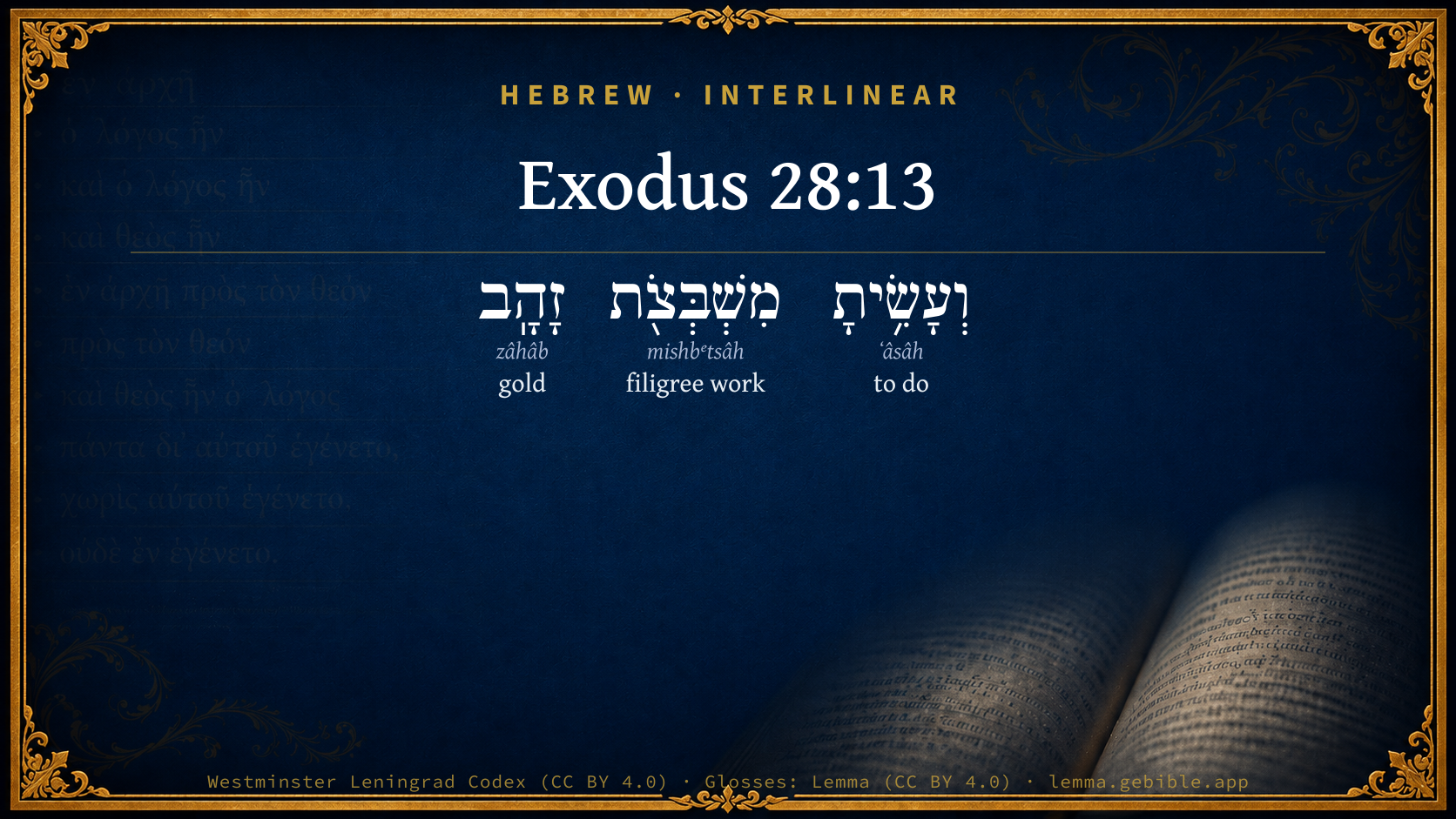
Exodus 28:13

Hebrew (Westminster Leningrad Codex) Exodus 28:13 appears in the Hebrew Old Testament. The text above is from the Westminster Leningrad Codex. Each word links to its Strong’s number, a concise gloss, and parsing drawn from the Open Scriptures Hebrew Bible morphology. Click any word for its full Brown-Driver-Briggs (BDB) entry.
Download image
Cite this verse

Exodus 28:13 (World English Bible). Public Domain. Lemma interlinear Bible study tool, https://lemma.gebible.app/v/exodus/28/13.

Show BibTeX & RIS
BibTeX
RIS
English Translation
You shall make settings of gold,
World English Bible · Public Domain
Download a study sheet

One document with this verse’s original text, its word-by-word gloss line, the meaning frame, cross-references with their text, attributed commentary, and full source and license credits — printable, and it pastes into notes with its structure intact.

This verse Autodidact and up

Study sheet (.html) Plain text (.txt)

A passage Seminary Student

Up to 50 verses in one chapter. A passage sheet keeps up to 6 commentary sources and 12 cross-references per verse, in the order this page ranks them, and says so on the sheet whenever that leaves anything out. Ask for a single verse and you get the Autodidact verse sheet above.

Everything on this page stays free to read, with no account — the sheet is a download of what is already on screen, not access to it.

Want to remove ads? Support Godless Engineer
Compare translations 3

The same verse in 3 English versions, stacked beneath the original-language interlinear above. Click any original word for its lexicon entry.

Each is an independent rendering of the whole verse — the interlinear is not word-aligned to these translations.

Highlighted words mark where these versions differ — a whole-verse word diff, not a word-by-word alignment.

  • World English Bible Public Domain
    You shall make settings of gold,
  • King James Version Public Domain
    And thou shalt make ouches of gold;
  • unfoldingWord Literal Text CC BY-SA 4.0
    And you shall make ornamental settings of gold

unfoldingWord Literal Text — © unfoldingWord, licensed CC BY-SA 4.0. Word-aligned USFM3 via Door43 (git.door43.org/unfoldingWord/en_ult).

Versions to compare (up to 4)

3 of 4 selected

Show all 18 translations

Every available English version of this verse, each an independent rendering of the whole verse.

  • World English Bible Public Domain
    You shall make settings of gold,
  • Berean Standard Bible Public Domain
    Fashion gold filigree settings
  • Majority Standard Bible Public Domain
    Fashion gold filigree settings
  • King James Version Public Domain
    And thou shalt make ouches of gold;
  • American Standard Version (1901) Public Domain
    And thou shalt make settings of gold,
  • Revised Version (1885) Public Domain
    And thou shalt make ouches of gold:
  • Geneva Bible (1599) Public Domain
    So thou shalt make bosses of golde,
  • Douay-Rheims (1899) Public Domain
    Thou shalt make also hooks of gold.
  • Young's Literal Translation Public Domain
    `And thou hast made embroidered things of gold,
  • Literal Standard Version CC BY-SA 4.0
    And you have made filigrees of gold,
  • Unlocked Literal Bible CC BY-SA 4.0
    You must make settings of gold
  • unfoldingWord Literal Text CC BY-SA 4.0
    And you shall make ornamental settings of gold
  • Darby Bible Public Domain
    And thou shalt make enclosures of gold;
  • World Messianic Bible Public Domain
    You shall make settings of gold,
  • Webster's Bible Public Domain
    And thou shalt make ouches of gold;
  • Free Bible Version CC BY-SA 4.0
    Make ornamental gold settings
  • Bible in Basic English Public Domain
    And you are to make twisted frames of gold;
  • JPS Tanakh (1917) Public Domain
    And thou shalt make settings of gold;

Literal Standard Version (2020), Covenant Press — licensed CC BY-SA 4.0. Text via the HelloAO Bible API (eBible.org). Unlocked Literal Bible (unfoldingWord) — licensed CC BY-SA 4.0. Text via the HelloAO Bible API (eBible.org). unfoldingWord Literal Text — © unfoldingWord, licensed CC BY-SA 4.0. Word-aligned USFM3 via Door43 (git.door43.org/unfoldingWord/en_ult). Free Bible Version, Dr. Jonathan Gallagher — licensed CC BY-SA 4.0. Text via the HelloAO Bible API (eBible.org).

Word by word

More ways to search: Search by grammar → Find every occurrence → Compare this word →

Practice this passage: Drill this verse → Learn its vocabulary →

About this verse

These counts appear in no published source. They are computed here, from the morphology-tagged text and Lemma’s own curated glosses. What Lemma adds →

3
words
3
distinct lemmas
Pentateuch
section

Notable vocabulary

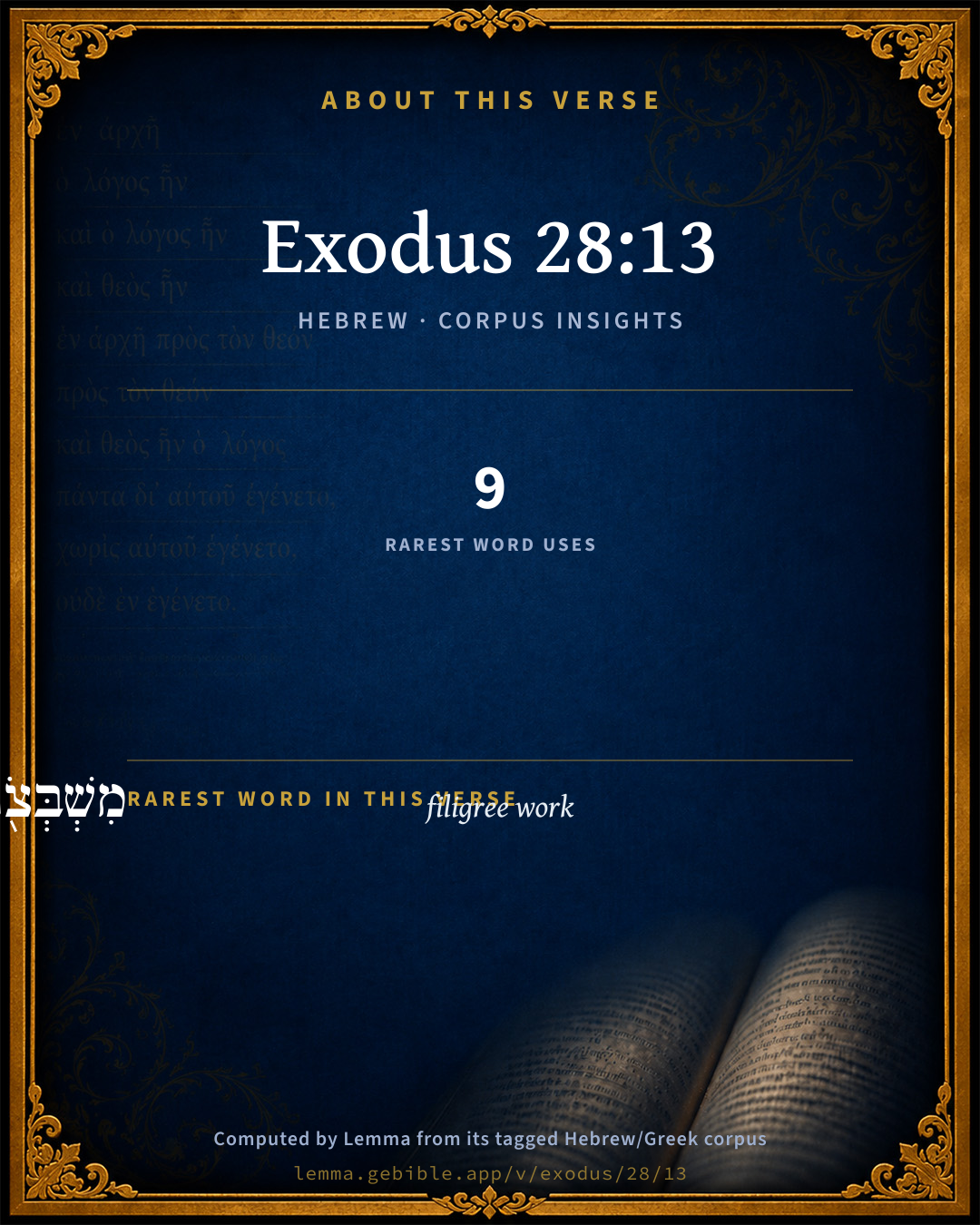
The rarest word here is מִשְׁבְּצֹ֖ת filigree work H4865 — appearing just 9 times in the whole Hebrew Bible.

Shared distinctive vocabulary

מִשְׁבְּצֹ֖ת filigree work H4865 occurs in 9 verses of the Hebrew Bible. Also found in:

Grammatical profile

  • 1 verb
  • 2 nouns

Verb forms

  • וְעָשִׂ֥יתָ Qal · Sequential Perfect

Hebrew & Septuagint length

In English translation the verse runs 6 words from the Hebrew and 8 from the Septuagint (LXX English) — closely comparable.

A rough comparison of the two English renderings, which tokenize alike — not a word-level alignment.

Word counts can differ between the Hebrew and the Greek without any difference in meaning — e.g. the Hebrew direct-object marker אֵת has no separate Greek word, and Greek often adds the article ὁ.

Hebrew and Greek witnesses Masoretic Hebrew ↔ Greek Septuagint

The same verse in the two great witnesses to the Old Testament, shown verse-for-verse.

These are two independent witnesses, not word-aligned to each other, and the Septuagint is shown in lemma (dictionary) form.

Hebrew Exodus 28:13 Masoretic · Westminster Leningrad Codex

וְעָשִׂ֥יתָ מִשְׁבְּצֹ֖ת זָהָֽב

You shall make settings of gold,

World English Bible · Public Domain

Greek LXX Exodus 28:13 Septuagint · lemma form

καί ποιέω ἀσπιδίσκη ἐκ χρυσίον καθαρός

And you shall make circlets of pure gold;

LXX2012 (modern English Septuagint) · Public Domain

On this verse, Haydock's Catholic Bible Commentary discusses the Septuagint’s reading. Read the note in Commentary ↓

Hebrew: Westminster Leningrad Codex (CC BY 4.0). Greek: Septuagint (public domain); English from LXX2012 (modern English Septuagint) (Public Domain). How the Septuagint differs from the Hebrew →

Targum (Aramaic paraphrase)

2

The Targum is the ancient Jewish Aramaic paraphrase of the Hebrew Scriptures — an interpretive translation, not the Hebrew text itself. Onkelos (literal) and Pseudo-Jonathan (expansive) render the Torah, and Jonathan the Prophets. Coverage is partial: where no permissively-licensed English translation exists for a verse, only the Aramaic is shown. This is verse-level text, not a word-by-word alignment to the Hebrew.

  1. Targum Onkelos Torah (Genesis–Deuteronomy)
    וְתַעְבֵּד מְרַמְצָן דִדְהַב:

    (no public-domain English translation for this verse)

    Targum Onkelos — Aramaic: “Onkelos Genesis” (public domain); “Onkelos Exodus” (public domain); “Onkelos Leviticus” (public domain); “Onkelos Numbers” (public domain); “Onkelos Deuteronomy” (public domain). English: “Sefaria Community Translation” (CC0 1.0 (public-domain dedication)); “J.W. Etheridge. The Targums of Onkelos and Jonathan Ben Uzziel on the Pentateuch. London: Longmans, Green, 1862” (public domain). Text via Sefaria.

  2. Targum Pseudo-Jonathan Torah (Genesis–Deuteronomy)
    וְתַעֲבֵיד מְרַמְצָן דִּדְהַב

    And thou shalt make the sockets of gold.

    Targum Pseudo-Jonathan — Aramaic: “Targum Jonathan on Genesis” (public domain); “Targum Jonathan on Exodus” (public domain); “Targum Jonathan on Leviticus” (public domain); “Targum Jonathan on Numbers” (public domain); “Targum Jonathan on Deuteronomy” (public domain). English: “The Targum of Jonathan ben Uzziel, trans. J. W. Etheridge, London, 1862” (public domain). Text via Sefaria.

Commentary

Notes on Exodus 28:13 from classic Christian and Jewish commentators (each source and its license shown beneath its notes). The classic Christian expositions comment on the surrounding passage and are grouped to its opening verse, so a note may address several verses; the Jewish commentaries on the Tanakh (Rashi and others) are per-verse, so they appear only where the commentator wrote on this verse.

Lemma curates 59 commentaries, every one of them public domain or Creative Commons licensed, each selected and text-cleaned for this edition rather than reprinted as found. About our sources →

Ellicott's Commentary for English Readers

(13) Ouches of gold.—“Buttons” or “rosettes” of similar open-work to that which formed the setting of the onyx stones upon the shoulders of the ephod (Exo_28:11). These “buttons” must have been sewn on to the ephod.

2. THE BREASTPLATE.

(13-30) The space devoted to the “breastplate” is indicative of its high importance. It was the most costly, most magnificent, and most conspicuous of the high priest’s garments, while at the same time it was the most mysterious. Externally it was a blaze of gold and jewels; internally it held those strange and precious objects known as “the Urim and the Thummim” (Exo_28:30), by means of which the Divine will was made known to the high priest, and through him to the people. The basis of the garment was a linen fabric of similar materials and workmanship with the ephod (Exo_28:15), square in shape, about nine inches each way, and “doubled,” so as to form internally a bag or pocket. Upon this linen groundwork were fastened twelve “stones,” or jewels, set in an open-work of gold, and arranged in four rows, three in each (Exo_28:17-21). These stones covered probably the greater portion of the external surface of the breastplate. To its two upper corners were attached two rings of gold, which were made fast by means of gold chains to buttons (“ ouches”) on the upper part of the ephod; and to its two lower corners were attached similar rings, which were fastened by a lace to rings of the same material on the lower part of the ephod (Exo_28:13-14; Exo_28:22-28).

A Bible Commentary for English Readers, edited by Charles John Ellicott (1878–1897) — public domain. Text from a community e-Sword module.

Adam Clarke's Commentary

Verse 13. Ouches of gold] משבצת mishbetsoth, strait places, sockets to insert the stones in, from שבץ shabats, to close, inclose, straiten. Socket, in this place, would be a more proper translation, as ouch cannot be traced up to any legitimate authority. It appears sometimes to signify a hook, or some mode of attaching things together.

Adam Clarke's Commentary on the Bible (1810–1826) — public domain. Text from a community e-Sword/MySword module.

The Cambridge Bible for Schools and Colleges

gen. ed. J. J. S. Perowne

13. ouches] filigree settings or rosettes (v. 11).

13, 14. Two rosettes of gold to be made, with chains of gold attached to them. The object of these chains is explained in vv. 22–5: they are to attach the ‘breastplate’ to the shoulder-straps.

The Cambridge Bible for Schools and Colleges (gen. ed. J. J. S. Perowne; Cambridge University Press, 1878–1918) — public domain. Text from a community e-Sword module.

John Gill's Exposition

And thou shalt make ouches of gold. Or sockets of gold, to put the two onyx stones in, Exo 28:11 for of other ouches we read not, excepting the enclosings, in which the twelve stones of the breastplate were set, Exo 28:20 and these are again mentioned because of the chains to be fastened to them, of which in the following verse.

and these are again mentioned because of the chains to be fastened to them, of which in the following verse.

Exodus 28:14

exo 28:14

exo 28:14

exo 28:14And two chains of pure gold at the ends,.... The use of which was to hang the breast plate on, after described; one end of them was fastened to rings on the ouches in the shoulder pieces, and the other end to rings on the breastplate, and thus it hung:

of wreathen work shall thou make them; these chains were not made after the manner of circles or ringlets coupled together, as chains usually are, but of golden wires twisted together as a rope is twisted

and fasten the wreathen chains to the ouches; to the ouches on the shoulder pieces of the ephod, in which the onyx stones were set, very probably to rings that were in these ouches.

John Gill's Exposition of the Whole Bible (1746–1763) — public domain (CC PDM 1.0). Text via the HelloAO Bible API.

Haydock's Catholic Bible Commentary

Hooks. Septuagint aspidiscas, "imitating the form or biting of an asp." (Calmet) --- Gold, on the ephod, by which the rational was suspended from the shoulders. (Haydock)

George Leo Haydock (1774–1849), Haydock's Catholic Family Bible and Commentary, 1859 edition — public domain. Excludes Psalms (Douay-Rheims chapter numbering differs from Protestant) and Deuterocanonical books (Catholic canon only).

Whedon's Commentary on the Bible

Daniel D. Whedon

13, 14. Ouches… chains — These were designed in some way to fasten the ephod and breastplate together, (comp. Exo_28:25,) and so serve to introduce the description of the latter.

Daniel D. Whedon (gen. ed.), Commentary on the Old and New Testaments (1874–1909) — public domain. Text from a community e-Sword module.

The Pulpit Commentary

Vers. 13-30. THE BREAST-PLATE. It has been noticed that the ephod had for its main object or purpose to be a receptacle for the breastplate which was attached to it after it had been put on, and formed its principal ornament. The Hebrew word khoshen, which is translated "breast-plate," means "ornament;" and the khoshen must certainly have been the most striking and brilliant object in the whole attire of the high priest. Externally, it did but repeat the symbolism of the ephod, exhibiting the high priest as the representative of the twelve tribes, whose names were engraved upon its twelve stones, as well as upon the onyxes of the ephod. Internally, it had, however, another, and a deeper import. It contained within it the Urim and the Thummim (ver. 30), by means of which God was consulted, and signified his will to his people. This must be regarded as its main end and use. It was from the decisions thus given that it received the name of "the breastplate (or ornament) of judgment.

Ouches of gold. "Buttons" according to one view (Cook): "sockets," according to another (Kalisch): "rosettes," according to a third (Keil). Some small ornament of open-work (see the comment on ver. 11), which could be sewn on to the ephod, and whereto a chain might be attached, seems to be intended. The object was to fasten the "breast-plate" firmly to the ephod.

Vers. 13-30. The Teachings of the Breast-plate.

The breast-plate of judgment has many aspects, and teaches us several important truthse.g. :

I THE PRECIOUSNESS OF SOULS IN GOD"S SIGHT. The tribes of Israel are represented by gems gems of the most precious kinds known to, and workable by the engravers of the day sard, and onyx, and carbuncle, and lapis lazuli, and chrysolite, and perhaps turquoise. We are reminded by this of the saying of the Lord recorded by the prophet Malachi (that fear me) shall be mine in that day when I make up my jewels". (Mal_3:17) His own elect are the "jewels" of Christ, wherewith he decks himself as a bridegroom with his ornaments. (Isa_61:10) As Israel was of old, not only his "special people," but his "peculiar treasure", (Exo_19:5) so are Christians now each one of them dear to him; each one of them purchased with his blood; each one of them a stone in that glorious temple whereof he is the chief corner stone a "white stone," having on it "a new name written". (Rev_2:17 Rev_3:12)

II THE VARIETY IN THEIR GIFTS. Each stone in the breast-plate was different from all the rest each had its own peculiar beauty. One was more brilliant, one more lovely in its hue, one more curious from its complexity. Yet the breast-plate needed all, would not have been perfect without all. None could say to its neighbour have no need of thee." Contrast with its neighbours heightened the effect of each and so added to its beauty. It is the same with Christ"s "jewels no two are alike each has his own peculiar characteristics, his idiosyncrasy. And the crown in which the jewels are set is rendered more beautiful than it would otherwise have been by this diversity and variety. An endless repetition of even that which is most lovely pails. Of the thousands upon thousands whom Christ has saved and will save, no two but will be different; no one but will add somewhat to the majesty and beauty of the Church in heaven by its peculiar and distinctive character.

III THE HIGH VALUE OF HIDDEN GIFTS OF WISDOM AND KNOWLEDGE. It was not from its external beauty from the gold and purple, and scarlet, and blue, and fine linen of its main fabric, or from its ouches and its golden chains of wreathed work; or even from the dazzling brilliancy and varied hues of its twelve gems that the breast-plate of the high priest drew either its main value or its honourable title. It was "the breast-plate of judgment;" and this "judgment" was wholly unconnected with the external beauty and gorgeous appearance of the breast-plate. Hidden away in the treasury of its innermost folds lay the mysterious objects, known as "light" and "perfection," by means of which the priest pronounced his "judgments," and declared the will of God to the people.

These constituted the true glory of the breastplate. While the twelve stones symbolised the twelve tribes, with their varied gifts and faculties (Gen_49:3-27; Deu_33:6-25) the Urim and the Thummim symbolised light and perfection intellectual and moral excellence those best gifts of wisdom and moral knowledge which are the crowning graces of the regenerate human being. (Eph_1:8, Eph_1:17; Php_1:9; Col_1:9, Col_1:10; etc.)

IV THE PROPRIETY OF REFERRING ALL OUR DOUBTS TO GOD FOR DECISION. Though the Christian Church does not enjoy, any more than did the post-captivity Jewish Church, (Ezr_2:63) the advantage of oracular responses from on high, though our High Priest is gone before us into the holiest, and has taken with him the light and perfection, which are his alone, yet it is still possible to refer doubts to God, and so obtain light enough to serve as a guide to conduct. If we take our difficulties to God on our knees, and ask his counsel upon them in a faithful spirit, we have full reason to trust that we shall receive illumination from him. What after prayerful communion with God appears to us the best course to take, we may accept as his decision, his voice speaking to us. How consoling and encouraging the thought that we can, each one for himself, in the solitude of our chambers cast the burthen of our cares upon One who is perfectly good and perfectly wise, and who has promised to be our guide unto death!

The Pulpit Commentary (1880–1919), ed. H.D.M. Spence-Jones & Joseph S. Exell — public domain. Text from a community e-Sword module.

Kretzmann's Popular Commentary

Paul E. Kretzmann

The Breastplate

v. 13. And thou shalt make ouches of gold, clasps or buckles;

v. 14. and two chains of pure gold at the ends, attached to the clasps; of wreathen work shalt thou make them, by braiding gold wire, and fasten the wreathen chains to the ouches, so that the buckles, which probably had the form of rosettes, were firmly attached to the braided chains, the entire ornament being intended for holding the breastplate.

v. 15. And thou shalt make the breastplate of judgment, that being its full technical name, with cunning work, with the highest artistic workmanship; after the work of the ephod thou shalt make it; of gold, of blue, and of purple, and of scarlet, and of fine twined linen shalt thou make it.

v. 16. Foursquare it shall be being doubled, folded together to form a sort of pocket; a span shall be the length thereof, and a span shall be the breadth thereof, a span being half a cubit.

v. 17. And thou shalt set in it settings of stones, fill its outer side with rows of precious gems, even four rows of stones. The first row shall be a sardius, a topaz, and a carbuncle; this shall be the first row.

v. 18. And the second row shall be an emerald, a sapphire, and a diamond.

v. 19. And the third row a ligure, an agate, and an amethyst.

v. 20. And the fourth row a beryl, and an onyx, and a jasper (or a chrysolite, a beryl, and a jasper); they shall be set in gold in their inclosings, that is, in their settings. The modern names pretty accurately reproduce the Hebrew names, and may be accepted as fairly exact. The settings of the stones seem to have been ornamental clasps, which were of value also in fastening the stones to the heavy cloth of the breastplate. "The twelve precious stones denote the variety, manifoldness, and totality of the natural and gracious gifts bestowed on the people of God, and united in the one spirit of heavenly preciousness. "

v. 21. And the stones shall be with the names of the children of Israel, twelve, according to their names, like the engravings of a signet; everyone with his name shall they be according to the twelve tribes, corresponding both in number and in names.

v. 22. And thou shalt make upon the breastplate chains at the ends of wreathen work of pure gold. Cf v. 14.

v. 23. And thou shalt make upon the breastplate two rings of gold, and shalt put the two rings on the two ends of the breastplate, evidently above.

v. 24. And thou shalt put the two wreathen chains of gold, the braids of gold wire, in the two rings which are on the ends of the breastplate.

v. 25. And the other two ends of the two wreathen chains thou shalt fasten in the two ouches, in the clasps connected with the onyx stones on the shoulders, and put them on the shoulder-pieces of the ephod before it.

v. 26. And thou shalt make two rings of gold, and thou shalt put them upon the two ends of the breastplate in the border thereof, which is in the side of the ephod inward, on the lower edge, on the rear, or inner, side, facing the ephod.

v. 27. And two other rings of gold thou shalt make, and shalt put them on the two sides of the ephod underneath, toward the forepart thereof, over against the other coupling thereof, above the curious girdle of the ephod. The description indicates that these rings were placed on the shoulder-pieces of the ephod in the center below, where it was held together above the girdle.

v. 28. And they shall bind the breastplate by the rings thereof, that is, the lower rings, unto the rings of the ephod with a lace of blue, with threads of the hyacinth material which was used in the weaving of the cloth, that it may be above the curious girdle of the ephod, and that the breastplate be not loosed from the ephod. It was not only to be prevented from moving up and down, but also from sliding back and forth as it was worn, and from falling forward as the high priest stooped over.

v. 29. And Aaron shall bear the names of the children of Israel in the breastplate of judgment, of judicial sentence, upon his heart, when he goeth in unto the Holy Place, for a memorial before the Lord continually, v. 12.

v. 30. And thou shalt put in the breastplate of judgment, in the pocket formed by its fold, the Urim and the Thummim (light and perfection; or revelation and truth); and they shall be upon Aaron’s heart when he goeth in before the Lord; and Aaron shall bear the judgment of the children of Israel upon his heart before the Lord continually, that is, the sentence of salvation, or righteousness, and the sentence of judgment; as the high priest he was the mediator between God and the people. Every high priest appearing before the Lord with the Urim and Thummim thereby became the advocate of the people, and usually received from the Lord such illumination as served to protect the children of Israel in their promised rights, Num 27:21. Christ is our High Priest. He is our Advocate with the Father; He reveals to us God’s light and truth, God’s gracious and good will toward us, by which we receive counsel and comfort in dark days. The Word of the Lord is a lamp unto our feet and a light upon our path.

Paul E. Kretzmann, Popular Commentary of the Bible (1921–1924) — public domain. Text from a community e-Sword module.

unfoldingWord translationNotes

Door43 World Missions Community

General Information:

Yahweh continues to tell Moses what the people must do.

settings

These are pieces of metal that hold each stone onto the ephod. See how you translated this in Exodus 28:11.

two braided chains of pure gold like cords

"two chains of pure gold that are braided like cords"

translationWords

gold

pure

unfoldingWord translationNotes — © Distant Shores Media and the Door43 World Missions Community, licensed CC BY-SA 4.0. Source: git.door43.org/Door43/en_tn.

Rashi

Rabbi Shlomo Yitzchaki (Rashi)

ועשית משבצת AND THOU SHALT MAKE SETTINGS — two settings, for the minimum number of settings (the plural) is two. In this section it explains to you only part of their purpose, whilst in the section dealing with the breast-plate it completes for you the explanation about them.

Rashi on the Tanakh — English translations: “The Judaica Press complete Tanach with Rashi, translated by A. J. Rosenberg” (CC BY 4.0); “Pentateuch with Rashi's commentary by M. Rosenbaum and A.M. Silbermann, 1929-1934” (public domain); “The Metsudah Tanach series, Lakewood, N.J” (CC BY 4.0); and “The Book of Joshua, Metsudah Publications, 1997” (CC BY 4.0). Text via Sefaria.

Lesson kit

Teaching starters — assembled from the data on this page, not authored interpretation. Every prompt links to the verse data it draws on. Edit before teaching.

Exodus, in the Pentateuch, opens this verse with 3 words (3 distinct Hebrew lemmas). Its most distinctive word is mishbᵉtsâh (“filigree work”). A historical commentator’s framing appears above. Read the whole chapter for the surrounding context.

Discussion questions

  1. How does “filigree work” (mishbᵉtsâh) shape what this verse is saying?
  2. Exodus 28:11 shares the word «filigree work» with this verse. How do the two illuminate each other?
  3. These translations render this verse differently; the difference is in the English rendering, not the original. What questions does that raise?
  4. The verb «וְעָשִׂ֥יתָ» is Qal Sequential Perfect. How does its form color the action?
  5. Reading how Ellicott's Commentary for English Readers and Adam Clarke's Commentary read this verse, where do the two commentators agree and where do they part?

Things to notice

Reading settings

Reading text

Shown beneath each verse's original-language words.

Old Testament
Old Testament edition

Read the OT as the Masoretic Hebrew (MT) or the Greek Septuagint (LXX).

English shown for the Greek Septuagint (in the Hebrew ↔ Greek comparison).

Comparing translations? Open the Compare panel on any verse page to stack up to four side by side.