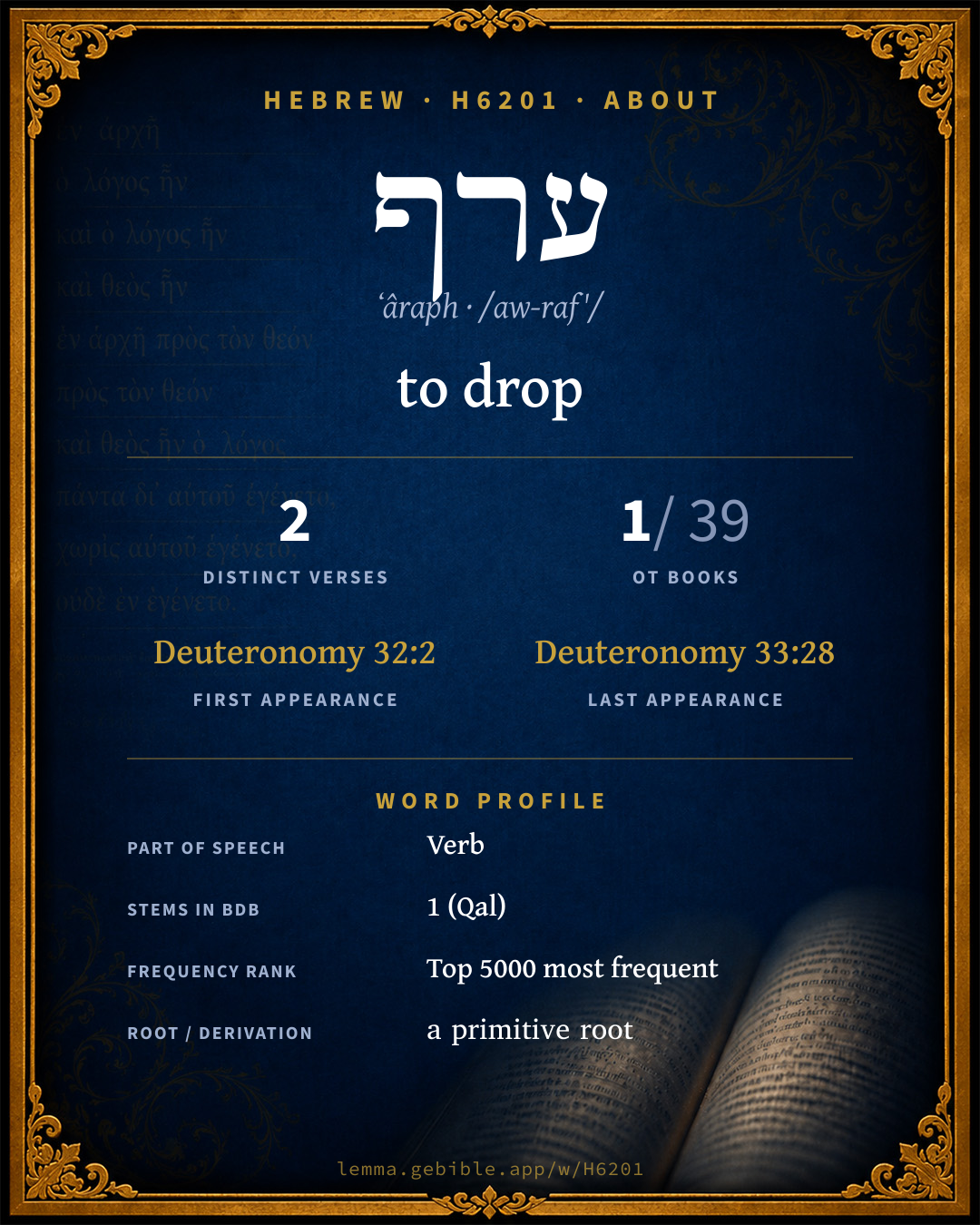
עָרַף
to drop
‘to drop’ is one of 2 main senses fuller range ↓
Full lexicon entry — Brown-Driver-Briggs (BDB)
From Brown-Driver-Briggs (BDB)
Where this word appears
Grammar key — what these labels mean
Part of speech
- Verb
- An action or state-of-being word.
Stem
- Qal
- The basic, simple active stem — the plain form of the verb (“he wrote”).
Form
- Imperfect
- An incomplete, ongoing, or future action (“he will / would write”).
Person
- 3rd Person
- The one spoken about (“he / she / it / they”).
Gender
- Masculine
- Grammatically masculine.
Number
- Plural
- More than one (in Hebrew, generally three or more).
- Singular
- One.
Grammatical forms
- Verb, Qal, Imperfect, 3rd Person, Masculine, Plural 1 time (50%)
- Verb, Qal, Imperfect, 3rd Person, Masculine, Singular 1 time (50%)
Parsed forms decoded from the imported morphology (morphhb / Westminster Leningrad Codex — WLC text public domain, morphhb tagging CC BY 4.0), counted across 2 parsed occurrences — not distinct verses.
Every verse where H6201 appears — 2 distinct verses across 1 book. Click any verse to open its interlinear word-by-word view. Verse text shown in the World English Bible for context — . Each verse’s Hebrew form is shown with its reference; the English is not keyword-highlighted, since the data carries no word-level English alignment. Use “Compare translations” on any verse to read it across multiple English versions. This concordance covers the Hebrew Bible; Septuagint (Greek Old Testament) occurrences are not indexed here.
Deuteronomy 2 verses
- Deuteronomy 32:2 יַעֲרֹ֤ף Qal impf 3ms My doctrine shall drop as the rain; My speech shall condense as the dew, As the small rain on the tender grass, As the showers on the herb.
- Deuteronomy 33:28 יַֽעַרְפוּ Qal impf 3mp Israel dwells in safety, The fountain of Jacob alone, In a land of grain and new wine; Yes, his heavens drop down dew.
About this entry
At a glance — auto-summarized from this page’s data, not written by a person. Every figure links to its source below. This summary describes the numbers; it doesn’t interpret them.
ערף (ʻâraph) is a Hebrew verb most often rendered “to drop.” The Hebrew Bible uses it only 2 verses. It clusters heavily in Deuteronomy, which alone accounts for 100% of its uses. It first appears in Deuteronomy 32:2. It is not a single-sense word — see its full sense range. The sections below give every sense, occurrence, and version rendering.
Gloss history
Strong's 1890 vs modern scholarship
About this word
Strong's H6201 catalogs a Hebrew word from the Hebrew Old Testament.
These counts are not copied from any lexicon or concordance. They are computed here, from the morphology-tagged Hebrew Old Testament. What Lemma adds →
- 2
- distinct verses
- The word appears in 2 distinct verses.
- 1 / 39
- OT books
- The word appears in 1 of 39 Old Testament books.
- #4,807
- by frequency
- Top 5000 most frequent Hebrew words (rank 4,807 of 8,640 Hebrew words by occurrence).
View all 2 occurrences in the concordance →
Most concentrated in
- Deuteronomy 2 verses 100%
By section of the Old Testament
By traditional corpus
Conventional, traditional groupings — biblical authorship is debated, so this is a traditional corpus grouping, not an authorship claim. Each share is this word’s portion of its verses in that division of the Hebrew canon. Each figure is a share of the word’s 2 distinct verses.
- Torah (Pentateuch) 2 verses · 100%
How translations render this word
Counts come from each version’s own published word-to-Strong’s tagging or interlinear alignment — an approximate guide to how each version renders this word, not a word-level alignment the data otherwise carries. Because each total is that version’s own tagged count, the per-version totals vary from one another and need not match the appearance or distinct-verse counts above. These counts may also differ from a printed concordance because Lemma counts each distinctly tagged rendering and does not collapse phrase taggings into a single head-word total. This is a fixed set of word-tagged versions (KJV, ASV, BSB, ULT) and does not change with the reading translation you choose elsewhere. Each version’s license is shown beside its name below (and on Sources).
BDB lists this Strong’s number as 2 distinct words (homographs). Each count above pools all of them and is not split by sense — see the Senses section below. A low-frequency rendering may belong to a different one of those words, not the primary meaning.
- King James Version†: Shall drop 1×, Shall drop down 1×
- American Standard Version†: Heavens drop down 1×, Shall drop 1×
- Berean Standard Bible†: Drip 1×, Fall 1×
- unfoldingWord Literal Text†: Drop 2×
King James Version Public Domain
Renders H6201 across 2† tagged occurrences — most commonly:
American Standard Version Public Domain
Renders H6201 across 2† tagged occurrences — most commonly:
Berean Standard Bible Public Domain
Renders H6201 across 2† tagged occurrences — most commonly:
unfoldingWord Literal Text CC BY-SA 4.0
Renders H6201 across 3† tagged occurrences — most commonly:
Plus 1 rendering that appears only once — usually multi-word phrases or single function words the recovered tagging swept in, not distinct renderings.
Senses in the full BDB
What do BDB’s symbols mean?
BDB uses these scholarly abbreviations:
| Symbol | Meaning |
|---|---|
| 𝔊 | the Septuagint (the ancient Greek translation, LXX) |
| 𝔙 | the Vulgate (the Latin translation) |
| 𝔖 | the Syriac version (the Peshitta) |
| 𝔗 | the Targum (the Aramaic translation) |
| ψ | the Psalms |
| √ | root (the underlying root or stem) |
| ‖ | parallel passage (a synonymous or contrasted parallel) |
| † | the dagger: every passage where the word occurs is cited |
The 2 senses and sub-senses the full Brown-Driver-Briggs lexicon distinguishes for this word, in lexicon order (not ranked by frequency), with BDB’s own verbatim wording and sub-sense lettering. Shown in Hebrew script with BDB’s own scholarly abbreviations. The condensed entry is in the Lexicon Entry tab. See also the Forms in the corpus table below.
ערף I denom. break the neck of an animal
Qal
- Pf. 2 ms. sf. וַעֲרַפְתּוֹ consec. Ex 13:13; 34:20 (JE), 3 pl. וְעָֽרְפוּ־שָׁם אֶת־הָעֶגְלָה consec. Dt 21:4; Pt. act. עוֹרֵף כֶּלֶב Is 66:3; pass. הָעֲרוּפָה הָעֶגְלָה Dt 21:6; Impf. 3 ms. יַעֲרֹף Ho 10:2 fig. of breaking down altars. e.g. Exodus 13:13
ערף II
Qal
- Impf. 3 mpl. שָׁמָיו יַעַרְפוּ־טָ֑ל Dt 33:28 his heavens drop dew; fig., of speech, intrans., יַעֲרֹף כַּמָּטָר לִקְחִי 32:2 let my teaching drop like the rain (‖ תִּזַּל כַּטַּל אִמְרָתִי).—Cf. רָעַף. e.g. Deuteronomy 33:28
Senses from the full Brown-Driver-Briggs lexicon (Brown, Driver, Briggs; Oxford 1906 — public domain), digitized via Sefaria, supplemented by the OpenScriptures HebrewLexicon (CC BY 4.0). Full attribution on Sources.
Word origin
I. vb. denom. break the neck of an animal;—
II. vb. drip, drop (cf. Arabic غَرَفَ lade out water with the hand (as with ladle) cf. Ph. ערפת portico (whence rain drips) v. HoffmAbh. d. GGW xxxvi. May, 1889, 12f.; cf. also غُرْفَةٌ upper-room; מערף ענן Ecclus 43:22 the dropping of a cloud, Assyrian irpu, irpitu, cloud(s));—
— Brown-Driver-Briggs (Oxford 1906, public domain), digitized via Sefaria, supplemented by the OpenScriptures HebrewLexicon (CC BY 4.0). See Sources.
Origin: a primitive root
Jastrow Dictionary
A second Hebrew/Aramaic lexicon for comparison, covering Aramaic and post-biblical (Talmudic, Targumic, Midrashic) usage that the biblical-Hebrew BDB does not. Matched by lemma rather than by Strong’s number, so a lemma may carry more than one Jastrow headword (shown separately below), and the entries cover usage well beyond the Bible.
עָרַף
- (b. h.)
- 1. to divide, cut. Sifré Deut. 306 (ref. to יערף, Deut. XXXII, 2) אין יַעֲרֹף … פרוט … אלא עֲרוֹף לי וכ׳ yaʿʿărof is a Phoenician (mercantile) term, e.g. one does not say to one’s neighbor, pʾroṭ (break into small change) this Selʿa for me, but ʿărof for me &c.—Denom. עוֹרֶף.—2) (cmp. קָטַף a. קְטָף) to drop, distill. Taan. 7ᵃ (ref. to Deut. l. c.) אם ת"ח … ואם לאו עוֹרְפֵיהוּ כמטר if a scholar is worthy, he is like dew; if unworthy, drop him like rain; Yalk. Deut. 942 עָרְפֵהוּ. e.g. Deuteronomy 32:2
- 3. (denom. of עוֹרֶף) to break the neck of; esp. to break the neck of a heifer to atone for a murder the author of which is unknown (Deut. XXI, 1–9); to perform the ceremony of atonement. Sot. IX, 2 לא היו עוֹרְפִין they did not perform the ceremony. Ib. 45ᵇ; a. fr.—Ib. IX, 5 ועורפין אותה בקופיץ וכ׳ and (if the ground is not hard and rough) they cut her head from behind with a hatchet.—Part. pass. עָרוּף; f. עֲרוּפָה.—עגלה ע׳, v. עֶגְלָה. e.g. Deuteronomy 21:1
- 4. (cmp. אָחַר) (of copulations of animals) to cover (from behind). Ib. 42ᵇ (play on עָרְפָּה) שהכל עורפין וכ׳ all covered her from behind.
- to have the neck broken. Ib. IX, 7 (47ᵃ) נמצא … עד שלא נֶעֶרְפָּה וכ׳ (Y. ed. עד שלא תֵיעָרֵף) if the murderer was discovered before the heifer was put to death; משנִתְעָרְפָה העגלה Mish. (Y. a. Bab. ed. משנערפה) after the ceremony had taken place. Ib. 46ᵃ יבוא דבר … ויֵעָרֵף וכ׳ let there be brought a thing which has not yet produced fruit (a heifer) and be broken in a place which produces no fruit, and atone for the murder of him who was prevented from producing fruit (good deeds on earth). Ex. R. s. 42, end (play on קשה ערף, Ex. XXXII, 9) ראויים הם להֵעָרֵף they deserve to have their necks broken; a. e. e.g. Exodus 32:9
עֲרַף
- , to break the neck of the heifer. Sot. 46ᵃ הכי נמי דלא עַרְפִינָן is it really so that we do not perform the ceremony (in such a case)?
עֵרֶף
- , pl. עֲרָפִין, substitute for עֲרָכִין, v. עֵרֶךְ. Y. Ned. I, beg. 36ᶜ ואילו תנינן … ע׳ ערצין ערקין but if we were to teach (substitutes for ʿărakhin), what would we teach? ʿĂrafin, ʿăratsin, ʿăraḳin
עֹרֶף
- , v. עוֹרֶף
A Dictionary of the Targumim, the Talmud Babli and Yerushalmi, and the Midrashic Literature (Marcus Jastrow; London, Luzac, 1903) — Public Domain. Digitized via Sefaria. Digitized via Sefaria. Full attribution on Sources.
Forms in the corpus
The 2 distinct written forms H6201 takes in the Hebrew Bible, most frequent first — each parse links to that stem’s occurrences in the concordance. Hebrew forms include their vowel points and cantillation, so a single lemma takes many written forms.
| Form | Parsing | Example | Uses |
|---|---|---|---|
| יַֽעַרְפוּ | Verb, Qal, Imperfect, 3rd Person, Masculine, Plural | Deuteronomy 33:28 | 1 |
| יַעֲרֹ֤ף | Verb, Qal, Imperfect, 3rd Person, Masculine, Singular | Deuteronomy 32:2 | 1 |
Same root — word family
Other BDB entries built from the same root as H6201, grouped by Strong’s listed origin. These share a root / origin per the lexicon — not necessarily a shared meaning. Each links to that word’s own entry.
Derived from this word
Compare all same-root words → They share a root, not necessarily a meaning.
Septuagint verse parallels
This word appears in 2 verses that also exist in the Greek Old Testament (Septuagint), out of the 2 Hebrew verses it occurs in. You can read those verses in Greek by switching the Old Testament edition to the Septuagint.
Read these verses in the Septuagint
This is a verse-level parallel only — the same verses exist in both the Hebrew and Greek Old Testaments. No word-level Hebrew↔Greek correspondence is claimed: the data carries no such alignment, so no Greek word is shown as this Hebrew word’s translation. Coverage is not total — the Septuagint omits the deuterocanon and renumbers the Psalms, so some Hebrew verses have no direct Greek parallel.