
Numbers 23:22

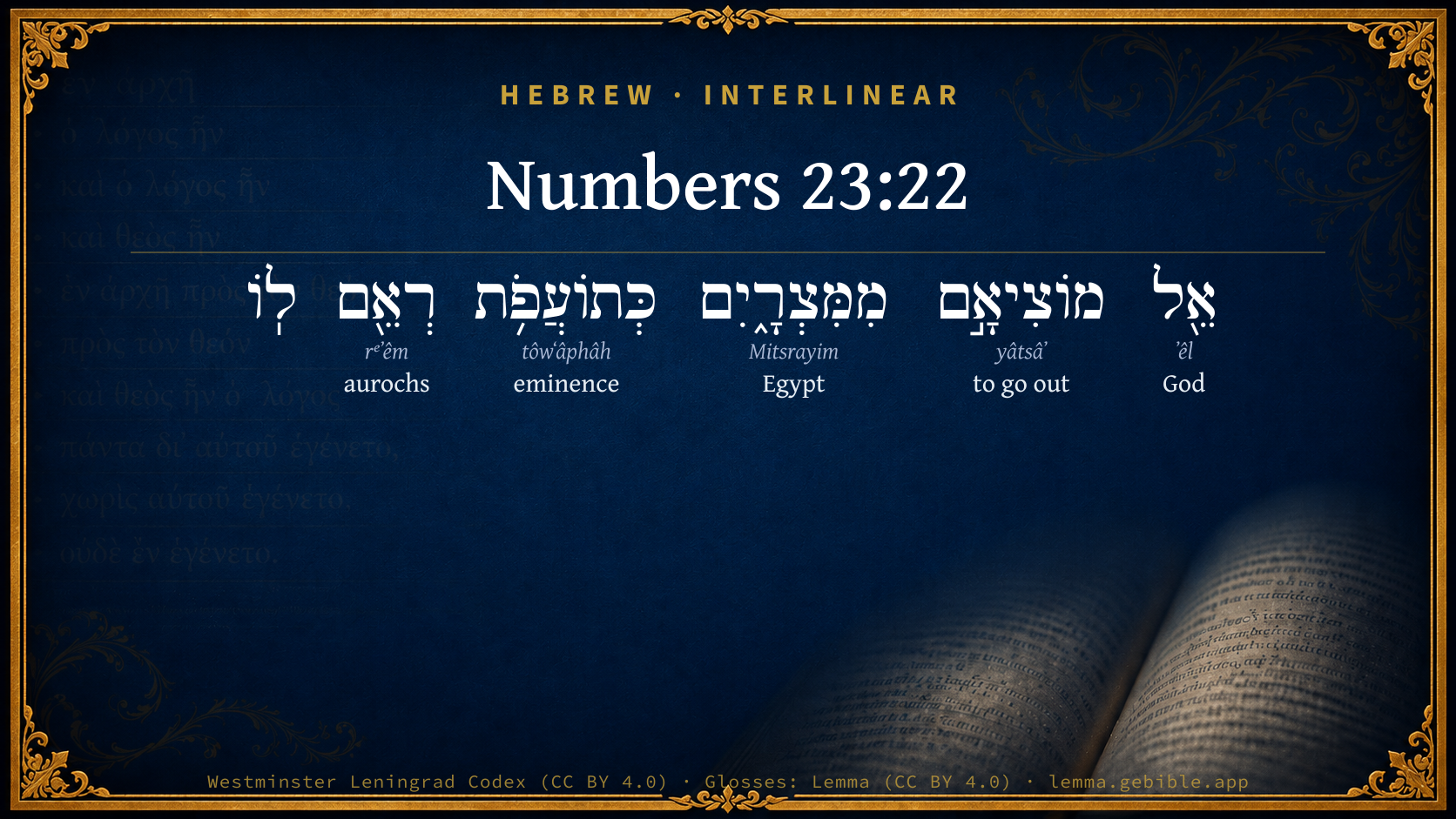
Hebrew (Westminster Leningrad Codex) Numbers 23:22 appears in the Hebrew Old Testament. The text above is from the Westminster Leningrad Codex. Each word links to its Strong’s number, a concise gloss, and parsing drawn from the Open Scriptures Hebrew Bible morphology. Click any word for its full Brown-Driver-Briggs (BDB) entry.
Download image
Cite this verse

Numbers 23:22 (World English Bible). Public Domain. Lemma interlinear Bible study tool, https://lemma.gebible.app/v/numbers/23/22.

Show BibTeX & RIS
BibTeX
RIS
English Translation
God brings them forth out of Egypt; He has as it were the strength of the wild-ox.
World English Bible · Public Domain
Highlights
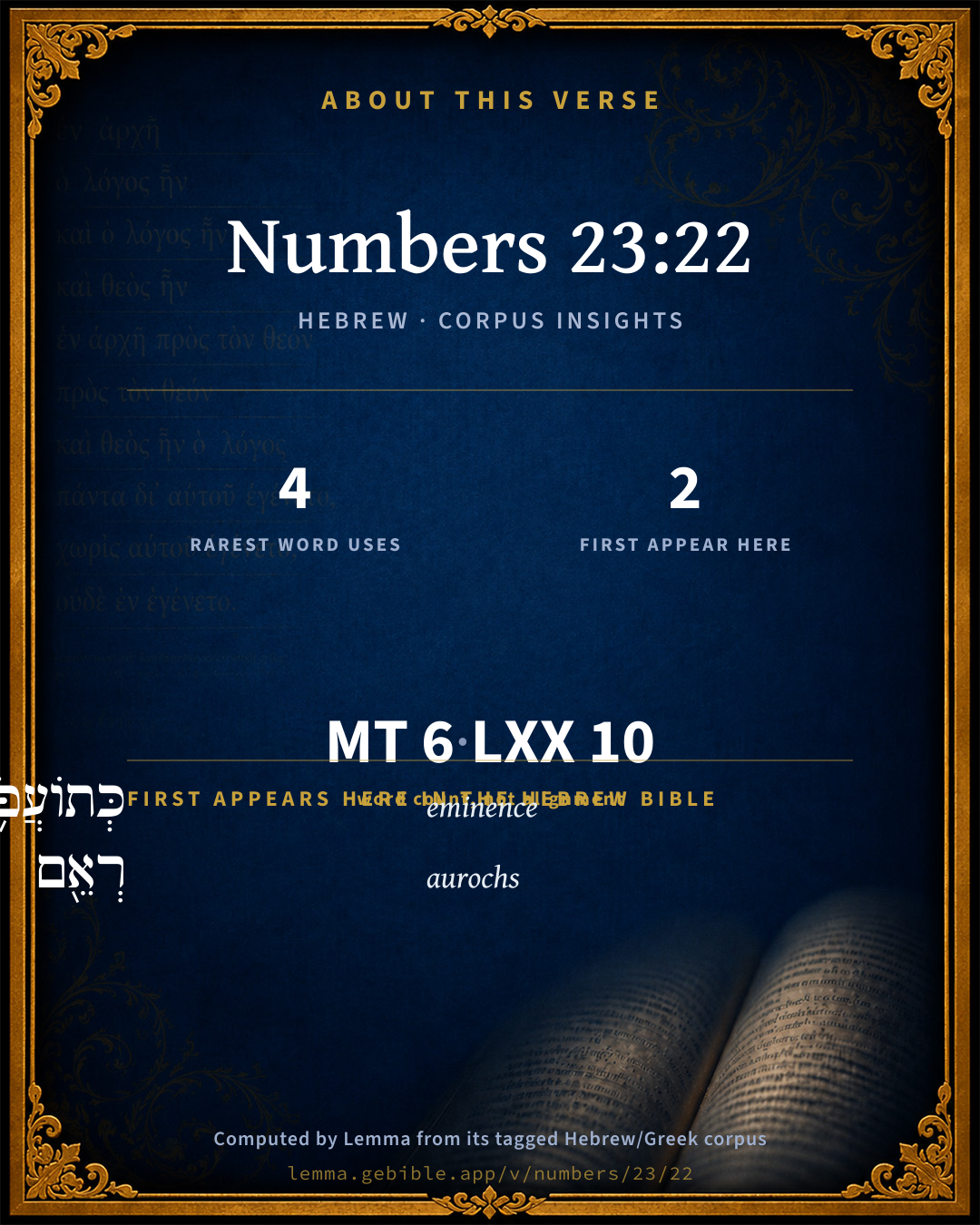
  • 2 first appearances in the Hebrew Bible
Full analysis ↓
Download a study sheet

One document with this verse’s original text, its word-by-word gloss line, the meaning frame, cross-references with their text, attributed commentary, and full source and license credits — printable, and it pastes into notes with its structure intact.

This verse Autodidact and up

Study sheet (.html) Plain text (.txt)

A passage Seminary Student

Up to 50 verses in one chapter. A passage sheet keeps up to 6 commentary sources and 12 cross-references per verse, in the order this page ranks them, and says so on the sheet whenever that leaves anything out. Ask for a single verse and you get the Autodidact verse sheet above.

Everything on this page stays free to read, with no account — the sheet is a download of what is already on screen, not access to it.

Want to remove ads? Support Godless Engineer
Compare translations 3

The same verse in 3 English versions, stacked beneath the original-language interlinear above. Click any original word for its lexicon entry.

Each is an independent rendering of the whole verse — the interlinear is not word-aligned to these translations.

Highlighted words mark where these versions differ — a whole-verse word diff, not a word-by-word alignment.

  • World English Bible Public Domain
    God brings them forth out of Egypt; He has as it were the strength of the wild-ox.
  • King James Version Public Domain
    God brought them out of Egypt; he hath as it were the strength of an unicorn.
  • unfoldingWord Literal Text CC BY-SA 4.0
    God is bringing them out from Egypt; like the horns of a wild ox for him.

unfoldingWord Literal Text — © unfoldingWord, licensed CC BY-SA 4.0. Word-aligned USFM3 via Door43 (git.door43.org/unfoldingWord/en_ult).

Versions to compare (up to 4)

3 of 4 selected

Show all 18 translations

Every available English version of this verse, each an independent rendering of the whole verse.

  • World English Bible Public Domain
    God brings them forth out of Egypt; He has as it were the strength of the wild-ox.
  • Berean Standard Bible Public Domain
    God brought them out of Egypt with strength like a wild ox.
  • Majority Standard Bible Public Domain
    God brought them out of Egypt with strength like a wild ox.
  • King James Version Public Domain
    God brought them out of Egypt; he hath as it were the strength of an unicorn.
  • American Standard Version (1901) Public Domain
    God bringeth them forth out of Egypt; He hath as it were the strength of the wild-ox.
  • Revised Version (1885) Public Domain
    God bringeth them forth out of Egypt; He hath as it were the strength of the wild-ox.
  • Geneva Bible (1599) Public Domain
    God brought them out of Egypt: their strength is as an vnicorne.
  • Douay-Rheims (1899) Public Domain
    God hath brought him out of Egypt, whose strength is like to the rhinoceros.
  • Young's Literal Translation Public Domain
    God is bringing them out from Egypt, As the swiftness of a Reem is to him;
  • Literal Standard Version CC BY-SA 4.0
    God is bringing them out from Egypt, || As the swiftness of a wild ox for him;
  • Unlocked Literal Bible CC BY-SA 4.0
    God brought them out of Egypt with strength like that of a wild ox.
  • unfoldingWord Literal Text CC BY-SA 4.0
    God is bringing them out from Egypt; like the horns of a wild ox for him.
  • Darby Bible Public Domain
    ùGod brought him out of Egypt; he hath as it were the strength of a buffalo.
  • World Messianic Bible Public Domain
    God brings them out of Egypt. He has as it were the strength of the wild ox.
  • Webster's Bible Public Domain
    God brought them out of Egypt; he hath as it were the strength of a unicorn.
  • Free Bible Version CC BY-SA 4.0
    God led them out of Egypt with great power, as strong as an ox.
  • Bible in Basic English Public Domain
    It is God who has taken them out of Egypt; his horns are like those of the mountain ox.
  • JPS Tanakh (1917) Public Domain
    God who brought them forth out of Egypt is for them like the lofty horns of the wild-ox.

Literal Standard Version (2020), Covenant Press — licensed CC BY-SA 4.0. Text via the HelloAO Bible API (eBible.org). Unlocked Literal Bible (unfoldingWord) — licensed CC BY-SA 4.0. Text via the HelloAO Bible API (eBible.org). unfoldingWord Literal Text — © unfoldingWord, licensed CC BY-SA 4.0. Word-aligned USFM3 via Door43 (git.door43.org/unfoldingWord/en_ult). Free Bible Version, Dr. Jonathan Gallagher — licensed CC BY-SA 4.0. Text via the HelloAO Bible API (eBible.org).

Word by word

More ways to search: Search by grammar → Find every occurrence → Compare this word →

Practice this passage: Drill this verse → Learn its vocabulary →

About this verse

These counts appear in no published source. They are computed here, from the morphology-tagged text and Lemma’s own curated glosses. What Lemma adds →

6
words
5
distinct lemmas
Pentateuch
section

Notable vocabulary

The rarest word here is כְּתוֹעֲפֹ֥ת eminence H8443 — appearing just 4 times in the whole Hebrew Bible.

First appearance in Scripture

These words make their first canonical appearance in the Hebrew Bible here:

  • כְּתוֹעֲפֹ֥ת eminence H8443
  • רְאֵ֖ם aurochs H7214

Shared distinctive vocabulary

כְּתוֹעֲפֹ֥ת eminence H8443 occurs in 4 verses of the Hebrew Bible. Also found in:

Grammatical profile

  • 1 verb
  • 4 nouns
  • 1 preposition

Verb forms

  • מוֹצִיאָ֣ם Hiphil · Participle Active

Hebrew & Septuagint length

In English translation the verse runs 17 words from the Hebrew and 19 from the Septuagint (LXX English) — closely comparable.

A rough comparison of the two English renderings, which tokenize alike — not a word-level alignment.

Word counts can differ between the Hebrew and the Greek without any difference in meaning — e.g. the Hebrew direct-object marker אֵת has no separate Greek word, and Greek often adds the article ὁ.

In the original languages it is 6 Hebrew tokens and 10 Greek tokens — but the two are counted differently (Hebrew bundles its prefixes and suffixes into one token; the Greek is in lemma form), so that isn’t a like-for-like length.

Cross-references

10

Topical passages linked to Numbers 23:22 in the Treasury of Scripture Knowledge — connected by theme and wording, ordered by reader-vote popularity; previews shown in the World English Bible.

  • Numbers 24:8 God brings him forth out of Egypt; He has as it were the strength of the wild-ox: He shall eat up the nations his adversaries, Shall break their bones in pieces, Smite [them] through with his arrows.
  • Deuteronomy 33:17 The firstborn of his herd, majesty is his; His horns are the horns of the wild-ox: With them he shall push the peoples all of them, [even] the ends of the earth: They are the ten thousands of Ephraim, They are the thousands of Manasseh.
  • Exodus 20:2 "I am Yahweh your God, who brought you out of the land of Egypt, out of the house of bondage.
  • Job 39:9–11 "Will the wild ox be content to serve you? Or will he stay by your feeding trough?
  • Psalms 22:21 Save me from the lion's mouth; Yes, from the horns of the wild oxen you have answered me.
  • Exodus 9:16 but indeed for this cause I have made you stand: to show you my power, and that my name may be declared throughout all the earth;
  • Exodus 14:18 The Egyptians shall know that I am Yahweh, when I have gotten myself honor over Pharaoh, over his chariots, and over his horsemen."
  • Numbers 22:5 He sent messengers to Balaam the son of Beor, to Pethor, which is by the River, to the land of the children of his people, to call him, saying, Behold, there is a people come out from Egypt: behold, they cover the surface of the earth, and they abide over against me.
  • Psalms 68:35 You are awesome, God, in your sanctuaries. The God of Israel gives strength and power to his people. Praise be to God!
  • Psalms 92:10 But you have exalted my horn like that of the wild ox. I am anointed with fresh oil.

Cross-references courtesy of OpenBible.info (CC BY 4.0).

Hebrew and Greek witnesses Masoretic Hebrew ↔ Greek Septuagint

The same verse in the two great witnesses to the Old Testament, shown verse-for-verse.

These are two independent witnesses, not word-aligned to each other, and the Septuagint is shown in lemma (dictionary) form.

Hebrew Numbers 23:22 Masoretic · Westminster Leningrad Codex

אֵ֖ל מוֹצִיאָ֣ם מִמִּצְרָ֑יִם כְּתוֹעֲפֹ֥ת רְאֵ֖ם לֽוֹ

God brings them forth out of Egypt; He has as it were the strength of the wild-ox.

World English Bible · Public Domain

Greek LXX Numbers 23:22 Septuagint · lemma form

θεός ὁ ἐκἄγω αὐτός ἐκ αἴγυπτος ὡς δόξα μονόκερως αὐτός

It was God who brought him out of Egypt; he has as it were the glory of a unicorn.

LXX2012 (modern English Septuagint) · Public Domain

On this verse, Adam Clarke's Commentary discusses the Septuagint’s reading. Read the note in Commentary ↓

Hebrew: Westminster Leningrad Codex (CC BY 4.0). Greek: Septuagint (public domain); English from LXX2012 (modern English Septuagint) (Public Domain). How the Septuagint differs from the Hebrew →

Targum (Aramaic paraphrase)

2

The Targum is the ancient Jewish Aramaic paraphrase of the Hebrew Scriptures — an interpretive translation, not the Hebrew text itself. Onkelos (literal) and Pseudo-Jonathan (expansive) render the Torah, and Jonathan the Prophets. Coverage is partial: where no permissively-licensed English translation exists for a verse, only the Aramaic is shown. This is verse-level text, not a word-by-word alignment to the Hebrew.

  1. Targum Onkelos Torah (Genesis–Deuteronomy)
    אֱלָהָא דְאַפֵּקִנוּן מִמִצְרָיִם תּוּקְפָא וְרוּמָא דִילֵיהּ

    (no public-domain English translation for this verse)

    Targum Onkelos — Aramaic: “Onkelos Genesis” (public domain); “Onkelos Exodus” (public domain); “Onkelos Leviticus” (public domain); “Onkelos Numbers” (public domain); “Onkelos Deuteronomy” (public domain). English: “Sefaria Community Translation” (CC0 1.0 (public-domain dedication)); “J.W. Etheridge. The Targums of Onkelos and Jonathan Ben Uzziel on the Pentateuch. London: Longmans, Green, 1862” (public domain). Text via Sefaria.

  2. Targum Pseudo-Jonathan Torah (Genesis–Deuteronomy)
    אֱלָהָא דִי פְרַק וְאַפֵּיק יַתְהוֹן פְּרִיקִין מִן אַרְעָא דְמִצְרַיִם תּוּקְפָא וְרוֹמְמוּתָא תּוּשְׁבְּחָא וּגְבוּרְתָּא דִידֵיהּ הוּא

    Unto Eloha, who redeemed and led them out of Mizraim free, belong power and exaltation, glorification and greatness.

    Targum Pseudo-Jonathan — Aramaic: “Targum Jonathan on Genesis” (public domain); “Targum Jonathan on Exodus” (public domain); “Targum Jonathan on Leviticus” (public domain); “Targum Jonathan on Numbers” (public domain); “Targum Jonathan on Deuteronomy” (public domain). English: “The Targum of Jonathan ben Uzziel, trans. J. W. Etheridge, London, 1862” (public domain). Text via Sefaria.

Commentary

Notes on Numbers 23:22 from classic Christian and Jewish commentators (each source and its license shown beneath its notes). The classic Christian expositions comment on the surrounding passage and are grouped to its opening verse, so a note may address several verses; the Jewish commentaries on the Tanakh (Rashi and others) are per-verse, so they appear only where the commentator wrote on this verse.

Lemma curates 59 commentaries, every one of them public domain or Creative Commons licensed, each selected and text-cleaned for this edition rather than reprinted as found. About our sources →

The Cambridge Bible for Schools and Colleges

gen. ed. J. J. S. Perowne

22. He hath as it were the horns of the wild-ox] ‘He’ means Israel, not God. The word for ‘horns’ is rare; but Deu_33:17 helps to decide the meaning. In Psa_95:4 it denotes mountain peaks. The wild-ox (re’çm) ‘is the rîmu of the Assyrian inscriptions. It is represented on the Assyrian sculptures as a huge species (now extinct) of the bovine kind.’ See art. ‘Unicorn’ in Hastings’ DB. iv.

23a. For divination is not in Jacob, and soothsaying is not in Israel] This appears to explain Israel’s victorious strength by the fact that they were free from these heathen practices. But the words are strange in the midst of a passage describing the fierce and irresistible advance of an army with a divine King and Captain at their head. In Num_23:21 the words for ‘calamity’ and ‘trouble’ can also be rendered, as in R.V. , ‘iniquity’ and ‘perverseness.’ And it is very probable that a scribe, who understood the two words in the latter sense, inserted the present clause as a marginal comment on Num_23:21, thus endorsing the principle contained in 1Sa_15:23, that soothsaying and divination by means of teraphim are sins no less than rebellion against God’s commands. It is further noteworthy that in the same chapter (1Sa_15:29) are quoted Balaam’s words in Num_23:19 a.

23b. Now shall it be said &c.] If the former half of the verse was not originally part of the poem, these words refer suitably to God’s action in bringing Israel out of Egypt (Num_23:22 a).

The Cambridge Bible for Schools and Colleges (gen. ed. J. J. S. Perowne; Cambridge University Press, 1878–1918) — public domain. Text from a community e-Sword module.

Joseph Benson's Commentary

Num 23:22. Out of Egypt — Namely, by a strong hand, and in spite of all their enemies, and therefore it is in vain to seek or hope to overcome them. He hath the strength of a unicorn — He, Israel, whom God brought out of Egypt, such change of numbers being very common in the Hebrew language. The sense is, Israel is not now what he was in Egypt, a poor, weak, dispirited, unarmed people, but high, and strong, and invincible. The only difficulty is, what creature is here meant by ראם, reem, which we translate unicorn. Bochart, who is followed by Le Clerc, Patrick, and others, is of opinion that it is a kind of mountain goat, or wild goat, of a very tall size, well known in Arabia. Others, with the learned Scheuchzer, suppose the rhinoceros to be meant, concerning one species of which, the unicorn is, Buffon informs us in his Natural History, that its length, from the extremity of the muzzle to the origin of the tail, is at least twelve feet, and the circumference of the body nearly the same. Of one of this species, sent to London from Bengal in the year 1739, Dr. Parsons observes, “The vivacity and promptitude of his movements led me to think that he is altogether unconquerable, and that he could easily overtake any man who should offend him.” — See Ency. Brit. It seems very probable this is the animal here alluded to, and in Num 23:8 of the next chapter.

Joseph Benson's Commentary on the Old and New Testaments (1811–1818) — public domain. Text from a community e-Sword module.

Jamieson, Fausset & Brown

Robert Jamieson, A. R. Fausset & David Brown

he hath as it were the strength of an unicorn--Israel is not as they were at the Exodus, a horde of poor, feeble, spiritless people, but powerful and invincible as a reem--that is, a rhinoceros (Job 39:9; Psa 22:21; Psa 92:10).

Jamieson, Fausset & Brown — Commentary Critical and Explanatory on the Whole Bible (1871) — public domain (CC PDM 1.0). Text via the HelloAO Bible API.

Adam Clarke's Commentary

Verse 22. The strength of a unicorn.] ראם reem and ראים reim. It is generally allowed that there is no such beast in nature as the unicorn; i. e., a creature of the horse kind, with one long rich curled horn in the forehead. The creature painted from fancy is represented as one of the supporters of the royal arms of Great Britain. It is difficult to say what kind of beast is intended by the original word. The Septuagint translate the word μονοκερως, the unicorn, or one-horned animal; the Vulgate, sometimes, unicornus; and in the text rhinocerotis, by which the rhinoceros, a creature which has its name from the horn on its nose, is supposed to be meant. That no single-horned animal can be intended by the reem of Moses, is sufficiently evident from this, that Moses, speaking of Joseph, says, "he has the HORNS of A unicorn," or reem, where the horns are spoken of in the plural, the animal in the singular. The creature referred to is either the rhinoceros, some varieties of which have two horns on the nose, or the wild bull, urus, or buffalo; though some think the beast intended is a species of goat; but the rhinoceros seems the most likely. There is literally a monoceros, or unicorn, with one large curled ivory horn growing horizontally out of his snout; but this is not a land animal, it is the modiodan or nurwal, a marine animal of the whale kind, a horn of which is now before me, measuring seven feet four inches; but I believe the rhinoceros is that intended by the sacred writers.

Adam Clarke's Commentary on the Bible (1810–1826) — public domain. Text from a community e-Sword/MySword module.

Ellicott's Commentary for English Readers

(22) God brought them out of Egypt.—Literally, is bringing them. The use of the participle denotes the continuance of the action. He who brought them forth out of Egypt was still conducting them on their march. There is an obvious allusion in these words to those of Balak in Num_22:5 : “Behold, there is a people come out from Egypt.” Seeing that the people did not come out of Egypt in obedience to their own caprice, but under Divine guidance, it was vain for Balak to resist them on their course, seeing that to contend with them was to contend against God.

The strength of an unicorn.—Better, of a buffalo. (Comp. Deu_33:17—a passage closely resembling the present—from which it appears that the reem had more than one horn.)

A Bible Commentary for English Readers, edited by Charles John Ellicott (1878–1897) — public domain. Text from a community e-Sword module.

John Gill's Exposition

God brought them out of Egypt,.... With a mighty hand and stretched out arm, and he will conduct them through the wilderness, and bring them safe to Canaan's land; he that brought them from thence will not suffer them to perish by any means; it is in vain to attempt to curse a people that is in such hands, and for whom he has done such great things: Jarchi thinks this stands opposed to what Balak had said, Num 22:5, thou sayest, "lo, a people is come out of Egypt";"they did not come out of themselves, but God brought them:"

he hath as it were the strength of an unicorn; that is, not God, but the people he brought out of Egypt, being a mighty people, able to push their enemies and subdue them, being numerous and strong, especially as strengthened by the mighty God of Jacob; and therefore their strength is expressed by the strength of this creature; for be it what it will, whether the rhinoceros or the wild ox, or one kind of goats, as Bochart (l) thinks; whatever is meant by the term here must be a strong creature, see Deu 33:17 and great is the strength of the spiritual Israel of God, which they have from him to exercise grace, perform duty, withstand and overcome all their spiritual enemies, sin, Satan, and the world.

(l) Hierozoic. par. 1. l. 3. c. 27. col. 965.

John Gill's Exposition of the Whole Bible (1746–1763) — public domain (CC PDM 1.0). Text via the HelloAO Bible API.

Albert Barnes' Notes on the Bible

An unicorn - A wild bull, the now extinct Aurochs, formidable for its size, strength, speed, and ferocity.

Albert Barnes' Notes on the Bible (1834–1885) — public domain. Text from a community e-Sword/MySword module.

Haydock's Catholic Bible Commentary

Rhinoceros. Hebrew ream, which is sometimes rendered unicorn. Bochart thinks it means the oryx, or the strong Arabian goat. The animal, of which the Scripture so often speaks, was remarkable for its strength, (Calmet) and could not easily be tamed, Job xxxix. 9. (Haydock) --- The Septuagint generally translate monoceros, which is a fish, with a horn proceeding from its upper jaw. This is often shewn in cabinets for the horn of the unicorn. There are various animals which have only one horn. Pliny and Aristotle instance the oryx, &c. Various authors of credit specify likewise the rhinoceros, which has "a horn upon its nose," and is found in Ethiopia. The emperor of that country sent one to the court of Persia, which Chardin saw and describes. It is as large as an elephant, and the people have learnt the method of taming both these huge beasts. (Calmet) --- It seems the art was unknown in the days of Job, if this be the animal of which he speaks. (Haydock) --- Moses (Deuteronomy xxxiii. 17,) seems to attribute two horns to the ream; and Pausanius allows a greater and a less one to the rhinoceros; the latter is very strong and erect. It is of a brownish colour. (Calmet) --- Whatever may be the precise meaning of ream, it certainly denotes an animal of superior strength, and very formidable. Balaam represents God, or the people of Israel, in this light. God had given repeated instances of his dominion over all nature, in delivering the Hebrews out of Egypt. They were also capable of striking the Moabites with terror, on account of their own prowess, and surprising numbers, ver. 24. (Haydock)

George Leo Haydock (1774–1849), Haydock's Catholic Family Bible and Commentary, 1859 edition — public domain. Excludes Psalms (Douay-Rheims chapter numbering differs from Protestant) and Deuterocanonical books (Catholic canon only).

Matthew Poole's English Annotations

God brought them out of Egypt, to wit, by a strong hand, and in spite of all their enemies, and therefore it is in vain to seek or hope to overcome them.

He; either,

1. God, last mentioned. But so the comparison is mean and unbecoming. Or rather,

2. Israel, whom God brought out of Egypt; such change of numbers being very common in the Hebrew language. The sense is, Israel is not now what he was in Egypt, a poor, weak, dispirited, unarmed people, but high, and strong, and invincible. The great strength and fierceness of a unicorn is celebrated in Scripture, Num 24:8; Deu 33:17 Job 39:9; Psa 22:21; 92:10. But whether it be a unicorn, or a rhinoceros, or a strong and fierce kind of wild goat, which is here called reem, it is not needful here to determine.

Matthew Poole's English Annotations on the Holy Bible (1683–1685) — public domain. Text from a community e-Sword/MySword module.

Whedon's Commentary on the Bible

Daniel D. Whedon

22. God brought them — Literally, is bringing; implying that the act was still going on.

The strength of a unicorn — This is not the rhinoceros, as some have supposed, but the “wild ox,” (R.V.,) or buffalo, which is untamable and incapable of agricultural service, and formidable on account of its horns. It was common in Palestine. Job_39:9-10; Deu_33:17; Psa_22:21. Instead of strength Furst uses fleetness.

Daniel D. Whedon (gen. ed.), Commentary on the Old and New Testaments (1874–1909) — public domain. Text from a community e-Sword module.

The Pulpit Commentary

God. lae, and also at the end of the next verse, and four times in the next chapter (verses 4, 8, 16, 23). The use seems to be poetic, and no particular signification can be attached to it. Brought them, or, perhaps, "is leading them." So the Septuagint: Yeon . Unicorn. Hebrew, It is uniformly rendered monokerwv by the Septuagint, under the mistaken notion that the rhinoceros was intended. It is evident, however, from Deu_33:17 and other passages that the teem had two hems, and that its horns were its most prominent feature. It would also appear from Job_39:9-12 and Isa_34:7 that, while itself untameable, it was allied to species employed in husbandry. The reem may therefore have been the aurochs or urus, now extinct, but which formerly had so large a range in the forests of the old world. There is some doubt, however, whether the urns existed in those days in Syria, and it may have been a wild buffalo, or some kindred animal of the bovine genus, whose size, fierceness, and length of horn made it a wonder and a fear.

The Pulpit Commentary (1880–1919), ed. H.D.M. Spence-Jones & Joseph S. Exell — public domain. Text from a community e-Sword module.

John Wesley's Explanatory Notes

Out of Egypt - Namely, by a strong hand, and in spite of all their enemies, and therefore it is in vain to seek or hope to overcome them. He - Israel, whom God brought out of Egypt, such change of numbers being very common in the Hebrew language. The sense is, Israel is not now what he was in Egypt, a poor, weak, dispirited, unarmed people, but high and strong and invincible. An unicorn - The word may mean either a rhinoceros, or a strong and fierce kind of wild goat. But such a creature as an unicorn, as commonly painted, has no existence in nature.

John Wesley, Explanatory Notes Upon the Whole Bible (1754–1765) — public domain. Text via the GEBible commentary corpus.

Scofield Reference Notes

C. I. Scofield

unicorn

i.e. the aurochs, or wild ox.

The Scofield Reference Bible (1917 edition), notes by C. I. Scofield — public domain. Text from a community e-Sword module.

Rashi

Rabbi Shlomo Yitzchaki (Rashi)

אל מוציאם ממצרים GOD BROUGHT THEM OUT FROM EGYPT — You said, (Numbers 22:5) “Behold, there is a people come out from Egypt” — it did not come out of its own account, but God brought it out (Midrash Tanchuma, Balak 14).

כתועפת ראם לו means [GOD BROUGHT THEM OUT OF EGYPT] IN ACCORDANCE WITH THE STRENGTH BEFITTING HIS SUBLIMITY (רום) and loftiness. Similar is (Job 22:25) “and silver of strength (‎תועפות‎)"‏ — they (the word תועפות here and in the verse quoted) are both expressions signifying strength. — And I say that really it has the same meaning as the verb in (Genesis 1:20) ועוף יעופף which signifies: a bird that raises itself into the heights and lofty spheres — and this is evidence of great strength. Accordingly ותועפות ראם really signifies “a flight in the heights”. — Another explanation of תועפות ראם is: “the strength of Reemim” and our Rabbis said that this refers to “the demons’” (their strength is subject to Him) (cf. Gittin 68b).

Rashi on the Tanakh — English translations: “The Judaica Press complete Tanach with Rashi, translated by A. J. Rosenberg” (CC BY 4.0); “Pentateuch with Rashi's commentary by M. Rosenbaum and A.M. Silbermann, 1929-1934” (public domain); “The Metsudah Tanach series, Lakewood, N.J” (CC BY 4.0); and “The Book of Joshua, Metsudah Publications, 1997” (CC BY 4.0). Text via Sefaria.

Lesson kit

Teaching starters — assembled from the data on this page, not authored interpretation. Every prompt links to the verse data it draws on. Edit before teaching.

Numbers, in the Pentateuch, opens this verse with 6 words (5 distinct Hebrew lemmas). Its most distinctive word is tôwʻâphâh (“eminence”). A historical commentator’s framing appears above. Read the whole chapter for the surrounding context.

Discussion questions

  1. The word tôwʻâphâh carries the sense “eminence.” How does it shape the verse?
  2. 2 words make their first appearance in Scripture here. What does this debut establish?
  3. How does Numbers 24:8, which shares the word «eminence», read alongside this verse?
  4. The translations on this page render this verse differently — a whole-verse word diff, not a word-by-word alignment. What might account for the different wordings?
  5. «מוֹצִיאָ֣ם» is a Hiphil Participle Active verb. How does that grammatical form shape the action described?
  6. Compare how The Cambridge Bible for Schools and Colleges and Joseph Benson's Commentary read this verse. Where do they agree or differ?

Things to notice

Reading settings

Reading text

Shown beneath each verse's original-language words.

Old Testament
Old Testament edition

Read the OT as the Masoretic Hebrew (MT) or the Greek Septuagint (LXX).

English shown for the Greek Septuagint (in the Hebrew ↔ Greek comparison).

Comparing translations? Open the Compare panel on any verse page to stack up to four side by side.