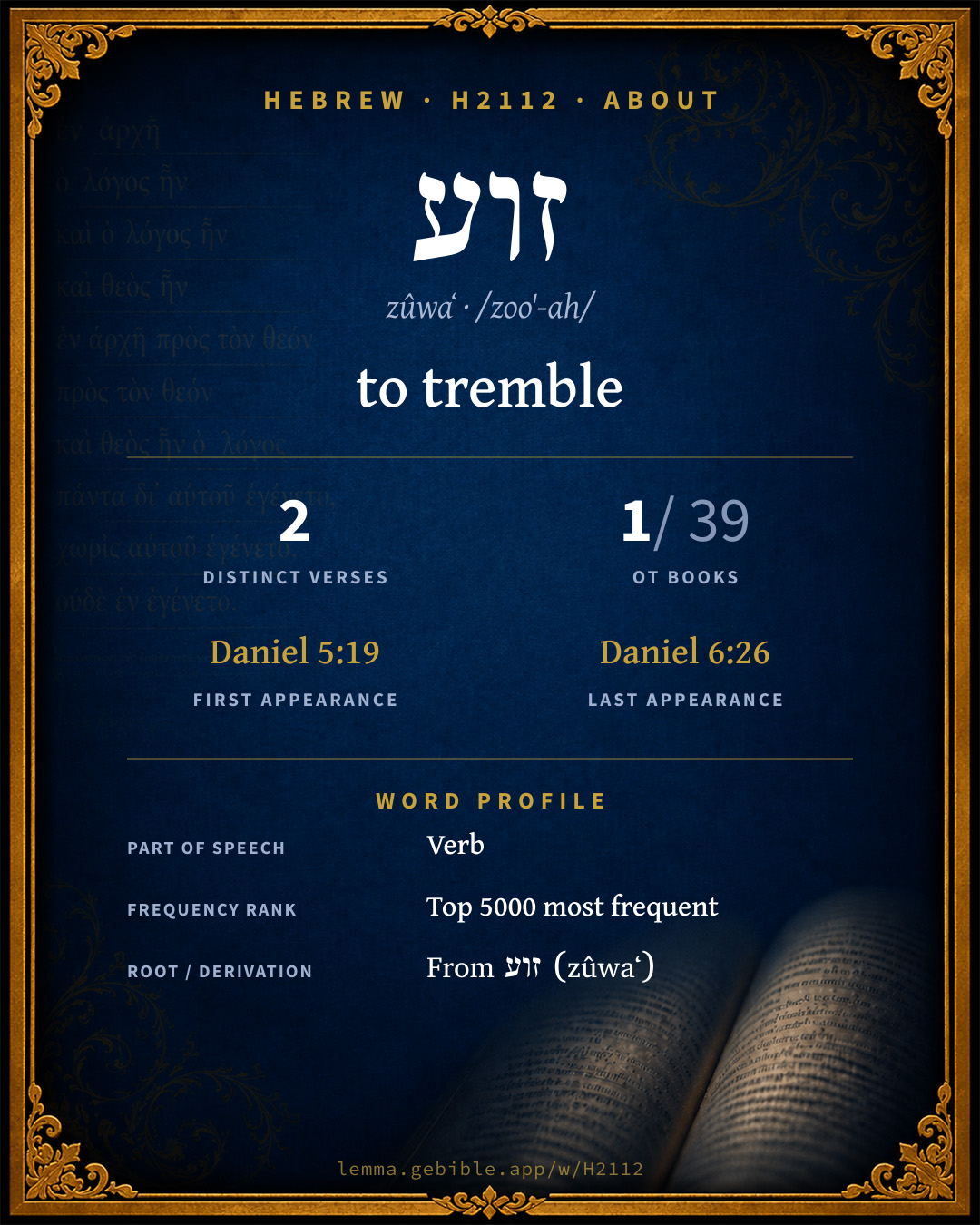
זוּעַ
to tremble
Full lexicon entry — Brown-Driver-Briggs (BDB)
From Brown-Driver-Briggs (BDB)
Where this word appears
Grammar key — what these labels mean
Part of speech
- Verb
- An action or state-of-being word.
Stem
- Qal
- The basic, simple active stem — the plain form of the verb (“he wrote”).
Form
- Participle Active
- A verbal adjective expressing ongoing or characteristic action (“writing / one who writes”).
State
- Absolute
- The independent form of a noun, not bound to a following word.
Gender
- Masculine
- Grammatically masculine.
Number
- Plural
- More than one (in Hebrew, generally three or more).
- Singular
- One.
Grammatical forms
- Verb, Qal, Participle Active, Masculine, Plural, Absolute 3 times (75%)
- Verb, Qal, Participle Active, Masculine, Singular, Absolute 1 time (25%)
Parsed forms decoded from the imported morphology (morphhb / Westminster Leningrad Codex — WLC text public domain, morphhb tagging CC BY 4.0), counted across 4 parsed occurrences — not distinct verses.
Every verse where H2112 appears — 2 distinct verses across 1 book. Click any verse to open its interlinear word-by-word view. Verse text shown in the World English Bible for context — . Each verse’s Hebrew form is shown with its reference; the English is not keyword-highlighted, since the data carries no word-level English alignment. Use “Compare translations” on any verse to read it across multiple English versions. This concordance covers the Hebrew Bible; Septuagint (Greek Old Testament) occurrences are not indexed here.
Daniel 2 verses
- Daniel 5:19 זאעין זָיְעִ֥ין Qal ptcp.act mp Qal ptcp.act ms and because of the greatness that he gave him, all the peoples, nations, and languages trembled and feared before him: whom he would he killed, and whom he would he kept alive; and whom he would he raised up, and whom he would he put down.
- Daniel 6:26 זאעין זָיְעִין֙ Qal ptcp.act mp Qal ptcp.act mp I make a decree, that in all the dominion of my kingdom men tremble and fear before the God of Daniel; for he is the living God, and steadfast forever, His kingdom that which shall not be destroyed; and his dominion shall be even to the end.
About this entry
At a glance — auto-summarized from this page’s data, not written by a person. Every figure links to its source below. This summary describes the numbers; it doesn’t interpret them.
At its core, זוע (zûwaʻ) means “to tremble.” It occurs a mere 2 verses across Scripture. Its uses cluster heavily in Daniel (100% of all occurrences). Scripture first uses it in Daniel 5:19. From the same root come זוע, זועה and זעה. Each statement above links to its evidence; the full detail follows below.
Gloss history
Strong's 1890 vs modern scholarship
About this word
Strong's H2112 catalogs a Hebrew word from the Hebrew Old Testament.
These counts are not copied from any lexicon or concordance. They are computed here, from the morphology-tagged Hebrew Old Testament. What Lemma adds →
- 2
- distinct verses
- The word appears in 2 distinct verses.
- 1 / 39
- OT books
- The word appears in 1 of 39 Old Testament books.
- #3,696
- by frequency
- Top 5000 most frequent Hebrew words (rank 3,696 of 8,640 Hebrew words by occurrence).
View all 2 occurrences in the concordance →
Most concentrated in
- Daniel 2 verses 100%
By section of the Old Testament
By traditional corpus
Conventional, traditional groupings — biblical authorship is debated, so this is a traditional corpus grouping, not an authorship claim. Each share is this word’s portion of its verses in that division of the Hebrew canon. Each figure is a share of the word’s 2 distinct verses.
- Writings (Ketuvim) 2 verses · 100%
How translations render this word
Counts come from each version’s own published word-to-Strong’s tagging or interlinear alignment — an approximate guide to how each version renders this word, not a word-level alignment the data otherwise carries. Because each total is that version’s own tagged count, the per-version totals vary from one another and need not match the appearance or distinct-verse counts above. These counts may also differ from a printed concordance because Lemma counts each distinctly tagged rendering and does not collapse phrase taggings into a single head-word total. This is a fixed set of word-tagged versions (KJV, ASV, BSB, ULT) and does not change with the reading translation you choose elsewhere. Each version’s license is shown beside its name below (and on Sources).
- King James Version: not separately translated
- Berean Standard Bible: Tremble 1×, Trembled 1×
- unfoldingWord Literal Text: Tremble 1×, Trembled 1×
King James Version Public Domain
Does not render H2112 with a distinct English word (not separately translated in its 2 tagged occurrences).
Berean Standard Bible Public Domain
Renders H2112 across 2 tagged occurrences — most commonly:
unfoldingWord Literal Text CC BY-SA 4.0
Renders H2112 across 2 tagged occurrences — most commonly:
Senses in BDB
The 1 sense BDB distinguishes for this word, in lexicon order (not ranked by frequency or importance). The full entry — with sub-senses — is in the Lexicon Entry tab.
- (Peal) to tremble
Word origin
Derived from זוע (zûwaʻ) (H2111) — to tremble.
Jastrow Dictionary
A second Hebrew/Aramaic lexicon for comparison, covering Aramaic and post-biblical (Talmudic, Targumic, Midrashic) usage that the biblical-Hebrew BDB does not. Matched by lemma rather than by Strong’s number, so a lemma may carry more than one Jastrow headword (shown separately below), and the entries cover usage well beyond the Bible.
זוּעַ
- (b. h.)
- 1. to drip, v. Hif.
- to move, shake, tremble. Pesik. R. s. 26 איברי זָעוּ עלי (read with Yalk. Jer. 262: קרבי) my bowels within me trembled.
- 1. to perspire, drip. Zeb. 18ᵇ (ref. to ביזע, Ez. XLIV, 18) במקום שמַזִּיעִין on that part of the body where one perspires. Toh. IX, 1; Meïl. 21ᵃ משיַזִּיעוּ Ar. (ed. משיָּזוּעוּ) from the time the olives begin to drip, v. מַעֲטָן. Sifra B’ḥuck., Par. 2, ch. V השמים מַזִּיעִים the heavens perspire (vapors, rain); הנחושת מזיע (read: מַזִּיעָה) bronze sweats. Gen. R. s. 20 (ref. to Gen. III, 19) הִזִּיעוּ פניו his face began to drip (tears, v. Pes. 118ᵃ); a. e. e.g. Ezekiel 44:18
- 2. to move. Tosef. Shebi. III, 4 מחרישה מְזִיעֲתָן, v. זִעֲזֵע. Koh. R. to I, 13, v. זוּז I.
- 3. to be agitated. Cant. R. to IV, 4 אפשר שלא ה׳ וכ׳ is it possible that the sensual desire was not at all agitated?
זוּעַ ²
- to move, tremble; hesitate. Targ. O. a. Y. II Ex. XX, 15. Targ. O. ib. XIII, 17 (h. text ינחם); a. fr.—Ab. V, 22 מינה לא תָזוּעַ thou shalt not move (deviate) from it (the Law).—Part. זָיַיע. Targ. Jer. IV, 24; a. e.—Lev. R. s. 10 מן … לית את ז׳ thou shalt never leave my palace. e.g. Exodus 20:15
- 1. to shake, frighten. Targ. Y. Num. VI, 24 מְזַיְּיעֵי frightening demons.
- 2. to sweat, drip. Targ. Y. Lev. XXVI, 19 (cmp. Sifra a. l., quot. in preced. w.); Targ. Y. Deut. XXVIII, 23 מְזִיעַ (Af.).
- 1. to shake, frighten. Targ. Jud. VIII, 12; a. fr.—Part. pass. מְזָעָא, f. מְזָעֲתָא. Targ. Prov. XXV, 19 Ms. (ed. מועדא).
- 2. to sweat; v. supra.
- to be frightened. Part. מִתְזְיַע. Targ. Prov. XVII, 12.
A Dictionary of the Targumim, the Talmud Babli and Yerushalmi, and the Midrashic Literature (Marcus Jastrow; London, Luzac, 1903) — Public Domain. Digitized via Sefaria. Digitized via Sefaria. Full attribution on Sources.
Forms in the corpus
The 3 distinct written forms H2112 takes in the Hebrew Bible, most frequent first — each parse links to that stem’s occurrences in the concordance. Hebrew forms include their vowel points and cantillation, so a single lemma takes many written forms.
| Form | Parsing | Example | Uses |
|---|---|---|---|
| זאעין | Verb, Qal, Participle Active, Masculine, Plural, Absolute | Daniel 5:19 | 2 |
| זָיְעִ֥ין | Verb, Qal, Participle Active, Masculine, Singular, Absolute | Daniel 5:19 | 1 |
| זָיְעִין֙ | Verb, Qal, Participle Active, Masculine, Plural, Absolute | Daniel 6:26 | 1 |
Same root — word family
Other BDB entries built from the same root as H2112, grouped by Strong’s listed origin. These share a root / origin per the lexicon — not necessarily a shared meaning. Each links to that word’s own entry.
Derives from
Shares the same root
Proper names from this root
People and places named from this root — a name, not an additional meaning of the word.
Compare all same-root words → Showing 4 of 6 — not the complete family. 2 of the same-root words are proper names (people or places). They share a root, not necessarily a meaning.
Septuagint verse parallels
This word appears in 2 verses that also exist in the Greek Old Testament (Septuagint), out of the 2 Hebrew verses it occurs in. You can read those verses in Greek by switching the Old Testament edition to the Septuagint.
Read these verses in the Septuagint
This is a verse-level parallel only — the same verses exist in both the Hebrew and Greek Old Testaments. No word-level Hebrew↔Greek correspondence is claimed: the data carries no such alignment, so no Greek word is shown as this Hebrew word’s translation. Coverage is not total — the Septuagint omits the deuterocanon and renumbers the Psalms, so some Hebrew verses have no direct Greek parallel.