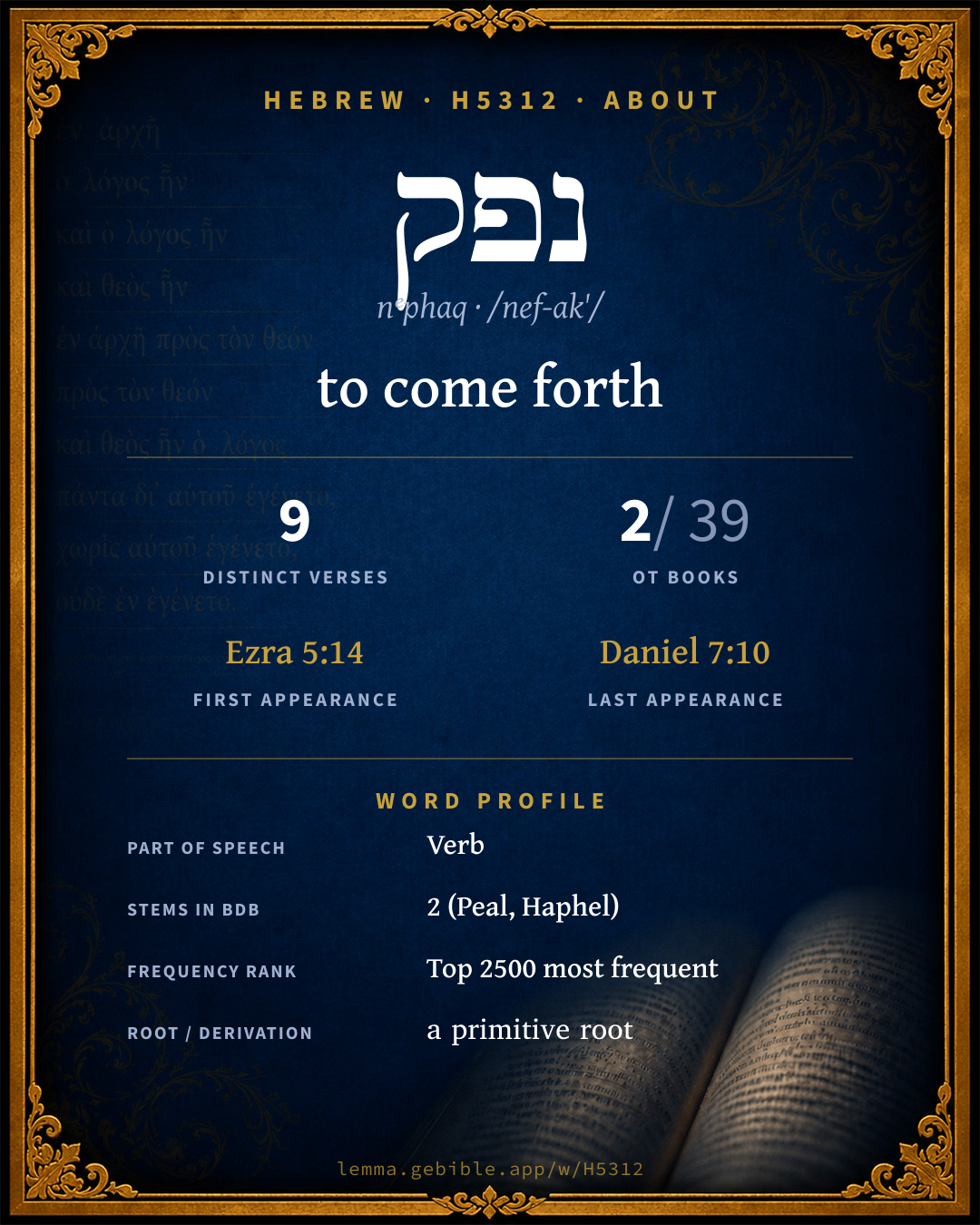
נְפַק
to come forth
‘to come forth’ is one of 3 main senses fuller range ↓
Full lexicon entry — Brown-Driver-Briggs (BDB)
From Brown-Driver-Briggs (BDB)
Where this word appears
See every Qal verb in the Hebrew Bible →
Grammar key — what these labels mean
Part of speech
- Verb
- An action or state-of-being word.
Stem
- Hiphil
- The causative active stem (“he caused / brought about”).
- Qal
- The basic, simple active stem — the plain form of the verb (“he wrote”).
Form
- Perfect
- A completed action or state — Hebrew marks aspect (completeness) more than strict tense (“he wrote”).
- Participle Active
- A verbal adjective expressing ongoing or characteristic action (“writing / one who writes”).
- Imperative
- A direct command (“write!”).
State
- Absolute
- The independent form of a noun, not bound to a following word.
Person
- 3rd Person
- The one spoken about (“he / she / it / they”).
- 2nd Person
- The one addressed (“you”).
Gender
- Masculine
- Grammatically masculine.
- Feminine
- Grammatically feminine.
Number
- Singular
- One.
- Plural
- More than one (in Hebrew, generally three or more).
Grammatical forms 9 distinct
- Verb, Hiphil, Perfect, 3rd Person, Masculine, Singular 4 times (33%)
- Verb, Qal, Participle Active, Masculine, Singular, Absolute 1 time (8%)
- Verb, Hiphil, Perfect, 3rd Person, Masculine, Plural 1 time (8%)
- Verb, Qal, Perfect, 3rd Person, Feminine, Plural 1 time (8%)
- Verb, Qal, Perfect, 3rd Person, Feminine, Singular 1 time (8%)
- Verb, Qal, Perfect, 3rd Person, Masculine, Plural 1 time (8%)
- Verb, Qal, Perfect, 3rd Person, Masculine, Singular 1 time (8%)
- Verb, Qal, Participle Active, Masculine, Plural, Absolute 1 time (8%)
+1 more form (1 occurrence)
Parsed forms decoded from the imported morphology (morphhb / Westminster Leningrad Codex — WLC text public domain, morphhb tagging CC BY 4.0), counted across 12 parsed occurrences — not distinct verses.
Every verse where H5312 appears — 9 distinct verses across 2 books. Click any verse to open its interlinear word-by-word view. Verse text shown in the World English Bible for context — . Each verse’s Hebrew form is shown with its reference; the English is not keyword-highlighted, since the data carries no word-level English alignment. Use “Compare translations” on any verse to read it across multiple English versions. This concordance covers the Hebrew Bible; Septuagint (Greek Old Testament) occurrences are not indexed here.
Ezra 2 verses
- Ezra 5:14 הַנְפֵּק֙ הַנְפֵּ֨ק Hiphil pf 3ms Hiphil pf 3ms The gold and silver vessels also of the house of God, which Nebuchadnezzar took out of the temple that was in Jerusalem, and brought into the temple of Babylon, those did Cyrus the king take out of the temple of Babylon, and they were delivered to one whose name was Sheshbazzar, whom he had made governor;
- Ezra 6:5 הַנְפֵּ֛ק Hiphil pf 3ms Also let the gold and silver vessels of the house of God, which Nebuchadnezzar took forth out of the temple which is at Jerusalem, and brought to Babylon, be restored, and brought again to the temple which is at Jerusalem, everyone to its place; and you shall put them in the house of God.
Daniel 7 verses
- Daniel 2:13 נֶפְקַ֔ת Qal pf 3fs So the decree went forth, and the wise men were to be slain; and they sought Daniel and his companions to be slain.
- Daniel 2:14 נְפַ֣ק Qal pf 3ms Then Daniel returned answer with counsel and prudence to Arioch the captain of the king's guard, who was gone forth to kill the wise men of Babylon;
- Daniel 3:26 פֻּ֣קוּ נָֽפְקִ֗ין Qal impv 2mp Qal ptcp.act mp Then Nebuchadnezzar came near to the mouth of the burning fiery furnace: he spoke and said, Shadrach, Meshach, and Abednego, you servants of the Most High God, come forth, and come here. Then Shadrach, Meshach, and Abednego came forth out of the midst of the fire.
- Daniel 5:2 הַנְפֵּק֙ Hiphil pf 3ms Belshazzar, while he tasted the wine, commanded to bring the golden and silver vessels which Nebuchadnezzar his father had taken out of the temple which was in Jerusalem; that the king and his lords, his wives and his concubines, might drink from it.
- Daniel 5:3 הַנְפִּ֗קוּ Hiphil pf 3mp Then they brought the golden vessels that were taken out of the temple of the house of God which was at Jerusalem; and the king and his lords, his wives and his concubines, drank from them.
- Daniel 5:5 נפקו נְפַ֨קָה֙ Qal pf 3mp Qal pf 3fp In the same hour came forth the fingers of a man's hand, and wrote over against the lampstand on the plaster of the wall of the king's palace: and the king saw the part of the hand that wrote.
- Daniel 7:10 וְ/נָפֵק֙ conj + Qal ptcp.act ms A fiery stream issued and came forth from before him: thousands of thousands ministered to him, and ten thousand times ten thousand stood before him: the judgment was set, and the books were opened.
About this entry
At a glance — auto-summarized from this page’s data, not written by a person. Every figure links to its source below. This summary describes the numbers; it doesn’t interpret them.
At its core, נפק (nᵉphaq) means “to come forth.” The word gravitates to Daniel (78%), then Ezra. It appears 9 verses across 2 books of the Hebrew Bible, among its uncommon vocabulary. Scripture first uses it in Ezra 5:14. Across 2 stems, its meaning turns on the binyan (Peal, Haphel). Dig into 9-verse concordance and the renderings breakdown below.
Gloss history
Strong's 1890 vs modern scholarship
About this word
Strong's H5312 catalogs a Hebrew word from the Hebrew Old Testament.
These counts are not copied from any lexicon or concordance. They are computed here, from the morphology-tagged Hebrew Old Testament. What Lemma adds →
- 9
- distinct verses
- The word appears in 9 distinct verses.
- 2 / 39
- OT books
- The word appears in 2 of 39 Old Testament books.
- #2,101
- by frequency
- Top 2500 most frequent Hebrew words (rank 2,101 of 8,640 Hebrew words by occurrence).
View all 9 occurrences in the concordance →
By traditional corpus
Conventional, traditional groupings — biblical authorship is debated, so this is a traditional corpus grouping, not an authorship claim. Each share is this word’s portion of its verses in that division of the Hebrew canon. Each figure is a share of the word’s 9 distinct verses.
- Writings (Ketuvim) 9 verses · 100%
How translations render this word
Counts come from each version’s own published word-to-Strong’s tagging or interlinear alignment — an approximate guide to how each version renders this word, not a word-level alignment the data otherwise carries. Because each total is that version’s own tagged count, the per-version totals vary from one another and need not match the appearance or distinct-verse counts above. These counts may also differ from a printed concordance because Lemma counts each distinctly tagged rendering and does not collapse phrase taggings into a single head-word total. This is a fixed set of word-tagged versions (KJV, ASV, BSB, ULT) and does not change with the reading translation you choose elsewhere. Each version’s license is shown beside its name below (and on Sources).
- King James Version: Came forth 3×
- American Standard Version: Came forth 3×
- Berean Standard Bible: Had taken 2×, Went out 2×
- unfoldingWord Literal Text: Had taken out 2×
King James Version Public Domain
Renders H5312 across 11 tagged occurrences — most commonly:
Plus 8 renderings that appear only once — usually multi-word phrases or single function words the recovered tagging swept in, not distinct renderings.
American Standard Version Public Domain
Renders H5312 across 11 tagged occurrences — most commonly:
Plus 8 renderings that appear only once — usually multi-word phrases or single function words the recovered tagging swept in, not distinct renderings.
Berean Standard Bible Public Domain
Renders H5312 across 11 tagged occurrences — most commonly:
Plus 7 renderings that appear only once — usually multi-word phrases or single function words the recovered tagging swept in, not distinct renderings.
unfoldingWord Literal Text CC BY-SA 4.0
Renders H5312 across 12 tagged occurrences — most commonly:
Plus 10 renderings that appear only once — usually multi-word phrases or single function words the recovered tagging swept in, not distinct renderings.
Senses in the full BDB
Hebrew verbs can shift meaning by stem (binyan): Qal is the basic action, Niphal is often passive or reflexive, Piel often intensifies or makes it factitive, and Hiphil is typically causative. The senses below are grouped under the stem BDB assigns to each. This entry also uses Peal (the basic Aramaic stem, parallel to Qal) and Haphel (the causative Aramaic stem, parallel to Hiphil).
What do BDB’s symbols mean?
BDB uses these scholarly abbreviations:
| Symbol | Meaning |
|---|---|
| 𝔊 | the Septuagint (the ancient Greek translation, LXX) |
| 𝔙 | the Vulgate (the Latin translation) |
| 𝔖 | the Syriac version (the Peshitta) |
| 𝔗 | the Targum (the Aramaic translation) |
| ψ | the Psalms |
| √ | root (the underlying root or stem) |
| ‖ | parallel passage (a synonymous or contrasted parallel) |
| † | the dagger: every passage where the word occurs is cited |
The 2 senses and sub-senses the full Brown-Driver-Briggs lexicon distinguishes for this word, in lexicon order (not ranked by frequency), with BDB’s own verbatim wording and sub-sense lettering. Shown in Hebrew script with BDB’s own scholarly abbreviations. The condensed entry is in the Lexicon Entry tab. See also the Forms in the corpus table below.
Peal
- . he went out
Haphel
- . bring forth
Senses from the full Brown-Driver-Briggs lexicon (Brown, Driver, Briggs; Oxford 1906 — public domain), digitized via Sefaria, supplemented by the OpenScriptures HebrewLexicon (CC BY 4.0). Full attribution on Sources.
Word origin
נְפַק vb. go, or come, out, forth
— Brown-Driver-Briggs (Oxford 1906, public domain), digitized via Sefaria, supplemented by the OpenScriptures HebrewLexicon (CC BY 4.0). See Sources.
Origin: a primitive root
Jastrow Dictionary
A second Hebrew/Aramaic lexicon for comparison, covering Aramaic and post-biblical (Talmudic, Targumic, Midrashic) usage that the biblical-Hebrew BDB does not. Matched by lemma rather than by Strong’s number, so a lemma may carry more than one Jastrow headword (shown separately below), and the entries cover usage well beyond the Bible.
*נָפַק
- (cmp. פּוּק) to go out. Cant. R. to III, 4 (play on פ̇ל̇צ̇ו̇ת̇, Is. XXI, 4) על ידי שנפֹקו לדבר ל̇צ̇ו̇ת̇ because they went out for lascivious purposes. e.g. Isaiah 21:4
נְפַק
- (corresp. to h. יצא) same,
- 1. to go out, come out; to result, end. Targ. O. VIII, 7 מִיפַּק ed. Berl. (oth. ed. a. Y. מֵיפַק); a. v. fr.—Y. Ber. I, 2ᶜ top שרי מלכא נ׳ וכ׳ when the king begins to march out, even if he has not yet gone out, we say, he has gone out. Ib. 3ᶜ bot. הוינן נַפְקִין לתעניתא we went out for fast and prayer. Koh. R. to X, 8 מִינְּפַק ליה (= מן נ׳) after he came out. Y. Taan. IV, 69ᵃ מִנַּפְקִין when they came out; Lam. R. to II, 2 מן דנַפְקוּן. Y. l. c. לא נפקון טבאות (Matt. K. to Lam. R. l. c. לא נַפְקַת להון) they did not end well. Pesik. B’shall., p. 94ᵃ וגוש חלבאי נפקין וכ׳ and the men of Giscala went out after them with sticks &c.; Koh. R. to XI, 2 וגוש חלב אנפקין (corr. acc.); a. v. fr.—Imperat. פּוּק. Targ. Gen. VIII, 16; a. fr.—Erub. 14ᵇ, a. e. פ׳ חזי וכ׳, v. דְּבַר. Sabb. 106ᵃ, a. e. פ׳ תני וכ׳, v. בַּר I ch.—Part. נָפֵיק. Targ. I Kings XV, 17; v. next w.; a. fr.—(כנ׳) כד נפיק ביה = h. כיוצא בו (v. יָצָא) similar to, corresponding. Targ. Y. II, Gen. II, 18. Targ. Y. Deut. XIV, 8 (not כַּנְפֵיק, כַּנְפַק).—Y. Ber. VI, 10ᵇ bot. נ׳ אנא ידי חובתי do I do my duty?, v. יָצָא. Succ. 36ᵇ ונ׳ בה and used it for doing his duty (for the ceremony of Ethrog).—Y. Sabb. VI, 8ᵃ top, a. e. מה נָ׳ מן ביניהון what is the outcome from between them?, i.e. what is the difference between them in practice?—נפקא מינה וכ׳ the practical difference is &c. Bets. 6ᵇ למאי נ׳ מינה in regard to what practice is there a difference (whether or not eggs found in a chicken can be hatched)? למקח וממכר it makes a difference in trade (if one bought eggs for breeding). Keth. 72ᵃ מאי נ׳ לה מינה תיעביד what difference does it make to her? let her do it; a. v. fr.—Tem. 7ᵃ נ׳ ליה וכ׳ it is derived from the Biblical word &c. Ib. תֵּיפוּק ליה זריקה וכ׳ let ‘sprinkling’ be derived from &c.—Gen. R. s. 52 ונֵיפוֹק ידוי and do justice to it (to the verse to be explained), v. supra.
- 2. to take out, exclude. Sabb. 74ᵃ ולֵיפוּק חדא וכ׳ let him take out one (of the enumerated categories) and insert another one. Ḥull. 43ᵃ לא תִיפַּק, v. infra.—[Targ. Am. IX, 13, v. infra.]
- , Haf. הַנְפַּק
- 1. to lead forth, carry forth; to bring forth, produce; to derive; to take out, exclude. Targ. Ex. XVI, 3. Targ. Am. IX, 13 במַפִּיק ed. Lag. (oth. ed. במִפַּק, corr. acc.). Targ. Job XV, 13; a. fr.—Ber. 38ᵃ (ref. to המוציא in the benediction over bread) דא׳ משמע it means ‘who has brought forth’; דמַפִּיק משמע it means ‘who brings forth’. Ib. אַפִּיקוּ ליה ריפתא they brought out bread (and placed it) before him. Ib. (ref. to המוציא, Ex. VI, 7) כד מַפִּיקְנָא לכו … דאַפֵּיקִית וכ׳ when I lead you forth, I shall do for you a thing that you may know that it is I who led you forth. Sot. 16ᵇ; R. Hash. 13ᵃ לא תַפִּיק נפשך יכ׳ do not let thyself go beyond the established rule. B. Bath. 60ᵃ דהוה מַפִּיק וכ׳ which led to (opened towards) etc. Tem. 3ᵇ מפיק שם וכ׳ utters the name of the Lord in vain. Ib. 7ᵃ מַפְּקִינָן לבמת יחיד we derive from it a rule for individual high-places.—Ḥull. 42ᵇ אַפֵּיק חדא וכ׳ take out one category and insert another. Ib. 43ᵃ top הנך דאַפְּקַת לא תַפִּיק Tosaf. (ed. לא תיפק) the two which thou didst exclude, do not exclude; a. v. fr.—לְאַפּוּקֵי or לַאֲפוּקֵי to the exclusion of, v. אַפֵּק. e.g. Exodus 6:7
- 2. to take out by legal decision; to collect; to claim. Keth. 76ᵇ מייתי אב ראיה ומפיק the father brings evidence and gets a verdict for collecting, opp. ומוקים for letting the money stand where it is. Y. Gitt. I, end, 43ᵈ ואַפְּקוּן מיניה and collected from him. Ib. בעון מִיפְּקָא (v. supra Pe. 2) they wanted to collect. Y. Shebu. VII, 38ᵃ top אתון ואַפְּקוּן דלא וכ׳ they came and claimed that he had not given them anything; a. fr.
- , Ithaf. אִתְאֵפַּק to be carried forth. Targ. Gen. XXXVIII, 25; a. fr.—Y. Gitt. VI, 48ᵃ bot. אתא׳ למקטלא was led out to be executed.
נָפֵק
- , constr. נְפַק (preced.) going out; נְ׳ בַּר a male prostitute; fem. נַפְקָא, constr. נַפְקַת; נַפְקַת בָּרָא a) a female prostitute. Targ. Y. II, Deut. XXIII, 18. Targ. Gen. XXIV, 35.—b) (sub בית) brothel, prostitution. Targ. I Kings XIV, 24; a. fr.
A Dictionary of the Targumim, the Talmud Babli and Yerushalmi, and the Midrashic Literature (Marcus Jastrow; London, Luzac, 1903) — Public Domain. Digitized via Sefaria. Digitized via Sefaria. Full attribution on Sources.
Forms in the corpus
The 11 distinct written forms H5312 takes in the Hebrew Bible, most frequent first — each parse links to that stem’s occurrences in the concordance. Hebrew forms include their vowel points and cantillation, so a single lemma takes many written forms.
Same root — word family
Other BDB entries built from the same root as H5312, grouped by Strong’s listed origin. These share a root / origin per the lexicon — not necessarily a shared meaning. Each links to that word’s own entry.
Derived from this word
Compare all same-root words → They share a root, not necessarily a meaning.
Septuagint verse parallels
This word appears in 9 verses that also exist in the Greek Old Testament (Septuagint), out of the 9 Hebrew verses it occurs in. You can read those verses in Greek by switching the Old Testament edition to the Septuagint.
Read these verses in the Septuagint
This is a verse-level parallel only — the same verses exist in both the Hebrew and Greek Old Testaments. No word-level Hebrew↔Greek correspondence is claimed: the data carries no such alignment, so no Greek word is shown as this Hebrew word’s translation. Coverage is not total — the Septuagint omits the deuterocanon and renumbers the Psalms, so some Hebrew verses have no direct Greek parallel.