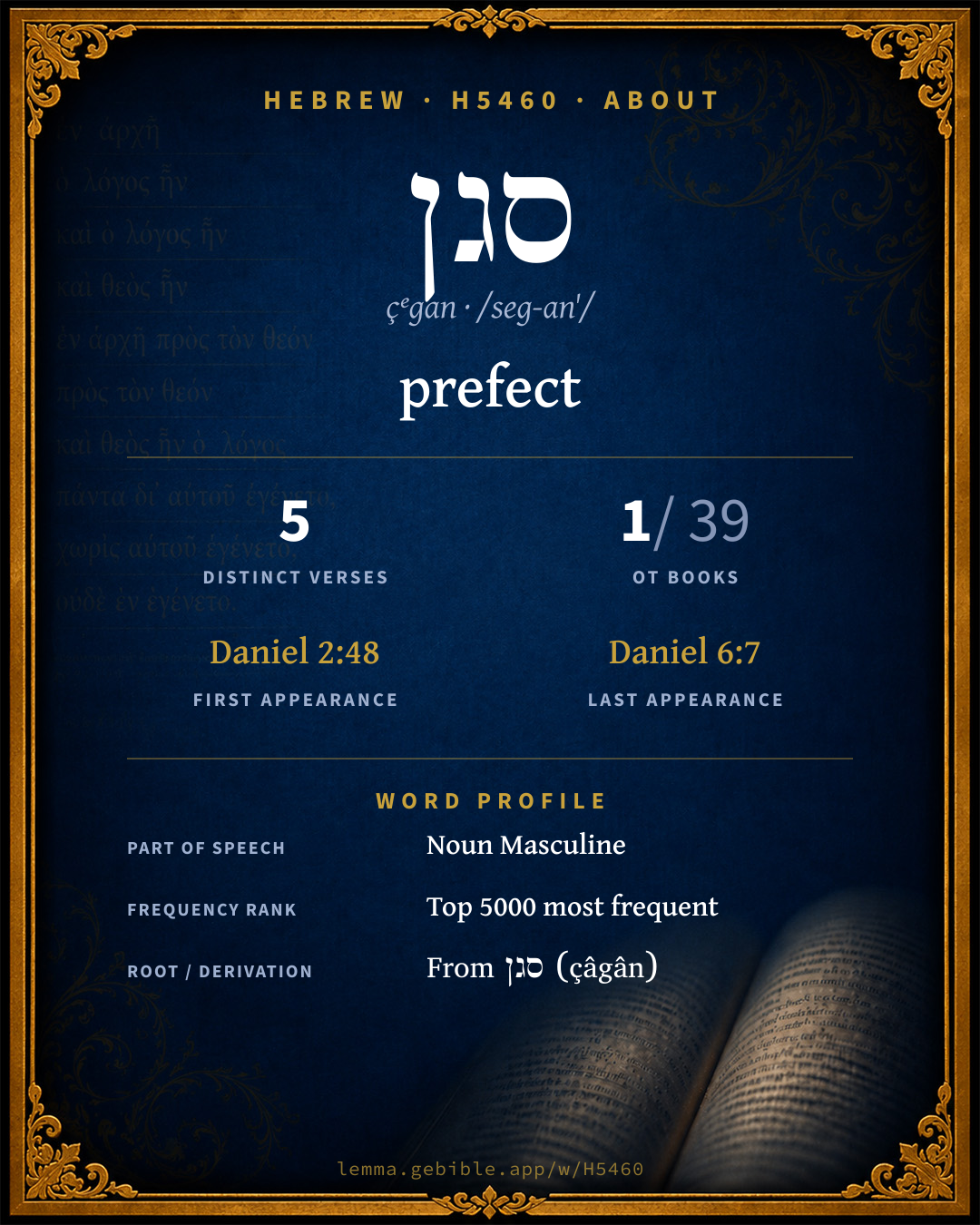
סְגַן
prefect
Full lexicon entry — Brown-Driver-Briggs (BDB)
From Brown-Driver-Briggs (BDB)
Where this word appears
Grammar key — what these labels mean
Part of speech
- Noun
- A naming word — a person, place, thing, or idea.
Noun type
- Common
- A common noun — a general class of person, place, or thing (“king,” “city,” “water”), not a specific name.
State
- Absolute
- The independent form of a noun, not bound to a following word.
Gender
- Masculine
- Grammatically masculine.
Number
- Plural
- More than one (in Hebrew, generally three or more).
Grammatical forms
- Particle, Definite Article 4 times (80%)
- Noun, Common, Masculine, Plural, Absolute 1 time (20%)
Parsed forms decoded from the imported morphology (morphhb / Westminster Leningrad Codex — WLC text public domain, morphhb tagging CC BY 4.0), counted across 5 parsed occurrences — not distinct verses.
Every verse where H5460 appears — 5 distinct verses across 1 book. Click any verse to open its interlinear word-by-word view. Verse text shown in the World English Bible for context — . Each verse’s Hebrew form is shown with its reference; the English is not keyword-highlighted, since the data carries no word-level English alignment. Use “Compare translations” on any verse to read it across multiple English versions. This concordance covers the Hebrew Bible; Septuagint (Greek Old Testament) occurrences are not indexed here.
Daniel 5 verses
- Daniel 2:48 סִגְנִ֔ין n c mp Then the king made Daniel great, and gave him many great gifts, and made him to rule over the whole province of Babylon, and to be chief governor over all the wise men of Babylon.
- Daniel 3:2 סִגְנַיָּ֣/א n c mp det + ptcl def.art Then Nebuchadnezzar the king sent to gather together the satraps, the deputies, and the governors, the judges, the treasurers, the counselors, the sheriffs, and all the rulers of the provinces, to come to the dedication of the image which Nebuchadnezzar the king had set up.
- Daniel 3:3 סִגְנַיָּ֣/א n c mp det + ptcl def.art Then the satraps, the deputies, and the governors, the judges, the treasurers, the counselors, the sheriffs, and all the rulers of the provinces, were gathered together to the dedication of the image that Nebuchadnezzar the king had set up; and they stood before the image that Nebuchadnezzar had set up.
- Daniel 3:27 סִגְנַיָּ֣/א n c mp det + ptcl def.art The satraps, the deputies, and the governors, and the king's counselors, being gathered together, saw these men, that the fire had no power on their bodies, nor was the hair of their head singed, neither were their pants changed, nor had the smell of fire passed on them.
- Daniel 6:7 סִגְנַיָּ֤/א n c mp det + ptcl def.art All the presidents of the kingdom, the deputies and the satraps, the counselors and the governors, have consulted together to establish a royal statute, and to make a strong interdict, that whoever shall ask a petition of any god or man for thirty days, save of you, O king, he shall be cast into the den of lions.
About this entry
At a glance — auto-summarized from this page’s data, not written by a person. Every figure links to its source below. This summary describes the numbers; it doesn’t interpret them.
סגן — transliterated çᵉgan — is a Hebrew noun carrying the sense “prefect.” It is rare — just 5 verses in the entire Hebrew Bible. Its uses cluster heavily in Daniel (100% of all occurrences). Debuting at Daniel 2:48, it then recurs through the corpus. See the sense tree, 5-verse concordance, and the renderings breakdown below.
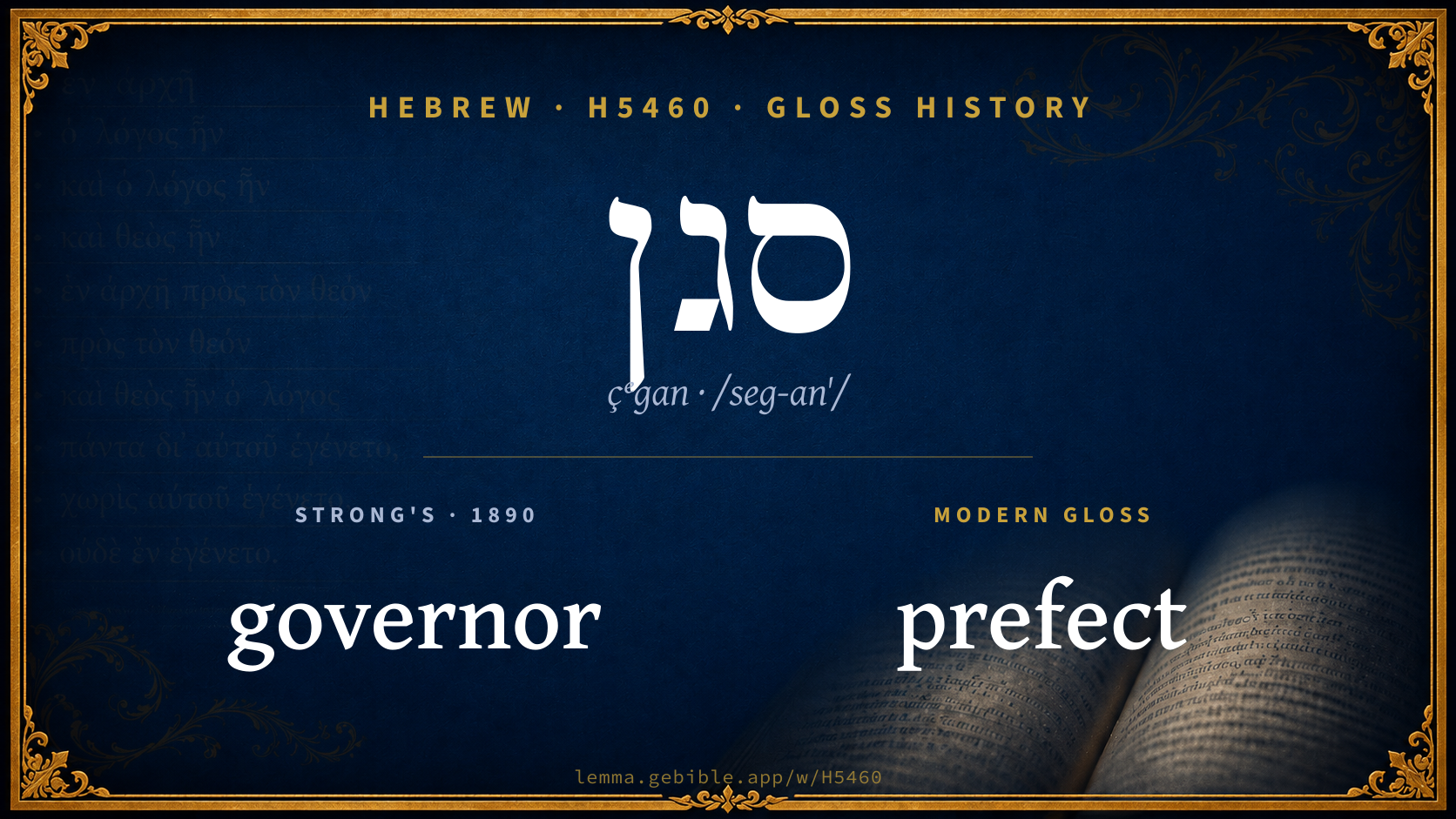
Gloss history
Strong's 1890 vs modern scholarship
About this word
Strong's H5460 catalogs a Hebrew word from the Hebrew Old Testament.
These counts are not copied from any lexicon or concordance. They are computed here, from the morphology-tagged Hebrew Old Testament. What Lemma adds →
- 5
- distinct verses
- The word appears in 5 distinct verses.
- 1 / 39
- OT books
- The word appears in 1 of 39 Old Testament books.
- #3,337
- by frequency
- Top 5000 most frequent Hebrew words (rank 3,337 of 8,640 Hebrew words by occurrence).
View all 5 occurrences in the concordance →
Most concentrated in
- Daniel 5 verses 100%
By section of the Old Testament
By traditional corpus
Conventional, traditional groupings — biblical authorship is debated, so this is a traditional corpus grouping, not an authorship claim. Each share is this word’s portion of its verses in that division of the Hebrew canon. Each figure is a share of the word’s 5 distinct verses.
- Writings (Ketuvim) 5 verses · 100%
How translations render this word
Counts come from each version’s own published word-to-Strong’s tagging or interlinear alignment — an approximate guide to how each version renders this word, not a word-level alignment the data otherwise carries. Because each total is that version’s own tagged count, the per-version totals vary from one another and need not match the appearance or distinct-verse counts above. These counts may also differ from a printed concordance because Lemma counts each distinctly tagged rendering and does not collapse phrase taggings into a single head-word total. This is a fixed set of word-tagged versions (KJV, ASV, BSB, ULT) and does not change with the reading translation you choose elsewhere. Each version’s license is shown beside its name below (and on Sources).
- King James Version: Governors 5×
- American Standard Version: Deputies 4×
- Berean Standard Bible: Prefects 4×
- unfoldingWord Literal Text: Prefects 4×
King James Version Public Domain
Renders H5460 across 5 tagged occurrences — most commonly:
American Standard Version Public Domain
Renders H5460 across 5 tagged occurrences — most commonly:
Plus 1 rendering that appears only once — usually multi-word phrases or single function words the recovered tagging swept in, not distinct renderings.
Berean Standard Bible Public Domain
Renders H5460 across 5 tagged occurrences — most commonly:
Plus 1 rendering that appears only once — usually multi-word phrases or single function words the recovered tagging swept in, not distinct renderings.
unfoldingWord Literal Text CC BY-SA 4.0
Renders H5460 across 5 tagged occurrences — most commonly:
Plus 1 rendering that appears only once — usually multi-word phrases or single function words the recovered tagging swept in, not distinct renderings.
Senses in BDB
The 1 sense BDB distinguishes for this word, in lexicon order (not ranked by frequency or importance). The full entry — with sub-senses — is in the Lexicon Entry tab.
- prefect, governor
Word origin
Derived from סגן (çâgân) (H5461) — governor.
Jastrow Dictionary
A second Hebrew/Aramaic lexicon for comparison, covering Aramaic and post-biblical (Talmudic, Targumic, Midrashic) usage that the biblical-Hebrew BDB does not. Matched by lemma rather than by Strong’s number, so a lemma may carry more than one Jastrow headword (shown separately below), and the entries cover usage well beyond the Bible.
סָגָן
- v. סְגֵי I; cmp. רַב) grandee, chief, viceroy. Midr. Till. to Ps. CXIX, 134 כלי … אין לס׳ רשות וכ׳ the viceroy is not permitted to use a vessel which the king has used.—[Num. R. s. 15; Tanḥ. Bhaăl. 11 למחר ס׳, v. פָּגָן.]—Esp. סְגַן הכהנים or הסָּ׳ the chief of the priests, adjutant high priest. Ab. III, 2. Yoma III, 9. Y. ib. III, 41ᵃ top לא היה … עד שנעשה ס׳ none could be appointed high priest, unless he was made a Sagan first. Sifra Tsav, Milluim, Par. 1 נעשה משה ס׳ הכ׳ לאהרן Moses was Aaron’s aid; וכשם שנעשה לו ס׳ בחייו וכ׳ and as he was his aid in his life-time, so was he his aid in his dying hour; a. fr.—Pl. סְגָנִים, סְגָנִין, constr. סִגְנֵי, סִי׳. Es. R. s. 1 מי שם הס׳ אלמים וכ׳ who made the chiefs (Pharaoh’s counsellors) mute &c.?; Tanḥ. Sh’moth 10. Cant. R. to VI, 12 כשנעשו … ונעשו ס׳ על וכ׳ when they were made free men and were redeemed and made the primates of all entering this world; Yalk. ib. 992 נעשו חורין וס׳ וכ׳ they were made nobles and primates &c. Num. R. s. 18 אחיו כ׳'ג ובניו סגני כהונה his brother is high priest and his sons the high priest’s aids; a. fr.—[סגניו, Midr. Till. to Ps. XX, end, v. סִיגְנוֹן.—סִגְנִים, Y’lamd. to Num. X, 2, quot. in Ar., v. סִיגְנוֹן.]
סְגַן
- Targ. Jer. LII, 24 ס׳ כהניא (h. text כהן המשנה), v. preced.—Targ. II Kings XXIII, 4 (h. text pl.); a. fr.—Pl. סִגְנִין, סִגְנַיָּא, סִגְנַיָּה, סִגְנֵי, סִי׳. Targ. I Chr. XVIII, 16.—Snh. 110ᵃ ס׳ דכהנא (Ms. M. סגני כהנים, v. Rabb. D. S. a. l. note). Ib. 106ᵃ, v. זְנֵי. Esth. R. to I, 3, v. טָעֲמָא.
סִיגְנִין II
- , pl. of סְגַן.
A Dictionary of the Targumim, the Talmud Babli and Yerushalmi, and the Midrashic Literature (Marcus Jastrow; London, Luzac, 1903) — Public Domain. Digitized via Sefaria. Digitized via Sefaria. Full attribution on Sources.
Forms in the corpus
The 3 distinct written forms H5460 takes in the Hebrew Bible, most frequent first — each parse links to that state’s occurrences in the concordance. Hebrew forms include their vowel points and cantillation, so a single lemma takes many written forms.
| Form | Parsing | Example | Uses |
|---|---|---|---|
| סִגְנַיָּ֣/א | Particle, Definite Article | Daniel 3:2 | 3 |
| סִגְנִ֔ין | Noun, Common, Masculine, Plural, Absolute | Daniel 2:48 | 1 |
| סִגְנַיָּ֤/א | Particle, Definite Article | Daniel 6:7 | 1 |
Septuagint verse parallels
This word appears in 5 verses that also exist in the Greek Old Testament (Septuagint), out of the 5 Hebrew verses it occurs in. You can read those verses in Greek by switching the Old Testament edition to the Septuagint.
Read these verses in the Septuagint
This is a verse-level parallel only — the same verses exist in both the Hebrew and Greek Old Testaments. No word-level Hebrew↔Greek correspondence is claimed: the data carries no such alignment, so no Greek word is shown as this Hebrew word’s translation. Coverage is not total — the Septuagint omits the deuterocanon and renumbers the Psalms, so some Hebrew verses have no direct Greek parallel.