
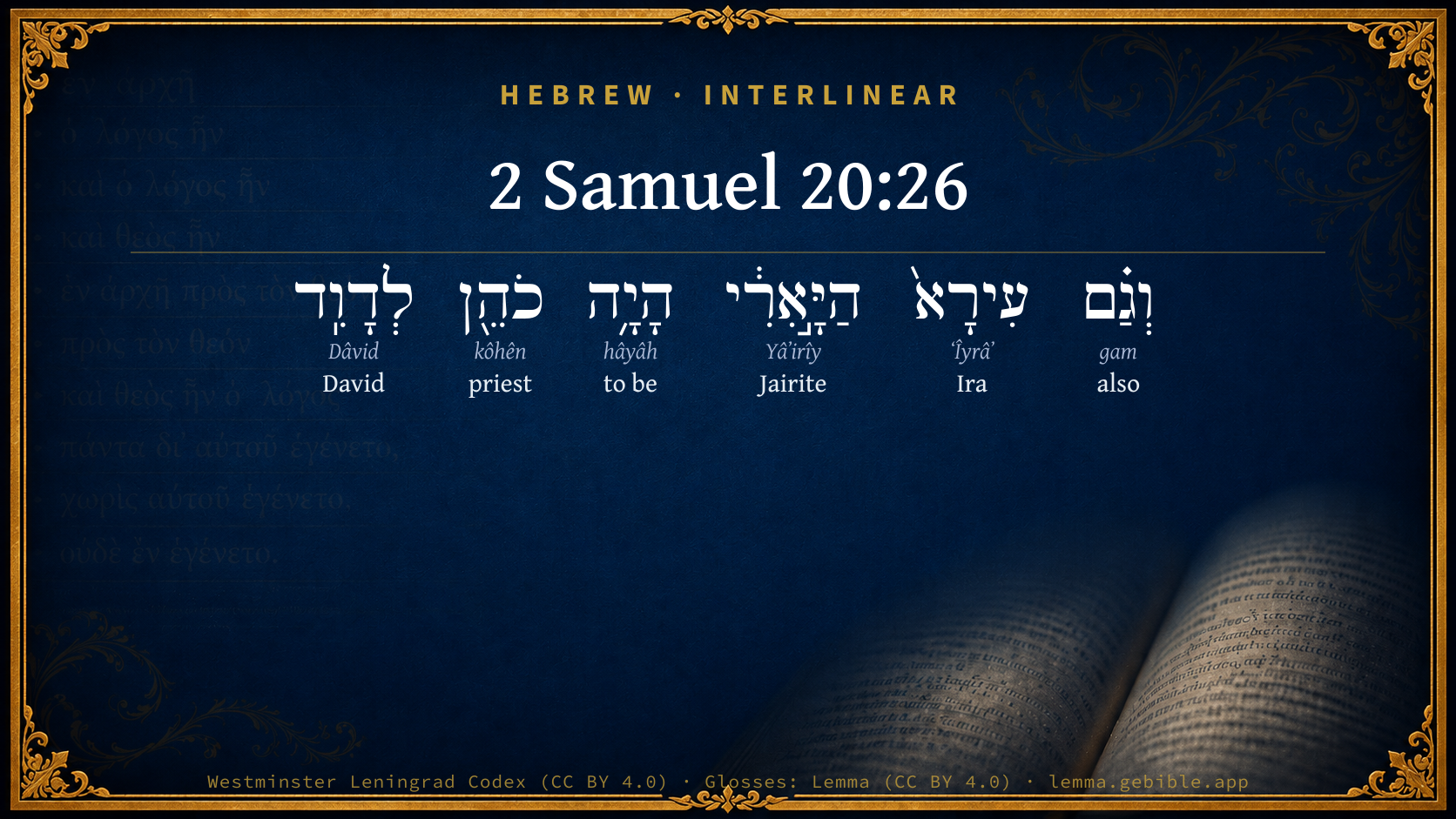
2 Samuel 20:26

Hebrew (Westminster Leningrad Codex) 2 Samuel 20:26 appears in the Hebrew Old Testament. The text above is from the Westminster Leningrad Codex. Each word links to its Strong’s number, a concise gloss, and parsing drawn from the Open Scriptures Hebrew Bible morphology. Click any word for its full Brown-Driver-Briggs (BDB) entry.
Download image
Cite this verse

2 Samuel 20:26 (World English Bible). Public Domain. Lemma interlinear Bible study tool, https://lemma.gebible.app/v/2-samuel/20/26.

Show BibTeX & RIS
BibTeX
RIS
English Translation
and also Ira the Jairite was chief minister to David.
World English Bible · Public Domain
Highlights
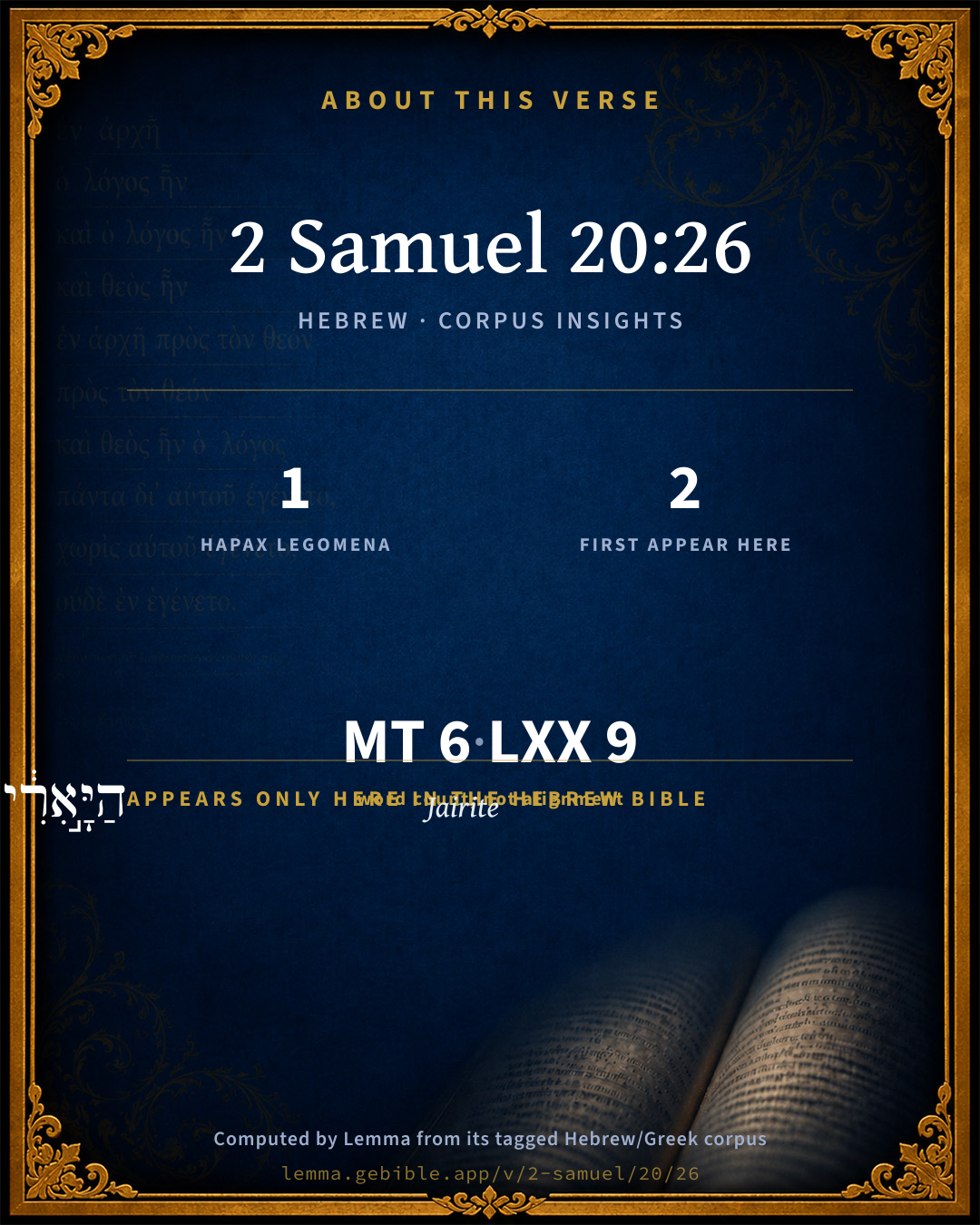
  • 1 hapax legomenon — only here in the Hebrew Bible
  • 2 first appearances in the Hebrew Bible
Full analysis ↓
Download a study sheet

One document with this verse’s original text, its word-by-word gloss line, the meaning frame, cross-references with their text, attributed commentary, and full source and license credits — printable, and it pastes into notes with its structure intact.

This verse Autodidact and up

Study sheet (.html) Plain text (.txt)

A passage Seminary Student

Up to 50 verses in one chapter. A passage sheet keeps up to 6 commentary sources and 12 cross-references per verse, in the order this page ranks them, and says so on the sheet whenever that leaves anything out. Ask for a single verse and you get the Autodidact verse sheet above.

Everything on this page stays free to read, with no account — the sheet is a download of what is already on screen, not access to it.

Want to remove ads? Support Godless Engineer
Compare translations 3

The same verse in 3 English versions, stacked beneath the original-language interlinear above. Click any original word for its lexicon entry.

Each is an independent rendering of the whole verse — the interlinear is not word-aligned to these translations.

Highlighted words mark where these versions differ — a whole-verse word diff, not a word-by-word alignment.

  • World English Bible Public Domain
    and also Ira the Jairite was chief minister to David.
  • King James Version Public Domain
    And Ira also the Jairite was a chief ruler about David.
  • unfoldingWord Literal Text CC BY-SA 4.0
    And also Ira the Jairite was a priest to David.

unfoldingWord Literal Text — © unfoldingWord, licensed CC BY-SA 4.0. Word-aligned USFM3 via Door43 (git.door43.org/unfoldingWord/en_ult).

Versions to compare (up to 4)

3 of 4 selected

Show all 18 translations

Every available English version of this verse, each an independent rendering of the whole verse.

  • World English Bible Public Domain
    and also Ira the Jairite was chief minister to David.
  • Berean Standard Bible Public Domain
    and Ira the Jairite was David’s priest.
  • Majority Standard Bible Public Domain
    and Ira the Jairite was David’s priest.
  • King James Version Public Domain
    And Ira also the Jairite was a chief ruler about David.
  • American Standard Version (1901) Public Domain
    and also Ira the Jairite was chief minister unto David.
  • Revised Version (1885) Public Domain
    and Ira also the Jairite was priest unto David.
  • Geneva Bible (1599) Public Domain
    And also Ira the Iairite was chiefe about Dauid.
  • Douay-Rheims (1899) Public Domain
    And Ira the Jairite was the priest of David.
  • Young's Literal Translation Public Domain
    and also, Ira the Jairite hath been minister to David.
  • Literal Standard Version CC BY-SA 4.0
    and also, Ira the Jairite has been minister to David.
  • Unlocked Literal Bible CC BY-SA 4.0
    Ira the Jairite was chief minister to David.
  • unfoldingWord Literal Text CC BY-SA 4.0
    And also Ira the Jairite was a priest to David.
  • Darby Bible Public Domain
    and Ira also, the Jairite, was David's chief ruler.
  • World Messianic Bible Public Domain
    and Ira the Jairite was chief minister to David.
  • Webster's Bible Public Domain
    And Ira also the Jairite was a chief ruler about David.
  • Free Bible Version CC BY-SA 4.0
    and Ira the Jairite was David's priest.
  • Bible in Basic English Public Domain
    And in addition, Ira the Jairite was a priest to David.
  • JPS Tanakh (1917) Public Domain
    and Ira also the Jairite was chief minister unto David.

Literal Standard Version (2020), Covenant Press — licensed CC BY-SA 4.0. Text via the HelloAO Bible API (eBible.org). Unlocked Literal Bible (unfoldingWord) — licensed CC BY-SA 4.0. Text via the HelloAO Bible API (eBible.org). unfoldingWord Literal Text — © unfoldingWord, licensed CC BY-SA 4.0. Word-aligned USFM3 via Door43 (git.door43.org/unfoldingWord/en_ult). Free Bible Version, Dr. Jonathan Gallagher — licensed CC BY-SA 4.0. Text via the HelloAO Bible API (eBible.org).

Word by word

More ways to search: Search by grammar → Find every occurrence → Compare this word →

Practice this passage: Drill this verse → Learn its vocabulary →

About this verse

These counts appear in no published source. They are computed here, from the morphology-tagged text and Lemma’s own curated glosses. What Lemma adds →

6
words
6
distinct lemmas
Historical
section

Notable vocabulary

1 hapax legomenon — a word that appears only here in the entire Hebrew Bible:

  • הַיָּ֣אִרִ֔י Jairite H2972

First appearance in Scripture

These words make their first canonical appearance in the Hebrew Bible here:

  • עִירָא֙ Ira H5896
  • הַיָּ֣אִרִ֔י Jairite H2972

Shared distinctive vocabulary

עִירָא֙ Ira H5896 occurs in 6 verses of the Hebrew Bible. Also found in:

Grammatical profile

  • 1 verb
  • 4 nouns
  • 1 particle

Verb forms

  • הָיָ֥ה Qal · Perfect

Hebrew & Septuagint length

In English translation the verse runs 10 words from the Hebrew and 10 from the Septuagint (LXX English) — the same length.

A rough comparison of the two English renderings, which tokenize alike — not a word-level alignment.

Word counts can differ between the Hebrew and the Greek without any difference in meaning — e.g. the Hebrew direct-object marker אֵת has no separate Greek word, and Greek often adds the article ὁ.

In the original languages it is 6 Hebrew tokens and 9 Greek tokens — but the two are counted differently (Hebrew bundles its prefixes and suffixes into one token; the Greek is in lemma form), so that isn’t a like-for-like length.

Cross-references

10

Topical passages linked to 2 Samuel 20:26 in the Treasury of Scripture Knowledge — connected by theme and wording, ordered by reader-vote popularity; previews shown in the World English Bible.

  • 2 Samuel 23:38 Ira the Ithrite, Gareb the Ithrite,
  • Exodus 2:14 He said, "Who made you a prince and a judge over us? Do you plan to kill me, as you killed the Egyptian?" Moses was afraid, and said, "Surely this thing is known."
  • Genesis 41:43 and he made him to ride in the second chariot which he had. They cried before him, "Bow the knee!" He set him over all the land of Egypt.
  • Genesis 41:45 Pharaoh called Joseph's name Zaphenath-paneah; and he gave him Asenath, the daughter of Potiphera priest of On as a wife. Joseph went out over the land of Egypt.
  • Exodus 2:16 Now the priest of Midian had seven daughters. They came and drew water, and filled the troughs to water their father's flock.
  • Exodus 24:11 He didn't lay his hand on the nobles of the children of Israel. They saw God, and ate and drank.
  • Judges 10:4–5 He had thirty sons who rode on thirty donkey colts, and they had thirty cities, which are called Havvoth Jair to this day, which are in the land of Gilead.
  • 2 Samuel 8:18 and Benaiah the son of Jehoiada [was over] the Cherethites and the Pelethites; and David's sons were chief ministers.
  • 1 Chronicles 11:40 Ira the Ithrite, Gareb the Ithrite,
  • 2 Chronicles 35:15 The singers the sons of Asaph were in their place, according to the commandment of David, and Asaph, and Heman, and Jeduthun the king's seer; and the porters were at every gate: they didn't need to depart from their service; for their brothers the Levites prepared for them.

Cross-references courtesy of OpenBible.info (CC BY 4.0).

Hebrew and Greek witnesses Masoretic Hebrew ↔ Greek Septuagint

The same verse in the two great witnesses to the Old Testament, shown verse-for-verse.

These are two independent witnesses, not word-aligned to each other, and the Septuagint is shown in lemma (dictionary) form.

Hebrew 2 Samuel 20:26 Masoretic · Westminster Leningrad Codex

וְגַ֗ם עִירָא֙ הַיָּ֣אִרִ֔י הָיָ֥ה כֹהֵ֖ן לְדָוִֽד

and also Ira the Jairite was chief minister to David.

World English Bible · Public Domain

Greek LXX 2 Samuel 20:26 Septuagint · lemma form

καί γέ ιρας ὁ ιαριν εἰμί ἱερεύς ὁ δαυίδ

Moreover Iras the son of Iarin was priest to David.

LXX2012 (modern English Septuagint) · Public Domain

On this verse, Adam Clarke's Commentary discusses the Septuagint’s reading. Read the note in Commentary ↓

Hebrew: Westminster Leningrad Codex (CC BY 4.0). Greek: Septuagint (public domain); English from LXX2012 (modern English Septuagint) (Public Domain). How the Septuagint differs from the Hebrew →

Targum (Aramaic paraphrase)

1

The Targum is the ancient Jewish Aramaic paraphrase of the Hebrew Scriptures — an interpretive translation, not the Hebrew text itself. Onkelos (literal) and Pseudo-Jonathan (expansive) render the Torah, and Jonathan the Prophets. Coverage is partial: where no permissively-licensed English translation exists for a verse, only the Aramaic is shown. This is verse-level text, not a word-by-word alignment to the Hebrew.

  1. Targum Jonathan Prophets (Joshua–Malachi)
    וְאַף עִירָא יָאִירָאָה דְמִתְּקוֹעַ הֲוָה רַב לְדָוִד:

    (no public-domain English translation for this verse)

    Targum Jonathan — Aramaic: “Mikraot Gedolot” (public domain). English: “Sefaria Community Translation” (CC0 1.0 (public-domain dedication)); “London "Chaldee Paraphrase," 1871” (public domain). Text via Sefaria.

Commentary

Notes on 2 Samuel 20:26 from classic Christian and Jewish commentators (each source and its license shown beneath its notes). The classic Christian expositions comment on the surrounding passage and are grouped to its opening verse, so a note may address several verses; the Jewish commentaries on the Tanakh (Rashi and others) are per-verse, so they appear only where the commentator wrote on this verse.

Lemma curates 59 commentaries, every one of them public domain or Creative Commons licensed, each selected and text-cleaned for this edition rather than reprinted as found. About our sources →

Trapp's Complete Commentary

John Trapp

2Sa 20:26 And Ira also the Jairite was a chief ruler about David.

Ver. 26. Was a chief ruler about David,] Heb., A prince, or a priest: whence some make him president of the council; others, the king’s chaplain or his almoner; others, his peculiar and familiar friend. {a}

{a} Amicus intimus et consiliarius. - Vat.

John Trapp, A Commentary or Exposition upon All the Books of the Old and New Testament (1647–1656) — public domain. Text from a community e-Sword module.

Tyndale Open Study Notes

Tyndale Open Resources

20:26 David’s personal priest was probably not a Levite but rather a special class of religious servant appointed for his royal court (see study note on 8:18)

Tyndale Open Study Notes — © Tyndale Open Resources, licensed CC BY-SA 4.0. Text via the HelloAO Bible API.

Geneva Bible (1599)

Geneva Bible translators

Either in dignity or familiarity.

Geneva Bible (1599) marginal notes — public domain. Text via Bolls.life.

Adam Clarke's Commentary

Verse 26. Ira - was a chief ruler about David.] The Hebrew is לדויד כהן cohen ledavid, a priest to David; and so the Vulgate, Septuagint, Syriac, and Arabic. The Chaldee has רב rab, a prince, or chief. He was probably a sort of domestic chaplain to the king. We know that the kings of Judah had their seers, which is nearly the same: Gad was David's seer, 2Sa 24:11, and Jeduthun was the seer of King Josiah, 2Ch 35:16.

The conclusion of this chapter is very similar to the conclusion of 2Sa 8:16-18, where see the notes.

Adam Clarke's Commentary on the Bible (1810–1826) — public domain. Text from a community e-Sword/MySword module.

Ellicott's Commentary for English Readers

(26) Ira also the Jairite.—He is not mentioned in the other lists of the king’s officers; Ira, an Ithrite, is found in the list of David’s “thirty and seven” heroes in 2Sa_23:38, but there is no ground for identifying the two persons. On the office of “chief ruler,” or cohen, see Note on 2Sa_8:18. Earlier in David’s reign the office had been occupied by his own sons, but the murder of the eldest, the rebellion and death of Absalom, and other disorders in his household had led apparently to a change.

A Bible Commentary for English Readers, edited by Charles John Ellicott (1878–1897) — public domain. Text from a community e-Sword module.

The Cambridge Bible for Schools and Colleges

gen. ed. J. J. S. Perowne

26. a chief ruler about David] Minister to David. The post formerly held by David’s sons. See on ch. 2Sa_8:18.

The Cambridge Bible for Schools and Colleges (gen. ed. J. J. S. Perowne; Cambridge University Press, 1878–1918) — public domain. Text from a community e-Sword module.

John Gill's Exposition

And Ira also the Jairite,.... Which some take to be the same with Ira the Ithrite, Sa2 23:38; a son of Jether or Ithra the Israelite, Sa2 17:25; though others suppose he was Ira the son of Ikkesh the Tekoite, Sa2 23:26; and so the Targum here calls him Ira the Jairite, which was of Tekoah; and Tekoah being the chief place in Israel for oil olive (d), with which the lamps were lighted, Jarchi thinks he had the name of Jairite from Jair, which signifies to enlighten; but rather he was a descendant from Jair the Gileadite, and perhaps was a great friend to David when in Gilead, and from whence he brought him and promoted him: for he

was a chief ruler about David; a prime minister, an intimate friend, the chief of his privy council; perhaps he succeeded Ahithophel; it is much we hear nothing of Hushai.

(d) Misn. Menachot, c. 8. sect. 3.

Next: 2 Samuel Chapter 21

John Gill's Exposition of the Whole Bible (1746–1763) — public domain (CC PDM 1.0). Text via the HelloAO Bible API.

Albert Barnes' Notes on the Bible

Ira the Jairite - Not mentioned before: perhaps the same as “Ira an Ithrite” (marginal reference), i. e., an inhabitant of Jattir in the hill country of Judah Jos 15:48; 1Sa 30:27. Perhaps we ought to read “Ithrite,” for “Jairite.”

A chief ruler ... about David - More simply and clearly, “was David’s kohen” (2Sa 8:18 note). In the early part oph David’s reign his own ons were כהן kôhên (chief rulers). The deaths of Amnon and Absalom, and the dissensions in the family, had probably caused the change of policy in this respect.

Albert Barnes' Notes on the Bible (1834–1885) — public domain. Text from a community e-Sword/MySword module.

Haydock's Catholic Bible Commentary

Jairite, a descendant of Jair, (Calmet) son of Manasses. (Haydock) --- Priest. Hebrew cohen, respected like a priest, (Haydock) chief favourite, (Worthington) the Rab., (Chaldean) chief counsellor of David, (Vatable) almoner, &c. It is not certain that he was of the family of Aaron, or qualified to be the domestic chaplain of the king. See chap. viii. 16, &c. No other king of Israel had an officer to whom this title was given. (Calmet)

George Leo Haydock (1774–1849), Haydock's Catholic Family Bible and Commentary, 1859 edition — public domain. Excludes Psalms (Douay-Rheims chapter numbering differs from Protestant) and Deuterocanonical books (Catholic canon only).

Matthew Poole's English Annotations

The Jairite; so called from his birth or dwelling in the country of Jair in Gilead, Num 32:41; Jdg 10:4.

A chief ruler; either the president of the king’s council; or his chief minister (as the Hebrew word cohen signifies) of state, instead of Ahithophel; or in some other very high place near the king’s person. Compare 2Sa 8:18, where this title is given to David’s sons, the chief of which were now cut off. And these things are here repeated with some alteration to show that David was now fully re-established in his former estate.

Matthew Poole's English Annotations on the Holy Bible (1683–1685) — public domain. Text from a community e-Sword/MySword module.

Whedon's Commentary on the Bible

Daniel D. Whedon

26. Ira the Jairite — He either took the place of David’s sons, or was added to their number as a private counsellor. See on chap. 2Sa_8:18. Of his personal history we know nothing beyond this single fact. The Ithrite of this name, mentioned 2Sa_23:38, was, perhaps, a different person.

Daniel D. Whedon (gen. ed.), Commentary on the Old and New Testaments (1874–1909) — public domain. Text from a community e-Sword module.

The Pulpit Commentary

Ira was a chief ruler; Hebrew, cohen, priest, minister (see on this term,. (2Sa_8:18) We there find David"s sons holding this confidential office; but the feuds which resulted from David"s sin had destroyed the concord of the family, and the usefulness of David"s children. In their degradation from this office we see also a preparation for their being set aside from the succession, and the throne given to Solomon.

ADDITIONAL NOTE.

With this chapter ends the second section of David"s history; for, as we have already seen, the last four chapters are not arranged in chronological order, but form an appendix remarkable both for the singularly varied nature of its contents, and also for its omissions. The Second Book of Samuel is so thoroughly a history of David, that we should naturally have expected some account of his latter years, and of his manner of government after his return to power. But such details would have been interesting politically rather than spiritually, and the two narratives which have gone before are complete each in itself; and in each David is regarded from an entirely distinct point of view. In the first eight chapters we have the history of David as the theocratic king. As such he takes the heathen for his inheritance, and founds an empire. Even more remarkable are the alterations he makes in the worship of Jehovah. To the old Levitical sacrifices he added a far more spiritual service of psalms and minstrelsy, without which Judaism would have been unable to develop the evangelical realities which lay embedded in its ritual and legal ordinances. And it is important to notice that his service of sacred song is called "prophecy", (1Ch_25:1-3) from which we learn two things. The first that David"s service was essentially the same as that established by Samuel at Ramah. There, too, we read of the company of the prophets prophesying, (1Sa_19:20) their service undoubtedly being one of minstrelsy; (1Sa_10:5, 1Sa_10:10, 1Sa_10:11) and without Samuel"s authority David would scarcely have ventured upon so great an innovation. Even so, this consecration of music by Samuel, and David"s ordinance whereby there was established a daily service, morning and evening, of thanksgiving and praise (1Ch_23:30; Neh_12:24) is a most remarkable step forward; and by it the service of God ceased to be mere ritual, and became "a reasonable service", (Rom_12:1) such as was repeatedly commended by St. Paul to the members of the Christian Church. (Col_3:16, etc.) But secondly, it drew the minds of the people to the evangelic meaning of the Levitical ordinances. To this day hymns form a most important part of our solemn services, and seem especially adapted to draw out the inner and deeper meaning of rites and doctrines. They did not, indeed, begin with David. There are psalms older than his reign; but this consecration of them to the public daily service of God led to an outburst of Divine psalmody which raised the minds of the people above the material and grosset elements of their worship, and taught them the true nature of God, and made them ascribe to him high and spiritual attributes in wonderful contrast with the grovelling frivolities of heathenism. The Levitical worship was necessarily typical: in the psalms the people learned that God desireth not sacrifice, but the offering of a broken and contrite heart. Even prophecy, in its sense of speaking for God, would scarcely have reached the high eminence of future days but for the psalms. For only in a nation deeply imbued with poetry and song could an Isaiah have arisen, capable of giving in so perfect an outward form the mysteries of Christ"s incarnation, his vicarious sacrifice, and universal kingdom. In the second section, neither the theocratic nor the prophetic element is in the forefront. It is the history of a fearful sin, and of its stern punishment. The sinner is the theocratic king: the punishment is the pollution of his house by incest and murder; the ruin of the glory of his realm, the rending asunder of his empire, begun in his days and consummated in those of his grandson; his own disgrace and flight; and his sorrowful return to his throne, impotent to avenge either the murder of his son or that of the man whom he had chosen in the hope that he would release him from the stern grip of the ruthless Joab. The moral lessons of this sad story are beyond number. We see the saint changed into a sinner. No privileges save him from hateful crime; no repentance from draining the last dregs of the bitter cup of retribution. But never was the power of repentance in cleansing the heart and giving peace to the conscience more clearly shown; and the psalms written by David as a penitent, and during his flight from Absalom, are the most spiritual and choice and edifying of the whole Psalter. Without them the depths of self-abasement would have been left without inspired expression. The sinner in his greatest need, when crushed with the conviction of sin, when earnestly longing for forgiveness, when thirsting for the restored presence of God within his soul, and when feeling that, vile as he was, yet that he was not shut out from mercy, but that access to God"s presence was still permitted him; at all such times he would have gone to his Bible, and it would have been silent. These psalms are still the sinner"s comfort, and give him the words which best express what is present in his heart. Without them the Jewish Church would never have reached that fervid purity of spiritual feeling which so animated the prophets; and even the Christian Church would possibly have stopped short of that full doctrine of repentance which she now holds. It is, indeed, the Christian"s privilege to unite the doctrine of repentance with the thought of all that Christ has done and suffered for us, and so to understand why repentance avails to cleanse the heart; but even with this knowledge no Christian writer has ever reached so high a level of spirituality as David, though we may thankfully acknowledge that many of our best hymns do not fall far short of it.

It is easy, then, to see that these two histories are not only of primary importance, but that no narrative after the time of the Exodus equals them in value. They form the very kernel of the Book of the Earlier Prophets, giving us, in the first, the true meaning and spiritual import of the settlement of Israel in Palestine; and setting before us, in the second, the nature of repentance, and so preparing the way for the revelation of the gospel of pardon and peace.

They are followed by an appendix containing several narratives recorded apparently for their intrinsic value. Commentators have endeavoured to trace a connection between them, but their arguments are farfetched, and their conclusions unsatisfactory. It is better to regard them as separate and complete, each one in itself. They are six in number:

(1) the visitation of famine because of Saul"s cruelty to the Gibeonites;

(2) some incidents in the war with the Philistines, illustrating the heroic character of David"s worthies;

(3) David"s psalm of deliverance;

(4) David"s last words;

(5) a list of the Gibborim, with special records of acts of bravery and devotion;

(6) the visitation of pestilence because of David"s numbering the people. The third and fourth sections especially are of the highest interest; while the second makes it plain that David"s bravery in encountering the giant of Gath lit up an equally bright flame of patriotic heroism in the armies of Israel.

The Pulpit Commentary (1880–1919), ed. H.D.M. Spence-Jones & Joseph S. Exell — public domain. Text from a community e-Sword module.

Rashi

Rabbi Shlomo Yitzchaki (Rashi)

Eiroh the Yoiri. Yonoson translated: "Eiroh who gives forth light from Tekuah." And so is he referred to in this book Eiroh ben Eikash of Tekuah. He was called Yoiri because it is taught in Menochos, "Tekuah was first in [olive] oil," because olive oil was prevalent there from which candles are lit [in the Beis Mikdosh].

Was a Kokein for Dovid. He [Dovid] would give him [Eiroh] all his Kehunah gifts, that is what our Rabbis explained. The simple explanation of the verse is that he [Dovid] made him [Eiroh] an officer and a judge.

Rashi on the Tanakh — English translations: “The Judaica Press complete Tanach with Rashi, translated by A. J. Rosenberg” (CC BY 4.0); “Pentateuch with Rashi's commentary by M. Rosenbaum and A.M. Silbermann, 1929-1934” (public domain); “The Metsudah Tanach series, Lakewood, N.J” (CC BY 4.0); and “The Book of Joshua, Metsudah Publications, 1997” (CC BY 4.0). Text via Sefaria.

Lesson kit

Teaching starters — assembled from the data on this page, not authored interpretation. Every prompt links to the verse data it draws on. Edit before teaching.

2 Samuel, in the Historical, opens this verse with 6 words (6 distinct Hebrew lemmas). Its most distinctive word is Yâʼirîy (“Jairite”). A historical commentator’s framing appears above. Read the whole chapter for the surrounding context.

Discussion questions

  1. What does “Jairite” (Yâʼirîy) contribute to the verse as a whole?
  2. 1 word here appears nowhere else in the Hebrew Bible. Why might the author reach for such rare wording?
  3. 2 words make their first appearance in Scripture here. What does this debut establish?
  4. How does 2 Samuel 23:26, which shares the word «Ira», read alongside this verse?
  5. These translations render this verse differently; the difference is in the English rendering, not the original. What questions does that raise?
  6. «הָיָ֥ה» is a Qal Perfect verb. How does that grammatical form shape the action described?
  7. Compare how Trapp's Complete Commentary and Tyndale Open Study Notes read this verse. Where do they agree or differ?

Things to notice

Reading settings

Reading text

Shown beneath each verse's original-language words.

Old Testament
Old Testament edition

Read the OT as the Masoretic Hebrew (MT) or the Greek Septuagint (LXX).

English shown for the Greek Septuagint (in the Hebrew ↔ Greek comparison).

Comparing translations? Open the Compare panel on any verse page to stack up to four side by side.