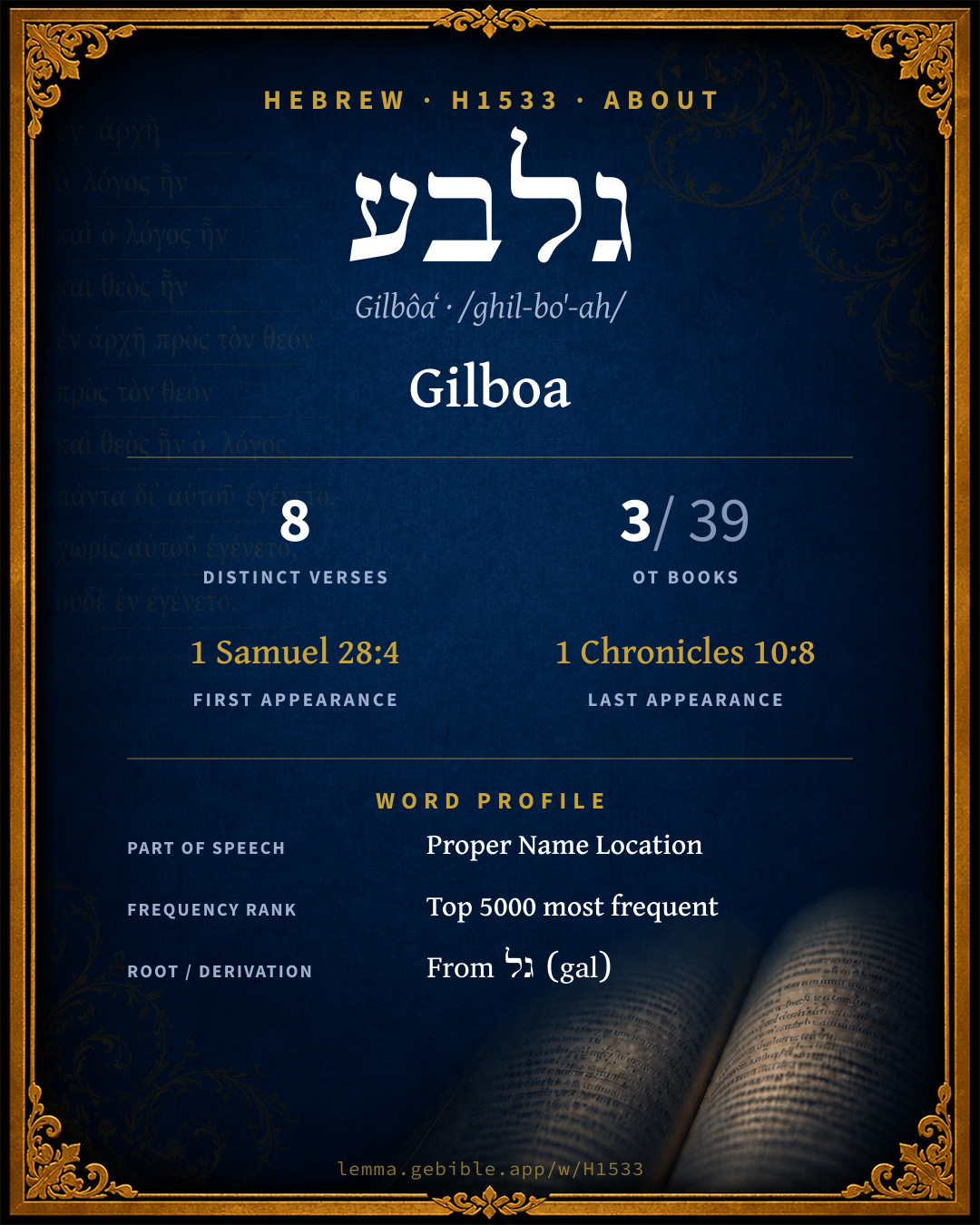
גִּלְבֹּעַ
Gilboa
BDB lists 2 entries for ‘Gilboa’ fuller range ↓
Full lexicon entry — Brown-Driver-Briggs (BDB)
From Brown-Driver-Briggs (BDB)
Where this word appears
Grammar key — what these labels mean
Part of speech
- Noun
- A naming word — a person, place, thing, or idea.
Noun type
- Proper
- A name of a specific person, place, or people (e.g. Abraham, Zion, Israel).
Every verse where H1533 appears — 8 distinct verses across 3 books. Click any verse to open its interlinear word-by-word view. Verse text shown in the World English Bible for context — . Each verse’s Hebrew form is shown with its reference; the English is not keyword-highlighted, since the data carries no word-level English alignment. Use “Compare translations” on any verse to read it across multiple English versions. This concordance covers the Hebrew Bible; Septuagint (Greek Old Testament) occurrences are not indexed here.
1 Samuel 3 verses
- 1 Samuel 28:4 בַּ/גִּלְבֹּֽעַ prep det + n Proper The Philistines gathered themselves together, and came and encamped in Shunem: and Saul gathered all Israel together, and they encamped in Gilboa.
- 1 Samuel 31:1 הַ/גִּלְבֹּֽעַ ptcl def.art + n Proper Now the Philistines fought against Israel: and the men of Israel fled from before the Philistines, and fell down slain on Mount Gilboa.
- 1 Samuel 31:8 הַ/גִּלְבֹּֽעַ ptcl def.art + n Proper It happened on the next day, when the Philistines came to strip the slain, that they found Saul and his three sons fallen on Mount Gilboa.
2 Samuel 3 verses
- 2 Samuel 1:6 הַ/גִּלְבֹּ֔עַ ptcl def.art + n Proper The young man who told him said, As I happened by chance on Mount Gilboa, behold, Saul was leaning on his spear; and, behold, the chariots and the horsemen followed hard after him.
- 2 Samuel 1:21 בַ/גִּלְבֹּ֗עַ prep det + n Proper You mountains of Gilboa, Let there be no dew nor rain on you, neither fields of offerings: For there the shield of the mighty was vilely cast away, The shield of Saul, not anointed with oil.
- 2 Samuel 21:12 בַּ/גִּלְבֹּֽעַ prep det + n Proper David went and took the bones of Saul and the bones of Jonathan his son from the men of Jabesh Gilead, who had stolen them from the street of Beth-shan, where the Philistines had hanged them, in the day that the Philistines killed Saul in Gilboa;
1 Chronicles 2 verses
- 1 Chronicles 10:1 גִּלְבֹּֽעַ n Proper Now the Philistines fought against Israel: and the men of Israel fled from before the Philistines, and fell down slain on Mount Gilboa.
- 1 Chronicles 10:8 גִּלְבֹּֽעַ n Proper It happened on the next day, when the Philistines came to strip the slain, that they found Saul and his sons fallen on Mount Gilboa.
About this entry
At a glance — auto-summarized from this page’s data, not written by a person. Every figure links to its source below. This summary describes the numbers; it doesn’t interpret them.
“Gilboa” is the headline sense of the Hebrew name גלבע (Gilbôaʻ). First canonically at 1 Samuel 28:4, it enters the text early. It appears 8 verses across 3 books of the Hebrew Bible, among its uncommon vocabulary. More than a third of its appearances fall in 1 Samuel. The sections below give every occurrence and version rendering.
Gloss history
Strong's 1890 vs modern scholarship
About this word
Strong's H1533 catalogs a Hebrew word from the Hebrew Old Testament.
These counts are not copied from any lexicon or concordance. They are computed here, from the morphology-tagged Hebrew Old Testament. What Lemma adds →
- 8
- distinct verses
- The word appears in 8 distinct verses.
- 3 / 39
- OT books
- The word appears in 3 of 39 Old Testament books.
- #2,625
- by frequency
- Top 5000 most frequent Hebrew words (rank 2,625 of 8,640 Hebrew words by occurrence).
View all 8 occurrences in the concordance →
Most concentrated in
- 1 Samuel 3 verses 38%
- 2 Samuel 3 verses 38%
- 1 Chronicles 2 verses 25%
By section of the Old Testament
By traditional corpus
Conventional, traditional groupings — biblical authorship is debated, so this is a traditional corpus grouping, not an authorship claim. Each share is this word’s portion of its verses in that division of the Hebrew canon. Each figure is a share of the word’s 8 distinct verses.
- Prophets (Nevi'im) 6 verses · 75%
- Writings (Ketuvim) 2 verses · 25%
How translations render this word
Counts come from each version’s own published word-to-Strong’s tagging or interlinear alignment — an approximate guide to how each version renders this word, not a word-level alignment the data otherwise carries. Because each total is that version’s own tagged count, the per-version totals vary from one another and need not match the appearance or distinct-verse counts above. These counts may also differ from a printed concordance because Lemma counts each distinctly tagged rendering and does not collapse phrase taggings into a single head-word total. This is a fixed set of word-tagged versions (KJV, ASV, BSB, ULT) and does not change with the reading translation you choose elsewhere. Each version’s license is shown beside its name below (and on Sources).
- King James Version: Gilboa 8×
- American Standard Version: Gilboa 8×
- Berean Standard Bible: Gilboa 8×
- unfoldingWord Literal Text: Gilboa 8×
King James Version Public Domain
Renders H1533 across 8 tagged occurrences — most commonly:
American Standard Version Public Domain
Renders H1533 across 8 tagged occurrences — most commonly:
Berean Standard Bible Public Domain
Renders H1533 across 8 tagged occurrences — most commonly:
unfoldingWord Literal Text CC BY-SA 4.0
Renders H1533 across 8 tagged occurrences — most commonly:
Senses in BDB
The 2 senses BDB distinguishes for this word, in lexicon order (not ranked by frequency or importance). The full entry — with sub-senses — is in the Lexicon Entry tab.
- Gilboa = "swollen heap"
- a mountain-ridge at the southeastern end of the plain of Jezreel, site of the death of Saul and Jonathan
Word origin
n.pr.loc. Gilboaʿ (derivation unknown), mountain-ridge at S.E. end of plain of Jezreel, where Saul & Jonathan were killed; usually c. art. הַר הַגּ׳ 1 S 31:1, 8 2 S 1:6; הָרֵי בַּגִּלְבֹּעַ 2 S 1:21 (David’s lament); בַּגּ׳ alone 1 S 28:4 2 S 21:12; without art. הַר גִּלְבֹּעַ 1 Ch 10:1, 8 (‖ 1 S 31:1, 8 supr.);—mod. Jebel Fuḳûʿa BdPal. 244.
— Brown-Driver-Briggs (Oxford 1906, public domain), digitized via Sefaria, supplemented by the OpenScriptures HebrewLexicon (CC BY 4.0). See Sources.
Derived from גל (gal) (H1530) — wave.
Forms in the corpus
The 5 distinct written forms H1533 takes in the Hebrew Bible, most frequent first — each parse links to that state’s occurrences in the concordance. Hebrew forms include their vowel points and cantillation, so a single lemma takes many written forms.
| Form | Parsing | Example | Uses |
|---|---|---|---|
| בַּ/גִּלְבֹּֽעַ | Noun, Proper | 1 Samuel 28:4 | 2 |
| גִּלְבֹּֽעַ | Noun, Proper | 1 Chronicles 10:1 | 2 |
| הַ/גִּלְבֹּֽעַ | Noun, Proper | 1 Samuel 31:1 | 2 |
| בַ/גִּלְבֹּ֗עַ | Noun, Proper | 2 Samuel 1:21 | 1 |
| הַ/גִּלְבֹּ֔עַ | Noun, Proper | 2 Samuel 1:6 | 1 |
Same root — word family
Other BDB entries built from the same root as H1533, grouped by Strong’s listed origin. These share a root / origin per the lexicon — not necessarily a shared meaning. Each links to that word’s own entry.
Derives from
Proper names from this root
People and places named from this root — a name, not an additional meaning of the word.
Compare all same-root words → 2 of the same-root words are proper names (people or places). They share a root, not necessarily a meaning.
Bible dictionary
Public-domain dictionary articles matched to this entry by name (Gilboa). A biblical name can be shared by more than one person or place, so an article may treat several.
Easton's Bible Dictionary · M. G. Easton, 1897
Boiling spring, a mountain range, now Jebel Fukua', memorable as the scene of Saul's disastrous defeat by the Philistines. Here also his three sons were slain, and he himself died by his own hand (1 Sam. 28:4; 31:1-8; 2 Sam. 1:6-21; 21:12; 1 Chr. 10:1, 8). It was a low barren range of mountains bounding the valley of Esdraelon (Jezreel) on the east, between it and the Jordan valley. When the tidings of this defeat were conveyed to David, he gave utterance to those pathetic words in the "Song of the Bow" (2 Sam. 1:19-27).
Smith's Bible Dictionary · William Smith, 1863
(a bubbling spring) a mountain range on the eastern side of the plain of Esdraelon, rising over the city of Jezreel. Comp. (1 Samuel 28:4) with 1Sam 29:1 It is mentioned in Scripture only in connection with one event in Israelitish history, the defeat and death of Saul and Jonathan by the Philistines. (1 Samuel 31:11; 2 Samuel 1:6; 21:12; 1 Chronicles 10:1,8) Of the identity of Gilboa with the ridge which stretches eastward from the ruins of Jezreel no doubt can be entertained. The village is now called Jelbou .
Hitchcock's Bible Names Dictionary · Roswell D. Hitchcock, 1869
revolution of inquiry
Classic public-domain reference works; full attribution on Sources.
Septuagint verse parallels
This word appears in 8 verses that also exist in the Greek Old Testament (Septuagint), out of the 8 Hebrew verses it occurs in. You can read those verses in Greek by switching the Old Testament edition to the Septuagint.
Read these verses in the Septuagint
This is a verse-level parallel only — the same verses exist in both the Hebrew and Greek Old Testaments. No word-level Hebrew↔Greek correspondence is claimed: the data carries no such alignment, so no Greek word is shown as this Hebrew word’s translation. Coverage is not total — the Septuagint omits the deuterocanon and renumbers the Psalms, so some Hebrew verses have no direct Greek parallel.