
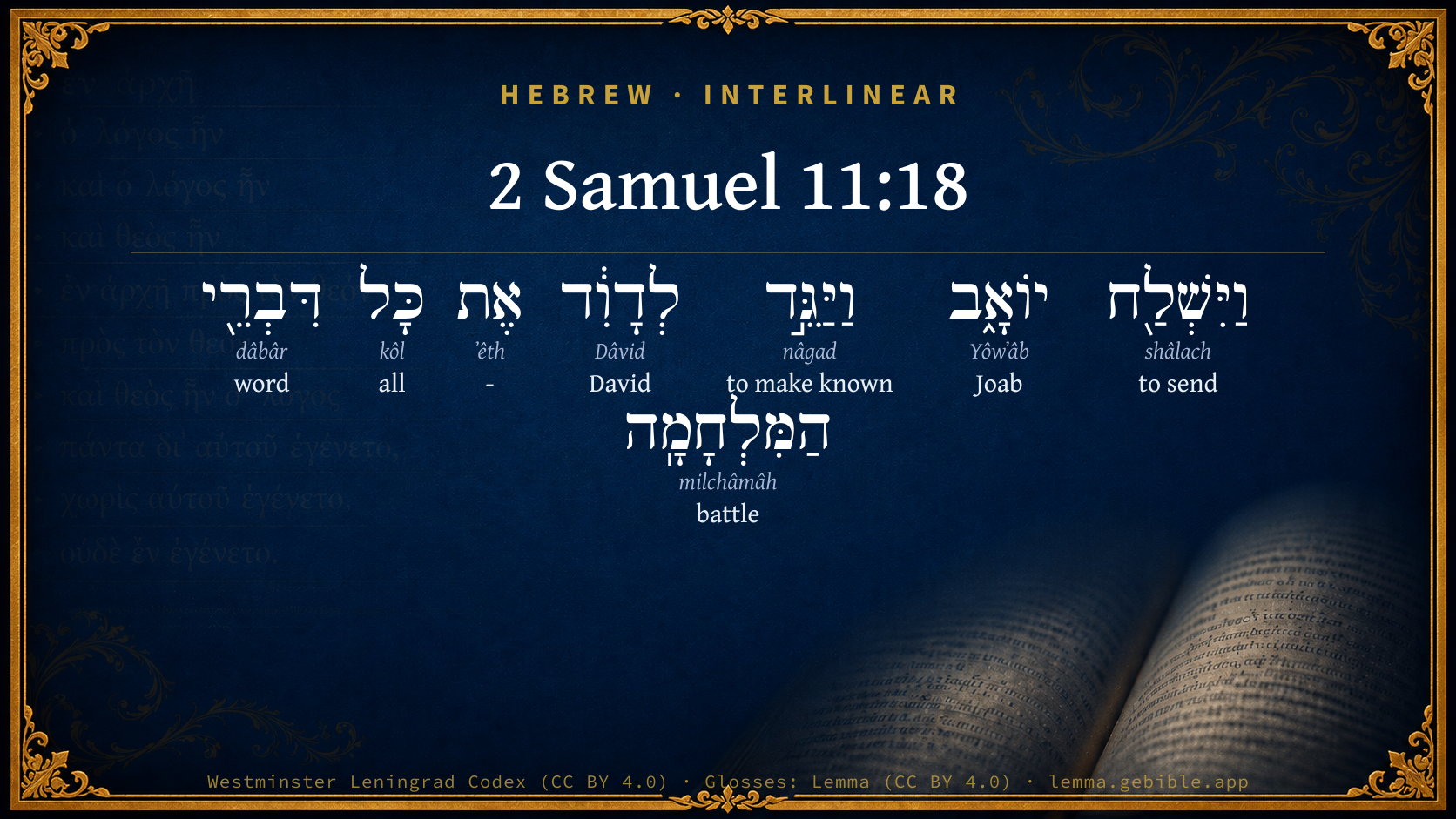
2 Samuel 11:18

Hebrew (Westminster Leningrad Codex) 2 Samuel 11:18 appears in the Hebrew Old Testament. The text above is from the Westminster Leningrad Codex. Each word links to its Strong’s number, a concise gloss, and parsing drawn from the Open Scriptures Hebrew Bible morphology. Click any word for its full Brown-Driver-Briggs (BDB) entry.
Download image
Cite this verse

2 Samuel 11:18 (World English Bible). Public Domain. Lemma interlinear Bible study tool, https://lemma.gebible.app/v/2-samuel/11/18.

Show BibTeX & RIS
BibTeX
RIS
English Translation
Then Joab sent and told David all the things concerning the war;
World English Bible · Public Domain
Download a study sheet

One document with this verse’s original text, its word-by-word gloss line, the meaning frame, cross-references with their text, attributed commentary, and full source and license credits — printable, and it pastes into notes with its structure intact.

This verse Autodidact and up

Study sheet (.html) Plain text (.txt)

A passage Seminary Student

Up to 50 verses in one chapter. A passage sheet keeps up to 6 commentary sources and 12 cross-references per verse, in the order this page ranks them, and says so on the sheet whenever that leaves anything out. Ask for a single verse and you get the Autodidact verse sheet above.

Everything on this page stays free to read, with no account — the sheet is a download of what is already on screen, not access to it.

Want to remove ads? Support Godless Engineer
Compare translations 3

The same verse in 3 English versions, stacked beneath the original-language interlinear above. Click any original word for its lexicon entry.

Each is an independent rendering of the whole verse — the interlinear is not word-aligned to these translations.

Highlighted words mark where these versions differ — a whole-verse word diff, not a word-by-word alignment.

  • World English Bible Public Domain
    Then Joab sent and told David all the things concerning the war;
  • King James Version Public Domain
    Then Joab sent and told David all the things concerning the war;
  • unfoldingWord Literal Text CC BY-SA 4.0
    And Joab sent, and he declared to David all of the things of the battle.

unfoldingWord Literal Text — © unfoldingWord, licensed CC BY-SA 4.0. Word-aligned USFM3 via Door43 (git.door43.org/unfoldingWord/en_ult).

Versions to compare (up to 4)

3 of 4 selected

Show all 18 translations

Every available English version of this verse, each an independent rendering of the whole verse.

  • World English Bible Public Domain
    Then Joab sent and told David all the things concerning the war;
  • Berean Standard Bible Public Domain
    Joab sent to David a full account of the battle
  • Majority Standard Bible Public Domain
    Joab sent to David a full account of the battle
  • King James Version Public Domain
    Then Joab sent and told David all the things concerning the war;
  • American Standard Version (1901) Public Domain
    Then Joab sent and told David all the things concerning the war;
  • Revised Version (1885) Public Domain
    Then Joab sent and told David all the things concerning the war;
  • Geneva Bible (1599) Public Domain
    Then Ioab sent and tolde Dauid all the things concerning the warre,
  • Douay-Rheims (1899) Public Domain
    Then Joab sent, and told David all things concerning the battle.
  • Young's Literal Translation Public Domain
    And Joab sendeth and declareth to David all the matters of the war,
  • Literal Standard Version CC BY-SA 4.0
    And Joab sends and declares to David all the matters of the war,
  • Unlocked Literal Bible CC BY-SA 4.0
    When Joab sent word to David about everything concerning the war,
  • unfoldingWord Literal Text CC BY-SA 4.0
    And Joab sent, and he declared to David all of the things of the battle.
  • Darby Bible Public Domain
    Then Joab sent and told David all the matters of the war;
  • World Messianic Bible Public Domain
    Then Joab sent and told David all the things concerning the war;
  • Webster's Bible Public Domain
    Then Joab sent and told David all the things concerning the war;
  • Free Bible Version CC BY-SA 4.0
    Joab sent David a full report about the battle.
  • Bible in Basic English Public Domain
    Then Joab sent David news of everything which had taken place in the war:
  • JPS Tanakh (1917) Public Domain
    Then Joab sent and told David all the things concerning the war;

Literal Standard Version (2020), Covenant Press — licensed CC BY-SA 4.0. Text via the HelloAO Bible API (eBible.org). Unlocked Literal Bible (unfoldingWord) — licensed CC BY-SA 4.0. Text via the HelloAO Bible API (eBible.org). unfoldingWord Literal Text — © unfoldingWord, licensed CC BY-SA 4.0. Word-aligned USFM3 via Door43 (git.door43.org/unfoldingWord/en_ult). Free Bible Version, Dr. Jonathan Gallagher — licensed CC BY-SA 4.0. Text via the HelloAO Bible API (eBible.org).

Word by word

More ways to search: Search by grammar → Find every occurrence → Compare this word →

Practice this passage: Drill this verse → Learn its vocabulary →

About this verse

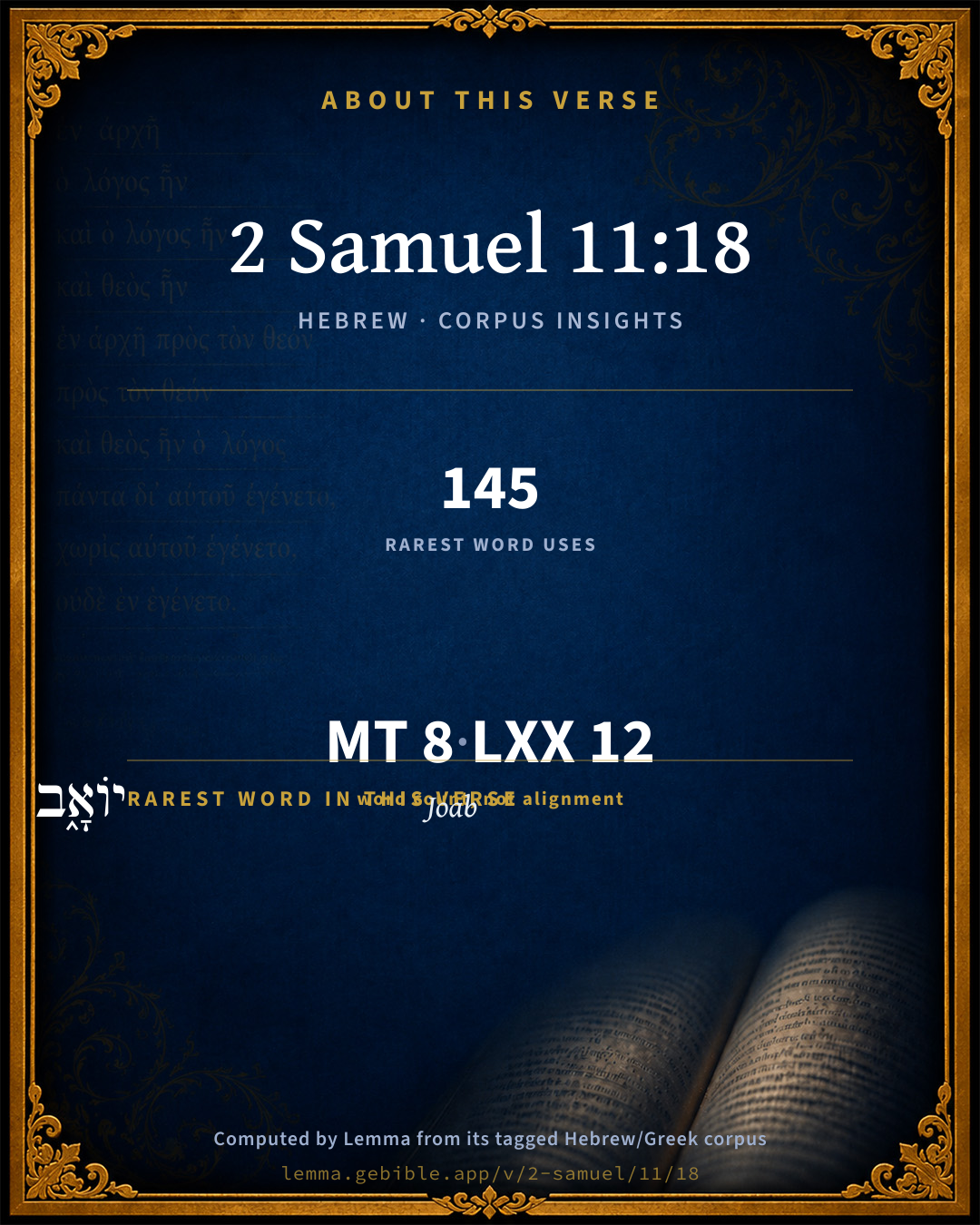
These counts appear in no published source. They are computed here, from the morphology-tagged text and Lemma’s own curated glosses. What Lemma adds →

8
words
8
distinct lemmas
Historical
section

Grammatical profile

  • 2 verbs
  • 5 nouns
  • 1 particle

Verb forms

  • וַיִּשְׁלַ֖ח Qal · Sequential Imperfect
  • וַיַּגֵּ֣ד Hiphil · Sequential Imperfect

Hebrew & Septuagint length

In English translation the verse runs 12 words from the Hebrew and 21 from the Septuagint (LXX English) — the Septuagint runs noticeably longer here. See the side-by-side →

A rough comparison of the two English renderings, which tokenize alike — not a word-level alignment.

Word counts can differ between the Hebrew and the Greek without any difference in meaning — e.g. the Hebrew direct-object marker אֵת has no separate Greek word, and Greek often adds the article ὁ.

In the original languages it is 8 Hebrew tokens and 12 Greek tokens — but the two are counted differently (Hebrew bundles its prefixes and suffixes into one token; the Greek is in lemma form), so that isn’t a like-for-like length.

Hebrew and Greek witnesses Masoretic Hebrew ↔ Greek Septuagint

The same verse in the two great witnesses to the Old Testament, shown verse-for-verse.

Here the Septuagint runs noticeably longer than the Hebrew — LXX2012 (modern English Septuagint) 21 words vs World English Bible 12. A rough length comparison of the two English translations, not a word-level alignment — read both below.

These are two independent witnesses, not word-aligned to each other, and the Septuagint is shown in lemma (dictionary) form.

Hebrew 2 Samuel 11:18 Masoretic · Westminster Leningrad Codex

וַיִּשְׁלַ֖ח יוֹאָ֑ב וַיַּגֵּ֣ד לְדָוִ֔ד אֶת כָּל דִּבְרֵ֖י הַמִּלְחָמָֽה

Then Joab sent and told David all the things concerning the war;

World English Bible · Public Domain

Greek LXX 2 Samuel 11:18 Septuagint · lemma form

καί ἀποστέλλω ιωαβ καί ἀποἀγγέλλω ὁ βασιλεύς πᾶς ὁ λόγος ὁ πόλεμος

And Joab sent, and reported to David all the events of the war, so as to tell them to the king.

LXX2012 (modern English Septuagint) · Public Domain

Hebrew: Westminster Leningrad Codex (CC BY 4.0). Greek: Septuagint (public domain); English from LXX2012 (modern English Septuagint) (Public Domain). How the Septuagint differs from the Hebrew →

Targum (Aramaic paraphrase)

1

The Targum is the ancient Jewish Aramaic paraphrase of the Hebrew Scriptures — an interpretive translation, not the Hebrew text itself. Onkelos (literal) and Pseudo-Jonathan (expansive) render the Torah, and Jonathan the Prophets. Coverage is partial: where no permissively-licensed English translation exists for a verse, only the Aramaic is shown. This is verse-level text, not a word-by-word alignment to the Hebrew.

  1. Targum Jonathan Prophets (Joshua–Malachi)
    וּשְׁלַח יוֹאָב וְחַוֵי לְדָוִד יַת כָּל עִסְקֵי קְרָא:

    (no public-domain English translation for this verse)

    Targum Jonathan — Aramaic: “Mikraot Gedolot” (public domain). English: “Sefaria Community Translation” (CC0 1.0 (public-domain dedication)); “London "Chaldee Paraphrase," 1871” (public domain). Text via Sefaria.

Commentary

Notes on 2 Samuel 11:18 from classic Christian and Jewish commentators (each source and its license shown beneath its notes). The classic Christian expositions comment on the surrounding passage and are grouped to its opening verse, so a note may address several verses; the Jewish commentaries on the Tanakh (Rashi and others) are per-verse, so they appear only where the commentator wrote on this verse.

Lemma curates 59 commentaries, every one of them public domain or Creative Commons licensed, each selected and text-cleaned for this edition rather than reprinted as found. About our sources →

Trapp's Complete Commentary

John Trapp

2Sa 11:18 Then Joab sent and told David all the things concerning the war;

Ver. 18. And told David all the things.] But all was to bring in that one thing which he knew would be most pleasing to David’s palate, the death of Uriah. Such a dead and dedolent disposition had seized upon David’s heart, such a hoof had overgrown it, that he could hardly ever recover his ancient tenderness to his dying day.

John Trapp, A Commentary or Exposition upon All the Books of the Old and New Testament (1647–1656) — public domain. Text from a community e-Sword module.

John Gill's Exposition

Then Joab sent,.... Messengers to David, as soon as Uriah was killed:

and told David all the things concerning the war; how the siege had been carried on; what success they had had, good or ill; what their advantages and disadvantages; what men they had lost, and especially in one sally of the enemy upon them, for the sake of which the express was sent.

John Gill's Exposition of the Whole Bible (1746–1763) — public domain (CC PDM 1.0). Text via the HelloAO Bible API.

The Pulpit Commentary

Then Joab sent. Joab now performs another act in this iniquitous drama, and goes through the form of sending the king a report of the disaster which had followed upon his approaching too near the walls. With well-feigned hypocrisy, he makes the messenger believe that David will be displeased at the loss of life, and will blame him for his want of caution. But it is curious that the messenger is instructed to mention the death of Uriah only after the king has given utterance to his anger. Possibly the meaning of this is that the loss of one so high in rank, and the king"s near neighbour, is so serious a matter that it must be gradually broken to him, lest his indignation at Joab should be too violent. Probably there was also the suggestion that Uriah had been himself too rash, and had incurred his fate by his own fault. The reference to the fate of Abimelech (Jud_1:9:53) proves that the history of the times of the judges was generally known. Very probably not only records of the several events existed, but the Book of Judges was already written In Samuel"s schools the youth of Israel were instructed in the annals of their country, and men like Nathan and Gad, and ethers who aided Samuel in his work, would be sure quickly to turn their attention to the orderly arrangement and digest of the records in their possession.

Vers. 18-27.

Complicity in evil.

The facts are:

1. Joab, having executed the wicked commission, sends word to David asto the progress of the war.

2. He furnishes the messenger with a means of appeasing the probablewrath of David on his learning that the conflict was more serious than either he or Joab looked for, namely, an announcement of Uriah"s death.

3. The messenger carefully describes the seriousness of the engagementwith the enemy, and concludes by referring to the death of Uriah.

4. David sends back an encouraging message to Joab, and professes toacknowledge the inevitable losses and chances of war.

5. On suitable sorrow being shown by the widow, for the loss of herhusband, David takes her to himself as a wife.

6. The deed of David is displeasing to God. The narrative here gives us thematuring of David"s scheme, and the general character of the secret negotiations carried on with Joab in order to bring his purpose to pass. We have, then, an instance of accomplices in crime, revealing to us truth, and illustrating facts in connection with human life in all ages.

I MEN INTENT ON A GREAT EVIL ARE FORCED TO BRING OTHERS INTO THEIR WICKED SECRETS. Providence kindly frustrated David"s attempt to cover his sin by means of Uriah"s free action; and it therefore became necessary, in his desperate wickedness, to seek the end in view by means of Uriah"s death. But unless David committed murder with his own hand, which his conscience would not allow, he must find some one whose ingenuity, with his own, would bring it to pass, and save appearances. Such is the logic of evil. God in his mercy has filled the world with obstacles to the committal of sin and to persistence in it when once committed; but such is the baseness of the human heart that this, instead of being regarded as a help in the warfare with evil propensity, is turned into a reason for seeking the aid of another"s wits and agency. It is a further fall in evil when men are thus impelled to drag others into the meshes of their sin. So hardened does the heart become by dalliance with sin and indulgence in it, that even the character and souls of others are to be ruined in order to gratify self and hide iniquity for a few years from human view.

II THERE ARE GENERALLY MEN TO BE FOUND READY TO CARRY OUT THE EVIL PURPOSES OF THEIR SUPERIORS. Even in the chosen nation a Joab was to be found, cruel, hard of heart, habituated to acts of severity, and glad to have the opportunity of retorting in spirit, if not in words, the former reproaches of his master. (2Sa_3:29, 2Sa_3:39) It is a sign of the marvellous change that had come over David, that he, who had so bitterly reproached this man for cruelty and hard heartedness, now turns to him for the purpose of using those very qualities for accomplishing his own cruel design. The presence of such a man in Israel for doing the evil work of his superior is typical of a universal fact. There is a vast amount of reserve evil in the world, waiting only for some influential will to draw it out into activity. The power of superiors over subordinates sometimes extends to the moral sphere. In strict fact, a king has only power, in virtue of his office, over the legal actions of his subjects, and a master over the legal actions of his servants; but when a king or a master, in excess of his right, extends his authority into the moral sphere, it too often happens that the subordinate whose conscience is not sensitive allows the authority due to the legal position to pass over to the moral sphere and break down the defences of conscience. This is an abuse of influence on the one side, and an abandonment of most sacred duties on the other. The wicked heart is apt to find excuses in the fact that a superior leads the way, and that, if guilt lies anywhere, it is on him.

III MEN BENT ON AN EVIL DESIGN WILL EVEN RISK THE RUIN OF THE INNOCENT IN CARRYING OUT THEIR SCHEMES. David knew very well that Joab could not carry out his instructions without, not only exposing Uriah to the certain risk of death, but also placing other men, not concerned in this domestic trouble, in positions of peril; for the meaning of the instructions was plainly to create a position of extreme peril, which in war can only be done by engaging a troop. What if several innocent men fell in this "hottest battle"! Uriah, at all events, would be amongst them! The more the progressive conduct of the king is scrutinized, the more base and abominable does it appear. This dreadful sin is not confined to David. Monarchs and diplomatists, who from motives of vanity or mere love of power bring on war, really cause the death of innocent men and the wailings of widows in carrying out their designs. What if thousands of men fall! Some regal or other obstacle to ambition or pride will at least be got rid of! That is the moral side of too many wars. The same in a measure applies to men who will be rich, though it cost the health, the poverty, and often lives of workmen. What of all that? Wealth must be secured! Other instances are to be found in modern life.

IV MEN IN CARRYING OUT NEFARIOUS DESIGNS ARE CAREFUL TO CONFORM TO THE DECENCIES OF OUTWARD LIFE. Bad men understand one another. There is a freemasonry in evil. Joab knew what he was about when he anticipated that David would manifest signs of wrath on hearing of his fruitless attack on the city. Each evil doer played his part with skill. The messenger was to remind David of historic parallels (ver. 21), and to tell him that the rash man Uriah, who led the bootless assault, had been punished for his rashness by death. No court martial would be necessary, lamentable as the affair certainly was! Heart answers to heart. The anger ceases; maxims concerning the chances of war come to one"s aid (ver. 25); the lessons of failure must be laid to heart; the general at the head of the army must not be discouraged. All this was very proper in harmony with the proprieties of life. Men doing evil are inwardly ashamed of it, and are compelled to keep up the appearance of doing and being good. It is the outward conformity with the decencies of life that enables wicked men to go on in their evil ways for years. They follow the teaching and example of their chief, who is a liar in deed and word, and who, to perfect his schemes, assumes, if necessary, the form of an "angel of light.

V EVIL MEN BRING THEIR DEVICES TO A SUCCESSFUL ISSUE WITH ONE NOTABLE EXCEPTION. The success of David was complete. Uriah was safely put away; Bathsheba was the king"s wife within a date to prevent convincing exposure; the army and the people were kept in ignorance of actual facts; the future was hopeful; but there was one fact on which the infatuated king did not reflect the Lord was displeased. The brethren of Joseph seemed to succeed in getting rid of a troublesome brother, but God saw their wickedness, and this counted for more than they then imagined. The wicked husbandmen succeeded in freeing themselves from annoyance when they killed the heir; (Mat_21:38) but there was One to reckon with of whom they did not think. The conspiring scribes and Pharisees doubtless congratulated themselves that their plans for getting rid of the "babbler" who caused them so much trouble were wonderfully successful; but there was One whose "power" was not secured to their side. (Act_2:23, Act_2:24) Kings and diplomatists and exactors of unjust labours and secret defrauders, and evil livers may succeed in keeping up appearances, in passing as honourable men, and in securing their heart"s desire; but there will always be one factor in the case with which they some day will have to reckon the displeasure of the Lord.

GENERAL LESSONS.

1. It is a disgrace to a master to be in league with a servant, and it puts themaster within the servant"s power. Many a subordinate is in possession of secrets which, if used, would blast character and ruin earthly prospects. The coils of iniquity!

2. Every new device to hide sin, and every effort to keep up appearances,only blinds the mind the more to the actual state of the soul in its relation to God.

3. In all our affairs, and especially when tempted to persist in courses ofsin, we should endeavour to remember that we shall have to reckon with One who knows all and is already displeased.

4. That a man professing religion can go on in a secret course of sinwithout giving due heed to the knowledge which he must possess of God"s knowledge of himself and deeds, is a striking sign of the utter deterioration of his spiritual sensibilities and his being nigh unto perdition.

The Pulpit Commentary (1880–1919), ed. H.D.M. Spence-Jones & Joseph S. Exell — public domain. Text from a community e-Sword module.

unfoldingWord translationNotes

Door43 World Missions Community

Joab sent word to David

The phrase "sent word" means that he sent a messenger to give a report. AT: "Joab sent a messenger to David to give a report" (See: Metonymy)

Why did you go so near ... from the wall?

Joab says that David may rebuke him by asking these rhetorical questions. These questions may be written as statements. AT: "You should not have gone so near to the city to fight. You should have known that they would shoot from the wall." (See: Rhetorical Question)

shoot from the wall

This refers to men of the city shooting arrows down at their enemy from the top of the city wall. AT: "shoot arrows at you from the top of the city wall" (See: Assumed Knowledge and Implicit Information)

translationWords

Joab

word

David

command

messenger

anger

unfoldingWord translationNotes — © Distant Shores Media and the Door43 World Missions Community, licensed CC BY-SA 4.0. Source: git.door43.org/Door43/en_tn.

Lesson kit

Teaching starters — assembled from the data on this page, not authored interpretation. Every prompt links to the verse data it draws on. Edit before teaching.

2 Samuel, in the Historical, opens this verse with 8 words (8 distinct Hebrew lemmas). Its most distinctive word is Yôwʼâb (“Joab”). The Greek Septuagint runs longer here. A historical commentator’s framing appears above. Read the whole chapter for the surrounding context.

Discussion questions

  1. The word Yôwʼâb carries the sense “Joab.” How does it shape the verse?
  2. Compared with the Hebrew, the Septuagint runs longer here. What questions does that raise?
  3. These translations render this verse differently. What is at stake in choosing one wording over another?
  4. The verb «וַיִּשְׁלַ֖ח» is Qal Sequential Imperfect. How does its form color the action?
  5. Reading how Trapp's Complete Commentary and John Gill's Exposition read this verse, where do the two commentators agree and where do they part?

Things to notice

Reading settings

Reading text

Shown beneath each verse's original-language words.

Old Testament
Old Testament edition

Read the OT as the Masoretic Hebrew (MT) or the Greek Septuagint (LXX).

English shown for the Greek Septuagint (in the Hebrew ↔ Greek comparison).

Comparing translations? Open the Compare panel on any verse page to stack up to four side by side.