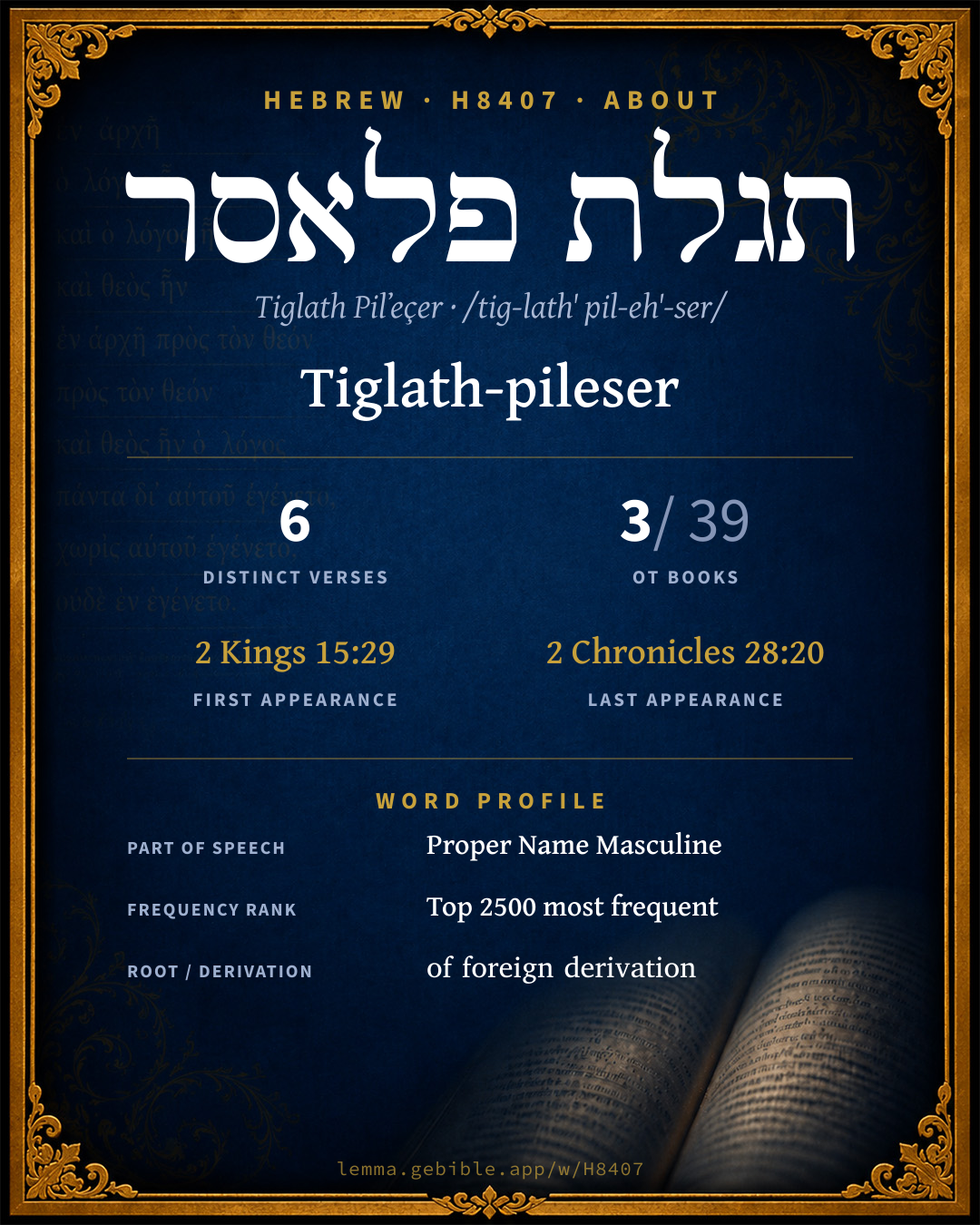
תִּגְלַת פִּלְאֶ֫סֶר
Tiglath-pileser
BDB lists 2 entries for ‘Tiglath-pileser’ fuller range ↓
Full lexicon entry — Brown-Driver-Briggs (BDB)
From Brown-Driver-Briggs (BDB)
Where this word appears
Grammar key — what these labels mean
Part of speech
- Noun
- A naming word — a person, place, thing, or idea.
Noun type
- Proper
- A name of a specific person, place, or people (e.g. Abraham, Zion, Israel).
Every verse where H8407 appears — 6 distinct verses across 3 books. Click any verse to open its interlinear word-by-word view. Verse text shown in the World English Bible for context — . Each verse’s Hebrew form is shown with its reference; the English is not keyword-highlighted, since the data carries no word-level English alignment. Use “Compare translations” on any verse to read it across multiple English versions. This concordance covers the Hebrew Bible; Septuagint (Greek Old Testament) occurrences are not indexed here.
2 Kings 3 verses
- 2 Kings 15:29 תִּגְלַ֣ת פִּלְאֶסֶר֮ n Proper n Proper In the days of Pekah king of Israel came Tiglath Pileser king of Assyria, and took Ijon, and Abel Beth Maacah, and Janoah, and Kedesh, and Hazor, and Gilead, and Galilee, all the land of Naphtali; and he carried them captive to Assyria.
- 2 Kings 16:7 תִּ֠גְלַת פְּלֶ֤סֶר n Proper n Proper So Ahaz sent messengers to Tiglath Pileser king of Assyria, saying, I am your servant and your son: come up, and save me out of the hand of the king of Syria, and out of the hand of the king of Israel, who rise up against me.
- 2 Kings 16:10 תִּגְלַ֨ת פִּלְאֶ֤סֶר n Proper n Proper King Ahaz went to Damascus to meet Tiglath Pileser king of Assyria, and saw the altar that was at Damascus; and king Ahaz sent to Urijah the priest the fashion of the altar, and the pattern of it, according to all the workmanship of it.
1 Chronicles 2 verses
- 1 Chronicles 5:6 תִּלְּגַ֥ת פִּלְנְאֶ֖סֶר n Proper n Proper Beerah his son, whom Tilgath Pilneser king of Assyria carried away captive: he was prince of the Reubenites.
- 1 Chronicles 5:26 תִּלְּגַ֤ת פִּלְנֶ֨סֶר֙ n Proper n Proper The God of Israel stirred up the spirit of Pul king of Assyria, and the spirit of Tilgath Pilneser king of Assyria, and he carried them away, even the Reubenites, and the Gadites, and the half-tribe of Manasseh, and brought them to Halah, and Habor, and Hara, and to the river of Gozan, to this day.
2 Chronicles 1 verse
About this entry
At a glance — auto-summarized from this page’s data, not written by a person. Every figure links to its source below. This summary describes the numbers; it doesn’t interpret them.
At its core, תגלת פלאסר (Tiglath Pilʼeçer) means “Tiglath-pileser.” Its uses cluster heavily in 2 Kings (50% of all occurrences). With 6 verses in 3 books, it is an uncommon word in the Hebrew Bible. First canonically at 2 Kings 15:29, it enters the text early. Each statement above links to its evidence; the full detail follows below.
Gloss history
Strong's 1890 vs modern scholarship
About this word
Strong's H8407 catalogs a Hebrew word from the Hebrew Old Testament.
These counts are not copied from any lexicon or concordance. They are computed here, from the morphology-tagged Hebrew Old Testament. What Lemma adds →
- 6
- distinct verses
- The word appears in 6 distinct verses.
- 3 / 39
- OT books
- The word appears in 3 of 39 Old Testament books.
- #2,101
- by frequency
- Top 2500 most frequent Hebrew words (rank 2,101 of 8,640 Hebrew words by occurrence).
View all 6 occurrences in the concordance →
Most concentrated in
- 2 Kings 3 verses 50%
- 1 Chronicles 2 verses 33%
- 2 Chronicles 1 verse 17%
By section of the Old Testament
By traditional corpus
Conventional, traditional groupings — biblical authorship is debated, so this is a traditional corpus grouping, not an authorship claim. Each share is this word’s portion of its verses in that division of the Hebrew canon. Each figure is a share of the word’s 6 distinct verses.
- Prophets (Nevi'im) 3 verses · 50%
- Writings (Ketuvim) 3 verses · 50%
How translations render this word
Counts come from each version’s own published word-to-Strong’s tagging or interlinear alignment — an approximate guide to how each version renders this word, not a word-level alignment the data otherwise carries. Because each total is that version’s own tagged count, the per-version totals vary from one another and need not match the appearance or distinct-verse counts above. These counts may also differ from a printed concordance because Lemma counts each distinctly tagged rendering and does not collapse phrase taggings into a single head-word total. This is a fixed set of word-tagged versions (KJV, ASV, BSB, ULT) and does not change with the reading translation you choose elsewhere. Each version’s license is shown beside its name below (and on Sources).
- King James Version: Tiglathpileser 3×, Tilgathpilneser 3×
- American Standard Version: Tiglath-pileser 3×, Tilgath-pilneser 3×
- Berean Standard Bible: Tiglath-pileser 6×
- unfoldingWord Literal Text: Pileser 6×, Tiglath 4×, Tilgath 2×
King James Version Public Domain
Renders H8407 across 6 tagged occurrences — most commonly:
American Standard Version Public Domain
Renders H8407 across 6 tagged occurrences — most commonly:
Berean Standard Bible Public Domain
Renders H8407 across 6 tagged occurrences — most commonly:
unfoldingWord Literal Text CC BY-SA 4.0
Renders H8407 across 12 tagged occurrences — most commonly:
Senses in BDB
The 2 senses BDB distinguishes for this word, in lexicon order (not ranked by frequency or importance). The full entry — with sub-senses — is in the Lexicon Entry tab.
- Tiglath-pileser or Tilgath-pilneser = "thou will uncover the wonderful bond"
- an Assyrian king who attacked Samaria or northern kingdom of Israel in the reign of Pekah
Word origin
n. pr. m. Tiglathpileser (III), king of Assyria (Zinj. תגלתפלסר, תגלתפליסר, GACookeInscr. 178. 183. 188; = Assyrian Tukulti-apil-êšar-ra Rost Keilinschr. TP III (1893), 42 COT 2 K 15:29; v. also PinchesEncy. Bib. TP SayHast. DB. TP);—2 K 15:29; 16:10 = ת׳ פְּלֶ֫סֶר v 7; corrupt תִּלְּגַת פִּלְנְאֶ֫סֶר 1 Ch 5:6; 2 Ch 28:20, ת׳ פִּלְנֶסֶר 1 Ch 5:26; v. also פּוּל;—Αλγαθφελλασαρ, Θαλγαθ[λ]φελλασαρ, Θαλγαβανασαρ, etc., 𝔊L (Kings) Θεγλαφαλασαρ.
— Brown-Driver-Briggs (Oxford 1906, public domain), digitized via Sefaria, supplemented by the OpenScriptures HebrewLexicon (CC BY 4.0). See Sources.
Origin: of foreign derivation
Forms in the corpus
The 10 distinct written forms H8407 takes in the Hebrew Bible, most frequent first — each parse links to that state’s occurrences in the concordance. Hebrew forms include their vowel points and cantillation, so a single lemma takes many written forms.
| Form | Parsing | Example | Uses |
|---|---|---|---|
| פִּלְנְאֶ֖סֶר | Noun, Proper | 1 Chronicles 5:6 | 2 |
| תִּלְּגַ֥ת | Noun, Proper | 1 Chronicles 5:6 | 2 |
| פְּלֶ֤סֶר | Noun, Proper | 2 Kings 16:7 | 1 |
| פִּלְאֶ֤סֶר | Noun, Proper | 2 Kings 16:10 | 1 |
| פִּלְאֶסֶר֮ | Noun, Proper | 2 Kings 15:29 | 1 |
| פִּלְנֶ֨סֶר֙ | Noun, Proper | 1 Chronicles 5:26 | 1 |
| תִּ֠גְלַת | Noun, Proper | 2 Kings 16:7 | 1 |
| תִּגְלַ֣ת | Noun, Proper | 2 Kings 15:29 | 1 |
| תִּגְלַ֨ת | Noun, Proper | 2 Kings 16:10 | 1 |
| תִּלְּגַ֤ת | Noun, Proper | 1 Chronicles 5:26 | 1 |
Bible dictionary
Public-domain dictionary articles matched to this entry by name (Tiglath-pileser). A biblical name can be shared by more than one person or place, so an article may treat several.
Smith's Bible Dictionary · William Smith, 1863
(In (1 Chronicles 5:26) and again in 2Chr 28:20 The name of this king is given as TIGLATH-PILNESER.) Tiglath-pileser is the second Assyrian king mentioned in Scripture as having come into contact with the Israelites. He attacked Samaria in the reign of Pekah, B.C. 756-736. probably because Pekah withheld his tribute, and having entered his territories, he "took Ijon, and Abel-beth-maachah and Janoah and Kedesh, and Hazer, and Gilead, and Galilee, and all the land of Naphtali, and carried them captive to Assyria." (2 Kings 15:29) The date of this invasion cannot be fixed. After his first expedition a close league was formed between Rezin, king of Syria, and Pekah, having for its special object the humiliation of Judah. At first great successes were gained by Pekah and his confederate, (2 Kings 15:37; 2 Chronicles 28:6-8) but on their proceeding to attack Jerusalem itself, Ahaz applied to Assyria for assistance, and Tiglath-pileser, consenting to aid him, again appeared at the head of an army in these regions. He first marched, naturally, against Damascus. which he took, (2 Kings 16:9) razing it to the ground, and killing Rezin, the Damascene monarch. After this, probably, he proceeded to chastise Pekah, whose country he entered on the northeast, where it bordered upon "Syria of Damascus." Here he overran the whole district to the east of Jordan, carrying into captivity "the Reubenites, the Gadites and the half tribe of Manasseh," (1 Chronicles 5:26) Before returning into his own land, Tiglath pileser had an interview with Ahaz at Damascus. (2 Kings 16:10) This is all that Scripture tells us of Tiglath-pileser. He reigned certainly from B.C. 747 to B.C. 730, and possibly a few years longer, being succeeded by Shalmaneser at least as early as B.C. 785, Tiglath-pileser's wars do not generally, appear to have been of much importance. No palace or great building can be ascribed to this king. His slabs, which are tolerably numerous show that he must have built or adorned a residence at Calah (Nimrud), where they were found.
Hitchcock's Bible Names Dictionary · Roswell D. Hitchcock, 1869
that binds or takes away captivity
Classic public-domain reference works; full attribution on Sources.
Septuagint verse parallels
This word appears in 6 verses that also exist in the Greek Old Testament (Septuagint), out of the 6 Hebrew verses it occurs in. You can read those verses in Greek by switching the Old Testament edition to the Septuagint.
Read these verses in the Septuagint
This is a verse-level parallel only — the same verses exist in both the Hebrew and Greek Old Testaments. No word-level Hebrew↔Greek correspondence is claimed: the data carries no such alignment, so no Greek word is shown as this Hebrew word’s translation. Coverage is not total — the Septuagint omits the deuterocanon and renumbers the Psalms, so some Hebrew verses have no direct Greek parallel.