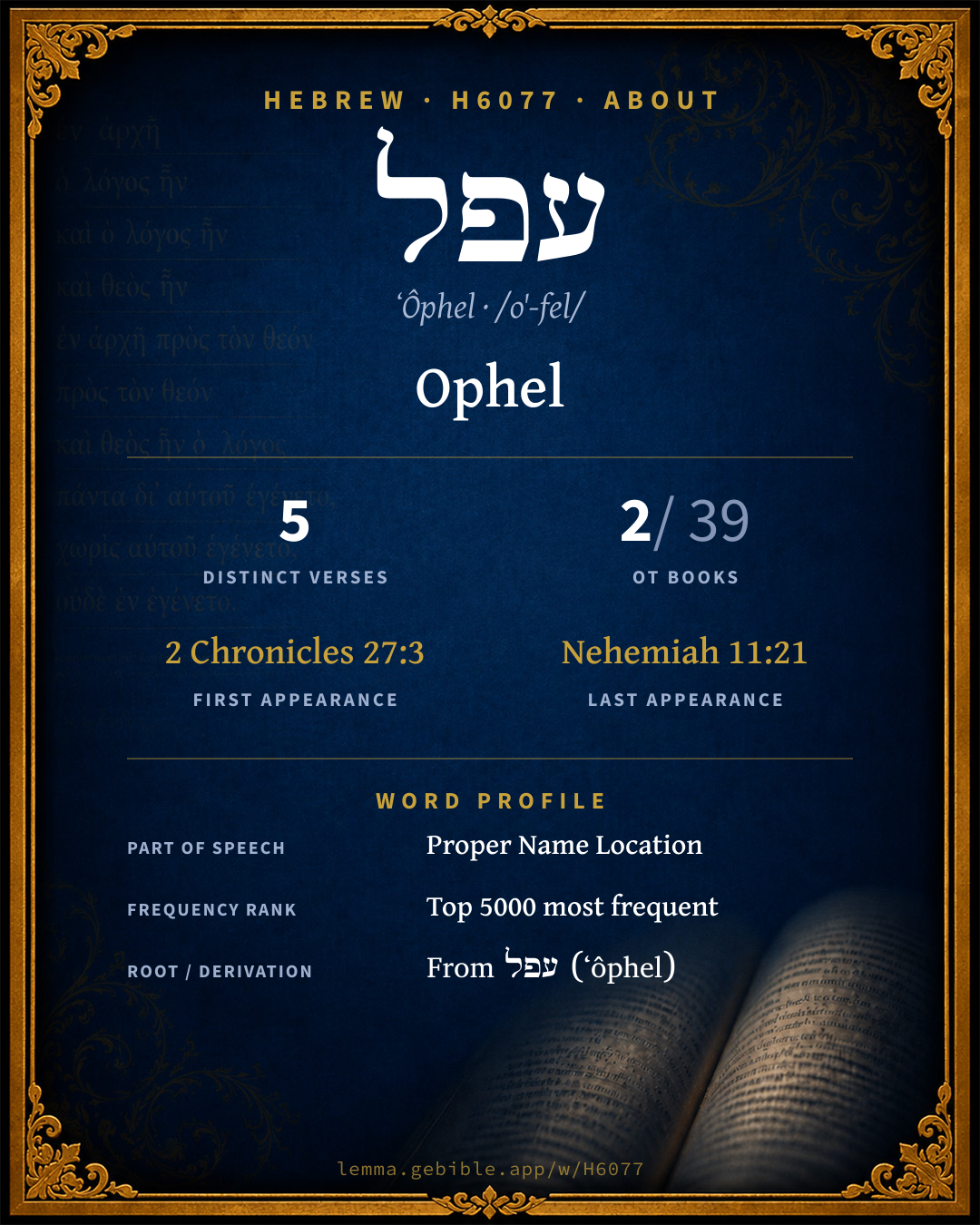
עֹ֫פֶל
Ophel
BDB lists 2 entries for ‘Ophel’ fuller range ↓
Full lexicon entry — Brown-Driver-Briggs (BDB)
From Brown-Driver-Briggs (BDB)
Where this word appears
Grammar key — what these labels mean
Noun type
- Proper
- A name of a specific person, place, or people (e.g. Abraham, Zion, Israel).
- Common
- A common noun — a general class of person, place, or thing (“king,” “city,” “water”), not a specific name.
State
- Absolute
- The independent form of a noun, not bound to a following word.
Gender
- Masculine
- Grammatically masculine.
Number
- Singular
- One.
Grammatical forms
- Noun, Proper 4 times (80%)
- Noun, Common, Masculine, Singular, Absolute 1 time (20%)
Parsed forms decoded from the imported morphology (morphhb / Westminster Leningrad Codex — WLC text public domain, morphhb tagging CC BY 4.0), counted across 5 parsed occurrences — not distinct verses.
Every verse where H6077 appears — 5 distinct verses across 2 books. Click any verse to open its interlinear word-by-word view. Verse text shown in the World English Bible for context — . Each verse’s Hebrew form is shown with its reference; the English is not keyword-highlighted, since the data carries no word-level English alignment. Use “Compare translations” on any verse to read it across multiple English versions. This concordance covers the Hebrew Bible; Septuagint (Greek Old Testament) occurrences are not indexed here.
2 Chronicles 2 verses
- 2 Chronicles 27:3 הָ/עֹ֛פֶל ptcl def.art + n Proper He built the upper gate of the house of Yahweh, and on the wall of Ophel he built much.
- 2 Chronicles 33:14 לָ/עֹ֔פֶל prep det + n Proper Now after this he built an outer wall to the city of David, on the west side of Gihon, in the valley, even to the entrance at the fish gate; and he compassed Ophel about [with it], and raised it up to a very great height: and he put valiant captains in all the fortified cities of Judah.
Nehemiah 3 verses
- Nehemiah 3:26 בָּ/עֹ֑פֶל prep det + n c ms (Now the Nethinim lived in Ophel, to the place over against the water gate toward the east, and the tower that stands out.)
- Nehemiah 3:27 הָ/עֹֽפֶל ptcl def.art + n Proper After him the Tekoites repaired another portion, over against the great tower that stands out, and to the wall of Ophel.
- Nehemiah 11:21 בָּ/עֹ֑פֶל prep + n Proper But the Nethinim lived in Ophel: and Ziha and Gishpa were over the Nethinim.
About this entry
At a glance — auto-summarized from this page’s data, not written by a person. Every figure links to its source below. This summary describes the numbers; it doesn’t interpret them.
At its core, עפל (ʻÔphel) means “Ophel.” The Hebrew Bible uses it only 5 verses. The word gravitates to Nehemiah (60%), then 2 Chronicles. It first appears in 2 Chronicles 27:3. Dig into 5-verse concordance and the renderings breakdown below.
Gloss history
Strong's 1890 vs modern scholarship
About this word
Strong's H6077 catalogs a Hebrew word from the Hebrew Old Testament.
These counts are not copied from any lexicon or concordance. They are computed here, from the morphology-tagged Hebrew Old Testament. What Lemma adds →
- 5
- distinct verses
- The word appears in 5 distinct verses.
- 2 / 39
- OT books
- The word appears in 2 of 39 Old Testament books.
- #3,337
- by frequency
- Top 5000 most frequent Hebrew words (rank 3,337 of 8,640 Hebrew words by occurrence).
View all 5 occurrences in the concordance →
Most concentrated in
- Nehemiah 3 verses 60%
- 2 Chronicles 2 verses 40%
By section of the Old Testament
By traditional corpus
Conventional, traditional groupings — biblical authorship is debated, so this is a traditional corpus grouping, not an authorship claim. Each share is this word’s portion of its verses in that division of the Hebrew canon. Each figure is a share of the word’s 5 distinct verses.
- Writings (Ketuvim) 5 verses · 100%
How translations render this word
Counts come from each version’s own published word-to-Strong’s tagging or interlinear alignment — an approximate guide to how each version renders this word, not a word-level alignment the data otherwise carries. Because each total is that version’s own tagged count, the per-version totals vary from one another and need not match the appearance or distinct-verse counts above. These counts may also differ from a printed concordance because Lemma counts each distinctly tagged rendering and does not collapse phrase taggings into a single head-word total. This is a fixed set of word-tagged versions (KJV, ASV, BSB, ULT) and does not change with the reading translation you choose elsewhere. Each version’s license is shown beside its name below (and on Sources).
BDB lists this Strong’s number as 2 distinct words (homographs). Each count above pools all of them and is not split by sense — see the Senses section below. A low-frequency rendering may belong to a different one of those words, not the primary meaning.
- King James Version†: Ophel 4×
- American Standard Version†: Ophel 5×
- Berean Standard Bible†: Ophel 5×
- unfoldingWord Literal Text†: Ophel 4×
King James Version Public Domain
Renders H6077 across 5† tagged occurrences — most commonly:
Plus 1 rendering that appears only once — usually multi-word phrases or single function words the recovered tagging swept in, not distinct renderings.
American Standard Version Public Domain
Renders H6077 across 5† tagged occurrences — most commonly:
Berean Standard Bible Public Domain
Renders H6077 across 5† tagged occurrences — most commonly:
unfoldingWord Literal Text CC BY-SA 4.0
Renders H6077 across 5† tagged occurrences — most commonly:
Plus 1 rendering that appears only once — usually multi-word phrases or single function words the recovered tagging swept in, not distinct renderings.
Senses in BDB
The 2 senses BDB distinguishes for this word, in lexicon order (not ranked by frequency or importance). The full entry — with sub-senses — is in the Lexicon Entry tab.
- Ophel = "hill"
- a ridge of hills in Jerusalem, fortified for defense of the city
Word origin
I. n. [m.] mound, hill, only as acropolis;—ע׳ abs. 2 K 5:24 +, cstr. Mi 4:8;—fortified mound or hill within city, of Jerus. (cf. RobBR i. 267 GuZPVv (1882), 326) Mi 4:8; Is 32:14; S. end of eastern hill Ne 3:26; 11:21; 2 Ch 33:14 חוֹמַת הָע׳ Ne 3:27; 2 Ch 27:3 (cf. חמת העפל in קרחה MI21.22); of Samaria 2 K 5:24.
II. n.m. 1 S 6:4 hemorrhoid;—only pl. Kt (בָּ)עֳפָלִים Dt 28:27; 1 S 5:6, 9, 12; cstr. עָפְלֵי 6:4; sf. עָפְלֵיכֶם v 5; Qr in all (ב)טְחֹרִים, טְחֹרֵי, טְחֹרֵיכֶם, v. [טְחוֹר].
— Brown-Driver-Briggs (Oxford 1906, public domain), digitized via Sefaria, supplemented by the OpenScriptures HebrewLexicon (CC BY 4.0). See Sources.
Derived from עפל (ʻôphel) (H6076) — hill.
Jastrow Dictionary
A second Hebrew/Aramaic lexicon for comparison, covering Aramaic and post-biblical (Talmudic, Targumic, Midrashic) usage that the biblical-Hebrew BDB does not. Matched by lemma rather than by Strong’s number, so a lemma may carry more than one Jastrow headword (shown separately below), and the entries cover usage well beyond the Bible.
עָפַל
- (b. h.) to swell, rise.—V. עוֹפֶל.
- to act rashly, be foolhardy. Sabb. 97ᵃ מן המַעְפִּילִים הוה Ms. M. (v. Rabb. D. S. a. l. note; ed. מִוַּיַּעְפִּילוּ) he was one of the foolhardy (Num. XIV, 44); Yalk. Num. 749 המַעְפִּילִין. e.g. Numbers 14:44
עֹפֶל
- , v. עוֹפֶל
A Dictionary of the Targumim, the Talmud Babli and Yerushalmi, and the Midrashic Literature (Marcus Jastrow; London, Luzac, 1903) — Public Domain. Digitized via Sefaria. Digitized via Sefaria. Full attribution on Sources.
Forms in the corpus
The 4 distinct written forms H6077 takes in the Hebrew Bible, most frequent first — each parse links to that state’s occurrences in the concordance. Hebrew forms include their vowel points and cantillation, so a single lemma takes many written forms.
| Form | Parsing | Example | Uses |
|---|---|---|---|
| בָּ/עֹ֑פֶל | Noun, Proper | Nehemiah 11:21 | 2 |
| הָ/עֹ֛פֶל | Noun, Proper | 2 Chronicles 27:3 | 1 |
| הָ/עֹֽפֶל | Noun, Proper | Nehemiah 3:27 | 1 |
| לָ/עֹ֔פֶל | Noun, Proper | 2 Chronicles 33:14 | 1 |
Bible dictionary
Public-domain dictionary articles matched to this entry by name (Ophel). A biblical name can be shared by more than one person or place, so an article may treat several.
Easton's Bible Dictionary · M. G. Easton, 1897
Hill; mound, the long, narrow, rounded promontory on the southern slope of the temple hill, between the Tyropoeon and the Kedron valley (2 Chr. 27:3; 33:14; Neh. 3:26, 27). It was surrounded by a separate wall, and was occupied by the Nethinim after the Captivity. This wall has been discovered by the engineers of the Palestine Exploration Fund at the south-eastern angle of the temple area. It is 4 feet below the present surface. In 2 Kings 5:24 this word is translated "tower" (R.V., "hill"), denoting probably some eminence near Elisha's house.
Smith's Bible Dictionary · William Smith, 1863
(hill), a part of ancient Jerusalem. Ophel was the swelling declivity by which the mount of the temple slopes on its southern side into the valley of Hinnom--a long, narrowish rounded spur or promontory, which intervenes between the mouth of the central valley of Jerusalem (the Tyropoeon) and the Kidron, or valley of Jehoshaphat. Halfway down it on its eastern face is the ("Fount of the Virgin," so called; and at its foot the lower outlet of the same spring--the Pool of Siloam. In (2 Chronicles 27:3) Jotham is said to have built much "on the wall of Ophel." Manasseh, among his other defensive works, "compassed about Ophel." Ibid. (2 Chronicles 33:14) It appears to have been near the "water-gate," (Nehemiah 3:26) and the "great tower that lieth out." ver. (Nehemiah 3:27) It was evidently the residence of the Levites. (Nehemiah 11:21)
Hitchcock's Bible Names Dictionary · Roswell D. Hitchcock, 1869
a tower; darkness; small white cloud
Classic public-domain reference works; full attribution on Sources.
Septuagint verse parallels
This word appears in 2 verses that also exist in the Greek Old Testament (Septuagint), out of the 5 Hebrew verses it occurs in. You can read those verses in Greek by switching the Old Testament edition to the Septuagint.
Read these verses in the Septuagint
This is a verse-level parallel only — the same verses exist in both the Hebrew and Greek Old Testaments. No word-level Hebrew↔Greek correspondence is claimed: the data carries no such alignment, so no Greek word is shown as this Hebrew word’s translation. Coverage is not total — the Septuagint omits the deuterocanon and renumbers the Psalms, so some Hebrew verses have no direct Greek parallel.