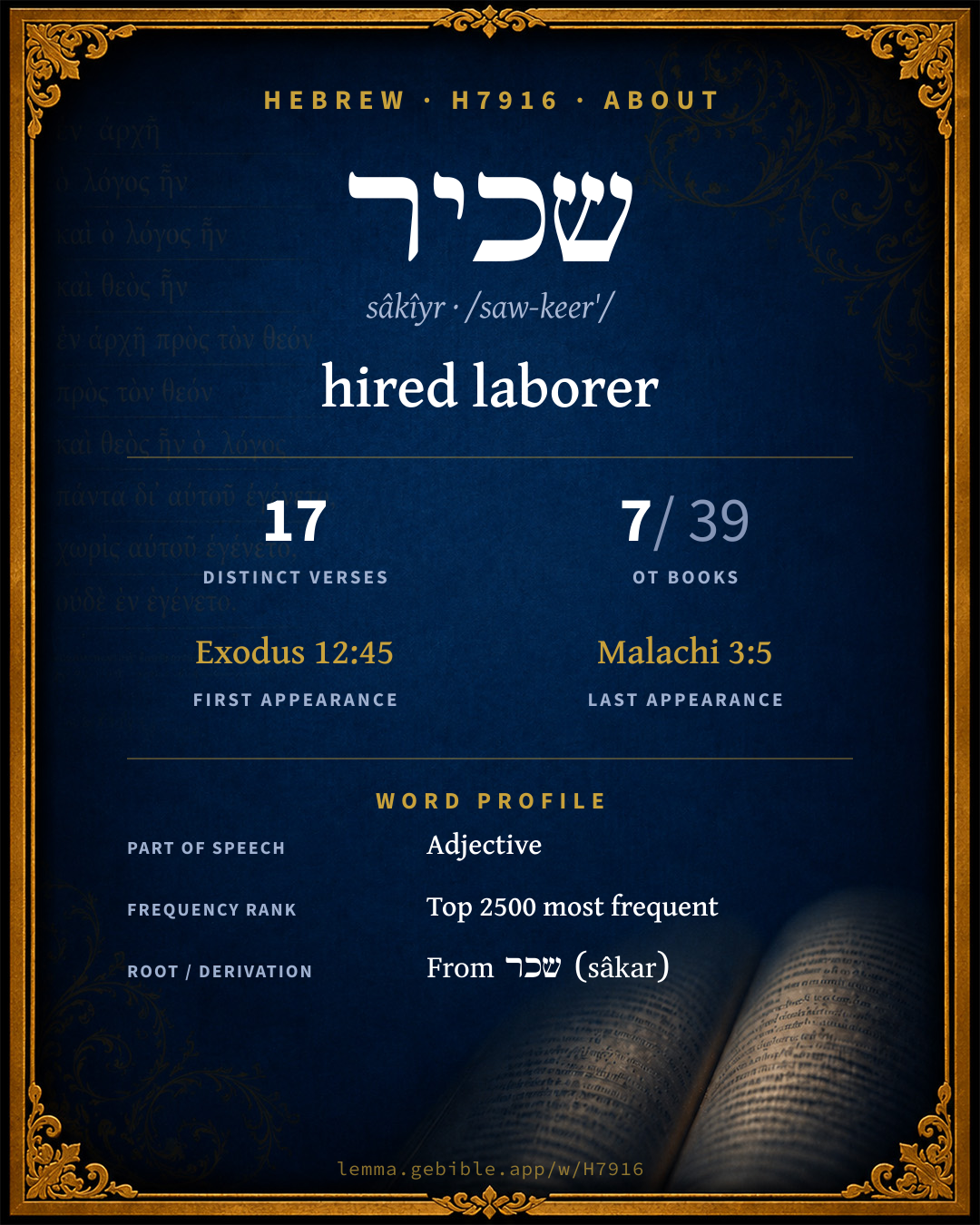
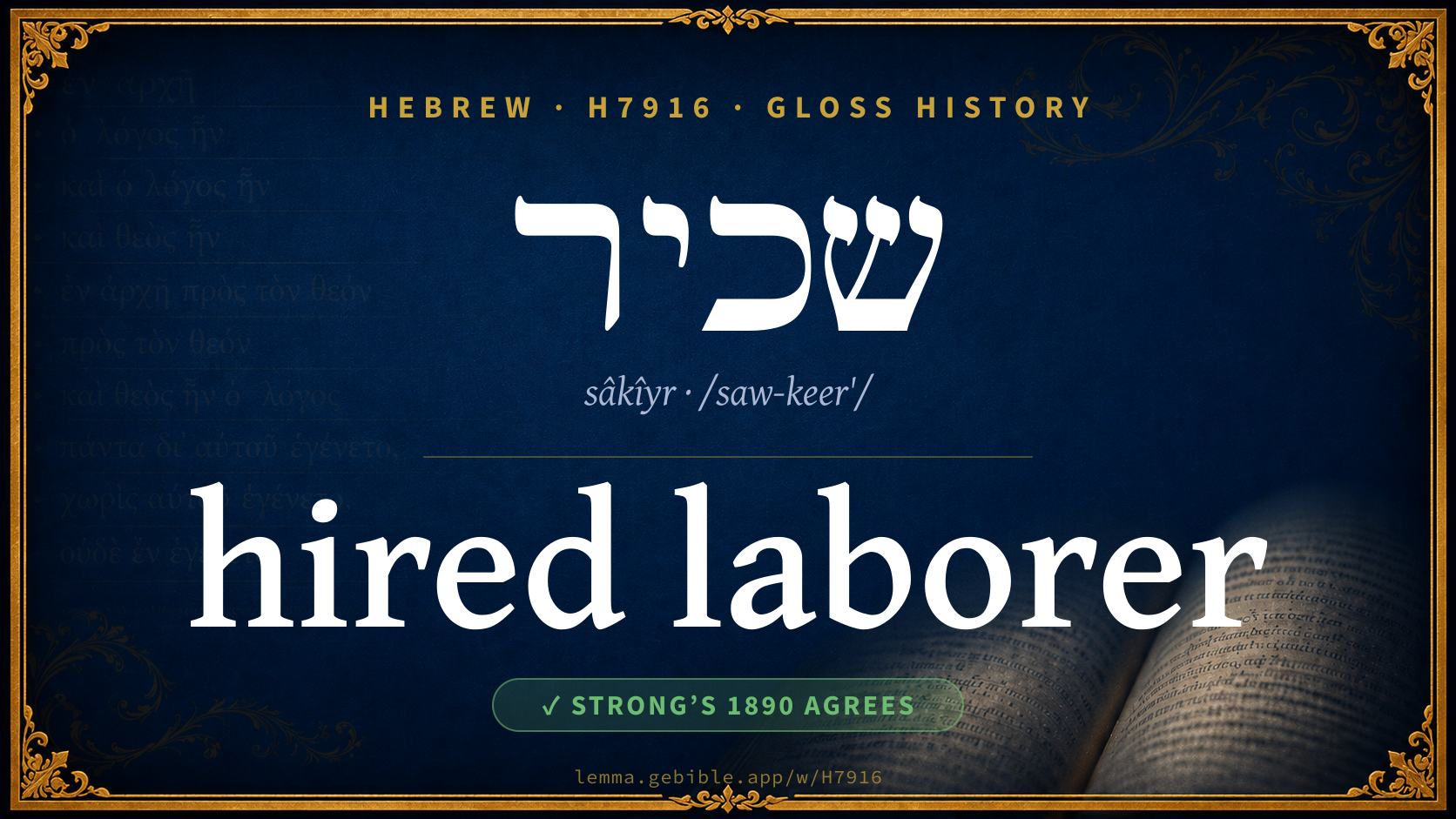
שָׂכִיר
hired laborer
‘hired laborer’ is one of 3 main senses fuller range ↓
Full lexicon entry — Brown-Driver-Briggs (BDB)
From Brown-Driver-Briggs (BDB)
Where this word appears
Grammar key — what these labels mean
Part of speech
- Adjective
- A word that describes or qualifies a noun.
Noun type
- Common
- A common noun — a general class of person, place, or thing (“king,” “city,” “water”), not a specific name.
State
- Absolute
- The independent form of a noun, not bound to a following word.
- Construct
- A noun bound to a following noun in a possessive / “of” relationship (the construct chain).
Gender
- Masculine
- Grammatically masculine.
Number
- Singular
- One.
- Plural
- More than one (in Hebrew, generally three or more).
Every verse where H7916 appears in the Book of Isaiah — 2 distinct verses. Click any verse to open its interlinear word-by-word view. Verse text shown in the World English Bible for context — . Each verse’s Hebrew form is shown with its reference; the English is not keyword-highlighted, since the data carries no word-level English alignment. Use “Compare translations” on any verse to read it across multiple English versions. This concordance covers the Hebrew Bible; Septuagint (Greek Old Testament) occurrences are not indexed here.
Isaiah
- Isaiah 16:14 שָׂכִ֔יר adj Adjective ms But now Yahweh has spoken, saying, Within three years, as the years of a hireling, the glory of Moab shall be brought into contempt, with all his great multitude; and the remnant shall be very small and of no account.
- Isaiah 21:16 שָׂכִ֔יר adj Adjective ms For thus has the Lord said to me, Within a year, according to the years of a hireling, all the glory of Kedar shall fail;
About this entry
At a glance — auto-summarized from this page’s data, not written by a person. Every figure links to its source below. This summary describes the numbers; it doesn’t interpret them.
At its core, שכיר (sâkîyr) means “hired laborer.” Older and newer Bibles part ways — “hired servant” in the King James Version, “hired hand” (Berean Standard Bible) in modern versions. See the renderings breakdown. It appears 17 verses across 7 books of the Hebrew Bible, among its uncommon vocabulary. The word gravitates to Leviticus (35%), then Job and Exodus. Not a single-sense word: explore its full sense range. For the data behind this summary, explore the sense tree and the renderings breakdown below.
Gloss history
Strong's 1890 vs modern scholarship
About this word
Strong's H7916 catalogs a Hebrew word from the Hebrew Old Testament.
These counts are not copied from any lexicon or concordance. They are computed here, from the morphology-tagged Hebrew Old Testament. What Lemma adds →
- 17
- distinct verses
- The word appears in 17 distinct verses.
- 7 / 39
- OT books
- The word appears in 7 of 39 Old Testament books.
- #1,671
- by frequency
- Top 2500 most frequent Hebrew words (rank 1,671 of 8,640 Hebrew words by occurrence).
View all 17 occurrences in the concordance →
By section of the Old Testament
By traditional corpus
Conventional, traditional groupings — biblical authorship is debated, so this is a traditional corpus grouping, not an authorship claim. Each share is this word’s portion of its verses in that division of the Hebrew canon. Each figure is a share of the word’s 17 distinct verses.
- Torah (Pentateuch) 10 verses · 59%
- Prophets (Nevi'im) 4 verses · 24%
- Writings (Ketuvim) 3 verses · 18%
How translations render this word
Counts come from each version’s own published word-to-Strong’s tagging or interlinear alignment — an approximate guide to how each version renders this word, not a word-level alignment the data otherwise carries. Because each total is that version’s own tagged count, the per-version totals vary from one another and need not match the appearance or distinct-verse counts above. These counts may also differ from a printed concordance because Lemma counts each distinctly tagged rendering and does not collapse phrase taggings into a single head-word total. This is a fixed set of word-tagged versions (KJV, ASV, BSB, ULT) and does not change with the reading translation you choose elsewhere. Each version’s license is shown beside its name below (and on Sources).
- King James Version: Hired servant 7×, Hireling 6×
- American Standard Version: Hireling 7×, Hired servant 4×
- Berean Standard Bible: Hired hand 5×, Hired worker 3×
- unfoldingWord Literal Text: Hired 3×, Hired worker 3×, Hired man 2×
King James Version Public Domain
Renders H7916 across 17 tagged occurrences — most commonly:
Plus 4 renderings that appear only once — usually multi-word phrases or single function words the recovered tagging swept in, not distinct renderings.
American Standard Version Public Domain
Renders H7916 across 17 tagged occurrences — most commonly:
Plus 6 renderings that appear only once — usually multi-word phrases or single function words the recovered tagging swept in, not distinct renderings.
Berean Standard Bible Public Domain
Renders H7916 across 17 tagged occurrences — most commonly:
Plus 9 renderings that appear only once — usually multi-word phrases or single function words the recovered tagging swept in, not distinct renderings.
unfoldingWord Literal Text CC BY-SA 4.0
Renders H7916 across 21 tagged occurrences — most commonly:
Plus 5 renderings that appear only once — usually multi-word phrases or single function words the recovered tagging swept in, not distinct renderings.
Senses in the full BDB
What do BDB’s symbols mean?
BDB uses these scholarly abbreviations:
| Symbol | Meaning |
|---|---|
| 𝔊 | the Septuagint (the ancient Greek translation, LXX) |
| 𝔙 | the Vulgate (the Latin translation) |
| 𝔖 | the Syriac version (the Peshitta) |
| 𝔗 | the Targum (the Aramaic translation) |
| ψ | the Psalms |
| √ | root (the underlying root or stem) |
| ‖ | parallel passage (a synonymous or contrasted parallel) |
| † | the dagger: every passage where the word occurs is cited |
The 2 senses and sub-senses the full Brown-Driver-Briggs lexicon distinguishes for this word, in lexicon order (not ranked by frequency), with BDB’s own verbatim wording and sub-sense lettering. Shown in Hebrew script with BDB’s own scholarly abbreviations. The condensed entry is in the Lexicon Entry tab. See also the Forms in the corpus table below.
- 1. hired, of beast Ex 22:14 (E), razor Is 7:20 (fig.). e.g. Exodus 22:14
- 2. usually as subst. hireling, hired labourer Dt 15:18; 24:14; Lv 19:13; 22:10; 25:6, 40, 53 (all H), Ex 12:45; Lv 25:50 (both P), Mal 3:5; Jb 7:1, 2; 14:6; כִּשְׁנֵי שׂ׳ Is 16:14 years like a hireling’s years (reckoned strictly), so 21:16; mercenaries Je 46:21. e.g. Deuteronomy 15:18
Senses from the full Brown-Driver-Briggs lexicon (Brown, Driver, Briggs; Oxford 1906 — public domain), digitized via Sefaria, supplemented by the OpenScriptures HebrewLexicon (CC BY 4.0). Full attribution on Sources.
Word origin
adj. hired;—abs. שׂ׳ Ex 12:45 +, f. שְׂכִירָה Is 7:20; cstr. שְׂכִיר Lv 25:53; sf. שְׂכִירְךָ v 6; pl. sf. שְׂכִרֶיהָ Je 46:21;—
— Brown-Driver-Briggs (Oxford 1906, public domain), digitized via Sefaria, supplemented by the OpenScriptures HebrewLexicon (CC BY 4.0). See Sources.
Derived from שכר (sâkar) (H7936) — to hire.
Jastrow Dictionary
A second Hebrew/Aramaic lexicon for comparison, covering Aramaic and post-biblical (Talmudic, Targumic, Midrashic) usage that the biblical-Hebrew BDB does not. Matched by lemma rather than by Strong’s number, so a lemma may carry more than one Jastrow headword (shown separately below), and the entries cover usage well beyond the Bible.
כִּיר
- , Pi. (כִּיֵּיד) כִּיֵּיר (denom. of כִּירָה II or of כַּד II) [to do the work of the stove-setter or of the potter (כַּיָּיר or כַּיָּיד, v. בִּרְכַּיָּיר),] to cement; to lay out with tiles, panels &c. [Ar. reads ר, editions mostly ד.] B. Kam. 51ᵃ bot. אחד … וסייד וכ׳ (Ms. F. וסייר וכייר) if one dug a pit ten handbreadths deep, and another came and lined it with plaster and cemented it; Mekh. Mishp., N’zik., s. 11. Ab. Zar. III, 7 (47ᵇ) סיידו וכִיְּירוֹ לאליל Mish. (Bab. ed. וכיידו לע"ז) he plastered the room and put tiles on (v. Sm. Ant. s. v. Abacus) designing it for idolatrous purposes. Ib. סיידה וכִיְּירָהּ וכ׳ (Ms. M. וציירה) if one plastered and stuccoed a stone (slab) for an idolatrous purpose. Gen. R. s. 28 סיידה וכיירה וציירה he plastered and panelled and painted the wedding chamber; Lam. R. to IV, 11 וכיידה. Tosef. Sot. VIII, 7 כִּיְּירוּהוּ וסיידוהו וכ׳ (Var. כִּיְּדוּהָ, כִּיְּרוּהָ) they panelled the stone and stuccoed it and wrote upon it. B. Bath. 60ᵇ אין מסיידין ואין מְכַיְּירִין וכ׳ we must not decorate our rooms with plaster, panels and paintings in these days (after the destruction of the Temple); Tosef. ib. II, 17.—Part. pass. מְכוּיָּיר, f. מְכוּיֶּירֶת. Ib.
שָׂכִיר
- hired man. Erub. 64ᵃ; Shebu. 46ᵇ שְׂכִירוֹ וכ׳, v. לָקִיט h. B. Mets. IX, 11 שְׂ׳ יום one hired for day work; ש׳ לילה for night work; ש׳ שעות by hours; ש׳ חדש by the month. Ib. 112ᵇ (in Chald. dict.) עקרוה … ושדיוה אַשָּׂ׳ the Rabbis took the oath from the employer, and put it on the hired man. Ib. ש׳ נמי … איתגר the hired man, too, hires himself out from necessity; a. fr.
A Dictionary of the Targumim, the Talmud Babli and Yerushalmi, and the Midrashic Literature (Marcus Jastrow; London, Luzac, 1903) — Public Domain. Digitized via Sefaria. Digitized via Sefaria. Full attribution on Sources.
Forms in the corpus
The 11 distinct written forms H7916 takes in the Hebrew Bible, most frequent first — each parse links to that state’s occurrences in the concordance. Hebrew forms include their vowel points and cantillation, so a single lemma takes many written forms.
| Form | Parsing | Example | Uses |
|---|---|---|---|
| שָׂכִ֔יר | Adjective, Adjective, Masculine, Singular, Absolute | Deuteronomy 15:18 | 3 |
| וְ/שָׂכִ֖יר | Adjective, Adjective, Masculine, Singular, Absolute | Exodus 12:45 | 2 |
| כְּ/שָׂכִ֥יר | Adjective, Adjective, Masculine, Singular, Absolute | Job 14:6 | 2 |
| שָׂכִ֖יר | Adjective, Adjective, Masculine, Singular, Absolute | Deuteronomy 24:14 | 2 |
| שָׂכִ֣יר | Adjective, Adjective, Masculine, Singular, Absolute | Exodus 22:15 | 2 |
| וְ/לִ/שְׂכִֽירְ/ךָ֙ | Adjective, Adjective, Masculine, Singular, Construct | Leviticus 25:6 | 1 |
| וּ֝/כְ/שָׂכִ֗יר | Noun, Common, Masculine, Singular, Absolute | Job 7:2 | 1 |
| כִּ/שְׂכִ֥יר | Adjective, Adjective, Masculine, Singular, Construct | Leviticus 25:53 | 1 |
| שְׂכִרֶ֤י/הָ | Adjective, Adjective, Masculine, Plural, Construct | Jeremiah 46:21 | 1 |
| שָׂ֠כִיר | Adjective, Adjective, Masculine, Singular, Absolute | Malachi 3:5 | 1 |
| שָׂכִ֛יר | Adjective, Adjective, Masculine, Singular, Absolute | Leviticus 19:13 | 1 |
Same root — word family
Other BDB entries built from the same root as H7916, grouped by Strong’s listed origin. These share a root / origin per the lexicon — not necessarily a shared meaning. Each links to that word’s own entry.
Derives from
Shares the same root
Derived from this word
Compare all same-root words → Showing 4 of 6 — not the complete family. They share a root, not necessarily a meaning.
Septuagint verse parallels
This word appears in 16 verses that also exist in the Greek Old Testament (Septuagint), out of the 17 Hebrew verses it occurs in. You can read those verses in Greek by switching the Old Testament edition to the Septuagint.
Read these verses in the Septuagint
This is a verse-level parallel only — the same verses exist in both the Hebrew and Greek Old Testaments. No word-level Hebrew↔Greek correspondence is claimed: the data carries no such alignment, so no Greek word is shown as this Hebrew word’s translation. Coverage is not total — the Septuagint omits the deuterocanon and renumbers the Psalms, so some Hebrew verses have no direct Greek parallel.