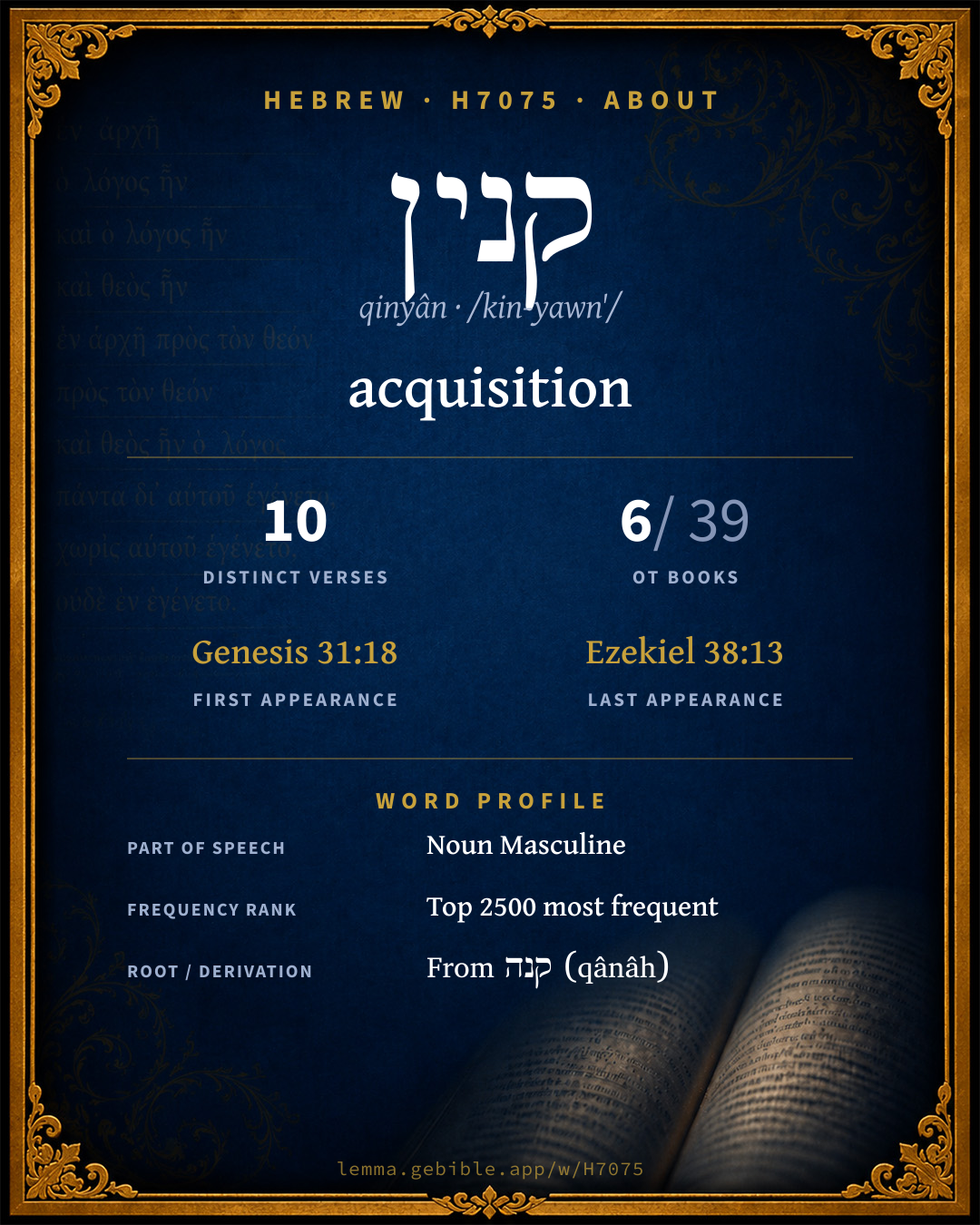
קִנְיָן
acquisition
also: thing acquired, possession, purchased property, wealth fuller range ↓
Full lexicon entry — Brown-Driver-Briggs (BDB)
From Brown-Driver-Briggs (BDB)
Where this word appears
Grammar key — what these labels mean
Part of speech
- Noun
- A naming word — a person, place, thing, or idea.
Noun type
- Common
- A common noun — a general class of person, place, or thing (“king,” “city,” “water”), not a specific name.
State
- Construct
- A noun bound to a following noun in a possessive / “of” relationship (the construct chain).
- Absolute
- The independent form of a noun, not bound to a following word.
Gender
- Masculine
- Grammatically masculine.
Number
- Singular
- One.
Every verse where H7075 appears in the Book of Leviticus — 1 distinct verse. Click any verse to open its interlinear word-by-word view. Verse text shown in the World English Bible for context — . Each verse’s Hebrew form is shown with its reference; the English is not keyword-highlighted, since the data carries no word-level English alignment. Use “Compare translations” on any verse to read it across multiple English versions. This concordance covers the Hebrew Bible; Septuagint (Greek Old Testament) occurrences are not indexed here.
Leviticus
About this entry
At a glance — auto-summarized from this page’s data, not written by a person. Every figure links to its source below. This summary describes the numbers; it doesn’t interpret them.
קנין (qinyân) is a Hebrew noun most often rendered “acquisition.” It first appears in Genesis 31:18. It turns up in 10 verses across 6 books, an uncommon footprint. It concentrates in Genesis, which alone accounts for 30% of its uses. It also covers “thing acquired”, “possession”, and “purchased property”, alongside “acquisition” — see its full sense range. For the data behind this summary, explore the sense tree and the renderings breakdown below.
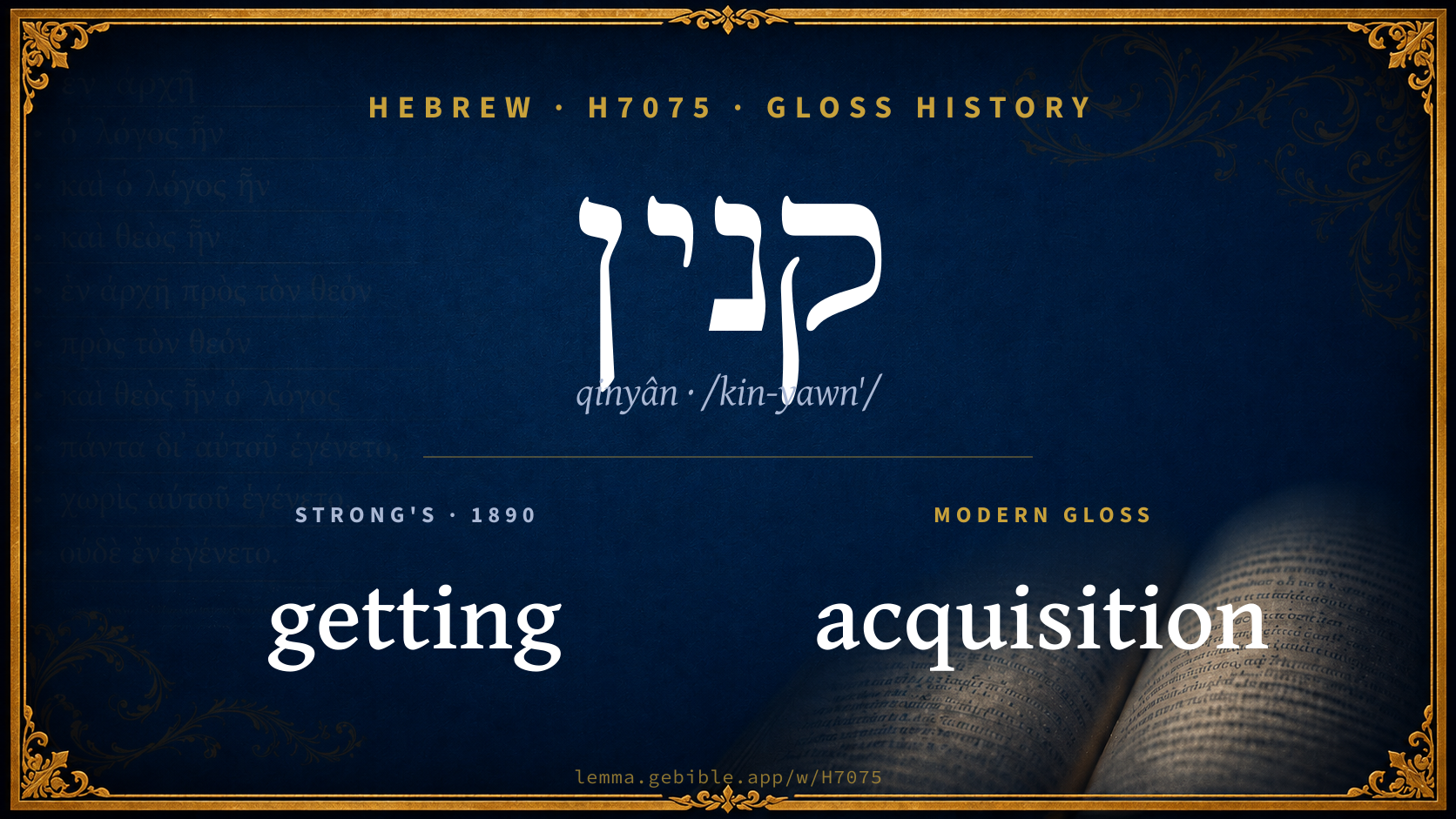
Gloss history
Strong's 1890 vs modern scholarship
About this word
Strong's H7075 catalogs a Hebrew word from the Hebrew Old Testament.
These counts are not copied from any lexicon or concordance. They are computed here, from the morphology-tagged Hebrew Old Testament. What Lemma adds →
- 10
- distinct verses
- The word appears in 10 distinct verses.
- 6 / 39
- OT books
- The word appears in 6 of 39 Old Testament books.
- #2,342
- by frequency
- Top 2500 most frequent Hebrew words (rank 2,342 of 8,640 Hebrew words by occurrence).
View all 10 occurrences in the concordance →
By section of the Old Testament
By traditional corpus
Conventional, traditional groupings — biblical authorship is debated, so this is a traditional corpus grouping, not an authorship claim. Each share is this word’s portion of its verses in that division of the Hebrew canon. Each figure is a share of the word’s 10 distinct verses.
- Torah (Pentateuch) 4 verses · 40%
- Prophets (Nevi'im) 3 verses · 30%
- Writings (Ketuvim) 3 verses · 30%
How translations render this word
Counts come from each version’s own published word-to-Strong’s tagging or interlinear alignment — an approximate guide to how each version renders this word, not a word-level alignment the data otherwise carries. Because each total is that version’s own tagged count, the per-version totals vary from one another and need not match the appearance or distinct-verse counts above. These counts may also differ from a printed concordance because Lemma counts each distinctly tagged rendering and does not collapse phrase taggings into a single head-word total. This is a fixed set of word-tagged versions (KJV, ASV, BSB, ULT) and does not change with the reading translation you choose elsewhere. Each version’s license is shown beside its name below (and on Sources).
- King James Version: All his substance 2×, Goods 2×, Substance 2×
- American Standard Version: Goods 2×, Substance 2×
- Berean Standard Bible: Possessions 2×
- unfoldingWord Literal Text: Property 4×
King James Version Public Domain
Renders H7075 across 10 tagged occurrences — most commonly:
Plus 4 renderings that appear only once — usually multi-word phrases or single function words the recovered tagging swept in, not distinct renderings.
American Standard Version Public Domain
Renders H7075 across 9 tagged occurrences — most commonly:
Plus 5 renderings that appear only once — usually multi-word phrases or single function words the recovered tagging swept in, not distinct renderings.
Berean Standard Bible Public Domain
Renders H7075 across 9 tagged occurrences — most commonly:
Plus 7 renderings that appear only once — usually multi-word phrases or single function words the recovered tagging swept in, not distinct renderings. Not rendered by a distinct English word in 1 further occurrence.
unfoldingWord Literal Text CC BY-SA 4.0
Renders H7075 across 10 tagged occurrences — most commonly:
Plus 6 renderings that appear only once — usually multi-word phrases or single function words the recovered tagging swept in, not distinct renderings.
Senses in the full BDB
What do BDB’s symbols mean?
BDB uses these scholarly abbreviations:
| Symbol | Meaning |
|---|---|
| 𝔊 | the Septuagint (the ancient Greek translation, LXX) |
| 𝔙 | the Vulgate (the Latin translation) |
| 𝔖 | the Syriac version (the Peshitta) |
| 𝔗 | the Targum (the Aramaic translation) |
| ψ | the Psalms |
| √ | root (the underlying root or stem) |
| ‖ | parallel passage (a synonymous or contrasted parallel) |
| † | the dagger: every passage where the word occurs is cited |
The 2 senses and sub-senses the full Brown-Driver-Briggs lexicon distinguishes for this word, in lexicon order (not ranked by frequency), with BDB’s own verbatim wording and sub-sense lettering. Shown in Hebrew script with BDB’s own scholarly abbreviations. The condensed entry is in the Lexicon Entry tab. See also the Forms in the corpus table below.
- 1. thing acquired by purchase קִנְיַן כֶּסֶף Lv 22:11 (H; cf. מִקְנָה); of property Gn 34:23; 36:6; Jos 14:4; (all P), Ez 38:12, 13 (in all disting, from מִקְנֶה cattle); ‖ בַּיִת ψ 105:21; מִקְנֵה קִנְיָנוֹ Gn 31:18 (P; prob. doublet, 𝔊 om.); בְּכָל־קִנְיָֽנְךָ קְנֵה בִינָה Pr 4:7 with (or at the price of) all that thou hast acquired, get understanding. e.g. Leviticus 22:11
- 2. more gen.: coll. creatures 𝔊 κτίσις ψ 104:24 (cf. √ 1 a). e.g. Psalms 104:24
Senses from the full Brown-Driver-Briggs lexicon (Brown, Driver, Briggs; Oxford 1906 — public domain), digitized via Sefaria, supplemented by the OpenScriptures HebrewLexicon (CC BY 4.0). Full attribution on Sources.
Word origin
n.[m.] thing got or acquired, acquisition (Aramaism, LagBN 205); abs. ק׳ Ez 38:12, 13; cstr. קִנְיַן Lv 22:11; sf. קִנְיָֽנְךָ Pr 4:7 +, etc.;—
— Brown-Driver-Briggs (Oxford 1906, public domain), digitized via Sefaria, supplemented by the OpenScriptures HebrewLexicon (CC BY 4.0). See Sources.
Derived from קנה (qânâh) (H7069) — to acquire.
Jastrow Dictionary
A second Hebrew/Aramaic lexicon for comparison, covering Aramaic and post-biblical (Talmudic, Targumic, Midrashic) usage that the biblical-Hebrew BDB does not. Matched by lemma rather than by Strong’s number, so a lemma may carry more than one Jastrow headword (shown separately below), and the entries cover usage well beyond the Bible.
קָנֶה
- calamus, reed; anything resembling a reed, branch of a candlestick; windpipe &c. Cant. R. to I, 6 (legend about the origin of Rome) ירד … ק׳ גדול וכ׳ Michael the archangel came down and planted a large reed in the sea &c. Taan. 20ᵃ לעולם … רך כק׳ וכ׳ man must at all times be yielding like a reed and not unbending like a cedar, v. קוֹלְמוֹס. Tosef. Sabb. XII (XIII), 14 ק׳ של מנורה the branch of a candlestick; Sabb. 47ᵃ קְנֵה מנורה; Y. ib. XII, 13ᶜ קְנֵי. Ib. ק׳ של ציידין a part of the composite pole which the hunters use (to reach the nests); Bab. l. c. קְ׳ סיידין of the whitewashers; Tosef. l. c. ציידין (Var. ס׳). Ker. 5ᵃ קְנֵה בשם sweet calamus. Kel. XVII, 16 קְ׳ מאזניים the beam of the balance. Ib. ק׳ של עני וכ׳ the poor man’s cane which has a receptacle for water.—דחה בק׳, v. דָּחָה.—Ber. 61ᵃ bot. ק׳ מוציא קול the windpipe produces sound. Ḥull. 21ᵇ; Zeb. 65ᵇ עד שמגיע … לק׳ until he reaches (with his nail) the gullet or the windpipe. Ḥull. 28ᵇ (in Chald. dict.) נבדקיה לק׳ וכ׳ let him examine the windpipe and cut it &c. Men. XI, 6 עשרים … כחצי ק׳ חלול twenty-eight staves shaped like a segment of a hollow reed; a. fr.—Ohol. I, 8 ק׳ = קְנֵה זרוע forearm.—קְנֵה שפה, v. קָמָה.—הושיט בק׳ [to hold forth on a cane,] to treat lightly, consider unimportant. Num. R. s. 8 end דבר … והושיטו לו בק׳ (not והושיטה) something for which that ancestor prostrated himself in prayer (Gen. XXVIII, 20) …, and now comes this man (Aquila) and holds it up to contempt!; Yalk. Gen. 123; Gen. R. s. 70. Ib. את מושיטו לזה בק׳ dost thou make it appear contemptible to this man?; Koh. R. to VII, 8.—Pl. קָנִים, קָנִין. Men. l. c. Ib. סידור ק׳ the arrangement of the staves between the cakes of the show-bread. Kel. XVII, 17, a. fr. מחצלת ק׳ a reed mat. Ex. R. s. 35 (ref. to Ps. LXVIII, 31) חיה הדרה בין הק׳ the beast that dwells among the reeds (Rome, v. Cant. R. to I, 6, quoted above). Gen. R. s. 1 עשיר … לק׳ he is a rich man and needs no reeds (for his house); הרי הוא צריך לקְנֵי המדה he still needs the measuring rods; a. fr. e.g. Genesis 28:20
קִנְיָן
- 1. purchase, ownership, right of possession. Gitt. 47ᵇ יש ק׳ לנכרי בא"י וכ׳ a gentile has the right of possession in Palestine inasmuch as his produces are exempt from tithes. Ib. קִנְיַן פירות כק׳ הגוף דמי the acquisition of usufruct is like the acquisition of the soil itself (and the Jewish owner of the usufruct has to offer the first fruits as if he were the owner of the land). Gitt. I, 6 מפני שהוא קִנְיָנוֹ (Y. ed. קִנְיָינוֹ) because he (the slave) is his property. Esth. R. introd. (ref. to Lev. XXV, 45) אתם יש לכם ק׳ וכ׳ you have the right of possession (of slaves) of the nations, but the nations have no right of possession of you, v. קָנָה; a. fr. e.g. Leviticus 25:45
- 2. property, esp. cattle. Num. R. s. 22 הפרישו … בשביל קִנְיָנָם they separated themselves from their brethren for the sake of their cattle; a. e.
- 3. affirmation, making sure; symbolical form of making an agreement binding, by handing over an object from one to the other of the contracting parties (v. קָנָה 2). B. Bath. 40ᵃ ק׳ בפני שנים ואינו … כתיבו an agreement by symbol is made in the presence of two (forming a court), nor is it then necessary to say, ‘write’, i.e. a document is made out without special authorization. Ib. סתם ק׳ לכתיבה עומד an agreement by symbol, unless otherwise stipulated, is intended to be written out. Ib. 3ᵃ ק׳ דברים בעלמא חוא it is merely an agreement on words (no transfer of a tangible object being agreed upon); a. fr.—Pl. קִנְיָנִים, קִנְיָנִין, קִנְיָי׳. Pes. 87ᵇ אחד מארבעה ק׳ שקניתי בעולמי one of the four possessions which I own in my world. Sifré Deut. 309 (ref. to Deut. XXXII, 6) ק׳ אתם לי וכ׳ (not זקנים) you are to me an acquired property, and not an inheritance. Ab. ch. VI; a. e. e.g. Deuteronomy 32:6
קִנְיָן ²
- 1. possession, esp. cattle. Targ. Gen. XIV, 11, sq. (h. text רכש). Targ. O. ib. 19; a. fr.—Sot. 34ᵇ עבדא רעיא ושמן ק׳ it (the soil) produces pasture, and the cattle grows fat on it.—Pl. קִנְיָנִין, קִנְיָי׳, קִי׳. Targ. Ez. XXXVIII, 12, sq.; a. e.
- 2. agreement by symbol, the object exchanged to make the agreement binding. Targ. Ruth. IV, 7, sq.
A Dictionary of the Targumim, the Talmud Babli and Yerushalmi, and the Midrashic Literature (Marcus Jastrow; London, Luzac, 1903) — Public Domain. Digitized via Sefaria. Digitized via Sefaria. Full attribution on Sources.
Forms in the corpus
The 8 distinct written forms H7075 takes in the Hebrew Bible, most frequent first — each parse links to that state’s occurrences in the concordance. Hebrew forms include their vowel points and cantillation, so a single lemma takes many written forms.
| Form | Parsing | Example | Uses |
|---|---|---|---|
| וְ/קִנְיָ֔ן | Noun, Common, Masculine, Singular, Absolute | Ezekiel 38:12 | 2 |
| קִנְיָנ֔/וֹ | Noun, Common, Masculine, Singular, Construct | Genesis 31:18 | 2 |
| וְ/קִנְיָנָ/ם֙ | Noun, Common, Masculine, Singular, Construct | Genesis 34:23 | 1 |
| וּ/לְ/קִנְיָנָֽ/ם | Noun, Common, Masculine, Singular, Construct | Joshua 14:4 | 1 |
| קִ֝נְיָנְ/ךָ֗ | Noun, Common, Masculine, Singular, Construct | Proverbs 4:7 | 1 |
| קִנְיַ֣ן | Noun, Common, Masculine, Singular, Construct | Leviticus 22:11 | 1 |
| קִנְיָנֶֽ/ךָ | Noun, Common, Masculine, Singular, Construct | Psalms 104:24 | 1 |
| קִנְיָנֽ/וֹ | Noun, Common, Masculine, Singular, Construct | Psalms 105:21 | 1 |
Same root — word family
Other BDB entries built from the same root as H7075, grouped by Strong’s listed origin. These share a root / origin per the lexicon — not necessarily a shared meaning. Each links to that word’s own entry.
Derives from
Shares the same root
Proper names from this root
People and places named from this root — a name, not an additional meaning of the word.
Compare all same-root words → Showing 4 of 6 — not the complete family. 1 of the same-root words is a proper name (a person or place). They share a root, not necessarily a meaning.
Septuagint verse parallels
This word appears in 9 verses that also exist in the Greek Old Testament (Septuagint), out of the 10 Hebrew verses it occurs in. You can read those verses in Greek by switching the Old Testament edition to the Septuagint.
Read these verses in the Septuagint
This is a verse-level parallel only — the same verses exist in both the Hebrew and Greek Old Testaments. No word-level Hebrew↔Greek correspondence is claimed: the data carries no such alignment, so no Greek word is shown as this Hebrew word’s translation. Coverage is not total — the Septuagint omits the deuterocanon and renumbers the Psalms, so some Hebrew verses have no direct Greek parallel.