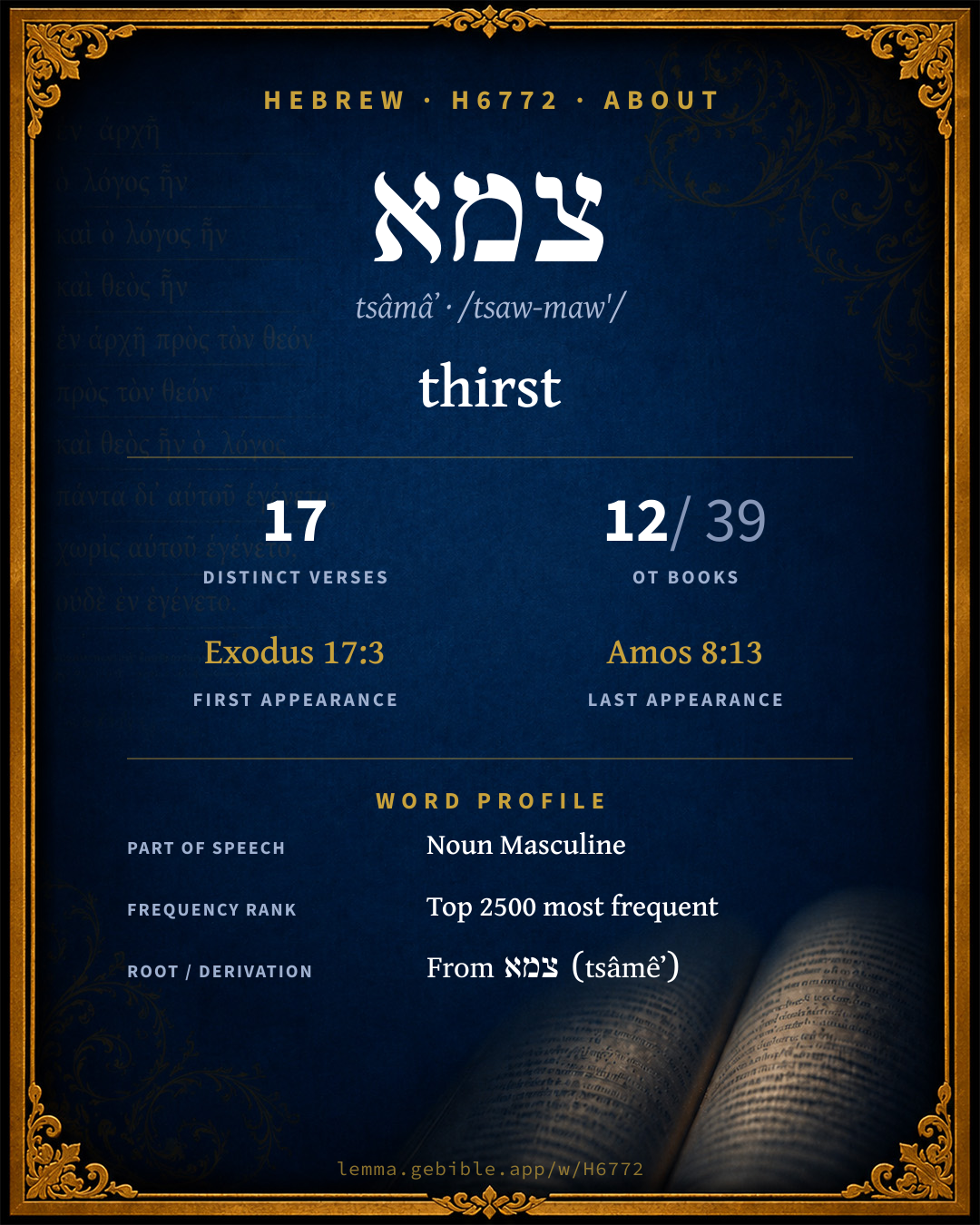
צָמָא
thirst
Full lexicon entry — Brown-Driver-Briggs (BDB)
From Brown-Driver-Briggs (BDB)
Where this word appears
See every Absolute-state word in the Hebrew Bible →
Grammar key — what these labels mean
Part of speech
- Noun
- A naming word — a person, place, thing, or idea.
Noun type
- Common
- A common noun — a general class of person, place, or thing (“king,” “city,” “water”), not a specific name.
State
- Absolute
- The independent form of a noun, not bound to a following word.
- Construct
- A noun bound to a following noun in a possessive / “of” relationship (the construct chain).
Gender
- Masculine
- Grammatically masculine.
Number
- Singular
- One.
13 distinct verses where H6772 appears in the Absolute state, across 10 books. Filtered view — show all forms. Click any verse to open its interlinear word-by-word view. Verse text shown in the World English Bible for context — . Each verse’s Hebrew form is shown with its reference; the English is not keyword-highlighted, since the data carries no word-level English alignment. Use “Compare translations” on any verse to read it across multiple English versions. This concordance covers the Hebrew Bible; Septuagint (Greek Old Testament) occurrences are not indexed here.
Exodus 1 verse
Deuteronomy 1 verse
Judges 1 verse
2 Chronicles 1 verse
Isaiah 3 verses
- Isaiah 5:13 צָמָֽא n c ms Therefore my people go into captivity for lack of knowledge; Their honorable men are famished, And their multitudes are parched with thirst.
- Isaiah 41:17 בַּ/צָּמָ֣א prep det + n c ms The poor and needy seek water, and there is none, and their tongue fails for thirst; I, Yahweh, will answer them, I, the God of Israel, will not forsake them.
- Isaiah 50:2 בַּ/צָּמָֽא prep det + n c ms Why, when I came, was there no man? when I called, was there none to answer? Is my hand shortened at all, that it can't redeem? or have I no power to deliver? Behold, at my rebuke I dry up the sea, I make the rivers a wilderness: their fish stink, because there is no water, and die for thirst.
Jeremiah 1 verse
Lamentations 1 verse
Ezekiel 1 verse
Hosea 1 verse
Amos 2 verses
- Amos 8:11 צָמָ֣א n c ms Behold, the days come," says the Lord Yahweh, "That I will send a famine in the land, Not a famine of bread, Nor a thirst for water, But of hearing the words of Yahweh.
- Amos 8:13 בַּ/צָּמָֽא prep det + n c ms In that day the beautiful virgins And the young men will faint for thirst.
About this entry
At a glance — auto-summarized from this page’s data, not written by a person. Every figure links to its source below. This summary describes the numbers; it doesn’t interpret them.
At its core, צמא (tsâmâʼ) means “thirst.” Scripture first uses it in Exodus 17:3. Spanning 17 verses in 12 books, it ranks among the uncommon words of the Hebrew Bible. From the same root come צמא, צמא and צמאה. Each statement above links to its evidence; the full detail follows below.
Gloss history
Strong's 1890 vs modern scholarship
About this word
Strong's H6772 catalogs a Hebrew word from the Hebrew Old Testament.
These counts are not copied from any lexicon or concordance. They are computed here, from the morphology-tagged Hebrew Old Testament. What Lemma adds →
- 17
- distinct verses
- The word appears in 17 distinct verses.
- 12 / 39
- OT books
- The word appears in 12 of 39 Old Testament books.
- #1,671
- by frequency
- Top 2500 most frequent Hebrew words (rank 1,671 of 8,640 Hebrew words by occurrence).
View all 17 occurrences in the concordance →
By section of the Old Testament
By traditional corpus
Conventional, traditional groupings — biblical authorship is debated, so this is a traditional corpus grouping, not an authorship claim. Each share is this word’s portion of its verses in that division of the Hebrew canon. Each figure is a share of the word’s 17 distinct verses.
- Prophets (Nevi'im) 9 verses · 53%
- Writings (Ketuvim) 6 verses · 35%
- Torah (Pentateuch) 2 verses · 12%
How translations render this word
Counts come from each version’s own published word-to-Strong’s tagging or interlinear alignment — an approximate guide to how each version renders this word, not a word-level alignment the data otherwise carries. Because each total is that version’s own tagged count, the per-version totals vary from one another and need not match the appearance or distinct-verse counts above. These counts may also differ from a printed concordance because Lemma counts each distinctly tagged rendering and does not collapse phrase taggings into a single head-word total. This is a fixed set of word-tagged versions (KJV, ASV, BSB, ULT) and does not change with the reading translation you choose elsewhere. Each version’s license is shown beside its name below (and on Sources).
- King James Version: Thirst 16×
- American Standard Version: Thirst 15×
- Berean Standard Bible: Thirst 13×
- unfoldingWord Literal Text: Thirst 16×
King James Version Public Domain
Renders H6772 across 17 tagged occurrences — most commonly:
Plus 1 rendering that appears only once — usually multi-word phrases or single function words the recovered tagging swept in, not distinct renderings.
American Standard Version Public Domain
Renders H6772 across 17 tagged occurrences — most commonly:
Plus 2 renderings that appear only once — usually multi-word phrases or single function words the recovered tagging swept in, not distinct renderings.
Berean Standard Bible Public Domain
Renders H6772 across 17 tagged occurrences — most commonly:
Plus 4 renderings that appear only once — usually multi-word phrases or single function words the recovered tagging swept in, not distinct renderings.
unfoldingWord Literal Text CC BY-SA 4.0
Renders H6772 across 18 tagged occurrences — most commonly:
Plus 2 renderings that appear only once — usually multi-word phrases or single function words the recovered tagging swept in, not distinct renderings.
Senses in BDB
The 1 sense BDB distinguishes for this word, in lexicon order (not ranked by frequency or importance). The full entry — with sub-senses — is in the Lexicon Entry tab.
- thirst
Word origin
n.[m.] thirst;—abs. צ׳ Ex 17:3 +, sf. צְמָאִי ψ 69:22, etc.;—Ex 17:3 (E), Ju 15:18; Ho 2:5; Am 8:13; La 4:4; Ne 9:20 ψ 69:22; ‖ רָעָב Is 5:13 (van d. H. צָמָה), Dt 28:48; Ne 9:15; 2 Ch 32:11; of wild asses ψ 104:11, of fish וְתָמֹת בַּצּ׳ Is 50:2, but read perhaps (or בַּצְּמֵאָה) וּבְהֶמְתָּם בַּצָּמֵא GunkSchöpf. 98 CheHpt. Marti (cf. Is 44:3 sub foll.); fig. of grief of exile Is 41:17, cf. אֶרֶץ צִיָּה וְצָמָא Ez 19:13; c. ל, thirst for water Am 8:11.—בַּצּ׳ Je 48:18 is prob. corrupt; read perhaps לַאַרֶץ (Gie), or בֶּעָפָר.
— Brown-Driver-Briggs (Oxford 1906, public domain), digitized via Sefaria, supplemented by the OpenScriptures HebrewLexicon (CC BY 4.0). See Sources.
Derived from צמא (tsâmêʼ) (H6770) — to be thirsty.
Jastrow Dictionary
A second Hebrew/Aramaic lexicon for comparison, covering Aramaic and post-biblical (Talmudic, Targumic, Midrashic) usage that the biblical-Hebrew BDB does not. Matched by lemma rather than by Strong’s number, so a lemma may carry more than one Jastrow headword (shown separately below), and the entries cover usage well beyond the Bible.
צָמֵא I
- (b. h.) [shrunk,] parched, thirsty. Taan. 22ᵇ לא שכורה ולא צ׳ that the ground be neither drunk (oversated) nor thirsty; a. e.—Pl. צְמֵאִים, צְמֵאִין; צְמֵאוֹת. Midr. Till. to Ps. CXVIII, 19 משקה צ׳ הייתי I used to give drink to the thirsty; והם אומרים לו זה השער לה׳ משקה צ׳ הכנס בו ed. Bub. and they (in heaven) say to him, ‘this is the gate of the Lord’, thou, who hast been a giver of drink to the thirsty, enter thereby. Midr. Till. to Ps. XXII וכשצ׳ כל החיות וכ׳ and when they are thirsty, all the beasts gather around her (the hind) &c.; a. e.
צָמֵא II
- preced.) to be thirsty.
- to cause to perish from thirst. Sifré Deut. 199 (ref. to Deut. XX, 10 להלחם עליה … ולא להַצְמִיאָהּ וכ׳ ‘to wage war against it’, but not to let it perish from famine or thirst, or cause it to die from pestilence; a. e. e.g. Deuteronomy 20:10
צָמָא
- preced.) thirst. Ex. R. s. 2 (Moses said to the lamb) לא … מפני צ׳ וכ׳ I did not know that thou didst run off on account of thirst; thou must be tired &c. Ber. VI, 8 השותה מים לִצְמָאוֹ he who drinks water to satisfy his thirst. Pirké d’R. El. ch. XXX מיתת הצ׳ death from thirst; a. e.
A Dictionary of the Targumim, the Talmud Babli and Yerushalmi, and the Midrashic Literature (Marcus Jastrow; London, Luzac, 1903) — Public Domain. Digitized via Sefaria. Digitized via Sefaria. Full attribution on Sources.
Forms in the corpus
The 14 distinct written forms H6772 takes in the Hebrew Bible, most frequent first — each parse links to that state’s occurrences in the concordance. Hebrew forms include their vowel points and cantillation, so a single lemma takes many written forms.
Same root — word family
Other BDB entries built from the same root as H6772, grouped by Strong’s listed origin. These share a root / origin per the lexicon — not necessarily a shared meaning. Each links to that word’s own entry.
Derives from
Shares the same root
Derived from this word
Compare all same-root words → They share a root, not necessarily a meaning.
Septuagint verse parallels
This word appears in 14 verses that also exist in the Greek Old Testament (Septuagint), out of the 17 Hebrew verses it occurs in. You can read those verses in Greek by switching the Old Testament edition to the Septuagint.
Read these verses in the Septuagint
- Exodus 17:3
- Deuteronomy 28:48
- Judges 15:18
- 2 Chronicles 32:11
- Psalms 104:11
- Isaiah 5:13
- Jeremiah 48:18
- Lamentations 4:4
- Ezekiel 19:13
- Hosea 2:3
- Amos 8:11
This is a verse-level parallel only — the same verses exist in both the Hebrew and Greek Old Testaments. No word-level Hebrew↔Greek correspondence is claimed: the data carries no such alignment, so no Greek word is shown as this Hebrew word’s translation. Coverage is not total — the Septuagint omits the deuterocanon and renumbers the Psalms, so some Hebrew verses have no direct Greek parallel.