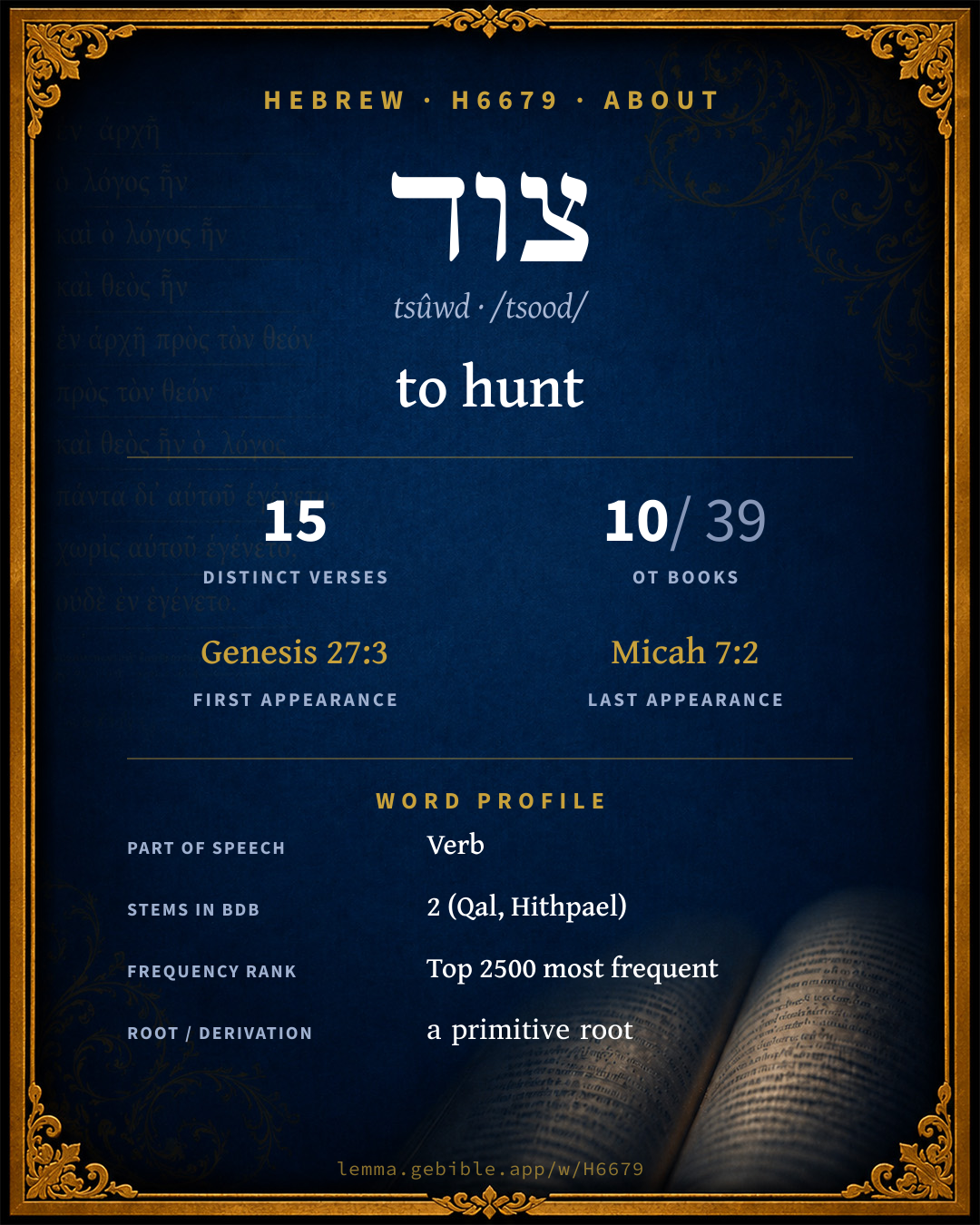
צוּד
to hunt
‘to hunt’ is one of 4 main senses fuller range ↓
Full lexicon entry — Brown-Driver-Briggs (BDB)
From Brown-Driver-Briggs (BDB)
Where this word appears
Grammar key — what these labels mean
Part of speech
- Verb
- An action or state-of-being word.
Stem
- Polel
- A stem of hollow/geminate roots functioning like the Piel — intensive active.
- Qal
- The basic, simple active stem — the plain form of the verb (“he wrote”).
- Hithpael
- The reflexive or reciprocal stem (the subject acts on itself). Here: ‘supply oneself with provisions’
Form
- Participle Active
- A verbal adjective expressing ongoing or characteristic action (“writing / one who writes”).
- Sequential Perfect
- A perfect with prefixed waw continuing a preceding imperfect or command (waw-consecutive perfect).
- Imperative
- A direct command (“write!”).
- Infinitive Construct
- A bound verbal noun, frequently with prepositions (“to write / in writing”).
- Imperfect
- An incomplete, ongoing, or future action (“he will / would write”).
- Infinitive Absolute
- An unbound verbal noun, often intensifying or standing in for a finite verb.
- Jussive
- A third- or second-person volitional form expressing wish or command (“let him write”).
- Perfect
- A completed action or state — Hebrew marks aspect (completeness) more than strict tense (“he wrote”).
State
- Absolute
- The independent form of a noun, not bound to a following word.
Person
- 3rd Person
- The one spoken about (“he / she / it / they”).
- 2nd Person
- The one addressed (“you”).
- 1st Person
- The speaker (“I / we”).
Gender
- Feminine
- Grammatically feminine.
- Common
- Either gender — not distinguished for this form.
- Masculine
- Grammatically masculine.
Number
- Plural
- More than one (in Hebrew, generally three or more).
- Singular
- One.
Every verse where H6679 appears in the Book of Proverbs — 1 distinct verse. Click any verse to open its interlinear word-by-word view. Verse text shown in the World English Bible for context — . Each verse’s Hebrew form is shown with its reference; the English is not keyword-highlighted, since the data carries no word-level English alignment. Use “Compare translations” on any verse to read it across multiple English versions. This concordance covers the Hebrew Bible; Septuagint (Greek Old Testament) occurrences are not indexed here.
Proverbs
About this entry
At a glance — auto-summarized from this page’s data, not written by a person. Every figure links to its source below. This summary describes the numbers; it doesn’t interpret them.
צוד (tsûwd) is a Hebrew verb most often rendered “to hunt.” It first appears in Genesis 27:3. With 15 verses in 10 books, it is an uncommon word in the Hebrew Bible. The verb spans 2 stems, from Qal to Hithpael. It clusters with מצד, מצוד and ציד under a shared root. For the data behind this summary, explore the sense tree and the renderings breakdown below.
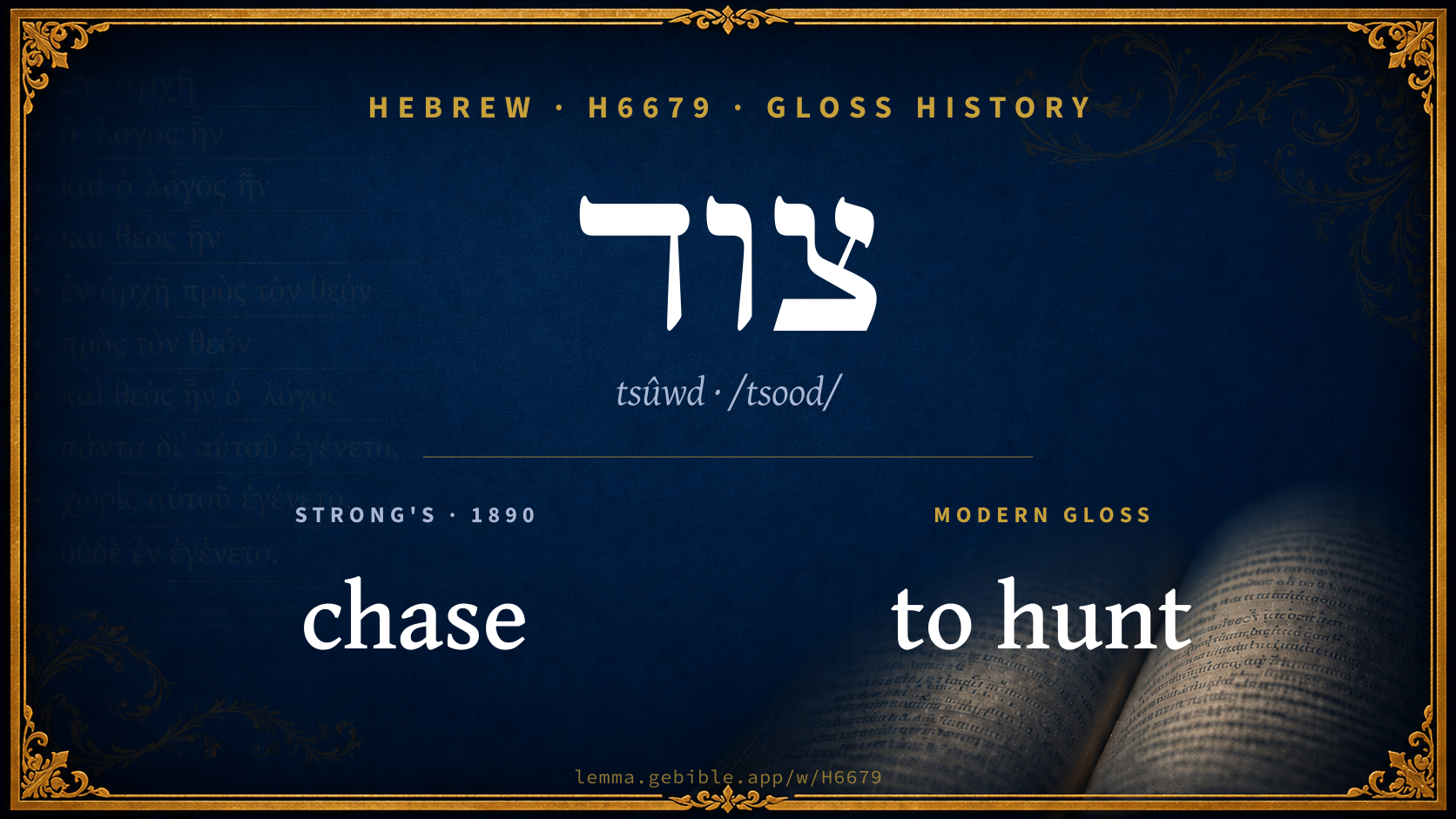
Gloss history
Strong's 1890 vs modern scholarship
About this word
Strong's H6679 catalogs a Hebrew word from the Hebrew Old Testament.
These counts are not copied from any lexicon or concordance. They are computed here, from the morphology-tagged Hebrew Old Testament. What Lemma adds →
- 15
- distinct verses
- The word appears in 15 distinct verses.
- 10 / 39
- OT books
- The word appears in 10 of 39 Old Testament books.
- #1,612
- by frequency
- Top 2500 most frequent Hebrew words (rank 1,612 of 8,640 Hebrew words by occurrence).
View all 15 occurrences in the concordance →
Most concentrated in
- Genesis 3 verses 20%
- Job 2 verses 13%
- Lamentations 2 verses 13%
By section of the Old Testament
By traditional corpus
Conventional, traditional groupings — biblical authorship is debated, so this is a traditional corpus grouping, not an authorship claim. Each share is this word’s portion of its verses in that division of the Hebrew canon. Each figure is a share of the word’s 15 distinct verses.
- Writings (Ketuvim) 6 verses · 40%
- Prophets (Nevi'im) 5 verses · 33%
- Torah (Pentateuch) 4 verses · 27%
How translations render this word
Counts come from each version’s own published word-to-Strong’s tagging or interlinear alignment — an approximate guide to how each version renders this word, not a word-level alignment the data otherwise carries. Because each total is that version’s own tagged count, the per-version totals vary from one another and need not match the appearance or distinct-verse counts above. These counts may also differ from a printed concordance because Lemma counts each distinctly tagged rendering and does not collapse phrase taggings into a single head-word total. This is a fixed set of word-tagged versions (KJV, ASV, BSB, ULT) and does not change with the reading translation you choose elsewhere. Each version’s license is shown beside its name below (and on Sources).
BDB lists this Strong’s number as 2 distinct words (homographs). Each count above pools all of them and is not split by sense — see the Senses section below. A low-frequency rendering may belong to a different one of those words, not the primary meaning.
- King James Version†: Hunt 3×, They hunt 2×
- American Standard Version†: Hunt 3×, They hunt 2×
- Berean Standard Bible†: Hunt 2×
- unfoldingWord Literal Text†: Hunt 2×, Hunts 2×
King James Version Public Domain
Renders H6679 across 18† tagged occurrences — most commonly:
Plus 13 renderings that appear only once — usually multi-word phrases or single function words the recovered tagging swept in, not distinct renderings.
American Standard Version Public Domain
Renders H6679 across 18† tagged occurrences — most commonly:
Plus 13 renderings that appear only once — usually multi-word phrases or single function words the recovered tagging swept in, not distinct renderings.
Berean Standard Bible Public Domain
Renders H6679 across 17† tagged occurrences — most commonly:
Plus 15 renderings that appear only once — usually multi-word phrases or single function words the recovered tagging swept in, not distinct renderings. Not rendered by a distinct English word in 1 further occurrence.
unfoldingWord Literal Text CC BY-SA 4.0
Renders H6679 across 19† tagged occurrences — most commonly:
Plus 15 renderings that appear only once — usually multi-word phrases or single function words the recovered tagging swept in, not distinct renderings.
Senses in the full BDB
Hebrew verbs can shift meaning by stem (binyan): Qal is the basic action, Niphal is often passive or reflexive, Piel often intensifies or makes it factitive, and Hiphil is typically causative. The senses below are grouped under the stem BDB assigns to each. This entry also uses Hithpael (reflexive or reciprocal).
What do BDB’s symbols mean?
BDB uses these scholarly abbreviations:
| Symbol | Meaning |
|---|---|
| 𝔊 | the Septuagint (the ancient Greek translation, LXX) |
| 𝔙 | the Vulgate (the Latin translation) |
| 𝔖 | the Syriac version (the Peshitta) |
| 𝔗 | the Targum (the Aramaic translation) |
| ψ | the Psalms |
| √ | root (the underlying root or stem) |
| ‖ | parallel passage (a synonymous or contrasted parallel) |
| † | the dagger: every passage where the word occurs is cited |
The 2 senses and sub-senses the full Brown-Driver-Briggs lexicon distinguishes for this word, in lexicon order (not ranked by frequency), with BDB’s own verbatim wording and sub-sense lettering. Shown in Hebrew script with BDB’s own scholarly abbreviations. The condensed entry is in the Lexicon Entry tab. See also the Forms in the corpus table below.
צוד I hunt (NH id. (rare), מְצוּדָה = BH Assyrian ṣâdu, hunt, so Arabic (صيد), صَادَ, Aramaic צוּד, צִיד, ((ܨܘܕ) ܨܳܕ) Old Aramaic צידא hunting)
Qal
- Pf. 3 pl. צָד֣וּ La 4:18; sf. צָדוּנִי 3:52, וְצָדוּם consec. Je 16:16; Impf. 3 ms. יָצוּד Lv 17:13, etc.; Imv. ms. צוּ֫דָה Gn 27:3; Inf. abs. צוֹד La 3:52; cstr. לָצוּד Gn 27:5; Pt. הַצָּד v 33;—hunt, c. acc. i. צַיִד Gn 27:3 Qr (> Kt צידה), v 5, 33 (all J), צֵיד חַיָּה Lv 17:13 (H); טֶרֶף Jb 38:39; c. acc. pers. Mi 7:2 (+ חֵרֶם, instr.), Je 16:16 (+ מֵעַל), Jb 10:16, צוֹד צָדוּנִי כַצִּפּוֹר La 3:52, subj. evil ψ 140:12; c. acc. צְעָדֵינוּ La 4:18, נֶפֶשׁ יְקָרָה Pr 6:26.—Ho 9:13 read prob. לָצוּד (or לָצַיִד), for MT לְצוֹר, v. צֹר. Pōʿl. hunt (Keenly, eagerly?), Impf. 2 fpl. תְּצוֹדֵדְנָה Ez 13:18; Inf. cstr. לְצוֹדֵד v 18; Pt. fpl. מְצֹדְדוֹת v 20(×2), all c. acc. נְפָשׁוֹת (of magic arts, necromancy, etc.). e.g. Lamentations 4:18
צוד II denom.
Hithpael
- supply oneself with provisions, take as one’s provision;—Pf. 1 pl. הִצְטַיַּדְנוּ Jos 9:12 this bread we took as our provision; Impf. 3 mpl. וַיִּצְטַיָּ֑דוּ v 4 (so read for MT וַיִּצְטַיָּ֑רוּ, Codd Vrss Thes al.), abs. e.g. Joshua 9:12
Senses from the full Brown-Driver-Briggs lexicon (Brown, Driver, Briggs; Oxford 1906 — public domain), digitized via Sefaria, supplemented by the OpenScriptures HebrewLexicon (CC BY 4.0). Full attribution on Sources.
Word origin
vb. hunt (NH id. (rare), מְצוּדָה = BH Assyrian ṣâdu, hunt, so Arabic (صيد), صَادَ, Aramaic צוּד, צִיד, ((ܨܘܕ) ܨܳܕ) Old Aramaic צידא hunting);—
— Brown-Driver-Briggs (Oxford 1906, public domain), digitized via Sefaria, supplemented by the OpenScriptures HebrewLexicon (CC BY 4.0). See Sources.
Origin: a primitive root
Jastrow Dictionary
A second Hebrew/Aramaic lexicon for comparison, covering Aramaic and post-biblical (Talmudic, Targumic, Midrashic) usage that the biblical-Hebrew BDB does not. Matched by lemma rather than by Strong’s number, so a lemma may carry more than one Jastrow headword (shown separately below), and the entries cover usage well beyond the Bible.
צוּד
- v. צָדָה) to lie in wait, hunt, catch. Gen. R. s. 66 (ref. to Gen. XXVII, 30) מזויין לָצוּד נפשות (not נפשו) armed to hunt lives (to kill, with ref. to Ex. XXI, 13, a. I Sam. XXIV, 12; v. ‘Rashi’ a. l.). Gen. R. s. 67 היה עשו צָד וכ׳ Esau caught deer and tied them. Ib. s. 63 (ref. to Gen. XXV, 27 sq.) צד את הבריות בפיו he (Esau-Rome) catches men with his mouth (by means of insidious cross-examination in court); ib. s. 37 צד … בפיהם catches people through their own mouth. Deut. R. s. 1 בשעה שיצא לצוד when he went hunting. Sot. 4ᵇ (ref. to Prov. VI, 26) היא תְצוּדֶנּוּ לדינה וכ׳ she will chase him to the judgment of Gehenna. Sabb. XIII, 5 הצד צפור למגדל וכ׳ he who chases a bird into the tower or a deer into the house. Ib. XIV, 1 הצָדָן he who catches them (on the Sabbath). Gen. R. s. 63 (ref. to Gen. l. c.) צידני צד בבית צד וכ׳ a hunter, catching (captivating Isaac’s good opinion) in the house, catching in the field, in the house (by asking), how are tithes given of salt &c.?; a. fr. e.g. Genesis 27:30
- to be hunted, caught. Sabb. 106ᵇ כל שבמינו נ׳ an animal which belongs to those that are hunted. Bets. III, 2 יודע שנָצוֹדוּ וכ׳ he knows that they have been caught on the eve of the festival. Sabb. I, 6 כדי שיִצּוֹדוּ וכ׳ in time to be caught in the net before the Sabbath begins; a. fr.
צוּד ²
- Targ. Gen. XXVII, 3; 5; 33; a. fr.—Part. צָיֵיד, צָאֵיד, צָאֵד; f. צָיְידָא, צָיְדָא &c. Targ. Prov. VI, 26 (Ms. צדיא, v. צְדֵי I). Ib. XXIII, 28 צָאִידָא בניא וכ׳ ed. Lag. (ed. צאר אבנא, corr. acc.) she catches thoughtless youths. Ib. II, 19 צָיְדִין (some ed. ציירין, corr. acc.; h. text ישיגו); a. fr.—Y. Sabb. VII, 10ᵃ דצָיֵיד, v. כַּוְורָא. B. Mets. 85ᵇ וצָיִידְנָא טבי; Keth. 103ᵇ וצָיִדְנָא (Rashi וצדיינא), v. טַבְיָא. Gen. R. s. 67 ציידא היך צָדוּךְ how they caught thee, O hunter! Y. B. Bath. X, end, 17ᵈ בר נש דהוה צייד לחבריה וכ׳ if a man catches his neighbor in the street (for a debt), and one comes and says, let him go &c. Ib. VIII, 16ᵇ top לא צייד כלום he catches (obtains) nothing. M. Kat. 11ᵃ אזיל … צוּד all went out and fished; a. fr.
- to be caught. Targ. Prov. VI, 2. Ib. III, 26.—Lev. R. s. 30 אתציד התוא וכ׳ (ed. Wil. אצתייד, oth. ed. אתצייד), v. לִיסְטָאָה. Y. Yeb. XVI, beg. 15ᶜ; Y. Sot. IX, 23ᶜ bot. ואִתְצִידוּן וכ׳, v. בִּידָּא; a. fr.
- same. Gen. R. s. 79 הוות מִתַּצְּדָה וכ׳ it (the bird) was caught and captured, v. סְפִיקוּלָא I; a. e.
A Dictionary of the Targumim, the Talmud Babli and Yerushalmi, and the Midrashic Literature (Marcus Jastrow; London, Luzac, 1903) — Public Domain. Digitized via Sefaria. Digitized via Sefaria. Full attribution on Sources.
Forms in the corpus
The 18 distinct written forms H6679 takes in the Hebrew Bible, most frequent first — each parse links to that stem’s occurrences in the concordance. Hebrew forms include their vowel points and cantillation, so a single lemma takes many written forms.
Same root — word family
Other BDB entries built from the same root as H6679, grouped by Strong’s listed origin. These share a root / origin per the lexicon — not necessarily a shared meaning. Each links to that word’s own entry.
Derived from this word
Proper names from this root
People and places named from this root — a name, not an additional meaning of the word.
Compare all same-root words → Showing 4 of 5 — not the complete family. 1 of the same-root words is a proper name (a person or place). They share a root, not necessarily a meaning.
Septuagint verse parallels
This word appears in 14 verses that also exist in the Greek Old Testament (Septuagint), out of the 15 Hebrew verses it occurs in. You can read those verses in Greek by switching the Old Testament edition to the Septuagint.
Read these verses in the Septuagint
- Genesis 27:3
- Leviticus 17:13
- Joshua 9:12
- Job 10:16
- Proverbs 6:26
- Jeremiah 16:16
- Lamentations 3:52
- Ezekiel 13:18
- Micah 7:2
This is a verse-level parallel only — the same verses exist in both the Hebrew and Greek Old Testaments. No word-level Hebrew↔Greek correspondence is claimed: the data carries no such alignment, so no Greek word is shown as this Hebrew word’s translation. Coverage is not total — the Septuagint omits the deuterocanon and renumbers the Psalms, so some Hebrew verses have no direct Greek parallel.