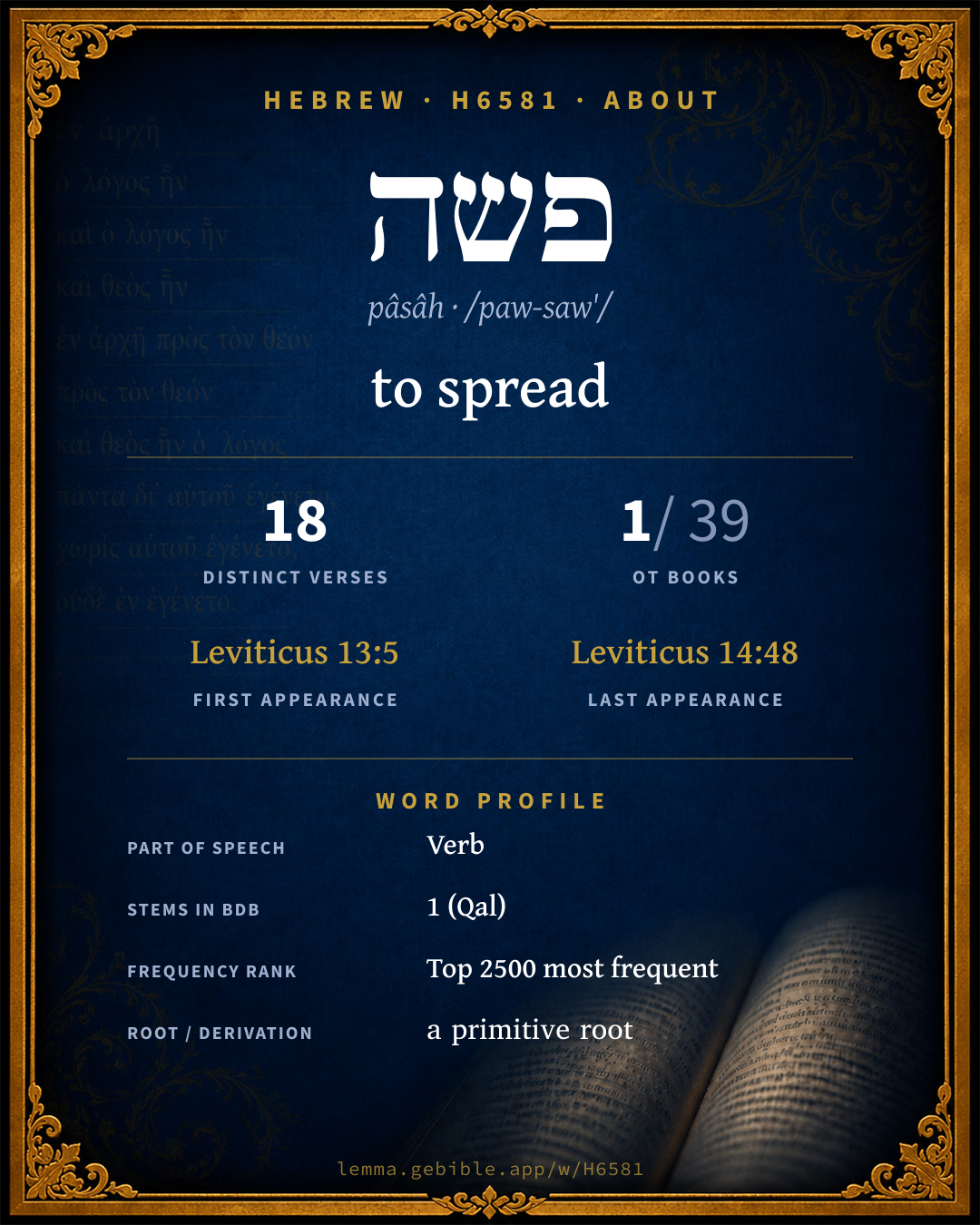
פָּשָׂה
to spread
Full lexicon entry — Brown-Driver-Briggs (BDB)
From Brown-Driver-Briggs (BDB)
Where this word appears
Grammar key — what these labels mean
Part of speech
- Verb
- An action or state-of-being word.
Stem
- Qal
- The basic, simple active stem — the plain form of the verb (“he wrote”).
Form
- Perfect
- A completed action or state — Hebrew marks aspect (completeness) more than strict tense (“he wrote”).
- Infinitive Absolute
- An unbound verbal noun, often intensifying or standing in for a finite verb.
- Imperfect
- An incomplete, ongoing, or future action (“he will / would write”).
Person
- 3rd Person
- The one spoken about (“he / she / it / they”).
Gender
- Masculine
- Grammatically masculine.
- Feminine
- Grammatically feminine.
Number
- Singular
- One.
Grammatical forms
- Verb, Qal, Perfect, 3rd Person, Masculine, Singular 11 times (50%)
- Verb, Qal, Infinitive Absolute 4 times (18%)
- Verb, Qal, Imperfect, 3rd Person, Feminine, Singular 3 times (14%)
- Verb, Qal, Perfect, 3rd Person, Feminine, Singular 3 times (14%)
- Verb, Qal, Imperfect, 3rd Person, Masculine, Singular 1 time (5%)
Parsed forms decoded from the imported morphology (morphhb / Westminster Leningrad Codex — WLC text public domain, morphhb tagging CC BY 4.0), counted across 22 parsed occurrences — not distinct verses.
Every verse where H6581 appears — 18 distinct verses across 1 book. Click any verse to open its interlinear word-by-word view. Verse text shown in the World English Bible for context — . Each verse’s Hebrew form is shown with its reference; the English is not keyword-highlighted, since the data carries no word-level English alignment. Use “Compare translations” on any verse to read it across multiple English versions. This concordance covers the Hebrew Bible; Septuagint (Greek Old Testament) occurrences are not indexed here.
Leviticus 18 verses
- Leviticus 13:5 פָשָׂ֥ה Qal pf 3ms The priest shall examine him on the seventh day, and, behold, if in his eyes the plague is arrested, and the plague hasn't spread in the skin, then the priest shall isolate him for seven more days.
- Leviticus 13:6 פָשָׂ֥ה Qal pf 3ms The priest shall examine him again on the seventh day; and, behold, if the plague has faded, and the plague hasn't spread in the skin, then the priest shall pronounce him clean. It is a scab. He shall wash his clothes, and be clean.
- Leviticus 13:7 פָּשֹׂ֨ה תִפְשֶׂ֤ה Qal inf.abs Qal impf 3fs But if the scab spreads on the skin, after he has shown himself to the priest for his cleansing, he shall show himself to the priest again.
- Leviticus 13:8 פָּשְׂתָ֥ה Qal pf 3fs The priest shall examine him; and, behold, if the scab has spread on the skin, then the priest shall pronounce him unclean. It is leprosy.
- Leviticus 13:22 פָּשֹׂ֥ה תִפְשֶׂ֖ה Qal inf.abs Qal impf 3fs If it spreads in the skin, then the priest shall pronounce him unclean. It is a plague.
- Leviticus 13:23 פָשָׂ֔תָה Qal pf 3fs But if the bright spot stays in its place, and hasn't spread, it is the scar from the boil; and the priest shall pronounce him clean.
- Leviticus 13:27 פָּשֹׂ֤ה תִפְשֶׂה֙ Qal inf.abs Qal impf 3fs The priest shall examine him on the seventh day. If it has spread in the skin, then the priest shall pronounce him unclean. It is the plague of leprosy.
- Leviticus 13:28 פָשְׂתָ֤ה Qal pf 3fs If the bright spot stays in its place, and hasn't spread in the skin, but is faded, it is the swelling from the burn, and the priest shall pronounce him clean; for it is the scar from the burn.
- Leviticus 13:32 פָשָׂ֣ה Qal pf 3ms On the seventh day the priest shall examine the plague; and, behold, if the itch hasn't spread, and there is no yellow hair in it, and the appearance of the itch isn't deeper than the skin,
- Leviticus 13:34 פָשָׂ֤ה Qal pf 3ms On the seventh day, the priest shall examine the itch; and, behold, if the itch hasn't spread in the skin, and its appearance isn't deeper than the skin, then the priest shall pronounce him clean. He shall wash his clothes, and be clean.
- Leviticus 13:35 פָּשֹׂ֥ה יִפְשֶׂ֛ה Qal inf.abs Qal impf 3ms But if the itch spreads in the skin after his cleansing,
- Leviticus 13:36 פָּשָׂ֥ה Qal pf 3ms then the priest shall examine him; and, behold, if the itch has spread in the skin, the priest shall not look for the yellow hair; he is unclean.
- Leviticus 13:51 פָשָׂ֤ה Qal pf 3ms He shall examine the plague on the seventh day. If the plague has spread in the garment, either in the warp, or in the woof, or in the skin, whatever use the skin is used for, the plague is a destructive mildew. It is unclean.
- Leviticus 13:53 פָשָׂ֣ה Qal pf 3ms "If the priest examines it, and, behold, the plague hasn't spread in the garment, either in the warp, or in the woof, or in anything of skin;
- Leviticus 13:55 פָשָׂ֔ה Qal pf 3ms Then the priest shall examine it, after the plague is washed; and, behold, if the plague hasn't changed its color, and the plague hasn't spread, it is unclean; you shall burn it in the fire. It is a mildewed spot, whether the bareness is inside or outside.
- Leviticus 14:39 פָּשָׂ֥ה Qal pf 3ms The priest shall come again on the seventh day, and look. If the plague has spread in the walls of the house,
- Leviticus 14:44 פָּשָׂ֥ה Qal pf 3ms then the priest shall come in and look; and, behold, if the plague has spread in the house, it is a destructive mildew in the house. It is unclean.
- Leviticus 14:48 פָשָׂ֤ה Qal pf 3ms "If the priest shall come in, and examine it, and, behold, the plague hasn't spread in the house, after the house was plastered, then the priest shall pronounce the house clean, because the plague is healed.
About this entry
At a glance — auto-summarized from this page’s data, not written by a person. Every figure links to its source below. This summary describes the numbers; it doesn’t interpret them.
The Hebrew verb פשה centers on the idea of “to spread.” The word gravitates to Leviticus (100%). It turns up in 18 verses across 1 book, an uncommon footprint. First canonically at Leviticus 13:5, it enters the text early. For the data behind this summary, explore the sense tree and the renderings breakdown below.
Gloss history
Strong's 1890 vs modern scholarship
About this word
Strong's H6581 catalogs a Hebrew word from the Hebrew Old Testament.
These counts are not copied from any lexicon or concordance. They are computed here, from the morphology-tagged Hebrew Old Testament. What Lemma adds →
- 18
- distinct verses
- The word appears in 18 distinct verses.
- 1 / 39
- OT books
- The word appears in 1 of 39 Old Testament books.
- #1,412
- by frequency
- Top 2500 most frequent Hebrew words (rank 1,412 of 8,640 Hebrew words by occurrence).
View all 18 occurrences in the concordance →
Most concentrated in
- Leviticus 18 verses 100%
By section of the Old Testament
By traditional corpus
Conventional, traditional groupings — biblical authorship is debated, so this is a traditional corpus grouping, not an authorship claim. Each share is this word’s portion of its verses in that division of the Hebrew canon. Each figure is a share of the word’s 18 distinct verses.
- Torah (Pentateuch) 18 verses · 100%
How translations render this word
Counts come from each version’s own published word-to-Strong’s tagging or interlinear alignment — an approximate guide to how each version renders this word, not a word-level alignment the data otherwise carries. Because each total is that version’s own tagged count, the per-version totals vary from one another and need not match the appearance or distinct-verse counts above. These counts may also differ from a printed concordance because Lemma counts each distinctly tagged rendering and does not collapse phrase taggings into a single head-word total. This is a fixed set of word-tagged versions (KJV, ASV, BSB, ULT) and does not change with the reading translation you choose elsewhere. Each version’s license is shown beside its name below (and on Sources).
- King James Version: Be spread 4×, Spread 4×, Abroad 3×
- American Standard Version: Abroad 4×, Spread 4×, Be not spread 3×
- Berean Standard Bible: Spread 9×, Has spread 5×, Spreads further 2×
- unfoldingWord Literal Text: Has 9×, Spread 9×, Has spread 7×
King James Version Public Domain
Renders H6581 across 22 tagged occurrences — most commonly:
Plus 4 renderings that appear only once — usually multi-word phrases or single function words the recovered tagging swept in, not distinct renderings.
American Standard Version Public Domain
Renders H6581 across 21 tagged occurrences — most commonly:
Plus 4 renderings that appear only once — usually multi-word phrases or single function words the recovered tagging swept in, not distinct renderings.
Berean Standard Bible Public Domain
Renders H6581 across 18 tagged occurrences — most commonly:
Plus 2 renderings that appear only once — usually multi-word phrases or single function words the recovered tagging swept in, not distinct renderings. Not rendered by a distinct English word in 4 further occurrences.
unfoldingWord Literal Text CC BY-SA 4.0
Renders H6581 across 31 tagged occurrences — most commonly:
Senses in the full BDB
What do BDB’s symbols mean?
BDB uses these scholarly abbreviations:
| Symbol | Meaning |
|---|---|
| 𝔊 | the Septuagint (the ancient Greek translation, LXX) |
| 𝔙 | the Vulgate (the Latin translation) |
| 𝔖 | the Syriac version (the Peshitta) |
| 𝔗 | the Targum (the Aramaic translation) |
| ψ | the Psalms |
| √ | root (the underlying root or stem) |
| ‖ | parallel passage (a synonymous or contrasted parallel) |
| † | the dagger: every passage where the word occurs is cited |
The 1 sense the full Brown-Driver-Briggs lexicon distinguishes for this word, in lexicon order (not ranked by frequency), with BDB’s own verbatim wording and sub-sense lettering. Shown in Hebrew script with BDB’s own scholarly abbreviations. The condensed entry is in the Lexicon Entry tab. See also the Forms in the corpus table below.
Qal
- Pf. 3 ms. פ׳ Lv 13:5 +, 3 fs. פָּֽשְׂתָה v 8, פָּשָׂ֑תָה v 23; Impf. 3 ms. יִפְשֶׂה v 35, 3 fs. תִּפְשֶׂה v 7 +; Inf. abs. פָּשׂה v 7 +;—only Lv 13, 14, of leprosy and like eruptions: c. בָּעוֹר, בַּבֶּגֶד, etc., Lv 13:5 + 7 times 13, 14:39, 44, 48 + בָּעוֹר פָּשׂה יִפְשֶׂה (תִּפ׳) 13:7, 22, 27, 35; abs. v 23, 32, 55. e.g. Leviticus 13:5
Senses from the full Brown-Driver-Briggs lexicon (Brown, Driver, Briggs; Oxford 1906 — public domain), digitized via Sefaria, supplemented by the OpenScriptures HebrewLexicon (CC BY 4.0). Full attribution on Sources.
Word origin
vb. spread, intrans. (NH פָּסָה id.; Arabic فَشَا (فشو) be divulged, spread, be extensive);—
— Brown-Driver-Briggs (Oxford 1906, public domain), digitized via Sefaria, supplemented by the OpenScriptures HebrewLexicon (CC BY 4.0). See Sources.
Origin: a primitive root
Jastrow Dictionary
A second Hebrew/Aramaic lexicon for comparison, covering Aramaic and post-biblical (Talmudic, Targumic, Midrashic) usage that the biblical-Hebrew BDB does not. Matched by lemma rather than by Strong’s number, so a lemma may carry more than one Jastrow headword (shown separately below), and the entries cover usage well beyond the Bible.
פסי
- to spread, be extended. Y. Yoma III, beg. 40ᵇ מאור החמה פּוֹסֶה וכ׳ the light of the sun (dawn) spreads over the whole eastern horizon, opp. מתמר ועולה. Ib. 41ᵃ bot. של בית היתה מתמרת … ופוֹסָה ויורדת וכ׳ … the frankincense of Beth Abtinas rose straight in a colunn and then spread and came down &c.; Y. Shek. V, 49ᵃ top; Cant. R. to I, 14; III, 6. Ib. to IV, 14 (ref. to ואהלות ib.) [read:] (עץ) שהוא פוסה כאהל a tree which spreads like a tent. Gen. R. s. 15 (ref. to עץ החיים, Gen. II, 9) עץ שהוא פוסה על פני וכ׳ a tree which spread over all living things. Neg. IV, 8, a. fr. ופָשְׂתָה וכ׳ and the spot spread &c.; Y. M. Kat. I, 80ᶜ bot. ופָסְתָה; a. fr. e.g. Genesis 2:9
פָּשָׂה
- , v. פָּסָה
A Dictionary of the Targumim, the Talmud Babli and Yerushalmi, and the Midrashic Literature (Marcus Jastrow; London, Luzac, 1903) — Public Domain. Digitized via Sefaria. Digitized via Sefaria. Full attribution on Sources.
Forms in the corpus
The 15 distinct written forms H6581 takes in the Hebrew Bible, most frequent first — each parse links to that stem’s occurrences in the concordance. Hebrew forms include their vowel points and cantillation, so a single lemma takes many written forms.
| Form | Parsing | Example | Uses |
|---|---|---|---|
| פָשָׂ֤ה | Verb, Qal, Perfect, 3rd Person, Masculine, Singular | Leviticus 13:34 | 3 |
| פָּשָׂ֥ה | Verb, Qal, Perfect, 3rd Person, Masculine, Singular | Leviticus 13:36 | 3 |
| פָשָׂ֣ה | Verb, Qal, Perfect, 3rd Person, Masculine, Singular | Leviticus 13:32 | 2 |
| פָשָׂ֥ה | Verb, Qal, Perfect, 3rd Person, Masculine, Singular | Leviticus 13:5 | 2 |
| פָּשֹׂ֥ה | Verb, Qal, Infinitive Absolute | Leviticus 13:22 | 2 |
| יִפְשֶׂ֛ה | Verb, Qal, Imperfect, 3rd Person, Masculine, Singular | Leviticus 13:35 | 1 |
| פָשְׂתָ֤ה | Verb, Qal, Perfect, 3rd Person, Feminine, Singular | Leviticus 13:28 | 1 |
| פָשָׂ֔ה | Verb, Qal, Perfect, 3rd Person, Masculine, Singular | Leviticus 13:55 | 1 |
| פָשָׂ֔תָה | Verb, Qal, Perfect, 3rd Person, Feminine, Singular | Leviticus 13:23 | 1 |
| פָּשְׂתָ֥ה | Verb, Qal, Perfect, 3rd Person, Feminine, Singular | Leviticus 13:8 | 1 |
| פָּשֹׂ֤ה | Verb, Qal, Infinitive Absolute | Leviticus 13:27 | 1 |
| פָּשֹׂ֨ה | Verb, Qal, Infinitive Absolute | Leviticus 13:7 | 1 |
| תִפְשֶׂ֖ה | Verb, Qal, Imperfect, 3rd Person, Feminine, Singular | Leviticus 13:22 | 1 |
| תִפְשֶׂ֤ה | Verb, Qal, Imperfect, 3rd Person, Feminine, Singular | Leviticus 13:7 | 1 |
| תִפְשֶׂה֙ | Verb, Qal, Imperfect, 3rd Person, Feminine, Singular | Leviticus 13:27 | 1 |
Septuagint verse parallels
This word appears in 18 verses that also exist in the Greek Old Testament (Septuagint), out of the 18 Hebrew verses it occurs in. You can read those verses in Greek by switching the Old Testament edition to the Septuagint.
Read these verses in the Septuagint
This is a verse-level parallel only — the same verses exist in both the Hebrew and Greek Old Testaments. No word-level Hebrew↔Greek correspondence is claimed: the data carries no such alignment, so no Greek word is shown as this Hebrew word’s translation. Coverage is not total — the Septuagint omits the deuterocanon and renumbers the Psalms, so some Hebrew verses have no direct Greek parallel.