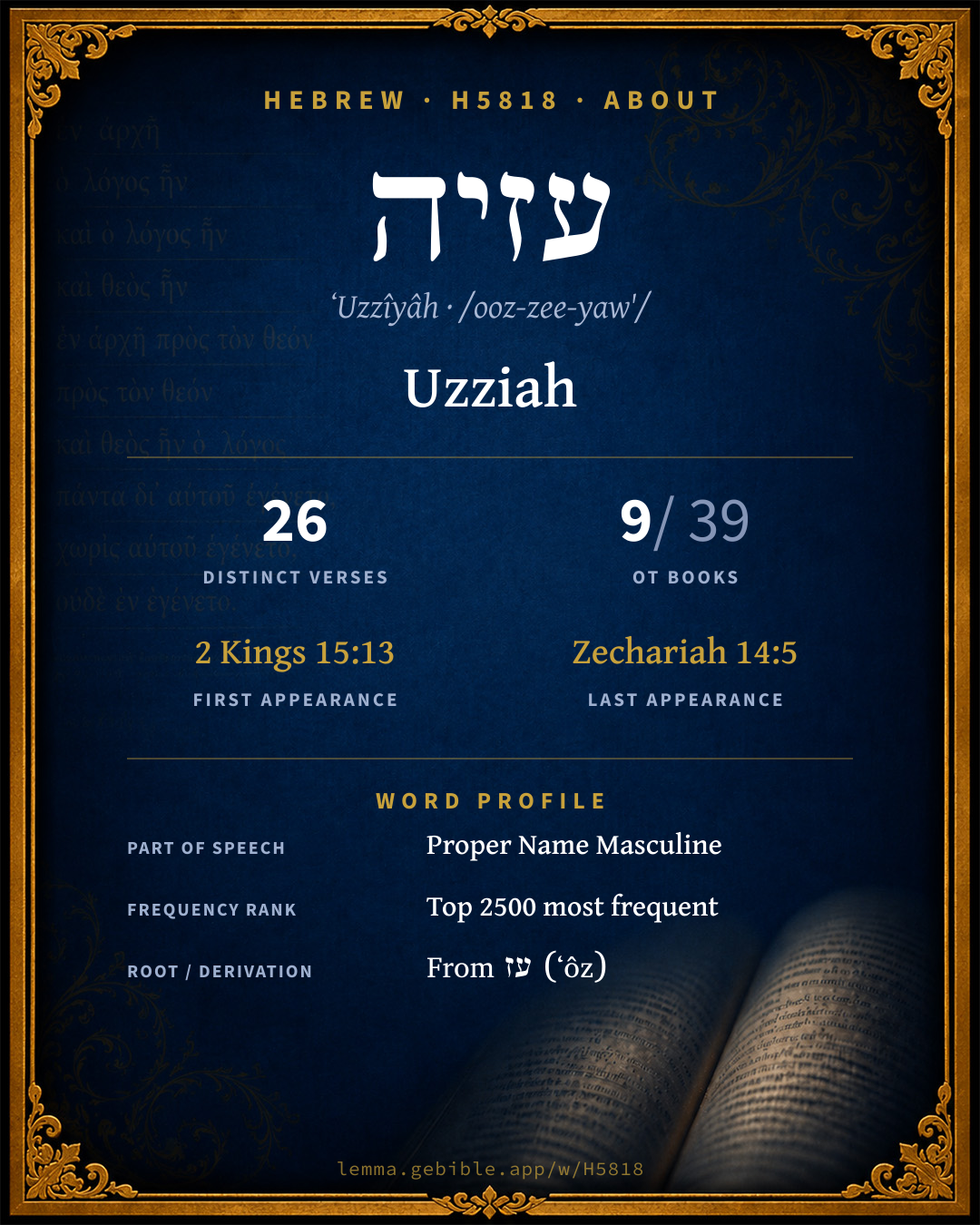
עֻזִּיָּהוּ
Uzziah
BDB lists 6 entries for ‘Uzziah’ fuller range ↓
Full lexicon entry — Brown-Driver-Briggs (BDB)
From Brown-Driver-Briggs (BDB)
Where this word appears
Grammar key — what these labels mean
Part of speech
- Noun
- A naming word — a person, place, thing, or idea.
Noun type
- Proper
- A name of a specific person, place, or people (e.g. Abraham, Zion, Israel).
Every verse where H5818 appears in the Book of Hosea — 1 distinct verse. Click any verse to open its interlinear word-by-word view. Verse text shown in the World English Bible for context — . Each verse’s Hebrew form is shown with its reference; the English is not keyword-highlighted, since the data carries no word-level English alignment. Use “Compare translations” on any verse to read it across multiple English versions. This concordance covers the Hebrew Bible; Septuagint (Greek Old Testament) occurrences are not indexed here.
Hosea
About this entry
At a glance — auto-summarized from this page’s data, not written by a person. Every figure links to its source below. This summary describes the numbers; it doesn’t interpret them.
עזיה (ʻUzzîyâh) is a Hebrew name most often rendered “Uzziah.” It first appears in 2 Kings 15:13. With 26 verses in 9 books, it is a moderately common word in the Hebrew Bible. It concentrates in 2 Chronicles, which alone accounts for 46% of its uses. The sections below give every occurrence and version rendering.
Gloss history
Strong's 1890 vs modern scholarship
About this word
Strong's H5818 catalogs a Hebrew word from the Hebrew Old Testament.
These counts are not copied from any lexicon or concordance. They are computed here, from the morphology-tagged Hebrew Old Testament. What Lemma adds →
- 26
- distinct verses
- The word appears in 26 distinct verses.
- 9 / 39
- OT books
- The word appears in 9 of 39 Old Testament books.
- #1,226
- by frequency
- Top 2500 most frequent Hebrew words (rank 1,226 of 8,640 Hebrew words by occurrence).
View all 26 occurrences in the concordance →
Most concentrated in
- 2 Chronicles 12 verses 46%
- 2 Kings 4 verses 15%
- Isaiah 3 verses 12%
By section of the Old Testament
By traditional corpus
Conventional, traditional groupings — biblical authorship is debated, so this is a traditional corpus grouping, not an authorship claim. Each share is this word’s portion of its verses in that division of the Hebrew canon. Each figure is a share of the word’s 26 distinct verses.
- Writings (Ketuvim) 16 verses · 62%
- Prophets (Nevi'im) 10 verses · 38%
How translations render this word
Counts come from each version’s own published word-to-Strong’s tagging or interlinear alignment — an approximate guide to how each version renders this word, not a word-level alignment the data otherwise carries. Because each total is that version’s own tagged count, the per-version totals vary from one another and need not match the appearance or distinct-verse counts above. These counts may also differ from a printed concordance because Lemma counts each distinctly tagged rendering and does not collapse phrase taggings into a single head-word total. This is a fixed set of word-tagged versions (KJV, ASV, BSB, ULT) and does not change with the reading translation you choose elsewhere. Each version’s license is shown beside its name below (and on Sources).
- King James Version: Uzziah 23×, Moreover uzziah 2×
- American Standard Version: Uzziah 23×, Moreover uzziah 2×
- Berean Standard Bible: Uzziah 26×
- unfoldingWord Literal Text: Uzziah 23×, Azariah 3×
King James Version Public Domain
Renders H5818 across 27 tagged occurrences — most commonly:
Plus 2 renderings that appear only once — usually multi-word phrases or single function words the recovered tagging swept in, not distinct renderings.
American Standard Version Public Domain
Renders H5818 across 27 tagged occurrences — most commonly:
Plus 2 renderings that appear only once — usually multi-word phrases or single function words the recovered tagging swept in, not distinct renderings.
Berean Standard Bible Public Domain
Renders H5818 across 27 tagged occurrences — most commonly:
Plus 1 rendering that appears only once — usually multi-word phrases or single function words the recovered tagging swept in, not distinct renderings.
unfoldingWord Literal Text CC BY-SA 4.0
Renders H5818 across 27 tagged occurrences — most commonly:
Plus 1 rendering that appears only once — usually multi-word phrases or single function words the recovered tagging swept in, not distinct renderings.
7 senses and sub-senses in the full BDB
What do BDB’s symbols mean?
BDB uses these scholarly abbreviations:
| Symbol | Meaning |
|---|---|
| 𝔊 | the Septuagint (the ancient Greek translation, LXX) |
| 𝔙 | the Vulgate (the Latin translation) |
| 𝔖 | the Syriac version (the Peshitta) |
| 𝔗 | the Targum (the Aramaic translation) |
| ψ | the Psalms |
| √ | root (the underlying root or stem) |
| ‖ | parallel passage (a synonymous or contrasted parallel) |
| † | the dagger: every passage where the word occurs is cited |
The 7 senses and sub-senses the full Brown-Driver-Briggs lexicon distinguishes for this word, in lexicon order (not ranked by frequency), with BDB’s own verbatim wording and sub-sense lettering. Shown in Hebrew script with BDB’s own scholarly abbreviations. The condensed entry is in the Lexicon Entry tab. See also the Forms in the corpus table below.
- 1. Οζειας, but also Αζαριας: king of Judah = עַזֲרְיָהוּ:
- a. עֻזִּיָּהוּ 2 K 15:32, 34; 2 Ch 26:1, 3, 8, 9, 11, 14, 18(×2), 19, 21, 22, 23; 27:2; Is 1:1; 6:1; 7:1. e.g. 2 Kings 15:32
- b. עֻזִּיָּה 2 K 15:13, 30; Ho 1:1; Am 1:1; Zc 14:5. e.g. 2 Kings 15:13
- 2. עֻזִּיָּהוּ father of an officer of David 1 Ch 27:25. e.g. 1 Chronicles 27:25
- 3. עֻזִּיָּה Levite name 1 Ch 6:9. e.g. 1 Chronicles 6:9
- 4. id.: priest with foreign wife Ezr 10:21. e.g. Ezra 10:21
- 5. id.: name in Judah Ne 11:4 (also v 5 𝔊 for חזיה).—Vid. also יַעֲזִיָּהוּ. e.g. Nehemiah 11:4
Senses from the full Brown-Driver-Briggs lexicon (Brown, Driver, Briggs; Oxford 1906 — public domain), digitized via Sefaria, supplemented by the OpenScriptures HebrewLexicon (CC BY 4.0). Full attribution on Sources.
Word origin
n.pr.m. (my strength is י׳; cf. OHeb. עזיו Lzb338);—
— Brown-Driver-Briggs (Oxford 1906, public domain), digitized via Sefaria, supplemented by the OpenScriptures HebrewLexicon (CC BY 4.0). See Sources.
Derived from עז (ʻôz) (H5797) — strength.
Jastrow Dictionary
A second Hebrew/Aramaic lexicon for comparison, covering Aramaic and post-biblical (Talmudic, Targumic, Midrashic) usage that the biblical-Hebrew BDB does not. Matched by lemma rather than by Strong’s number, so a lemma may carry more than one Jastrow headword (shown separately below), and the entries cover usage well beyond the Bible.
עֻזִּיָּה
- , v. עוּזִּיָּה
A Dictionary of the Targumim, the Talmud Babli and Yerushalmi, and the Midrashic Literature (Marcus Jastrow; London, Luzac, 1903) — Public Domain. Digitized via Sefaria. Digitized via Sefaria. Full attribution on Sources.
Forms in the corpus
The 19 distinct written forms H5818 takes in the Hebrew Bible, most frequent first — each parse links to that state’s occurrences in the concordance. Hebrew forms include their vowel points and cantillation, so a single lemma takes many written forms.
| Form | Parsing | Example | Uses |
|---|---|---|---|
| עֻזִּיָּ֔הוּ | Noun, Proper | 2 Chronicles 26:1 | 4 |
| עֻזִּיָּ֜הוּ | Noun, Proper | 2 Chronicles 26:14 | 3 |
| עֻזִּיָּ֣הוּ | Noun, Proper | 2 Chronicles 26:3 | 3 |
| עֻזִּיָּ֥ה | Noun, Proper | Hosea 1:1 | 2 |
| וְ/עֻזִיָּֽה | Noun, Proper | Ezra 10:21 | 1 |
| לְ/עֻזִיָּ֖ה | Noun, Proper | 2 Kings 15:13 | 1 |
| לְ/עֻזִּיָּ֑הוּ | Noun, Proper | 2 Chronicles 26:8 | 1 |
| לְ/עֻזִּיָּ֡הוּ | Noun, Proper | 2 Chronicles 26:11 | 1 |
| עֻזִיָּ֖הוּ | Noun, Proper | 2 Kings 15:32 | 1 |
| עֻזִיָּ֣ה | Noun, Proper | Amos 1:1 | 1 |
| עֻזִיָּ֥הוּ | Noun, Proper | 2 Kings 15:34 | 1 |
| עֻזִיָּֽה | Noun, Proper | 2 Kings 15:30 | 1 |
| עֻזִּיָּ֗הוּ | Noun, Proper | 2 Chronicles 26:18 | 1 |
| עֻזִּיָּ֜ה | Noun, Proper | Nehemiah 11:4 | 1 |
| עֻזִּיָּ֣ה | Noun, Proper | Zechariah 14:5 | 1 |
| עֻזִּיָּ֤הוּ | Noun, Proper | 2 Chronicles 26:9 | 1 |
| עֻזִּיָּ֧הוּ | Noun, Proper | Isaiah 1:1 | 1 |
| עֻזִּיָּ֨הוּ | Noun, Proper | 2 Chronicles 26:21 | 1 |
| עֻזִּיָּֽהוּ | Noun, Proper | 1 Chronicles 27:25 | 1 |
Same root — word family
Other BDB entries built from the same root as H5818, grouped by Strong’s listed origin. These share a root / origin per the lexicon — not necessarily a shared meaning. Each links to that word’s own entry.
Derives from
Shares the same root
Proper names from this root
People and places named from this root — a name, not an additional meaning of the word.
- עזא ʻUzzâʼ H5798 Uzza
- עזיאל ʻUzzîyʼêl H5816 Uzziel
- Οζιας Ozías G3604 Uzziah
- עזיא ʻUzzîyâʼ H5814 Uzzia
Compare all same-root words → Showing 4 of 7 — not the complete family. 4 of the same-root words are proper names (people or places). They share a root, not necessarily a meaning.
Bible dictionary
Public-domain dictionary articles matched to this entry by name (Uzziah). A biblical name can be shared by more than one person or place, so an article may treat several.
Easton's Bible Dictionary · M. G. Easton, 1897
A contracted form of Azari'ah the Lord is my strength. (1.) One of Amaziah's sons, whom the people made king of Judah in his father's stead (2 Kings 14:21; 2 Chr. 26:1). His long reign of about fifty-two years was "the most prosperous excepting that of Jehosaphat since the time of Solomon." He was a vigorous and able ruler, and "his name spread abroad, even to the entering in of Egypt" (2 Chr. 26:8, 14). In the earlier part of his reign, under the influence of Zechariah, he was faithful to Jehovah, and "did that which was right in the sight of the Lord" (2 Kings 15:3; 2 Chr. 26:4, 5); but toward the close of his long life "his heart was lifted up to his destruction," and he wantonly invaded the priest's office (2 Chr. 26:16), and entering the sanctuary proceeded to offer incense on the golden altar. Azariah the high priest saw the tendency of such a daring act on the part of the king, and with a band of eighty priests he withstood him (2 Chr. 26:17), saying, "It appertaineth not unto thee, Uzziah, to burn incense." Uzziah was suddenly struck with leprosy while in the act of offering incense (26:19-21), and he was driven from the temple and compelled to reside in "a several house" to the day of his death (2 Kings 15:5, 27; 2 Chr. 26:3). He was buried in a separate grave "in the field of the burial which belonged to the kings" (2 Kings 15:7; 2 Chr. 26:23). "That lonely grave in the royal necropolis would eloquently testify to coming generations that all earthly monarchy must bow before the inviolable order of the divine will, and that no interference could be tolerated with that unfolding of the purposes of God, which, in the fulness of time, would reveal the Christ, the true High Priest and King for evermore" (Dr. Green's Kingdom of Israel, etc.).
(2.) The father of Jehonathan, one of David's overseers (1 Chr. 27:25).
Smith's Bible Dictionary · William Smith, 1863
(strength of Jehovah).
+ King of Judah B.C. 809-8 to 757-6. In some passages his name appears in the lengthened form Azariah: After the murder of Amaziah, his son Uzziah was chosen by the people, at the age of sixteen, to occupy the vacant throne; and for the greater part of his long reign of fifty-two years he lived in the fear of God, and showed himself a wise, active and pious ruler. He never deserted the worship of the true God, and was much influenced by Zechariah, a prophet who is mentioned only in connection with him. (2 Chronicles 26:5) So the southern kingdom was raised to a condition of prosperity which it had not known since the death of Solomon. The end of Uzziah was less prosperous than his beginning. Elated with his splendid career, he determined to burn incense on the altar of God, but was opposed by the high priest Azariah and eighty others. See (Exodus 30:7,8; Numbers 16:40; 18:7) The king was enraged at their resistance, and, as he pressed forward with his censer was suddenly smitten with leprosy. This lawless attempt to burn incense was the only exception to the excellence of his administration. (2 Chronicles 27:2) Uzziah was buried "with his fathers," yet apparently not actually in the royal sepulchres. (2 Chronicles 26:23) During his reign a great earthquake occurred. (Amos 1:1; Zechariah 14:5) + A Kohathite Levite, and ancestor of Samuel. (1 Chronicles 6:24) (9). + A priest of the sons of Harim, who had taken a foreign wife in the days of Ezra. (Ezra 10:21) (B.C. 458.) + Father of Athaiah or Uthai. (Nehemiah 11:4) + Father of Jehonathan, one of David's overseers. (1 Chronicles 27:25) (B.C. about 1053.)
Hitchcock's Bible Names Dictionary · Roswell D. Hitchcock, 1869
Uzziel, the strength, or kid, of the Lord
Classic public-domain reference works; full attribution on Sources.
Septuagint verse parallels
This word appears in 25 verses that also exist in the Greek Old Testament (Septuagint), out of the 26 Hebrew verses it occurs in. You can read those verses in Greek by switching the Old Testament edition to the Septuagint.
Read these verses in the Septuagint
- 2 Kings 15:13
- 1 Chronicles 6:24
- 2 Chronicles 26:1
- Ezra 10:21
- Isaiah 1:1
- Hosea 1:1
- Amos 1:1
- Zechariah 14:5
This is a verse-level parallel only — the same verses exist in both the Hebrew and Greek Old Testaments. No word-level Hebrew↔Greek correspondence is claimed: the data carries no such alignment, so no Greek word is shown as this Hebrew word’s translation. Coverage is not total — the Septuagint omits the deuterocanon and renumbers the Psalms, so some Hebrew verses have no direct Greek parallel.