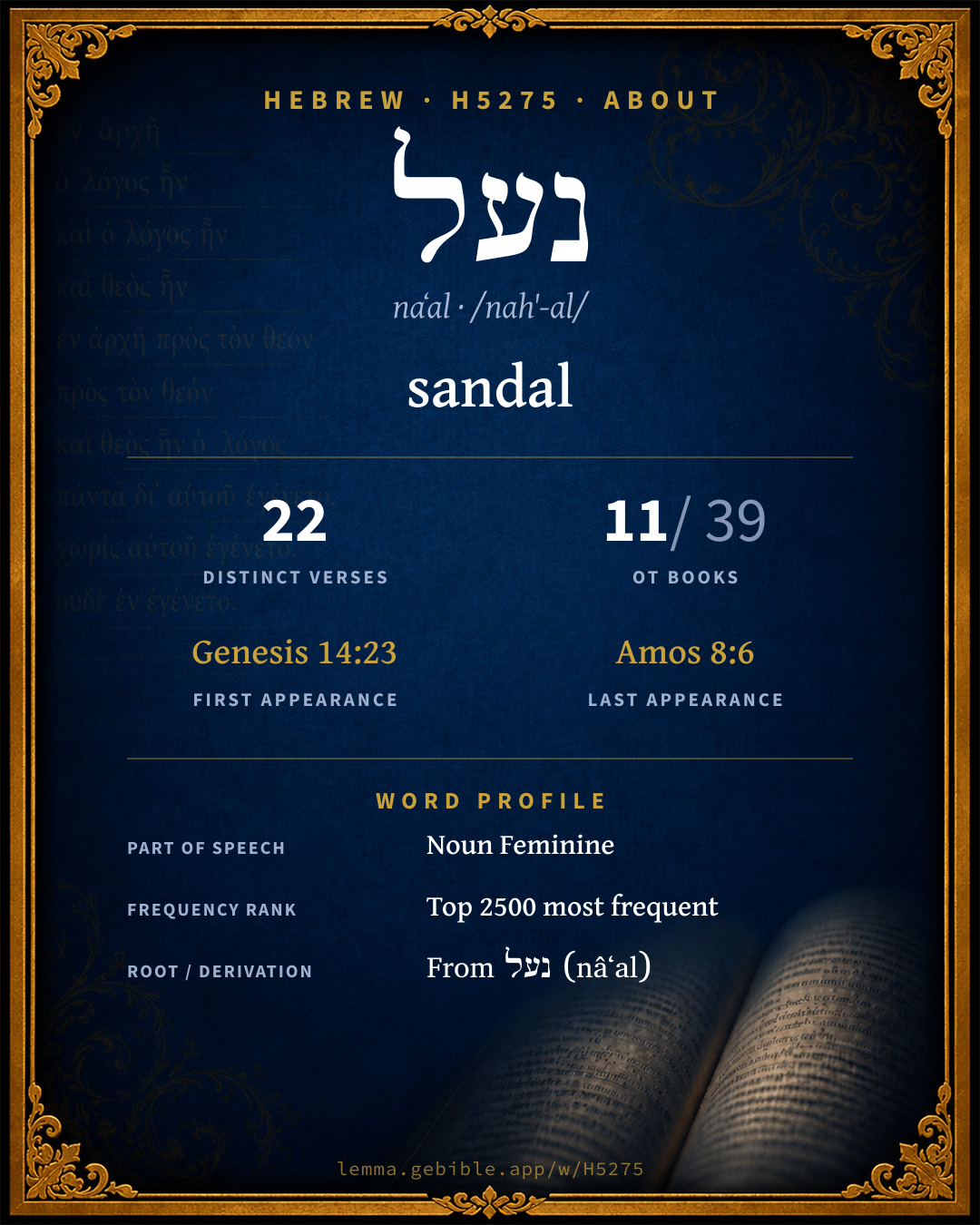
נַ֫עַל
sandal
Full lexicon entry — Brown-Driver-Briggs (BDB)
From Brown-Driver-Briggs (BDB)
Where this word appears
See every Construct-state word in the Hebrew Bible →
Grammar key — what these labels mean
Part of speech
- Noun
- A naming word — a person, place, thing, or idea.
Noun type
- Common
- A common noun — a general class of person, place, or thing (“king,” “city,” “water”), not a specific name.
State
- Construct
- A noun bound to a following noun in a possessive / “of” relationship (the construct chain).
- Absolute
- The independent form of a noun, not bound to a following word.
Gender
- Feminine
- Grammatically feminine.
Number
- Singular
- One.
- Dual
- Exactly two — for natural pairs and some measures of time.
- Plural
- More than one (in Hebrew, generally three or more).
1 verse where H5275 appears in the Absolute state in the Book of Joshua. Filtered view — show all forms. Click any verse to open its interlinear word-by-word view. Verse text shown in the World English Bible for context — . Each verse’s Hebrew form is shown with its reference; the English is not keyword-highlighted, since the data carries no word-level English alignment. Use “Compare translations” on any verse to read it across multiple English versions. This concordance covers the Hebrew Bible; Septuagint (Greek Old Testament) occurrences are not indexed here.
Joshua
About this entry
At a glance — auto-summarized from this page’s data, not written by a person. Every figure links to its source below. This summary describes the numbers; it doesn’t interpret them.
At its core, נעל (naʻal) means “sandal.” Where the King James Version says “shoes,” newer translations reach for “sandals” (Berean Standard Bible) and “sandal” (unfoldingWord Literal Text); the renderings breakdown has the detail. It appears 22 verses across 11 books of the Hebrew Bible, among its uncommon vocabulary. First canonically at Genesis 14:23, it enters the text early. It shares a root with נעל, מנעול and מנעל. Dig into 22-verse concordance and the renderings breakdown below.
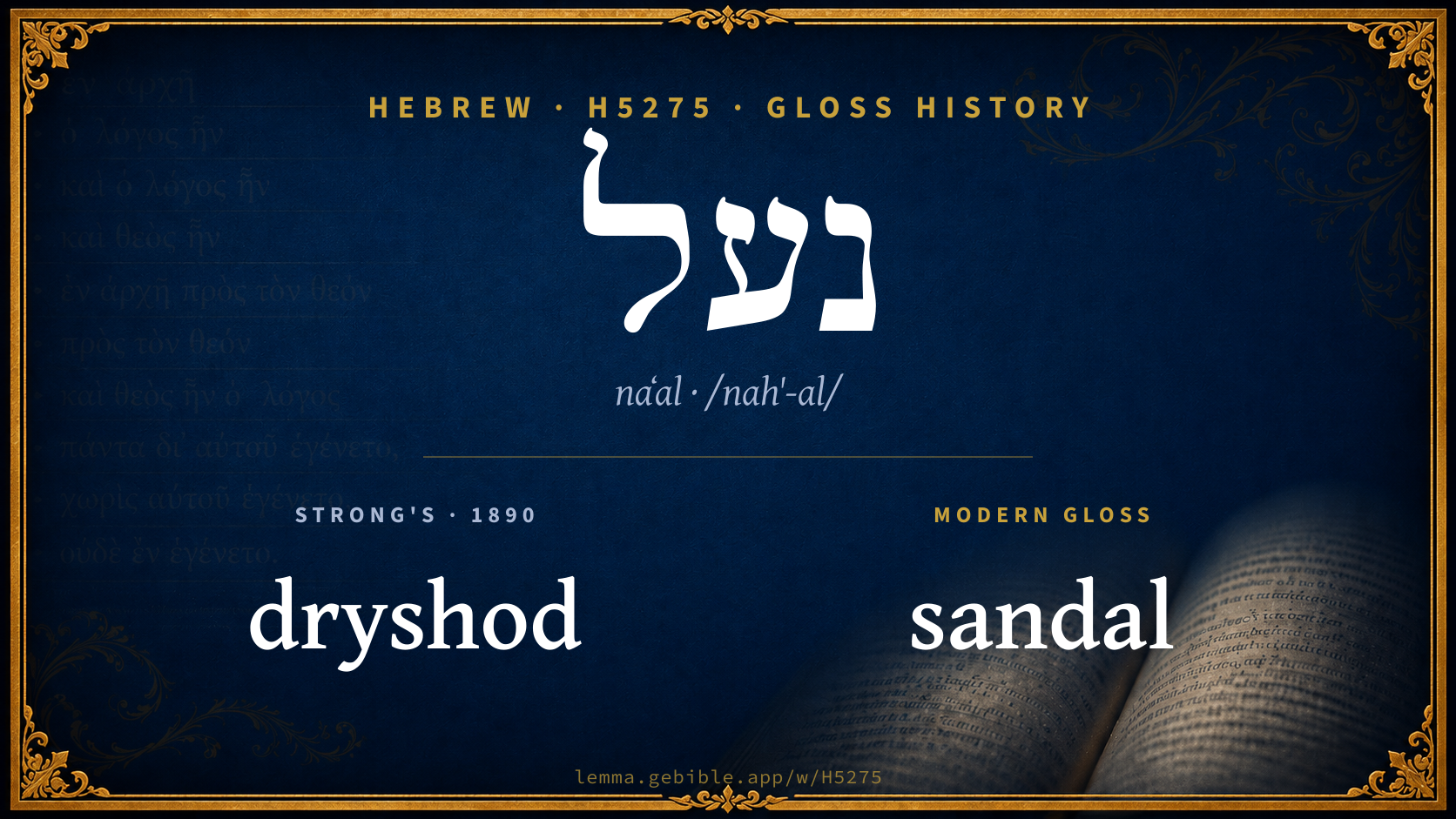
Gloss history
Strong's 1890 vs modern scholarship
About this word
Strong's H5275 catalogs a Hebrew word from the Hebrew Old Testament.
These counts are not copied from any lexicon or concordance. They are computed here, from the morphology-tagged Hebrew Old Testament. What Lemma adds →
- 22
- distinct verses
- The word appears in 22 distinct verses.
- 11 / 39
- OT books
- The word appears in 11 of 39 Old Testament books.
- #1,412
- by frequency
- Top 2500 most frequent Hebrew words (rank 1,412 of 8,640 Hebrew words by occurrence).
View all 22 occurrences in the concordance →
Most concentrated in
- Deuteronomy 3 verses 14%
- Joshua 3 verses 14%
- Isaiah 3 verses 14%
By section of the Old Testament
By traditional corpus
Conventional, traditional groupings — biblical authorship is debated, so this is a traditional corpus grouping, not an authorship claim. Each share is this word’s portion of its verses in that division of the Hebrew canon. Each figure is a share of the word’s 22 distinct verses.
- Prophets (Nevi'im) 11 verses · 50%
- Torah (Pentateuch) 6 verses · 27%
- Writings (Ketuvim) 5 verses · 23%
How translations render this word
Counts come from each version’s own published word-to-Strong’s tagging or interlinear alignment — an approximate guide to how each version renders this word, not a word-level alignment the data otherwise carries. Because each total is that version’s own tagged count, the per-version totals vary from one another and need not match the appearance or distinct-verse counts above. These counts may also differ from a printed concordance because Lemma counts each distinctly tagged rendering and does not collapse phrase taggings into a single head-word total. This is a fixed set of word-tagged versions (KJV, ASV, BSB, ULT) and does not change with the reading translation you choose elsewhere. Each version’s license is shown beside its name below (and on Sources).
- King James Version: Shoes 9×, Shoe 7×, Pair of shoes 2×
- American Standard Version: Shoes 7×, Shoe 5×, Pair of shoes 2×
- Berean Standard Bible: Sandals 10×, Sandal 7×, Pair of sandals 2×
- unfoldingWord Literal Text: Sandal 10×, Sandals 10×, And 2×
King James Version Public Domain
Renders H5275 across 22 tagged occurrences — most commonly:
Plus 4 renderings that appear only once — usually multi-word phrases or single function words the recovered tagging swept in, not distinct renderings.
American Standard Version Public Domain
Renders H5275 across 22 tagged occurrences — most commonly:
Plus 8 renderings that appear only once — usually multi-word phrases or single function words the recovered tagging swept in, not distinct renderings.
Berean Standard Bible Public Domain
Renders H5275 across 22 tagged occurrences — most commonly:
Plus 3 renderings that appear only once — usually multi-word phrases or single function words the recovered tagging swept in, not distinct renderings.
unfoldingWord Literal Text CC BY-SA 4.0
Renders H5275 across 24 tagged occurrences — most commonly:
Plus 2 renderings that appear only once — usually multi-word phrases or single function words the recovered tagging swept in, not distinct renderings.
Senses in BDB
The 1 sense BDB distinguishes for this word, in lexicon order (not ranked by frequency or importance). The full entry — with sub-senses — is in the Lexicon Entry tab.
- sandal, shoe
Word origin
n.f. Jos 9:5 sandal, shoe (NH id.; Arabic نَعْلٌ id. (also horse-shoe, etc.); Syriac ܢܰܥܠܴܐ appar. only horse-shoe (rare; also NS) PS2405; cf. poss. Ethiopic ንዑልት: (obsol.) wife of Levirate marriage Di676);—abs. נ׳ Gn 14:23, נָ֑עַל Dt 25:10; sf. נַעֲלִי ψ 60:10; 108:10, נַעַלְךָ Jos 5:15, etc.; du. נַעֲלָ֑יִם Am 2:6; 8:6; pl. נִ֑עָלִים Is 11:15; Ct 7:2, נְעָלוֹת Jos 9:5; sf. נְעָלֶיךָ Ex 3:5; Ez 24:17, נְעָלָיו Is 5:27, נְעָלֵינוּ Jos 9:13, נַעֲלֵיכֶם Ex 12:11; Ez 24:23;—sandal Ju 9:13, Am 2:6; 8:6 (du. = pair of sandals; mentioned as of little worth); Dt 29;4; on (ב) feet Jos 9:5 (JE), 1 K 2:5; Ez 24:23 Ex 12:11 (P); cf. פְּעָמַיִךְ בַּנְּעָלִים Ct 7:2, וְהִדְרִיךְ בַּנ׳ Is 11:15; put on sandal is שִׂים נ׳ בְּרֶגֶל Ez 24:17; loose the sandal is חָלַץ Is 20:2; Dt 25:9 cf. v 10; שַׁל (Imv.) Ex 3:5 (E), Jos 5:15 (JE); שָׁלַף Ru 4:7, 8 cf. BurtonMidian ii. 197); sandal-thong is שְׂרוֹךְ Gn 14:23; Is 5:27; עַל־אֱדוֹם אַשְׁלִיךְ נַעֲלִי ψ 60:10 upon Edom do I cast my sandal = 108:10, denotes either contempt (Hup; עַל = unto, fig. of slave), or taking possession of (Fl in De, Che Bae), ‖ מוֹאָב סִיר רַחְצִי favoursformer.—On symbolic use of sandal v. further GoldziherAbh. z. Arabic Philol. i. 47 f. JacobArab. Dicht. iv. 23.
— Brown-Driver-Briggs (Oxford 1906, public domain), digitized via Sefaria, supplemented by the OpenScriptures HebrewLexicon (CC BY 4.0). See Sources.
Derived from נעל (nâʻal) (H5274) — to lock.
Jastrow Dictionary
A second Hebrew/Aramaic lexicon for comparison, covering Aramaic and post-biblical (Talmudic, Targumic, Midrashic) usage that the biblical-Hebrew BDB does not. Matched by lemma rather than by Strong’s number, so a lemma may carry more than one Jastrow headword (shown separately below), and the entries cover usage well beyond the Bible.
נָעַל
- (b. h.)
- 1. to tie (the door), to lock up, close. B. Kam. VI, 1 נ׳ בפניה כראוי if he locked it in (secured the flock) properly. Tosef. B. Bath. II, 11, a. e. נ׳ וגדר וכ׳ if he fastened (something on the property), fenced in or tore down, it is possession (חֲזָקָה). Sabb. XIII, 6 ונ׳ אחד בפניו and one blocked it (by placing himself in the entrance). Ib. 7 לנוֹעֵל את ביתו וכ׳ it is like one locking up (sitting at the entrance of) his house to guard it. Mekh. Mishp. s. 18 שלא לִנְעוֹל בפני וכ׳ in order not to close the door to future proselytes (not to discourage them on account of advanced age). Snh. 32ᵃ, a. fr. כדי שלא תִנְעוֹל וכ׳, v. דֶּלֶת.—Y. Naz. VIII, 57ᵃ bot., v. וַעַד. Tosef. Sot. V, 9 [read:] שנעל דלת וכ׳ who locked his wife up (to prevent her from going astray); Y. ib. I, 17ᵃ bot.; Gitt. 90ᵃ; Y. Kidd. IV, 66ᵃ; a. fr.—Cant. R. to VII, 2 (play on בנעלים, ib.) אתם נוֹעֲלִים לפני … ואני נועל וכ׳ you lock up (interrupt business) for my sake on Passover …, and I lock up (the rain) for your sake, v. נְעִילָה. Ib. מה היה … שהיו נועלין בעד כל הצרות how great wa is the beauty of thy steps (pilgrimage to the Temple) which locked up (protected against) all troubles.—Part. pass. נְעוּל; f. נְעוּלָה; pl. נְעוּלִים, נְעוּלִין; נְעוּלוֹת. Midr. Till. to Ps. IV שערי תפלה … נ׳ וכ׳ the gates of prayer are sometimes open, sometimes closed, but the gates of tears are never closed; a. e.
- 2. to tie a sandal, to put shoes on. Tosef. Sabb. IV (V), 8 לא יִנְעוֹל אדם וכ׳ one must not put on a nail-studded sandal &c. Y. M. Kat. III, 83ᶜ הורי … לנעול בו ביום R. … allowed (the people mourning for R. Yassa) to wear shoes on the same day. Tosef. Kidd. I, 5 נ׳ לו סנדלו וכ׳ if the slave tied his sandals for him (the new master) or untied them, it is possession (v. supra); B. Bath. 53ᵇ (Ms. M. הִנְעִיל); a. fr.—Part. pass. as ab., shod. Yalk. Josh. 7 וכי במנעלים אתה נ׳ וכ׳ dost thou wear shoes and observest not mourning?
- to put shoes on a person. B. Bath. l. c.; Kidd. 22ᵇ הלבישו הִנְעִילוֹ וכ׳ if the slave helped him put on his clothes or his shoes or lifted him up (helped him into a conveyance), it is possession.
- to be closed. Ber. 32ᵇ מיום … נִנְעֲלוּ שערי וכ׳ since the day the Temple was destroyed, the gates of prayer have been closed. Ib. שערי דמעה לא ננעלו; Midr. Till. to Ps. IV נִנְעָלִים, v. supra. B. Mets. 59ᵃ כל השערים נִנְעָלִים חוץ וכ׳ all gates (of prayer) are (at times) closed, except the gates for the cry of oppression. Ib. הפרגוד ננעל, v. פַּרְגּוֹד. Erub. 6ᵇ, a. e. אילמלא דלתותיה נִנְעָלוֹת if its gates were not shut by night; a. fr.—Sabb. 67ᵃ bot. (in an incantation for a swallowed fish-bone) נִנְעַלְתָּה כתריס (Ms. M. מנעלתה בתריס) thou art locked up as (within) a cuirass.
נְעַל
- , to tie a shoe. Part. pass. נָעִיל, נְעִיל. Targ. Y. Deut. XXV, 9 ויהא נ׳ וכ׳ and there shall be tied on the foot … a sandal which &c.
- to provide with shoes. Targ. II Chr. XXVIII, 15. [Dan. II, 25, a. e. הַנְעִל to bring up, fr. עֲלַל.] e.g. Daniel 2:25
נַעַל
- preced.)
- 1. (cmp. Gr. ὑπόδημα) [tied under the foot,] shoe. Yeb. 102ᵃ התורה … נַעֲלוֹ ולא מנעלו the Law (Deut. XXV, 9) says, what is tied to his foot, but not what covers his foot (a full shoe, v. מִנְעוֹל). Sifré Deut. 291 (ref. to Deut. l. c.) נעלו שלו his own shoe; a. e. e.g. Deuteronomy 25:9
- 2. lock, locking up.—Pl. נְעָלִים. Cant. R. to VII, 2, v. נְעִילָה.
A Dictionary of the Targumim, the Talmud Babli and Yerushalmi, and the Midrashic Literature (Marcus Jastrow; London, Luzac, 1903) — Public Domain. Digitized via Sefaria. Digitized via Sefaria. Full attribution on Sources.
Forms in the corpus
The 21 distinct written forms H5275 takes in the Hebrew Bible, most frequent first — each parse links to that state’s occurrences in the concordance. Hebrew forms include their vowel points and cantillation, so a single lemma takes many written forms.
Same root — word family
Other BDB entries built from the same root as H5275, grouped by Strong’s listed origin. These share a root / origin per the lexicon — not necessarily a shared meaning. Each links to that word’s own entry.
Derives from
Shares the same root
Compare all same-root words → They share a root, not necessarily a meaning.
Septuagint verse parallels
This word appears in 22 verses that also exist in the Greek Old Testament (Septuagint), out of the 22 Hebrew verses it occurs in. You can read those verses in Greek by switching the Old Testament edition to the Septuagint.
Read these verses in the Septuagint
- Genesis 14:23
- Exodus 3:5
- Deuteronomy 25:9
- Joshua 5:15
- Ruth 4:7
- 1 Kings 2:5
- Psalms 60:8
- Song of Solomon 7:1
- Isaiah 5:27
- Ezekiel 24:17
- Amos 2:6
This is a verse-level parallel only — the same verses exist in both the Hebrew and Greek Old Testaments. No word-level Hebrew↔Greek correspondence is claimed: the data carries no such alignment, so no Greek word is shown as this Hebrew word’s translation. Coverage is not total — the Septuagint omits the deuterocanon and renumbers the Psalms, so some Hebrew verses have no direct Greek parallel.