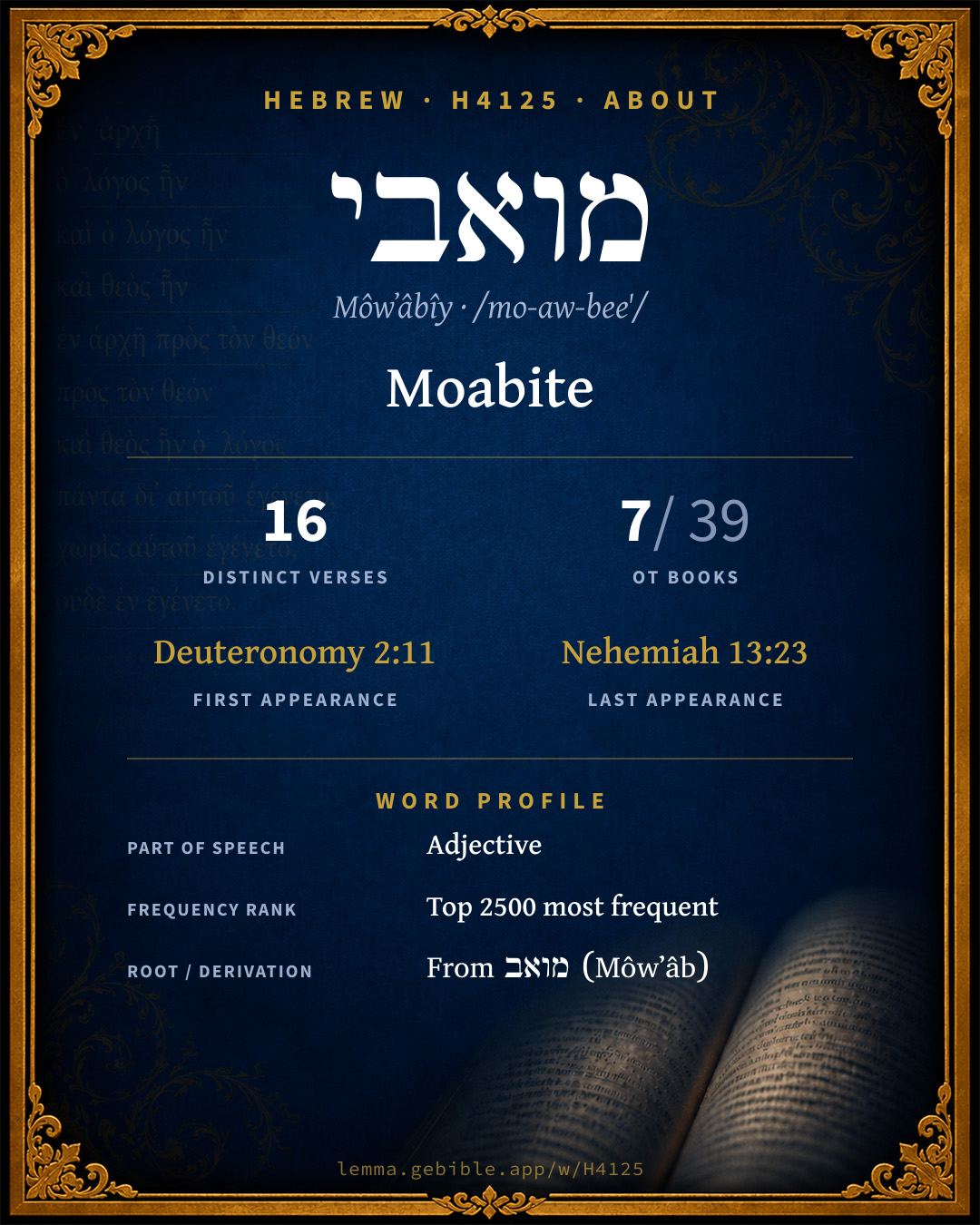
מוֹאָבִי
Moabite
BDB lists 3 entries for ‘Moabite’ fuller range ↓
Full lexicon entry — Brown-Driver-Briggs (BDB)
From Brown-Driver-Briggs (BDB)
Where this word appears
Grammar key — what these labels mean
Part of speech
- Noun
- A naming word — a person, place, thing, or idea.
Noun type
- Gentilic
- A noun naming a member of a people, tribe, or region of origin (e.g. an Israelite, a Moabite).
State
- Absolute
- The independent form of a noun, not bound to a following word.
Gender
- Feminine
- Grammatically feminine.
- Masculine
- Grammatically masculine.
Number
- Singular
- One.
- Plural
- More than one (in Hebrew, generally three or more).
Every verse where H4125 appears in the Book of 1 Chronicles — 1 distinct verse. Click any verse to open its interlinear word-by-word view. Verse text shown in the World English Bible for context — . Each verse’s Hebrew form is shown with its reference; the English is not keyword-highlighted, since the data carries no word-level English alignment. Use “Compare translations” on any verse to read it across multiple English versions. This concordance covers the Hebrew Bible; Septuagint (Greek Old Testament) occurrences are not indexed here.
1 Chronicles
About this entry
At a glance — auto-summarized from this page’s data, not written by a person. Every figure links to its source below. This summary describes the numbers; it doesn’t interpret them.
The Hebrew name מואבי centers on the idea of “Moabite.” Its earliest occurrence is Deuteronomy 2:11. It turns up in 16 verses across 7 books, an uncommon footprint. The word gravitates to Ruth (44%), then Deuteronomy and Nehemiah. For the data behind this summary, explore 16-verse concordance and the renderings breakdown below.
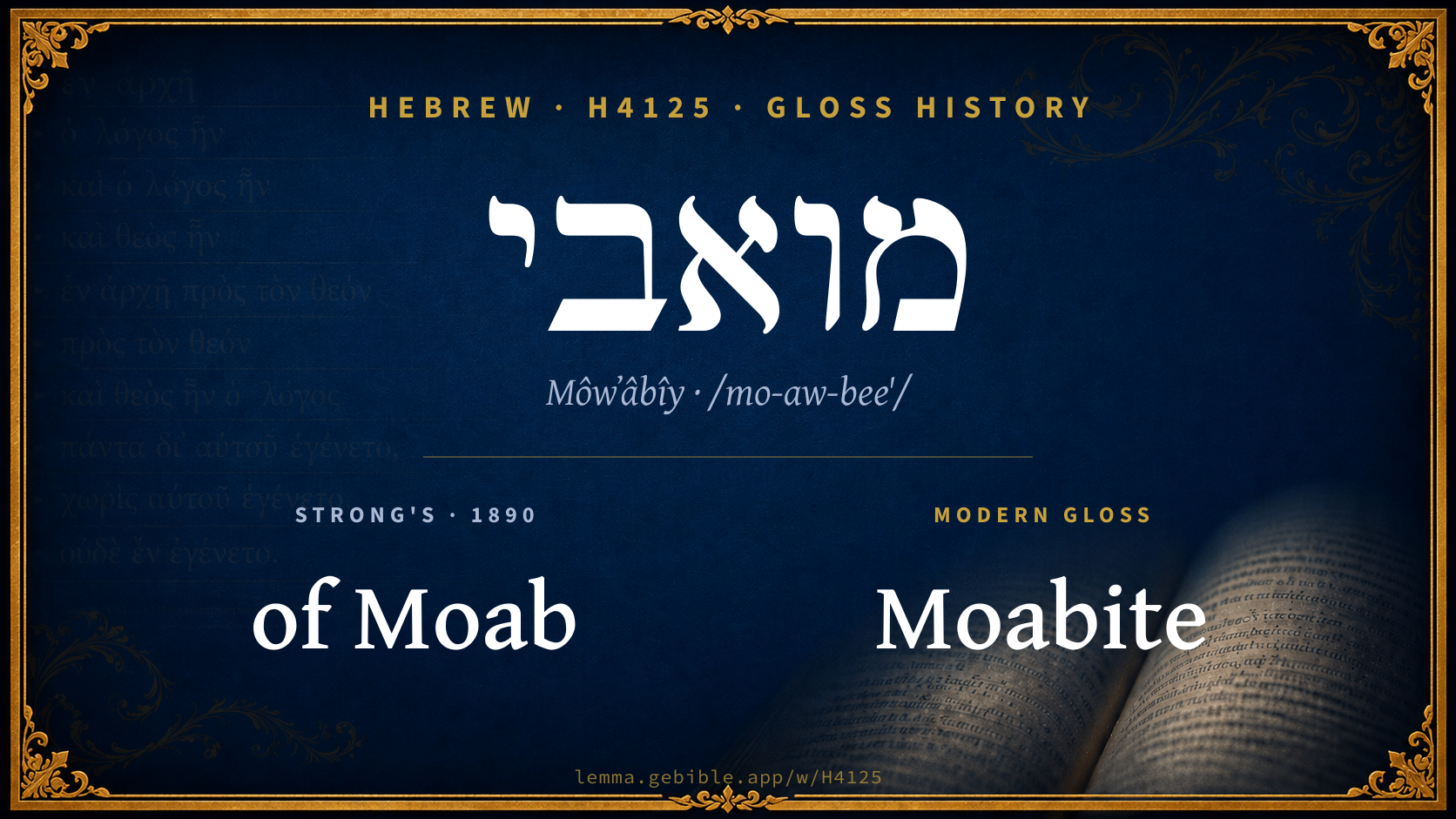
Gloss history
Strong's 1890 vs modern scholarship
About this word
Strong's H4125 catalogs a Hebrew word from the Hebrew Old Testament.
These counts are not copied from any lexicon or concordance. They are computed here, from the morphology-tagged Hebrew Old Testament. What Lemma adds →
- 16
- distinct verses
- The word appears in 16 distinct verses.
- 7 / 39
- OT books
- The word appears in 7 of 39 Old Testament books.
- #1,752
- by frequency
- Top 2500 most frequent Hebrew words (rank 1,752 of 8,640 Hebrew words by occurrence).
View all 16 occurrences in the concordance →
Most concentrated in
- Ruth 7 verses 44%
- Deuteronomy 3 verses 19%
- Nehemiah 2 verses 13%
By section of the Old Testament
By traditional corpus
Conventional, traditional groupings — biblical authorship is debated, so this is a traditional corpus grouping, not an authorship claim. Each share is this word’s portion of its verses in that division of the Hebrew canon. Each figure is a share of the word’s 16 distinct verses.
- Writings (Ketuvim) 12 verses · 75%
- Torah (Pentateuch) 3 verses · 19%
- Prophets (Nevi'im) 1 verse · 6%
How translations render this word
Counts come from each version’s own published word-to-Strong’s tagging or interlinear alignment — an approximate guide to how each version renders this word, not a word-level alignment the data otherwise carries. Because each total is that version’s own tagged count, the per-version totals vary from one another and need not match the appearance or distinct-verse counts above. These counts may also differ from a printed concordance because Lemma counts each distinctly tagged rendering and does not collapse phrase taggings into a single head-word total. This is a fixed set of word-tagged versions (KJV, ASV, BSB, ULT) and does not change with the reading translation you choose elsewhere. Each version’s license is shown beside its name below (and on Sources).
- King James Version: Moabitess 6×, Moabites 3×, Moab 2×
- American Standard Version: Moabitess 6×, Moabites 3×, Moab 2×
- Berean Standard Bible: Moabitess 7×, Moabites 3×, Moabite 2×
- unfoldingWord Literal Text: Moabite woman 5×, Moabite 4×, Moabites 2×
King James Version Public Domain
Renders H4125 across 16 tagged occurrences — most commonly:
Plus 3 renderings that appear only once — usually multi-word phrases or single function words the recovered tagging swept in, not distinct renderings.
American Standard Version Public Domain
Renders H4125 across 16 tagged occurrences — most commonly:
Plus 3 renderings that appear only once — usually multi-word phrases or single function words the recovered tagging swept in, not distinct renderings.
Berean Standard Bible Public Domain
Renders H4125 across 16 tagged occurrences — most commonly:
Plus 2 renderings that appear only once — usually multi-word phrases or single function words the recovered tagging swept in, not distinct renderings.
unfoldingWord Literal Text CC BY-SA 4.0
Renders H4125 across 16 tagged occurrences — most commonly:
Plus 5 renderings that appear only once — usually multi-word phrases or single function words the recovered tagging swept in, not distinct renderings.
Senses in BDB
The 3 senses BDB distinguishes for this word, in lexicon order (not ranked by frequency or importance). The full entry — with sub-senses — is in the Lexicon Entry tab.
- Moabite = "from father: what father?"
- an citizen of Moab
- an inhabitant of the land of Moab
Word origin
adj.gent. Moabitish;—מ׳ Dt 23:4 + 2 times, מֹאָבִי Ezr 9:1; pl. מֹאָבִים Dt 2:11; מוֹאָב׳ Dt 2:29; fs. מוֹאֲבִיָּה Ru 1:22 + 4 times; מֹאֲב׳ Ru 4:10; מוֹאָבִית 2 Ch 24:26; fpl. מוֹאֲבִיוֹת 1 K 11:1 Ne 13:23; מֹאֲב׳ Ru 1:4:—m. = a Moabite Dt 23:4 Ne 13:1; הַמּ׳ = the Moabite 1 Ch 11:46; coll. = the Moabites Ezr 9:1, so pl. Dt 2:11, 29; fpl. as adj. נָשִׁים מ׳ Ru 1:4; as subst., 1 K 11:1 Ne 13:23; fs. as adj. 2 Ch 24:26; especially רוּת הַמּ׳ Ru 1:22; 2:2, 21; 4:5, 10; מ׳ as n.fs. Ru 2:6.
— Brown-Driver-Briggs (Oxford 1906, public domain), digitized via Sefaria, supplemented by the OpenScriptures HebrewLexicon (CC BY 4.0). See Sources.
Derived from מואב (Môwʼâb) (H4124) — Moab.
Jastrow Dictionary
A second Hebrew/Aramaic lexicon for comparison, covering Aramaic and post-biblical (Talmudic, Targumic, Midrashic) usage that the biblical-Hebrew BDB does not. Matched by lemma rather than by Strong’s number, so a lemma may carry more than one Jastrow headword (shown separately below), and the entries cover usage well beyond the Bible.
מוֹאָבִי
- (b. h.) Moabite. Yeb. VIII, 3 עמוני ומ׳ אסורים וכ׳ marriage with an Ammonite or a Moabite is forbidden and the prohibition continues forever (with reference to their descendants; Deut. XXIII, 4); a. fr.—Pl. מוֹאָבִים, מוֹאָבִיִּים, מוֹאָבִיִּין. Num. R. s. 20. Gen. R. s. 74; a. fr.—Fem. מוֹאָבִית. Yeb. 69ᵃ, a. e. (ref. to Deut. l. c.) מואבי ולא מ׳ a male Moabite is excluded from intermarriage but not a female. e.g. Deuteronomy 23:4
A Dictionary of the Targumim, the Talmud Babli and Yerushalmi, and the Midrashic Literature (Marcus Jastrow; London, Luzac, 1903) — Public Domain. Digitized via Sefaria. Digitized via Sefaria. Full attribution on Sources.
Forms in the corpus
The 15 distinct written forms H4125 takes in the Hebrew Bible, most frequent first — each parse links to that state’s occurrences in the concordance. Hebrew forms include their vowel points and cantillation, so a single lemma takes many written forms.
| Form | Parsing | Example | Uses |
|---|---|---|---|
| הַ/מּוֹאֲבִיָּ֤ה | Noun, Gentilic, Feminine, Singular, Absolute | Ruth 1:22 | 2 |
| הַ/מֹּ֣אָבִ֔י | Noun, Gentilic, Masculine, Singular, Absolute | Ezra 9:1 | 1 |
| הַ/מֹּאֲבִיָּה֩ | Noun, Gentilic, Feminine, Singular, Absolute | Ruth 4:10 | 1 |
| הַ/מּוֹאֲבִיָּ֑ה | Noun, Gentilic, Feminine, Singular, Absolute | Ruth 2:21 | 1 |
| הַ/מּוֹאֲבִיָּ֜ה | Noun, Gentilic, Feminine, Singular, Absolute | Ruth 2:2 | 1 |
| הַ/מּוֹאָבִֽי | Noun, Gentilic, Masculine, Singular, Absolute | 1 Chronicles 11:46 | 1 |
| הַ/מּוֹאָבִֽית | Noun, Gentilic, Feminine, Singular, Absolute | 2 Chronicles 24:26 | 1 |
| וְ/הַ/מּ֣וֹאָבִ֔ים | Noun, Gentilic, Masculine, Plural, Absolute | Deuteronomy 2:29 | 1 |
| וְ/הַ/מֹּ֣אָבִ֔ים | Noun, Gentilic, Masculine, Plural, Absolute | Deuteronomy 2:11 | 1 |
| וּ/מֹאָבִ֛י | Noun, Gentilic, Masculine, Singular, Absolute | Nehemiah 13:1 | 1 |
| וּ/מוֹאָבִ֖י | Noun, Gentilic, Masculine, Singular, Absolute | Deuteronomy 23:3 | 1 |
| מֹֽאֲבִיּ֔וֹת | Noun, Gentilic, Feminine, Plural, Absolute | Ruth 1:4 | 1 |
| מֽוֹאֲבִיָּה֙ | Noun, Gentilic, Feminine, Singular, Absolute | Ruth 2:6 | 1 |
| מוֹאֲבִיּ֤וֹת | Noun, Gentilic, Feminine, Plural, Absolute | 1 Kings 11:1 | 1 |
| מוֹאֲבִיּֽוֹת | Noun, Gentilic, Feminine, Plural, Absolute | Nehemiah 13:23 | 1 |
Bible dictionary
Public-domain dictionary articles matched to this entry by name (Moabite). A biblical name can be shared by more than one person or place, so an article may treat several.
Easton's Bible Dictionary · M. G. Easton, 1897
The designation of a tribe descended from Moab, the son of Lot (Gen. 19:37). From Zoar, the cradle of this tribe, on the south-eastern border of the Dead Sea, they gradually spread over the region on the east of Jordan. Rameses II., the Pharaoh of the Oppression, enumerates Moab (Muab) among his conquests. Shortly before the Exodus, the warlike Amorites crossed the Jordan under Sihon their king and drove the Moabites (Num. 21:26-30) out of the region between the Arnon and the Jabbok, and occupied it, making Heshbon their capital. They were then confined to the territory to the south of the Arnon.
On their journey the Israelites did not pass through Moab, but through the "wilderness" to the east (Deut. 2:8; Judg. 11:18), at length reaching the country to the north of the Arnon. Here they remained for some time till they had conquered Bashan (see SIHON; OG). The Moabites were alarmed, and their king, Balak, sought aid from the Midianites (Num. 22:2-4). It was while they were here that the visit of Balaam (q.v.) to Balak took place. (See MOSES.)
After the Conquest, the Moabites maintained hostile relations with the Israelites, and frequently harassed them in war (Judg. 3:12-30; 1 Sam. 14). The story of Ruth, however, shows the existence of friendly relations between Moab and Bethlehem. By his descent from Ruth, David may be said to have had Moabite blood in his veins. Yet there was war between David and the Moabites (2 Sam. 8:2; 23:20; 1 Chr. 18:2), from whom he took great spoil (2 Sam. 8:2, 11, 12; 1 Chr. 11:22; 18:11).
During the one hundred and fifty years which followed the defeat of the Moabites, after the death of Ahab (see MESHA), they regained, apparently, much of their former prosperty. At this time Isaiah (15:1) delivered his "burden of Moab," predicting the coming of judgment on that land (comp. 2 Kings 17:3; 18:9; 1 Chr. 5:25, 26). Between the time of Isaiah and the commencement of the Babylonian captivity we have very seldom any reference to Moab (Jer. 25:21; 27:3; 40:11; Zeph. 2:8-10).
After the Return, it was Sanballat, a Moabite, who took chief part in seeking to prevent the rebuilding of Jerusalem (Neh. 2:19; 4:1; 6:1).
Classic public-domain reference works; full attribution on Sources.
Septuagint verse parallels
This word appears in 14 verses that also exist in the Greek Old Testament (Septuagint), out of the 16 Hebrew verses it occurs in. You can read those verses in Greek by switching the Old Testament edition to the Septuagint.
Read these verses in the Septuagint
This is a verse-level parallel only — the same verses exist in both the Hebrew and Greek Old Testaments. No word-level Hebrew↔Greek correspondence is claimed: the data carries no such alignment, so no Greek word is shown as this Hebrew word’s translation. Coverage is not total — the Septuagint omits the deuterocanon and renumbers the Psalms, so some Hebrew verses have no direct Greek parallel.