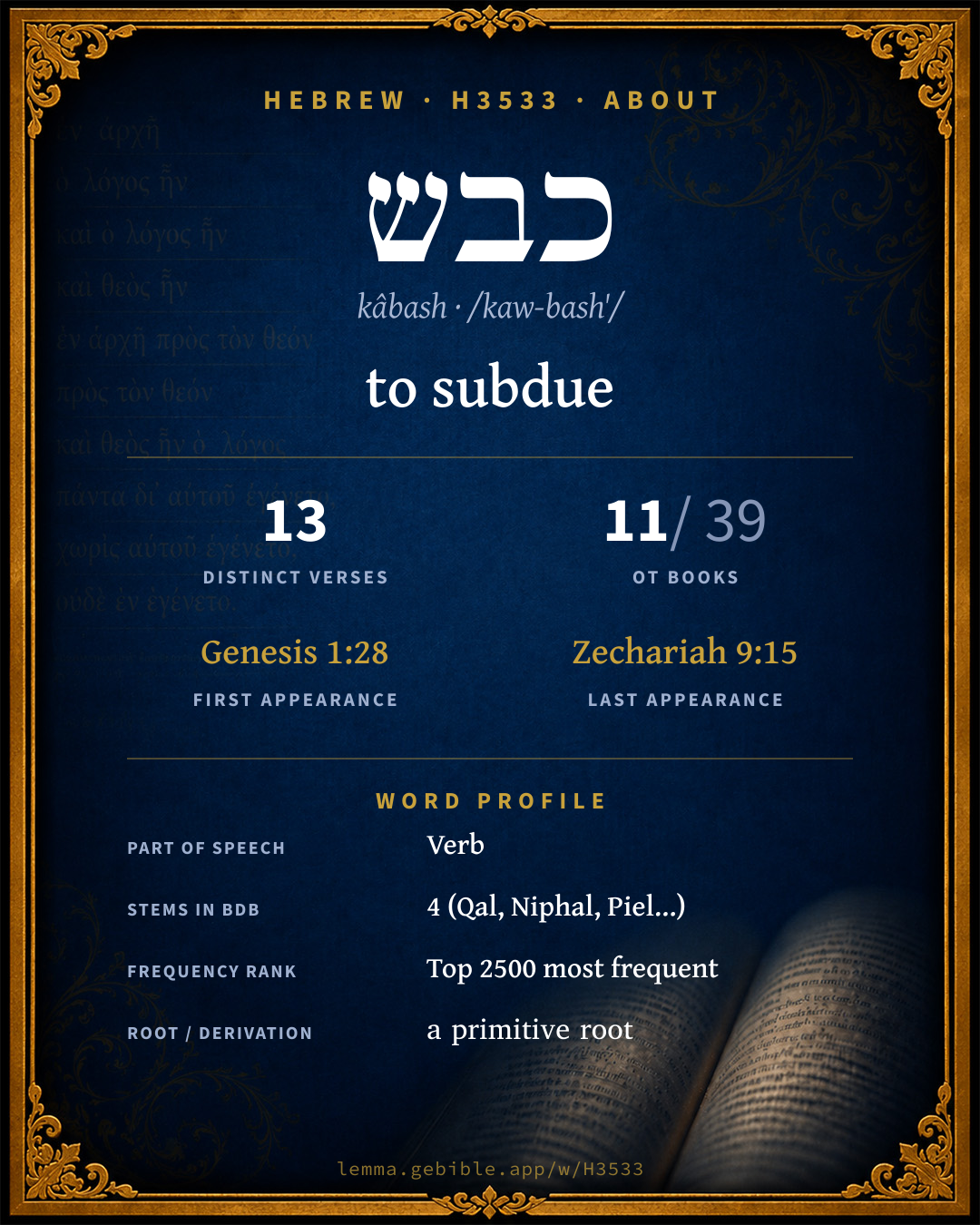
כָּבַשׁ
to subdue
‘to subdue’ is one of 4 main senses fuller range ↓
Full lexicon entry — Brown-Driver-Briggs (BDB)
From Brown-Driver-Briggs (BDB)
Where this word appears
See every Qal verb in the Hebrew Bible →
Grammar key — what these labels mean
Part of speech
- Verb
- An action or state-of-being word.
Stem
- Niphal
- Usually the simple passive or reflexive of the Qal (“he was written”).
- Qal
- The basic, simple active stem — the plain form of the verb (“he wrote”). Here: ‘bring into bondage’
- Hiphil
- The causative active stem (“he caused / brought about”).
- Piel
- An intensive or resultative active stem.
Form
- Sequential Perfect
- A perfect with prefixed waw continuing a preceding imperfect or command (waw-consecutive perfect).
- Infinitive Construct
- A bound verbal noun, frequently with prepositions (“to write / in writing”).
- Sequential Imperfect
- An imperfect with prefixed waw — the standard past-narrative form (waw-consecutive imperfect).
- Perfect
- A completed action or state — Hebrew marks aspect (completeness) more than strict tense (“he wrote”).
- Imperative
- A direct command (“write!”).
- Participle Passive
- A verbal adjective expressing action received (“written”).
- Imperfect
- An incomplete, ongoing, or future action (“he will / would write”).
- Participle Active
- A verbal adjective expressing ongoing or characteristic action (“writing / one who writes”).
State
- Absolute
- The independent form of a noun, not bound to a following word.
Person
- 3rd Person
- The one spoken about (“he / she / it / they”).
- 2nd Person
- The one addressed (“you”).
Gender
- Feminine
- Grammatically feminine.
- Masculine
- Grammatically masculine.
- Common
- Either gender — not distinguished for this form.
Number
- Singular
- One.
- Plural
- More than one (in Hebrew, generally three or more).
1 verse where H3533 appears in the Hiphil stem in the Book of Jeremiah. Filtered view — show all forms. Click any verse to open its interlinear word-by-word view. Verse text shown in the World English Bible for context — . Each verse’s Hebrew form is shown with its reference; the English is not keyword-highlighted, since the data carries no word-level English alignment. Use “Compare translations” on any verse to read it across multiple English versions. This concordance covers the Hebrew Bible; Septuagint (Greek Old Testament) occurrences are not indexed here.
Jeremiah
About this entry
At a glance — auto-summarized from this page’s data, not written by a person. Every figure links to its source below. This summary describes the numbers; it doesn’t interpret them.
כבש — transliterated kâbash — is a Hebrew verb carrying the sense “to subdue.” As a verb its force shifts by stem, across 4 stems (Qal, Niphal, and more). It appears 13 verses across 11 books of the Hebrew Bible, among its uncommon vocabulary. Debuting at Genesis 1:28, it then recurs through the corpus. Related forms include כבש and כבשן. Each statement above links to its evidence; the full detail follows below.
Gloss history
Strong's 1890 vs modern scholarship
About this word
Strong's H3533 catalogs a Hebrew word from the Hebrew Old Testament.
These counts are not copied from any lexicon or concordance. They are computed here, from the morphology-tagged Hebrew Old Testament. What Lemma adds →
- 13
- distinct verses
- The word appears in 13 distinct verses.
- 11 / 39
- OT books
- The word appears in 11 of 39 Old Testament books.
- #1,836
- by frequency
- Top 2500 most frequent Hebrew words (rank 1,836 of 8,640 Hebrew words by occurrence).
View all 13 occurrences in the concordance →
By section of the Old Testament
By traditional corpus
Conventional, traditional groupings — biblical authorship is debated, so this is a traditional corpus grouping, not an authorship claim. Each share is this word’s portion of its verses in that division of the Hebrew canon. Each figure is a share of the word’s 13 distinct verses.
- Prophets (Nevi'im) 6 verses · 46%
- Writings (Ketuvim) 4 verses · 31%
- Torah (Pentateuch) 3 verses · 23%
How translations render this word
Counts come from each version’s own published word-to-Strong’s tagging or interlinear alignment — an approximate guide to how each version renders this word, not a word-level alignment the data otherwise carries. Because each total is that version’s own tagged count, the per-version totals vary from one another and need not match the appearance or distinct-verse counts above. These counts may also differ from a printed concordance because Lemma counts each distinctly tagged rendering and does not collapse phrase taggings into a single head-word total. This is a fixed set of word-tagged versions (KJV, ASV, BSB, ULT) and does not change with the reading translation you choose elsewhere. Each version’s license is shown beside its name below (and on Sources).
- King James Version: Brought them into subjection 2×
- American Standard Version: Is subdued 2×
- Berean Standard Bible: Is subdued 2×
- unfoldingWord Literal Text: And 3×, Is subdued 2×
King James Version Public Domain
Renders H3533 across 14 tagged occurrences — most commonly:
Plus 12 renderings that appear only once — usually multi-word phrases or single function words the recovered tagging swept in, not distinct renderings. Not rendered by a distinct English word in 1 further occurrence.
American Standard Version Public Domain
Renders H3533 across 14 tagged occurrences — most commonly:
Plus 12 renderings that appear only once — usually multi-word phrases or single function words the recovered tagging swept in, not distinct renderings.
Berean Standard Bible Public Domain
Renders H3533 across 14 tagged occurrences — most commonly:
Plus 12 renderings that appear only once — usually multi-word phrases or single function words the recovered tagging swept in, not distinct renderings.
unfoldingWord Literal Text CC BY-SA 4.0
Renders H3533 across 16 tagged occurrences — most commonly:
Plus 11 renderings that appear only once — usually multi-word phrases or single function words the recovered tagging swept in, not distinct renderings.
7 senses and sub-senses in the full BDB
Hebrew verbs can shift meaning by stem (binyan): Qal is the basic action, Niphal is often passive or reflexive, Piel often intensifies or makes it factitive, and Hiphil is typically causative. The senses below are grouped under the stem BDB assigns to each.
What do BDB’s symbols mean?
BDB uses these scholarly abbreviations:
| Symbol | Meaning |
|---|---|
| 𝔊 | the Septuagint (the ancient Greek translation, LXX) |
| 𝔙 | the Vulgate (the Latin translation) |
| 𝔖 | the Syriac version (the Peshitta) |
| 𝔗 | the Targum (the Aramaic translation) |
| ψ | the Psalms |
| √ | root (the underlying root or stem) |
| ‖ | parallel passage (a synonymous or contrasted parallel) |
| † | the dagger: every passage where the word occurs is cited |
The 7 senses and sub-senses the full Brown-Driver-Briggs lexicon distinguishes for this word, in lexicon order (not ranked by frequency), with BDB’s own verbatim wording and sub-sense lettering. Shown in Hebrew script with BDB’s own scholarly abbreviations. The condensed entry is in the Lexicon Entry tab. See also the Forms in the corpus table below.
Qal
- Pf. 3 pl. וְכָֽבְשׁוּ consec. Zc 9:15; Impf. יִכְבּוֹשׁ Mi 7:19; וַיִּכְבְּשׁוּם Je 34:11 Qr (Kt Hiph), etc.; Imv. pl. sf. כִּבְשֻׁהָ Gn 1:28; Inf. כְּבוֹשׁ 2 Ch 28:10 Est 7:8; Pt. כֹּבְשִׁים Ne 5:5;— e.g. Zechariah 9:15
- 1. bring into bondage, sq. acc. + לַעֲבָדִים Je 34:11, 16 2 Ch 28:10 Ne 5:5. e.g. Jeremiah 34:11
- 2. (late) subdue, force, a woman Est 7:8 (= earlier עִנָּה). e.g. Esther 7:8
- 3. subdue, dominate, the earth Gn 1:28 (P), Zc 9:15 (of conquest); tread down, sq. אַבְנֵי־קֶלַע; fig. subdue, sq. עֲוֹנֹתֵינוּ Mi 7:19. e.g. Genesis 1:28
Niphal
- Pf. 3 fs. נִכְבְּשָׁה Jos 18:1 + 3 times; Pt. fpl. נִכְבָּשׁוֹת Ne 5:5;—pass. of Qal 1, subj. בְּנוֹתֵינוּ Ne 5:5; of Qal 3, subj. הָאָרֶץ (of conquest) Nu 32:22, 29 Jos 18:1 (all P), 1 Ch 22:18. e.g. Joshua 18:1
Piel
- Pf. כִּבֵּשׁ subdued 2 S 8:11, obj. גּוֹיִם. e.g. 2 Samuel 8:11
Hiphil
- Impf. bring into bondage sq. acc. + לַעֲבָדִים Je 34:11 Kt (Qr Qal). e.g. Jeremiah 34:11
Senses from the full Brown-Driver-Briggs lexicon (Brown, Driver, Briggs; Oxford 1906 — public domain), digitized via Sefaria, supplemented by the OpenScriptures HebrewLexicon (CC BY 4.0). Full attribution on Sources.
Word origin
vb. subdue, bring into bondage (NH id., press, oppress; Aramaic כְּבַשׁ, ܟܒܰܫ tread down, beat or make a path, subdue; Arabic كَبَسَ press, squeeze, knead (body or limb, as in the bath, massage), also attack, assault)—
— Brown-Driver-Briggs (Oxford 1906, public domain), digitized via Sefaria, supplemented by the OpenScriptures HebrewLexicon (CC BY 4.0). See Sources.
Origin: a primitive root
Jastrow Dictionary
A second Hebrew/Aramaic lexicon for comparison, covering Aramaic and post-biblical (Talmudic, Targumic, Midrashic) usage that the biblical-Hebrew BDB does not. Matched by lemma rather than by Strong’s number, so a lemma may carry more than one Jastrow headword (shown separately below), and the entries cover usage well beyond the Bible.
כָּבַשׁ
- 1. to press, squeeze. Ohol. VIII, 5 כ׳ את האבן וכ׳ if one pressed a stone on (weighted) the sheet. Bets. 23ᵇ שהיא כּוֹבֶשֶׁת because it (the wagon) presses (the ground) down. Sabb. XX, 5 לא כוֹבְשִׁין you must not screw down, v. מַכְבֵּשׁ; a. fr.—Part. pass. כָּבוּשׁ, f. כְּבוּשָׁה pressed, compressed; pressing. Ib. 135ᵃ; Tosef. ib. XV (XVI), 9; a. e. ערלה כ׳ היא the foreskin (which seems to be wanting) is pressed (to the membrum). Tosef. Ohol. IX, 4 כאילו אבנים כְּבוּשׁוֹת וכ׳ as if stones were placed tightly upon them. Ex. R. s. 15 ההר … כְּבוּשִׁין על וכ׳ a mountain on each side pressing upon (preventing the run of) the springs; a. fr.
- 2. כ׳ פנים (בקרקע) to press the face into the ground, to hide one’s self in fear or shame. Snh. 19ᵇ כָּבְשׁוּ פניהם בקרקע they cast their looks down (were afraid to give an opinion). Y. ib. X, 27ᵈ (ref. to Is. VII, 3) א"ת כובס אלא כּוֹבֵשׁ שהיה כובש פניו וכ׳ read not kobes, but kobesh, for he hid his face and fled before him; (Bab. ib. 104ᵃ דכבשינהו לאפי Chald.).—3) to press vegetables, meat &c.; to preserve, pickle. Toh. II, 1 האשה … כּוֹבֶשֶׁת וכ׳ if a woman was pressing vegetables in a pot. Ukts. II, 1 זתים שכְּבָשָׁן וכ׳ olives which one pressed with their leaves; a. fr.—Part. pass. כָּבוּשׁ preserved substance, pickle. Ḥull. 97ᵇ, a. fr. כ׳ הרי הוא כמבושל preserved substances are in ritual law like cooked.—Pl. כְּבוּשִׁין. Pes. II, 6. Y. Sabb. I, 3ᶜ bot. כְּבוּשֵׁיהֶן preserves made by gentiles; a. fr. e.g. Isaiah 7:3
- 4. Trnsf. to store, hide. Ḥag. 13ᵃ (ref. to Prov. XXVII, 26) א"ת כבשים אלא כְּבוּשִׁים Ms. M. (missing in ed.; v. Rabb. D. S. a. l. note) read not K’basim (sheep) but K’bushim (hidden things), v. כִּבְשָׁן; Yalk. Prov. 961.—Sot. 10ᵇ; Macc. 23ᵇ (ref. to Gen. XXXVIII, 25) יצאת … ממני יצאו כבושים a divine voice went forth and said, ‘from me went forth the secret things’ (I declare that Judah is the father of Tamar’s children; Ar.: ממני היו הדברים כ׳, v. Rabb. D. S. a. l. note 6); Yalk. Gen. 145; Yalk.Sam. 112., v. Rabb. D. S. a. l. note 6); Yalk. Gen. 145; Yalk.Sam. 112. e.g. Proverbs 27:26
- to detain (cmp. עצר). Pesik. Bayom, p. 193ᵇ; כָּבְשָׁה אותם מטרונא וכ׳ the matron detained them one day longer; כבשה אותן התורה וכ׳ the Law detained them one day longer (before the Lord); ib. 195ᵃ, sq.; Pesik. R. suppl., s. 4. Gen. R. s. 8, end האיש כּוֹבֵשׁ וכ׳ the man detains his wife from going out; a. e.
- 6. to suppress, restrain, conquer. Snh. XI, 5 (89ᵃ) הכּוֹבֵש את נבואתו (a prophet) who suppresses his prophecy (being afraid to proclaim it). Ab. IV, 1 הכיבש את יצרו who conquers his passion. Lam. R. to V, 1 כובש את הגדול (not כביש), v. זַרְזִיר I. Y. Succ. V, 55ᵇ top עד שאתה מְכַבֵּשׁ … בוא וכְבוֹש וכ׳ instead of conquering the barbarians, come and subdue the Jews; Lam. R. to I, 16; ib. to IV, 19. Ex. R. s. 25 הוא כוֹבְשׁוֹ וכ׳ he suppresses (withholds the evidence) and does not produce it.—כ׳ עון to suppress guilt, to forgive, cause forgiveness. Pesik. Eth Korb., p. 61ᵇ; Pesik. R. s. 16, v. כֶּבֶשׁ; a. fr.
- 7. to violate. Esth. R. to VII, 7 [read:] הרי הוא כּוֹבְשֵׁנִי וכ׳ behold, he is attacking me in thy presence.
- 8. to pave, grade a road.—Part. pass. כָּבוּשׁ, f. כְּבוּשָׁה. Tanḥ. Ḥuck. 20 דרך כ׳ a graded road; ib. ed. Bub. 47; Yalk. Num. 764. [Pirké d’R. El. ch. LII כובשים במזלות, read with Yalk. Josh. 22: חושבים; Yalk. Gen. 77 רוגשים.]
- 1. to press, squeeze.—Part. pass. מְכוּבָּשׁ, pl. מְכוּבָּשִׁים. Tosef. Mikv. VI (VII), 17 לכלוכי צואה … המ׳ (ed. Zuck. והמכושים, corr. acc.) secretory substances … which are compressed, i.e. dried up by being sat upon.
- 2. (cmp. סָלַל II) to press down, make even, grade. Bets. IV, 5 מְכַבְּשִׁין you may press the ashes down (make a graded surface for baking); a. e.—Trnsf. to level, make plain. Cant. R. to I, 2 (play on כבשים, Prov. XXVIII, 26, v. כֶּבֶשׁ) … כְּבָשִׁים … תהי׳ מְכַבֵּשׁ לפניהם וכ׳ it may be read K’bashim (grades), as long as thy pupils are young, make the words of the Law plain before them; when they are older reveal to them the secrets (reasons) of the Law; Yalk. ib. 985 הֱיֵה כוֹבֵשׁ לפניהם (another expl., v. infra).—כ׳ את הריחיים [to carve steps for the grain,] to put the millstones in working order. M. Kat. I, 9; expl. ib. 10ᵃ to sharpen the millstones (v. נָקַר I), (oth. opin.) to cut the hole out for the hopper. e.g. Proverbs 28:26
- 3. (interch. with Kal) to conquer, defeat. Y. Peah VII, 20ᶜ top שבע שכִּיבְּשׁוּ seven years during which they were engaged in conquering the land; Ḥull. 17ᵃ שכבשו. Sifré Deut. 51 לכַבֵּש ח"ל עד שלא יְכַבְּשׁוּ וכ׳ to conquer foreign land before they shall have conquered Palestine. Pes. 5ᵇ נכרי שכִּיבַּשְׁתּוֹ a gentile who is in thy power. Yeb. 65ᵇ (ref. to וכבשה, Gen. I, 28) איש דרכו לכַבֵּשׁ וכ׳ it is man who conquers (the earth) but not woman; Kidd. 35ᵃ; a. fr. e.g. Genesis 1:28
- 4. to suppress, withhold. Cant. R. l. c. תהי׳ מכבש לפניהם וכ׳ withhold from them, i.e. teach them merely the words of the Law without arguments; (another expl., v. supra).
- 5. (denom. of כֶּבֶשׁ) to storm, climb over. Tosef. Sot. VI, 6 מכבש את הגנות וכ׳ climbing over the garden fences and violating the women; Gen. R. s. 53; Yalk. Gen. 94 מַכְבִּישׁ Hif.
- 1. to be pressed down, suppressed. Pesik. Eth. Korb. p. 61ᵇ כל דבר שהוא נ׳ סופו לצוף whatever is pressed down, is liable to come to the surface again; Pesik. R. s. 16.
- 2. to be submissive. Midr. Till. to Ps. XXX, end when scholars sit down ונִכְבָּשִׁין אלו לאלו and are submissive (respectful) to one another; (Sabb. 63ᵃ ונוחין).
- 3. to have surreptitious intercourse. Sifra Emor, Par. 6, ch. V נ׳ עם; Yeb. VII, 5 נ׳ על.
- to climb, v. supra.
- to be conquered, be taken. Y. Shebi. VI, 36ᶜ bot. כמי שנִתְכַּבְּשׁוּ they are to be treated as if they had been subdued (in the days of Joshua). Ib. שמא נִתְכַּבְּשָׁה מד"ת perhaps it was to be taken by the command of the Law; Y. Yeb. VII, 8ᵃ bot. (corr. acc.). Ex. R. s. 18 עכשיו … מִתְכַּבֶּשֶׁת בידו just now Jerusalem may be taken by him (Sennacherib). [Pesik. Zutr., Ekeb, ed. Bub. p. 30 מתכבשים, מתכבשות, v. כָּתַשׁ.]
כְּבַשׁ
- 1. to press, grade, make a path. Targ. Job XIX, 12 (h. text סלל). Targ. Is. XL, 3; a. e.— Part. pass. כָּבִישׁ, f. כְּבִישָׁא. Targ. O. Num. XX, 19 (not כְּבָשָׁא). Targ. Is. XI, 16; a. e.—Pl. כְּבִישִׁין dams. Ib. XIX, 10.—Erub. 34ᵇ כְּבוּשׁוּ כבשי וכ׳ make a dam (or embankment) in the reed-marshes.
- 2. to press on, to put on (the head). Targ. Y. Lev. VIII, 13 (h. text חבש).
- 3. to bind, fillet; to inlay. Targ. Y. Ex. XXXVIII, 28 (h. text חשק; O. Pa.). Targ. Is. LIV, 11.—Part. pass. as ab.; pl. f. כְּבִישָׁן.
- 4. (with על) to tread upon, to stamp out. Targ. Mic. VII, 19. Targ. Esth. I, 5.
- 5. (interch. with Pa.) to suppress, oppress; to conquer, force; to violate. Targ. Josh. VIII, 21. Targ. Ps. IV, 6. Targ. II Esth. VII, 8; a. fr.—Part. pass. as ab. Targ. Hos. V, 11.—Zeb. 73ᵇ, נִיכְבְּשִׁינְהוּ, v. נוּד ch. Y. Sabb. IV, end, 7ᵃ דילמא לא כ׳ צינתה will it (the band around the head) not overcome (counter-act the effect of) the cold?
- 6. to withhold, detain. Targ. Y. II, Gen. XXIX, 22.—Nidd. 39ᵇ a hen that laid one day וכַבְשָׁה יומא וכ׳ and held back (failed to lay) one day &c.
- 7. to hide (the face); to close (the eyes). Targ. Ex. III, 6. Targ. Lev. XX, 4; a. fr.—Targ. O. Deut. XXII, 1 ed. Berl. (ed. Ithpe.); ib. 4 (sub. עינין).—B. Bath. 40ᵇ כְּבִישְׁנָא לשטר וכ׳ I shall hide the deed of mortgage.
- same. Targ. Prov. XVI, 32 מְכַבֵּישׁ Ms. (ed. מַכְבֵּישׁ Af.) who conquers. Targ. Josh. VIII, 19.—Targ. O. Ex. XXXVIII, 28 (v. supra). Targ. Lam. III, 34; a. fr.—Snh. 95ᵃ דכַבְּשִׁית בתקוף ידי which I conquered with the strength of my hand; [ib. כבשית כל מדינתי, read כנשית;] Yalk. Is. 284.—Part. pass. מְכַבַּשׁ, f. מְכַבְּשָׁא; pl. מְכַבְּשִׁין; מְכַכְּשָׁן. Targ. Ex. XXXVIII, 17 (h. text מחשקים). Ib. XXVII, 17 (not מְכֻבָּשִׁין, v. O. ed. Berl.). Targ. Am. VI, 4.—Targ. Jer. XVIII, 15 (h. text סלולה); a. e.
- , v. supra.
- 1. to be conquered; to be subdued, oppressed. Targ. Num. XXXII, 22. Targ. Y. Gen. XVI, 9 (some ed. אתכנעי); a. e.
- 2. (of the face) to be sunk (in fear, shame), to grieve. Targ. Gen. IV, 5; 6 (h. text נפל).
- 3. to withdraw one’s self. Targ. O. Deut. XXII, 1, v. supra.
כֶּבֶשׂ
- prob. fr. כבש to be thick, strong; cmp. Arab. kabš, a. v. אִימַּר) sheep (at least one year old). Men. XIII, 7, sq.; a. fr.—Pl. כְּבָשִׂים. Ib. 9 אחד מִכְּבָשַׂי one of my sheep. Zeb. IX, 5; a. fr.—Fem. כִּבְשָׂה or כַּבְשָׂה. Gen. R. s. 44 כ׳ של יחיד the sheep which is offered as an individual’s sacrifice. Tosef. Yeb. III, 4; Yoma 66ᵇ (v. Tosaf. a. l.)—Lev. R. s. 37; Tanḥ. Vayishl. 8 מביא (אדם) כִּבְשָׂתוֹ וכ׳ let man bring his sheep directly to the Temple court (without previous dedication by a vow); Y. Ned. I, 36ᵈ כִּשְׂבָּתוֹ. Tanḥ. Tol’d. 5; Esth. R. to IX, 2 גדולה היא הכ׳ וכ׳ great is the sheep (Israel) that lives among seventy wolves (nations). Tanḥ. Ki Thissa 4 אדם ששבה את הכ׳ וכ׳ a man who captured the lamb (Bathsheba, v. II Sam. XII, 3, sq.) and killed the shepherd (Uriah); a. fr. e.g. 2 Samuel 12:3
כֶּבֶשׁ
- m (b. h.;
- 1. press.—Pl. כְּבָשִׁים, כְּבָשִׁין. Pesik. Eth. Korb., p. 61ᵇ (play on כבשים, Num. XXVIII, 3) כ׳ שהן כובשין וכ׳ (the sacrifices are) presses, for they suppress the sins &c.; Pesik. R. s. 16. e.g. Numbers 28:3
- 2. ascent, grade, landing bridge. Zab. III, 1; 3. Sabb. XVI, 8; a. e.—Esp. the inclined plane leading to the altar. Midd. III, 3. Zeb. V, 3; a. fr.—Pl. as ab. Ib. 62ᵇ. Ib. 63ᵃ כל כִּבְשִי כבשים … חוץ של מזבח וכ׳ all grades of ascents (in the Temple) were at the rate of three cubits per one cubit (of vertical elevation), except the ascent of the altar which was at the rate of three cubits and a half and &c.; (for Var. lect. v. Rabb. D. S. a. l., and Tosaf. a. l. a. Men. 41ᵇ s. v. ארבעה); Y. Erub. II, 24ᵇ bot., v. כִּיבּוּשׁ h.—Lam. R. introd. (R. Josh. 2); Koh. R. to XII, 7 (expl. דָּיֵק, Ez. XXI, 27) כ׳ embankments round a besieged city (Lat. agger, v. כּוֹבֵשׁ). e.g. Ezekiel 21:27
- 3. preserving fruit. Ter. II, 6 זיתי כ׳ olives good for preserves, opp. זתי שמן.—Pl. as ab. pressed, preserved vegetables &c., Shebi. IX, 5 הכובש שלשה כ׳ וכ׳ if one puts three sorts of pressed vegetables into one vessel. Sabb. 108ᵇ; a. e.—[Gen. R. s. 66 כבשיהן some ed., v. כִּיבּוּשׁ h.]
כֵּבַשׁ I
- v. כִּיבּוּשׁ ch.
כֵּבַשׁ II
- 1. ascent (scamnum), stepping stool. Targ. I Chr. XXVI, 16 (h. text מסלה). Ib. XXVIII, 2 כבש (constr.); Targ. Ps. CXXXII, 7 (h. text הדם). Targ. Is. LXVI, 1 כְּבַשׁ (ed. Lag. כֵּיבַשׁ).
- 2. pressboard and loading stone.—Pl. כִּבְשֵׁי, כִּי׳. B. Bath. 67ᵇ (expl. עבירים, Mish. ib.) כִּי׳ Ms. M. (ed. כב׳).
- 3. grade; בֵּי כ׳ a graded field which requires no artificial irrigation, opp. בי שקיא. Kidd. 62ᵇ
- 4. dam or embankment. Pl. as ab. Erub. 34ᵇ, v. כְּבַשׁ.
- 5. the hot ashes (pressed and levelled) in the oven (v. Bets. IV, 5 quot. s. v. כָּבַשׁ Pi.). Ḥull. 93ᵇ רישא בכ׳ a head put in ashes (for removing the hair before boiling).
- 6. path. Targ. II Sam. XX, 12, sq. כי׳ ed. Lag. (ed. Wil. כַּבְ׳). Targ. I Sam. IV, 13 כִּבֶּשׁ constr., v. כְּבִישׁ.—6) (archit.) recess, enceinte. Targ. Ez. XLV, 4; ib. XLVIII, 21 constr. כֵּיבַשׁ ed. Wil. (h. text מקדש).
A Dictionary of the Targumim, the Talmud Babli and Yerushalmi, and the Midrashic Literature (Marcus Jastrow; London, Luzac, 1903) — Public Domain. Digitized via Sefaria. Digitized via Sefaria. Full attribution on Sources.
Forms in the corpus
The 14 distinct written forms H3533 takes in the Hebrew Bible, most frequent first — each parse links to that stem’s occurrences in the concordance. Hebrew forms include their vowel points and cantillation, so a single lemma takes many written forms.
Same root — word family
Other BDB entries built from the same root as H3533, grouped by Strong’s listed origin. These share a root / origin per the lexicon — not necessarily a shared meaning. Each links to that word’s own entry.
Derived from this word
Compare all same-root words → They share a root, not necessarily a meaning.
Septuagint verse parallels
This word appears in 12 verses that also exist in the Greek Old Testament (Septuagint), out of the 13 Hebrew verses it occurs in. You can read those verses in Greek by switching the Old Testament edition to the Septuagint.
Read these verses in the Septuagint
- Genesis 1:28
- Numbers 32:22
- Joshua 18:1
- 2 Samuel 8:11
- 1 Chronicles 22:18
- 2 Chronicles 28:10
- Esther 7:8
- Jeremiah 34:11
- Micah 7:19
- Zechariah 9:15
This is a verse-level parallel only — the same verses exist in both the Hebrew and Greek Old Testaments. No word-level Hebrew↔Greek correspondence is claimed: the data carries no such alignment, so no Greek word is shown as this Hebrew word’s translation. Coverage is not total — the Septuagint omits the deuterocanon and renumbers the Psalms, so some Hebrew verses have no direct Greek parallel.