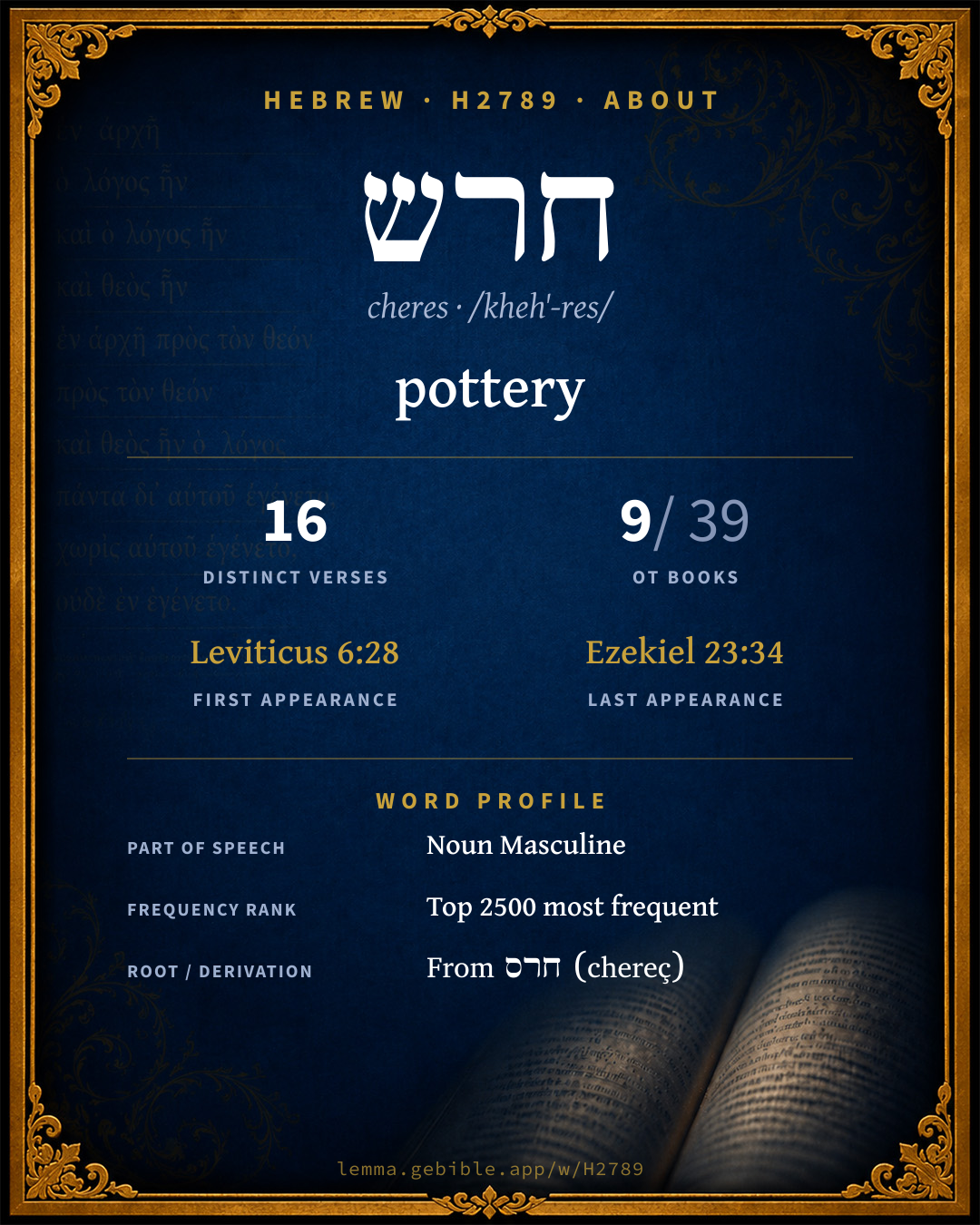
חֶ֫רֶשׂ
pottery
Full lexicon entry — Brown-Driver-Briggs (BDB)
From Brown-Driver-Briggs (BDB)
Where this word appears
See every Absolute-state word in the Hebrew Bible →
Grammar key — what these labels mean
Part of speech
- Noun
- A naming word — a person, place, thing, or idea.
Noun type
- Common
- A common noun — a general class of person, place, or thing (“king,” “city,” “water”), not a specific name.
State
- Absolute
- The independent form of a noun, not bound to a following word.
- Construct
- A noun bound to a following noun in a possessive / “of” relationship (the construct chain).
Gender
- Masculine
- Grammatically masculine.
Number
- Singular
- One.
- Plural
- More than one (in Hebrew, generally three or more).
1 verse where H2789 appears in the Construct state in the Book of Isaiah. Filtered view — show all forms. Click any verse to open its interlinear word-by-word view. Verse text shown in the World English Bible for context — . Each verse’s Hebrew form is shown with its reference; the English is not keyword-highlighted, since the data carries no word-level English alignment. Use “Compare translations” on any verse to read it across multiple English versions. This concordance covers the Hebrew Bible; Septuagint (Greek Old Testament) occurrences are not indexed here.
Isaiah
About this entry
At a glance — auto-summarized from this page’s data, not written by a person. Every figure links to its source below. This summary describes the numbers; it doesn’t interpret them.
חרש (cheres) is a Hebrew noun most often rendered “pottery.” Translators differ — “earthen” in the King James Version, then “clay” (Berean Standard Bible), as the renderings breakdown shows. With 16 verses in 9 books, it is an uncommon word in the Hebrew Bible. It concentrates in Leviticus, which alone accounts for 31% of its uses. It first appears in Leviticus 6:28. The sections below give every sense, occurrence, and version rendering.
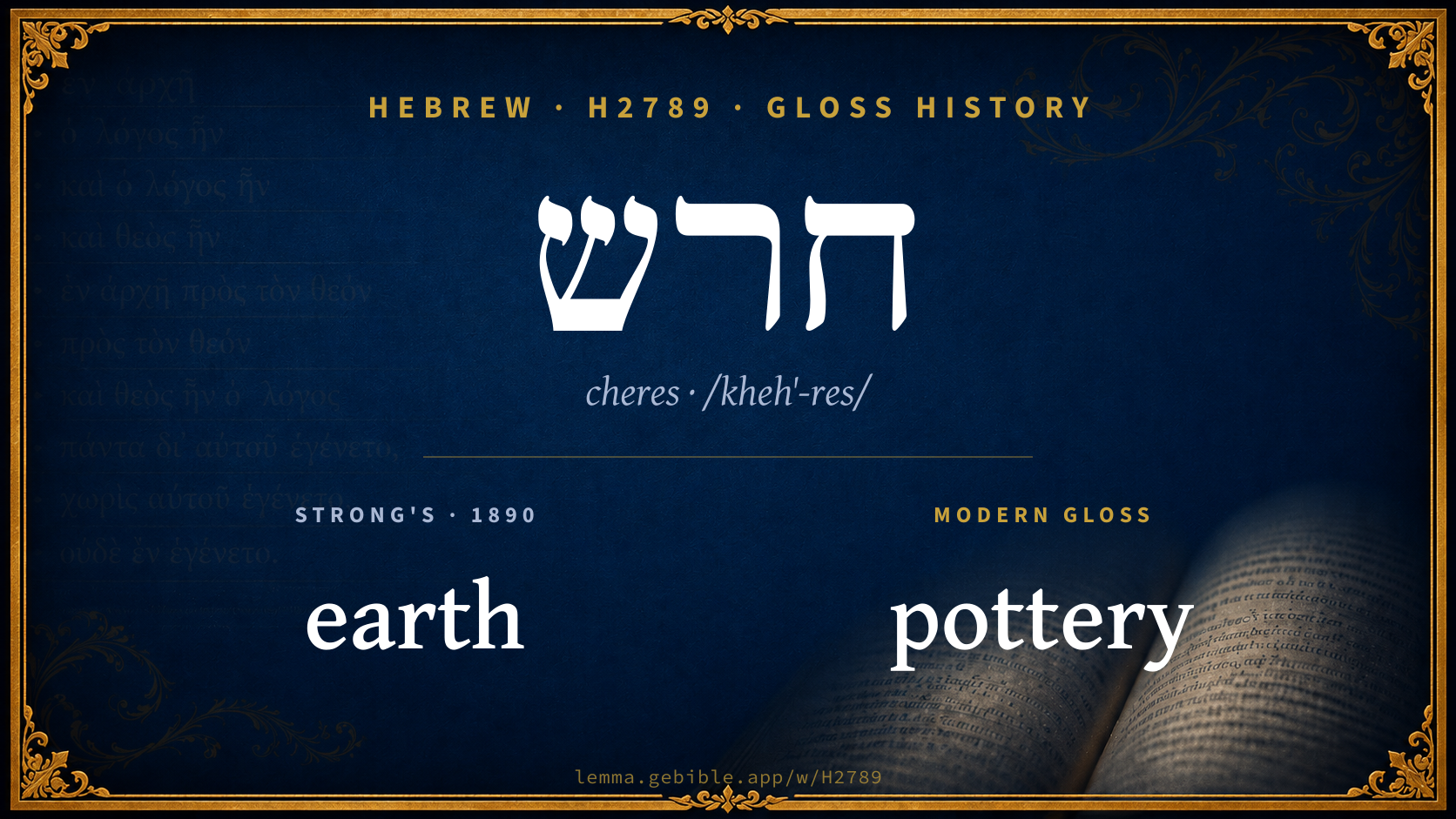
Gloss history
Strong's 1890 vs modern scholarship
About this word
Strong's H2789 catalogs a Hebrew word from the Hebrew Old Testament.
These counts are not copied from any lexicon or concordance. They are computed here, from the morphology-tagged Hebrew Old Testament. What Lemma adds →
- 16
- distinct verses
- The word appears in 16 distinct verses.
- 9 / 39
- OT books
- The word appears in 9 of 39 Old Testament books.
- #1,671
- by frequency
- Top 2500 most frequent Hebrew words (rank 1,671 of 8,640 Hebrew words by occurrence).
View all 16 occurrences in the concordance →
By section of the Old Testament
By traditional corpus
Conventional, traditional groupings — biblical authorship is debated, so this is a traditional corpus grouping, not an authorship claim. Each share is this word’s portion of its verses in that division of the Hebrew canon. Each figure is a share of the word’s 16 distinct verses.
- Torah (Pentateuch) 6 verses · 38%
- Prophets (Nevi'im) 5 verses · 31%
- Writings (Ketuvim) 5 verses · 31%
How translations render this word
Counts come from each version’s own published word-to-Strong’s tagging or interlinear alignment — an approximate guide to how each version renders this word, not a word-level alignment the data otherwise carries. Because each total is that version’s own tagged count, the per-version totals vary from one another and need not match the appearance or distinct-verse counts above. These counts may also differ from a printed concordance because Lemma counts each distinctly tagged rendering and does not collapse phrase taggings into a single head-word total. This is a fixed set of word-tagged versions (KJV, ASV, BSB, ULT) and does not change with the reading translation you choose elsewhere. Each version’s license is shown beside its name below (and on Sources).
- King James Version: Earthen 7×
- American Standard Version: Earthen 6×, Potsherd 2×
- Berean Standard Bible: Clay 8×
- unfoldingWord Literal Text: Clay 6×, Shard 4×, Earthenware 2×
King James Version Public Domain
Renders H2789 across 17 tagged occurrences — most commonly:
Plus 10 renderings that appear only once — usually multi-word phrases or single function words the recovered tagging swept in, not distinct renderings.
American Standard Version Public Domain
Renders H2789 across 16 tagged occurrences — most commonly:
Plus 8 renderings that appear only once — usually multi-word phrases or single function words the recovered tagging swept in, not distinct renderings.
Berean Standard Bible Public Domain
Renders H2789 across 17 tagged occurrences — most commonly:
Plus 9 renderings that appear only once — usually multi-word phrases or single function words the recovered tagging swept in, not distinct renderings.
unfoldingWord Literal Text CC BY-SA 4.0
Renders H2789 across 16 tagged occurrences — most commonly:
Plus 4 renderings that appear only once — usually multi-word phrases or single function words the recovered tagging swept in, not distinct renderings.
Senses in the full BDB
What do BDB’s symbols mean?
BDB uses these scholarly abbreviations:
| Symbol | Meaning |
|---|---|
| 𝔊 | the Septuagint (the ancient Greek translation, LXX) |
| 𝔙 | the Vulgate (the Latin translation) |
| 𝔖 | the Syriac version (the Peshitta) |
| 𝔗 | the Targum (the Aramaic translation) |
| ψ | the Psalms |
| √ | root (the underlying root or stem) |
| ‖ | parallel passage (a synonymous or contrasted parallel) |
| † | the dagger: every passage where the word occurs is cited |
The 2 senses and sub-senses the full Brown-Driver-Briggs lexicon distinguishes for this word, in lexicon order (not ranked by frequency), with BDB’s own verbatim wording and sub-sense lettering. Shown in Hebrew script with BDB’s own scholarly abbreviations. The condensed entry is in the Lexicon Entry tab. See also the Forms in the corpus table below.
- 1. earthenware: כְּלִי־ח׳ earthen vessel Je 32:14; especially P Lv 6:21; 11:33; 14:5, 50; 15:12; Nu 5:17; without כְּלִי Pr 26:23; cf. בַּקְבֻּק יוֹצֵר ח׳ Je 19:1; לְנִבְלֵי ח׳ La 4:2 they are reckoned as earthen vessels, sim. of sons of Zion; חֶרֶשׂ אֶת־חַרְשֵׂי אֲדָמָה Is 45:9 a potsherd (perhaps = earthen vessel, v. Pr 26:23 supr.) among earthen potsherds (of men, over against י׳ their potter); sim. of dryness ψ 22:16. e.g. Jeremiah 32:14
- 2. a fragment of earthenware, sherd Is 30:14 Ez 23:34; ה׳ לְהִתְגָּרֵד Jb 2:8 a sherd to scrape himself; חַדּוּדֵי ח׳ Jb 41:22 sharpest potsherds, fig. of sharp scales on belly of crocodile. e.g. Isaiah 30:14
Senses from the full Brown-Driver-Briggs lexicon (Brown, Driver, Briggs; Oxford 1906 — public domain), digitized via Sefaria, supplemented by the OpenScriptures HebrewLexicon (CC BY 4.0). Full attribution on Sources.
Word origin
n.[m.] earthenware, earthen vessel, sherd, potsherd, P and late (NH חֶרֶס, Aramaic חֲרַס)—abs. ח׳ Lv 6:21 + 9 times, חָ֑רֶשׂ Nu 5:17 + 4 times; pl. cstr. חַרְשֵׂי Is 45:9; sf. חֲרָשֶׂיהָ Ez 23:34.—
— Brown-Driver-Briggs (Oxford 1906, public domain), digitized via Sefaria, supplemented by the OpenScriptures HebrewLexicon (CC BY 4.0). See Sources.
Derived from חרס (chereç) (H2775) — itch.
Jastrow Dictionary
A second Hebrew/Aramaic lexicon for comparison, covering Aramaic and post-biblical (Talmudic, Targumic, Midrashic) usage that the biblical-Hebrew BDB does not. Matched by lemma rather than by Strong’s number, so a lemma may carry more than one Jastrow headword (shown separately below), and the entries cover usage well beyond the Bible.
חֶרֶשׂ
- , v. חֶרֶס
חָרַשׁ I
- (b. h.)
- 1. to engrave, draw, design. Koh. R. to I, 16 הלב חוֹרֵשׁ the heart designs.
- 2. to plough. Macc. III, 9 יש חוֹרֵשׁ תלם וכ׳ one may plough one bed and &c. Taan. 29ᵃ וח׳ את העיר Ms. M. and passed the plough over the city of Jerusalem. Sabb. VII, 2; a. fr.—Trnsf. to have sexual intercourse. Y. Yeb. I, 2ᵇ top. Gen. R. s. 98; a. e.
- to be ploughed over. Taan. IV, 6 נֶחְרְשָׁה העיר the plough was passed over the city of Jerusalem; a. e.
חָרַשׁ II
- Pi. חֵרֵשׁ, חֵי׳ (denom. of חֵרֵשׁ) to deafen, make deaf. B. Kam. 86ᵃ שחֵירְשׁוֹ וכ׳ when he made him deaf without wounding him. Ib. החוֹרֵשׁ את אביו (Ms. H. a. R. חֵרֵשׁ); ib. 98ᵃ חֵרְשׁוֹ לאביו if one injured his father’s hearing; v. חֲרִישָׁה II. Kidd. 24ᵇ.—Sabb. 109ᵃ top. יד מְחָרֶשֶׁת the unwashed hand put to the ear causes deafness.
- 1. same. B. Kam. 86ᵃ להַחֲרִישׁ, v. חֲרִישָׁה II.
- 2. (b. h.) to be silent. Y. Pes. IX, end. 37ᵃ (ref. to Prov. XVII, 28) ואין צ"ל חכם מַחֲרִישׁ and it is needless to say the same of a wise man keeping silence. [Usu. שָׁתַק.] e.g. Proverbs 17:28
- to become deaf (and dumb). Yeb. XIV, 1; Tosef. Ter. I, 1 פיקח ונ׳ if he had been well-hearing and became etc.; v. חֵרֵשׁ.
חֲרַשׁ
- (v. preced. wds.)
- 1. to be entangled. Targ. Job VIII, 17.
- 2. to be choked, obstructed, deaf. Gen. R. s. 81 (prov.) מהולתך חַרְשָׁה וכ׳ if thy sieve is choked, knock at it (when you are forgetful of your duties, the Lord will remind you through affliction); v. טְרַשׁ II.
- 3. to practice witchcraft. Gen. R. s. 86 באתר דחרשין חֲרִישִׁין where there are sorcerers witchcraft is practiced.
- to entangle, inure. Targ. Ez. XIII, 20 (h. text צדד).
- to be entangled, confounded. Y. Ḥag. II, 77ᶜ top (expl. תאלמנה, Ps. XXXI, 19) יִתְחַרְשָׁן וכ׳ may their lips be confounded, crushed, silenced, cmp. אִלֵּם a. חֵרֵשׁ; Gen. R. s. 1 (corr. acc.) e.g. Psalms 31:19
חָרָשׁ
- artist, artisan, carpenter, turner (faber). Deut. R. s. 2 לח׳ שהיה וכ׳ like an artist that was making an image &c.—Pl. חָרָשִׁים. Gen. R. s. 65, end; s. 70, v. חֲמוֹר; Pesik. Shek., p. 15ᵃ.—Trsnf. scholar. Gitt. 88ᵃ (ref. to II Kings XXIV, 16) חָ׳ שבשעה … כחֵרְשִׁין the scholars were named ḥarash, for when they opened argument, all were like dumb; Snh. 38ᵃ; Yalk. Dan. 1066; a. e.—Pl. as above. Ḥag. 14ᵃ (ref. to Is. III, 3). e.g. 2 Kings 24:16
חָרָשׁ ²
- sorcerer, v. חָרָשָׁא.
חֶרֶשׁ
- v. חֵרֵשׁ) silence. Tanḥ. Sh’mini 9 (play on חָרָשׁ, II Kings XXIV, 16) אלו … תפלת ח׳ בלחש וכ׳ ḥarash means those who hold silent prayers in murmuring, and yet conquer &c. e.g. 2 Kings 24:16
חֶרֶשׂ ²
- Ḥeres or Ḥeresh. Ab. IV, 15. Yoma 4ᵇ; a. e.
חֵרֵשׁ
- [closed up,] deaf, dumb (cmp. אִלֵּם); deaf and dumb. Ter. I, 2 ח׳ שדברו וכ׳ the ḥeresh of which the scholars speak (in a legal sense) means everywhere deaf and dumb. Ib. ח׳ המדבר וכ׳ a ḥeresh that can talk but not hear. Meg. II, 4 חוץ מח׳ except a deaf person. Sifré Num. 153 (ref. to Num. XXX, 5; 12) להוציא את הח׳ this excludes the case of the father (the husband) being deaf; Ned. 73ᵃ; a. fr.—Pl. חֵרְשִׁים, חֵרְשִׁין. Ḥag. 14ᵃ; Gitt. 88ᵃ, v. חָרָשׁ. Ruth R. s. 2 beg. (ref. to חרש, Josh. II, 1) עשו עצמכם ח׳ pretend to be deaf.—Fem. חֵרֶשֶׁת. Gitt. V, 5. Yeb. XIV, 1; a. e.—Pl. חֵרְשׁוֹת. Ib. 3. e.g. Numbers 30:5
A Dictionary of the Targumim, the Talmud Babli and Yerushalmi, and the Midrashic Literature (Marcus Jastrow; London, Luzac, 1903) — Public Domain. Digitized via Sefaria. Digitized via Sefaria. Full attribution on Sources.
Forms in the corpus
The 7 distinct written forms H2789 takes in the Hebrew Bible, most frequent first — each parse links to that state’s occurrences in the concordance. Hebrew forms include their vowel points and cantillation, so a single lemma takes many written forms.
| Form | Parsing | Example | Uses |
|---|---|---|---|
| חָ֑רֶשׂ | Noun, Common, Masculine, Singular, Absolute | Jeremiah 19:1 | 5 |
| חֶ֔רֶשׂ | Noun, Common, Masculine, Singular, Absolute | Isaiah 30:14 | 4 |
| חֶ֖רֶשׂ | Noun, Common, Masculine, Singular, Absolute | Isaiah 45:9 | 3 |
| חֶ֛רֶשׂ | Noun, Common, Masculine, Singular, Absolute | Leviticus 6:28 | 2 |
| חֲרָשֶׂ֛י/הָ | Noun, Common, Masculine, Plural, Construct | Ezekiel 23:34 | 1 |
| חַרְשֵׂ֣י | Noun, Common, Masculine, Plural, Construct | Isaiah 45:9 | 1 |
| כַּ/חֶ֨רֶשׂ | Noun, Common, Masculine, Singular, Absolute | Psalms 22:15 | 1 |
Same root — word family
Other BDB entries built from the same root as H2789, grouped by Strong’s listed origin. These share a root / origin per the lexicon — not necessarily a shared meaning. Each links to that word’s own entry.
Derives from
Shares the same root
Proper names from this root
People and places named from this root — a name, not an additional meaning of the word.
Compare all same-root words → Showing 4 of 5 — not the complete family. 2 of the same-root words are proper names (people or places). They share a root, not necessarily a meaning.
Septuagint verse parallels
This word appears in 13 verses that also exist in the Greek Old Testament (Septuagint), out of the 16 Hebrew verses it occurs in. You can read those verses in Greek by switching the Old Testament edition to the Septuagint.
Read these verses in the Septuagint
- Leviticus 11:33
- Numbers 5:17
- Job 2:8
- Proverbs 26:23
- Isaiah 30:14
- Jeremiah 19:1
- Lamentations 4:2
- Ezekiel 23:34
This is a verse-level parallel only — the same verses exist in both the Hebrew and Greek Old Testaments. No word-level Hebrew↔Greek correspondence is claimed: the data carries no such alignment, so no Greek word is shown as this Hebrew word’s translation. Coverage is not total — the Septuagint omits the deuterocanon and renumbers the Psalms, so some Hebrew verses have no direct Greek parallel.