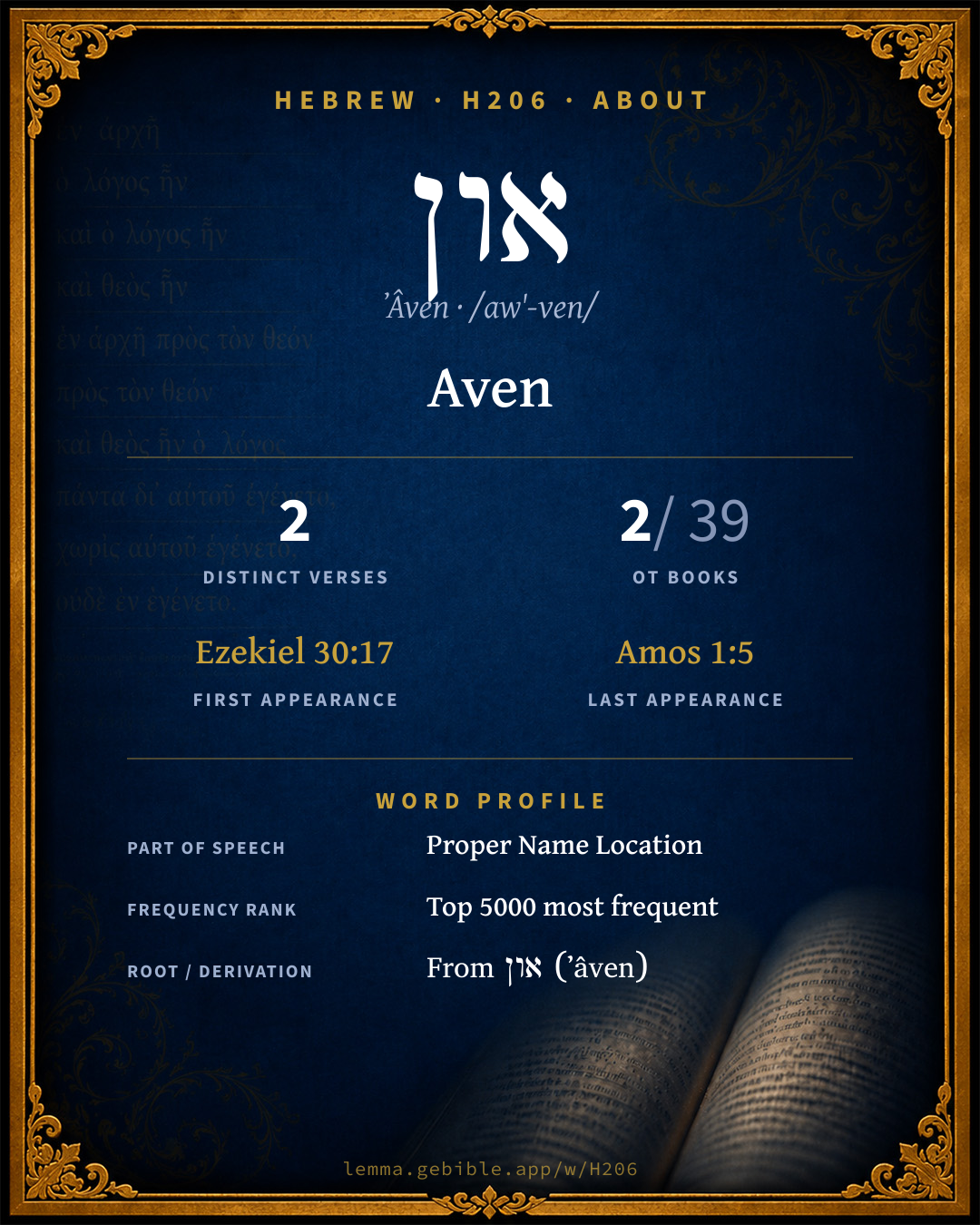
אָ֫וֶן
Aven
BDB lists 2 entries for ‘Aven’ fuller range ↓
Full lexicon entry — Brown-Driver-Briggs (BDB)
From Brown-Driver-Briggs (BDB)
Where this word appears
Grammar key — what these labels mean
Part of speech
- Noun
- A naming word — a person, place, thing, or idea.
Noun type
- Proper
- A name of a specific person, place, or people (e.g. Abraham, Zion, Israel).
Every verse where H206 appears — 2 distinct verses across 2 books. Click any verse to open its interlinear word-by-word view. Verse text shown in the World English Bible for context — . Each verse’s Hebrew form is shown with its reference; the English is not keyword-highlighted, since the data carries no word-level English alignment. Use “Compare translations” on any verse to read it across multiple English versions. This concordance covers the Hebrew Bible; Septuagint (Greek Old Testament) occurrences are not indexed here.
Ezekiel 1 verse
Amos 1 verse
About this entry
At a glance — auto-summarized from this page’s data, not written by a person. Every figure links to its source below. This summary describes the numbers; it doesn’t interpret them.
און (ʼÂven) is a Hebrew name most often rendered “Aven.” A scarce word — 2 verses in all of the Hebrew Bible. Ezekiel dominates its distribution — 1 of 2 verses. It first appears in Ezekiel 30:17. The sections below give every occurrence and version rendering.
Gloss history
Strong's 1890 vs modern scholarship
About this word
Strong's H206 catalogs a Hebrew word from the Hebrew Old Testament.
These counts are not copied from any lexicon or concordance. They are computed here, from the morphology-tagged Hebrew Old Testament. What Lemma adds →
- 2
- distinct verses
- The word appears in 2 distinct verses.
- 2 / 39
- OT books
- The word appears in 2 of 39 Old Testament books.
- #4,807
- by frequency
- Top 5000 most frequent Hebrew words (rank 4,807 of 8,640 Hebrew words by occurrence).
View all 2 occurrences in the concordance →
By traditional corpus
Conventional, traditional groupings — biblical authorship is debated, so this is a traditional corpus grouping, not an authorship claim. Each share is this word’s portion of its verses in that division of the Hebrew canon. Each figure is a share of the word’s 2 distinct verses.
- Prophets (Nevi'im) 2 verses · 100%
How translations render this word
Counts come from each version’s own published word-to-Strong’s tagging or interlinear alignment — an approximate guide to how each version renders this word, not a word-level alignment the data otherwise carries. Because each total is that version’s own tagged count, the per-version totals vary from one another and need not match the appearance or distinct-verse counts above. These counts may also differ from a printed concordance because Lemma counts each distinctly tagged rendering and does not collapse phrase taggings into a single head-word total. This is a fixed set of word-tagged versions (KJV, ASV, BSB, ULT) and does not change with the reading translation you choose elsewhere. Each version’s license is shown beside its name below (and on Sources).
- King James Version: Aven 3×
- American Standard Version: Aven 3×
- Berean Standard Bible: not separately translated
- unfoldingWord Literal Text: Aven 1×, Heliopolis 1×
King James Version Public Domain
Renders H206 across 3 tagged occurrences — most commonly:
American Standard Version Public Domain
Renders H206 across 3 tagged occurrences — most commonly:
Berean Standard Bible Public Domain
Does not render H206 with a distinct English word (not separately translated in its 1 tagged occurrence).
unfoldingWord Literal Text CC BY-SA 4.0
Renders H206 across 2 tagged occurrences — most commonly:
Senses in the full BDB
What do BDB’s symbols mean?
BDB uses these scholarly abbreviations:
| Symbol | Meaning |
|---|---|
| 𝔊 | the Septuagint (the ancient Greek translation, LXX) |
| 𝔙 | the Vulgate (the Latin translation) |
| 𝔖 | the Syriac version (the Peshitta) |
| 𝔗 | the Targum (the Aramaic translation) |
| ψ | the Psalms |
| √ | root (the underlying root or stem) |
| ‖ | parallel passage (a synonymous or contrasted parallel) |
| † | the dagger: every passage where the word occurs is cited |
The 3 senses and sub-senses the full Brown-Driver-Briggs lexicon distinguishes for this word, in lexicon order (not ranked by frequency), with BDB’s own verbatim wording and sub-sense lettering. Shown in Hebrew script with BDB’s own scholarly abbreviations. The condensed entry is in the Lexicon Entry tab. See also the Forms in the corpus table below.
- 1. trouble, sorrow בֶּן־אוֹנִי son of my trouble or sorrow Gn 35:18 (E); לֹא הִבִּיט אָוֶן בְּיַעֲקֹב Nu 23:21 (song of Balaam), he doth not behold trouble in Jacob (‖ he doth not see mischief— עָמָל—in Isr.); often ‖ עָמָל, ψ 7:15 (הִנֵּה יְחַבֶּל־אָוֶן lo he travaileth with trouble ‖ וְהָרָה עָמָל וְיָלַד שָׁ֑קֶר, yea he hath conceived misery & brought forth a lie), prob. thence Jb 15:35 (הָרֹה עָמָל וְיָלֹד אָוֶן) = Is 59:4; cf. עָמָל וָאָוֶן ψ 10:7; 55:11; 90:10; Jb 4:8; 5:6 Is 10:1 (v. עָמָל); also זוֹרֵעַ עַוְלָה יִקְצָר־אָוֶן Pr 22:8 the sower of iniquity shall reap trouble; in this sense elsewhere only Dt 26:14 Pr 12:21 Je 4:15 Hb 3:7 Am 5:5, pl. intens. לֶחֶם אוֹנִים bread of trouble, sorrow, or mourning Ho 9:4. e.g. Genesis 35:18
- 2. idolatry Ho 12:12; אָוֶן וּתְרָפִים הַפְצַ֑ר stubbornness is idolatry & (the use of) teraphim 1 S 15:23 (poet. source); בֵּית אָוֶן Ho 4:15 (for בֵּית אֵל because Bethel, house of God, is given over to idolatry) so also 5:8; 10:5 cf. בָּמוֹת א׳ Ho 10:8; בִּקְעַת א׳ Am 1:5 (Baalbek); בַּחוּרֵי א׳ read אוֹן, אֹן = On, Heliopolis Ez 30:17;—abstr. for concr. = idols Is 41:29; 66:3. e.g. Hosea 12:12
- 3. trouble of iniquity, wickedness, מְתֵי אָוֶן Jb 22:15; אַנְשֵׁי א׳ 34:36 = men of trouble, troublers, wicked men; cf. אִישׁ א׳ Pr 6:12; Is 55:7; פֹּעֲלֵי אָוֶן workers of trouble, evil-doers, workers of iniquity Jb 31:3; 34:8, 22 ψ 5:6 + (16 times chiefly late ψ) Pr 10:29; 21:15 Is 31:2 Ho 6:8; מַחְשְׁבוֹת אָוֶן thoughts of trouble, wicked imaginations Pr 6:18 Is 59:7 Je 4:14; often of words & thoughts Jb 11:11 + (5 times) ψ 36:5 + (9 times) Pr 17:4; 19:28; 30:20 Is 29:20; 32:6; 58:9; 59:6 Ez 11:2 Mi 2:1 Hb 1:3 Zc 10:2; לֹא אוּכַל אָוֶן וַעֲצָרָה Is 1:13 I cannot bear iniquity with the solemn meeting (RV & most mod.; AV it is iniquity, even the solemn meeting). e.g. Job 22:15
Senses from the full Brown-Driver-Briggs lexicon (Brown, Driver, Briggs; Oxford 1906 — public domain), digitized via Sefaria, supplemented by the OpenScriptures HebrewLexicon (CC BY 4.0). Full attribution on Sources.
Word origin
n.m. Jb 5:6 trouble, sorrow, wickedness—abs. Nu 23:21 +; sf. אוֹנִי Gn 35:18 etc.; pl. אוֹנִים Ho 9:4—
— Brown-Driver-Briggs (Oxford 1906, public domain), digitized via Sefaria, supplemented by the OpenScriptures HebrewLexicon (CC BY 4.0). See Sources.
Derived from און (ʼâven) (H205) — trouble.
Jastrow Dictionary
A second Hebrew/Aramaic lexicon for comparison, covering Aramaic and post-biblical (Talmudic, Targumic, Midrashic) usage that the biblical-Hebrew BDB does not. Matched by lemma rather than by Strong’s number, so a lemma may carry more than one Jastrow headword (shown separately below), and the entries cover usage well beyond the Bible.
אָוֶן
- √או = עו to curve, be curved, hollow; to press, be pressed; v. אוי,
- 1. oppression, wrong (= עָוֹן)
- 2. falsehood, vanity (= הֶבֶל). א׳ גִּלְיוֹן a cacophemistic adaptation of εὐαγγέλιον (v. גליון). Sabb. 116ᵃ bot. (after לסכוניה, omitted in ed.) דר׳ מאיר א׳ ג׳ ר׳ יוחנן קרי ליה עון גליון (Rashi Ms. ר׳ מאיר, v. Rabb. D. S. a. l. note) R. Meïr called the gospel falsehood of blank paper (or of revelation), R. Yoḥ. called it sin of &c. [Ib. several times עון גליון or און ג׳ in Ms. a. older editions, for אירייתא אחריתי &c. in recent ed., v. Rabb. D. S. a. l.]
אוֹן
- possession, power. Tosef. Ab. Zar. III, 16 (IV, beg.) כתב לו או̇נו̇ if he (the seller of the slave) wrote to him (gave him in writing) the liberty of his disposal of himself, i.e. that the slave, if he should run away from the buyer, would not be claimed by him who sold him; Git. 43ᵇ כתב עליו אונו (read אליו or לו). Ib. מאי אונו what means ‘his own possession’? Ans. He wrote to him this, ‘If thou run away from him (the purchaser), I have nothing to do with thee. Ib. 85ᵇ.—[Y. B. Mets. I, end, 8ᵃ; Y. Kidd. I, 60ᶜ אונו, v. אוֹנִי.] V. אוֹנָה.
A Dictionary of the Targumim, the Talmud Babli and Yerushalmi, and the Midrashic Literature (Marcus Jastrow; London, Luzac, 1903) — Public Domain. Digitized via Sefaria. Digitized via Sefaria. Full attribution on Sources.
Forms in the corpus
The 2 distinct written forms H206 takes in the Hebrew Bible, most frequent first — each parse links to that state’s occurrences in the concordance. Hebrew forms include their vowel points and cantillation, so a single lemma takes many written forms.
| Form | Parsing | Example | Uses |
|---|---|---|---|
| אָ֔וֶן | Noun, Proper | Amos 1:5 | 1 |
| אָ֛וֶן | Noun, Proper | Ezekiel 30:17 | 1 |
Same root — word family
Other BDB entries built from the same root as H206, grouped by Strong’s listed origin. These share a root / origin per the lexicon — not necessarily a shared meaning. Each links to that word’s own entry.
Derives from
Shares the same root
Compare all same-root words → They share a root, not necessarily a meaning.
Bible dictionary
Public-domain dictionary articles matched to this entry by name (Aven). A biblical name can be shared by more than one person or place, so an article may treat several.
Easton's Bible Dictionary · M. G. Easton, 1897
Nothingness; vanity. (1.) Hosea speaks of the "high places of Aven" (10:8), by which he means Bethel. He also calls it Beth-aven, i.e., "the house of vanity" (4:15), on account of the golden calves Jeroboam had set up there (1 Kings 12:28).
(2.) Translated by the LXX. "On" in Ezek. 30:17. The Egyptian Heliopolis or city of On (q.v.).
(3.) In Amos 1:5 it denotes the Syrian Heliopolis, the modern Baalbec.
Smith's Bible Dictionary · William Smith, 1863
(nothingness).
+ The "plain of Aven" is mentioned by (Amos 1:5) in his denunciation of Syria and the country to the north of Palestine. This Aven is by some supposed to be the once magnificent Heiropolis, "city of I the sun," now Baalbek (Bal'bek) of Coele-Syria, whose ruins are one of the wonders of the ages. It was situated in a plain near the foot of the Anti-Libanus range of mountains, 42 miles northwest of Damascus. It is famous for the colossal ruins of its temples, one of which with its courts and porticos, extended over 1000 feet in length. The temples were built of marble or limestone and granite. Some of the columns were 7 feet in diameter and 62 feet high, or including capital and pedestal, 89 feet. Some of the building-stones were 64 feet long and 12 feet thick. The temples are of Roman origin. + In (Hosea 10:8) the word is clearly an abbreviation of Bethaven, that is, Bethel. Comp. (Hosea 4:15) etc. + The sacred city of Heliopolis or On, in Egypt. (Ezekiel 30:17)
Hitchcock's Bible Names Dictionary · Roswell D. Hitchcock, 1869
iniquity; force; riches; sorrow
Classic public-domain reference works; full attribution on Sources.
Septuagint verse parallels
This word appears in 2 verses that also exist in the Greek Old Testament (Septuagint), out of the 2 Hebrew verses it occurs in. You can read those verses in Greek by switching the Old Testament edition to the Septuagint.
Read these verses in the Septuagint
This is a verse-level parallel only — the same verses exist in both the Hebrew and Greek Old Testaments. No word-level Hebrew↔Greek correspondence is claimed: the data carries no such alignment, so no Greek word is shown as this Hebrew word’s translation. Coverage is not total — the Septuagint omits the deuterocanon and renumbers the Psalms, so some Hebrew verses have no direct Greek parallel.