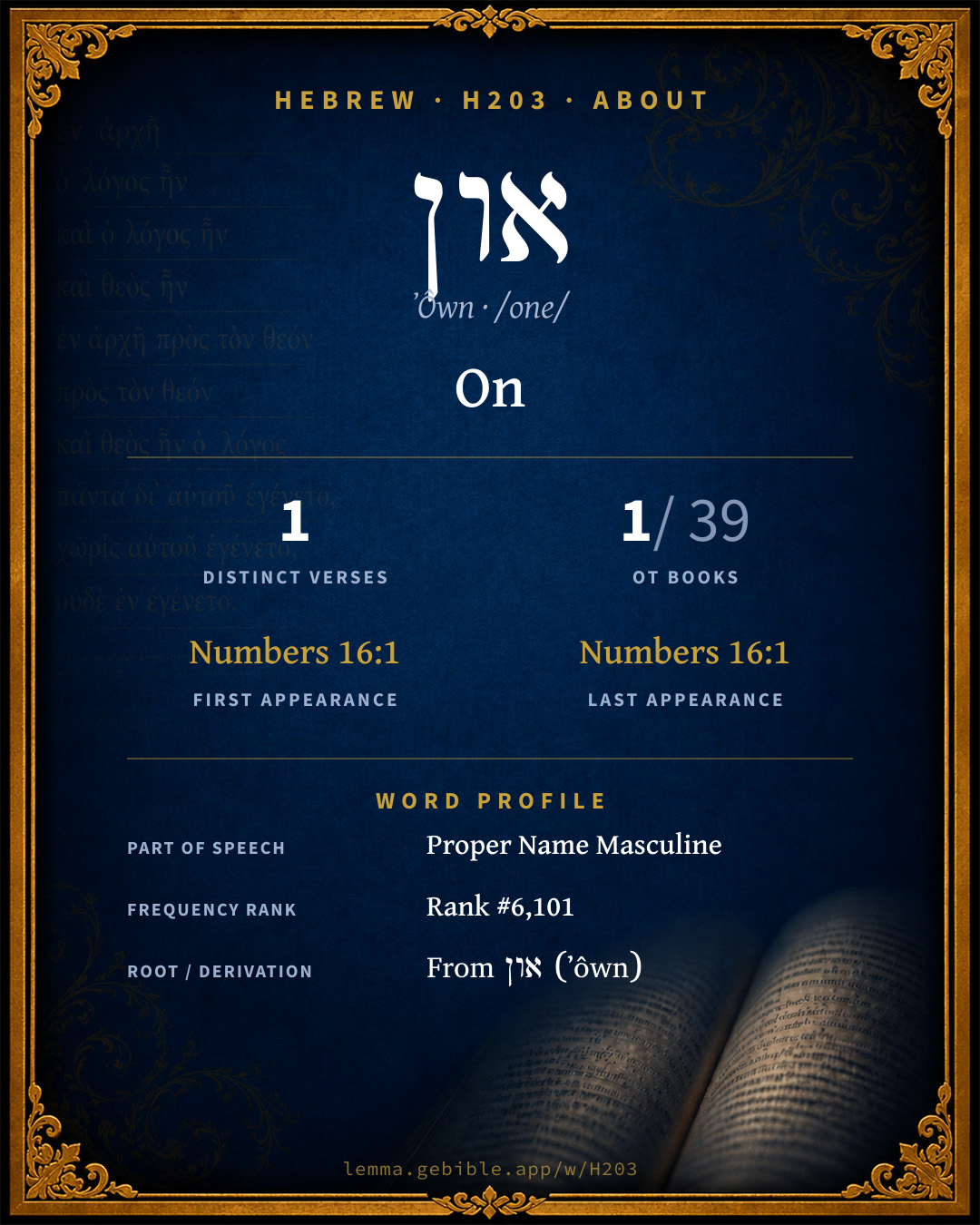
אוֹן
On
BDB lists 2 entries for ‘On’ fuller range ↓
Full lexicon entry — Brown-Driver-Briggs (BDB)
From Brown-Driver-Briggs (BDB)
Where this word appears
Grammar key — what these labels mean
Noun type
- Proper
- A name of a specific person, place, or people (e.g. Abraham, Zion, Israel).
Every verse where H203 appears — 1 distinct verse across 1 book. Click any verse to open its interlinear word-by-word view. Verse text shown in the World English Bible for context — . Each verse’s Hebrew form is shown with its reference; the English is not keyword-highlighted, since the data carries no word-level English alignment. Use “Compare translations” on any verse to read it across multiple English versions. This concordance covers the Hebrew Bible; Septuagint (Greek Old Testament) occurrences are not indexed here.
Numbers 1 verse
About this entry
At a glance — auto-summarized from this page’s data, not written by a person. Every figure links to its source below. This summary describes the numbers; it doesn’t interpret them.
The Hebrew name און centers on the idea of “On.” A scarce word — 1 verse in all of the Hebrew Bible. The word gravitates to Numbers (100%). It occurs only once, in Numbers 16:1. For the data behind this summary, explore 1-verse concordance and the renderings breakdown below.
Gloss history
Strong's 1890 vs modern scholarship
About this word
Strong's H203 catalogs a Hebrew word from the Hebrew Old Testament.
These counts are not copied from any lexicon or concordance. They are computed here, from the morphology-tagged Hebrew Old Testament. What Lemma adds →
- 1
- distinct verses
- The word appears in 1 distinct verse.
- 1 / 39
- OT books
- The word appears in 1 of 39 Old Testament books.
- #6,101
- by frequency
- Rank #6,101 (rank 6,101 of 8,640 Hebrew words by occurrence).
View all 1 occurrence in the concordance →
Most concentrated in
- Numbers 1 verse 100%
By section of the Old Testament
By traditional corpus
Conventional, traditional groupings — biblical authorship is debated, so this is a traditional corpus grouping, not an authorship claim. Each share is this word’s portion of its verses in that division of the Hebrew canon. Each figure is a share of the word’s 1 distinct verse.
- Torah (Pentateuch) 1 verse · 100%
How translations render this word
Counts come from each version’s own published word-to-Strong’s tagging or interlinear alignment — an approximate guide to how each version renders this word, not a word-level alignment the data otherwise carries. Because each total is that version’s own tagged count, the per-version totals vary from one another and need not match the appearance or distinct-verse counts above. These counts may also differ from a printed concordance because Lemma counts each distinctly tagged rendering and does not collapse phrase taggings into a single head-word total. This is a fixed set of word-tagged versions (KJV, ASV, BSB, ULT) and does not change with the reading translation you choose elsewhere. Each version’s license is shown beside its name below (and on Sources).
BDB lists this Strong’s number as 3 distinct words (homographs). Each count above pools all of them and is not split by sense — see the Senses section below. A low-frequency rendering may belong to a different one of those words, not the primary meaning.
- King James Version†: On 1×
- American Standard Version†: On 1×
- Berean Standard Bible†: On 1×
- unfoldingWord Literal Text†: On 1×
King James Version Public Domain
Renders H203 across 1† tagged occurrence — most commonly:
American Standard Version Public Domain
Renders H203 across 1† tagged occurrence — most commonly:
Berean Standard Bible Public Domain
Renders H203 across 1† tagged occurrence — most commonly:
unfoldingWord Literal Text CC BY-SA 4.0
Renders H203 across 1† tagged occurrence — most commonly:
Senses in the full BDB
What do BDB’s symbols mean?
BDB uses these scholarly abbreviations:
| Symbol | Meaning |
|---|---|
| 𝔊 | the Septuagint (the ancient Greek translation, LXX) |
| 𝔙 | the Vulgate (the Latin translation) |
| 𝔖 | the Syriac version (the Peshitta) |
| 𝔗 | the Targum (the Aramaic translation) |
| ψ | the Psalms |
| √ | root (the underlying root or stem) |
| ‖ | parallel passage (a synonymous or contrasted parallel) |
| † | the dagger: every passage where the word occurs is cited |
The 3 senses and sub-senses the full Brown-Driver-Briggs lexicon distinguishes for this word, in lexicon order (not ranked by frequency), with BDB’s own verbatim wording and sub-sense lettering. Shown in Hebrew script with BDB’s own scholarly abbreviations. The condensed entry is in the Lexicon Entry tab.
און I vigour, wealth
- 1. manly vigour בְּאוֹנוֹ שָׂרָה אֶת־אֱלֹהִים Ho 12:4 (of Jacob); רֵאשִׁית אוֹן beginning of manly vigour Gn 49:3 (of Reuben, first-born of Jacob); Dt 21:17 ψ 105:36 (first-born of Egyptians), so 78:51, רֵאשִׁית אוֹנִים where א׳ is assim. to מִצְרַיִם, or intens. pl. e.g. Hosea 12:4
- 2. strength of man Jb 18:7, 12; behemoth Jb 40:16; pl. intens. מֵרֹב אוֹנִים Is 40:26 because of the abundance of great strength (of God); of man אֵין אוֹנִים Is 40:29 one not having strength; תּוֹחֶלֶת אוֹנִים Pr 11:7 hope in strength (not the hope of iniquity RV, or of unjust men AV). e.g. Job 18:7
- 3. wealth Jb 20:10 Ho 12:9 מָצָאתִי א׳ לִי (‖ עָשַׁרְתִּי). e.g. Job 20:10
און II loc. v. אֹן.
Senses from the full Brown-Driver-Briggs lexicon (Brown, Driver, Briggs; Oxford 1906 — public domain), digitized via Sefaria, supplemented by the OpenScriptures HebrewLexicon (CC BY 4.0). Full attribution on Sources.
Word origin
I. n.m. vigour, wealth—abs. Ho 12:9, sf. אוֹנִי Gn 49:3 + etc.; pl. אוֹנִים ψ 78:51 +.
I. (Gn 41:45; 46:20) אוֹן (Gn 41:50 Ez 30:17) n.pr.loc. On (Egypt. Ȧn cf. EbGS 75 WiedSamml 46; perhaps = Assyrian Unu, SteindorffBAS i. 610, contr. DlPa 318) city in lower Egypt, prob. on border of land of Goshen, residence of ‘Potiphera, priest of On,’ father-in-law of Joseph Gn 41:45, 50; 46:20; also Ez 30:17 (where MT אָוֶן); it was celebrated for worship of sun-god Ra, & hence called also sun-city, בֵּית שֶׁמֶשׁ Je 43:13, 𝔊 Ἡλίου πόλις; mod. Matariye, on E. bank of Nile, c. 7 miles E. of N. from Cairo & 18 from Memphis;—cf. EbGS 75, 507 f. & map Wiedl.c.
— Brown-Driver-Briggs (Oxford 1906, public domain), digitized via Sefaria, supplemented by the OpenScriptures HebrewLexicon (CC BY 4.0). See Sources.
Derived from און (ʼôwn) (H202) — vigour.
Jastrow Dictionary
A second Hebrew/Aramaic lexicon for comparison, covering Aramaic and post-biblical (Talmudic, Targumic, Midrashic) usage that the biblical-Hebrew BDB does not. Matched by lemma rather than by Strong’s number, so a lemma may carry more than one Jastrow headword (shown separately below), and the entries cover usage well beyond the Bible.
אָוֶן
- √או = עו to curve, be curved, hollow; to press, be pressed; v. אוי,
- 1. oppression, wrong (= עָוֹן)
- 2. falsehood, vanity (= הֶבֶל). א׳ גִּלְיוֹן a cacophemistic adaptation of εὐαγγέλιον (v. גליון). Sabb. 116ᵃ bot. (after לסכוניה, omitted in ed.) דר׳ מאיר א׳ ג׳ ר׳ יוחנן קרי ליה עון גליון (Rashi Ms. ר׳ מאיר, v. Rabb. D. S. a. l. note) R. Meïr called the gospel falsehood of blank paper (or of revelation), R. Yoḥ. called it sin of &c. [Ib. several times עון גליון or און ג׳ in Ms. a. older editions, for אירייתא אחריתי &c. in recent ed., v. Rabb. D. S. a. l.]
אוֹן
- possession, power. Tosef. Ab. Zar. III, 16 (IV, beg.) כתב לו או̇נו̇ if he (the seller of the slave) wrote to him (gave him in writing) the liberty of his disposal of himself, i.e. that the slave, if he should run away from the buyer, would not be claimed by him who sold him; Git. 43ᵇ כתב עליו אונו (read אליו or לו). Ib. מאי אונו what means ‘his own possession’? Ans. He wrote to him this, ‘If thou run away from him (the purchaser), I have nothing to do with thee. Ib. 85ᵇ.—[Y. B. Mets. I, end, 8ᵃ; Y. Kidd. I, 60ᶜ אונו, v. אוֹנִי.] V. אוֹנָה.
A Dictionary of the Targumim, the Talmud Babli and Yerushalmi, and the Midrashic Literature (Marcus Jastrow; London, Luzac, 1903) — Public Domain. Digitized via Sefaria. Digitized via Sefaria. Full attribution on Sources.
Same root — word family
Other BDB entries built from the same root as H203, grouped by Strong’s listed origin. These share a root / origin per the lexicon — not necessarily a shared meaning. Each links to that word’s own entry.
Derives from
Proper names from this root
People and places named from this root — a name, not an additional meaning of the word.
Compare all same-root words → 1 of the same-root words is a proper name (a person or place). They share a root, not necessarily a meaning.
Bible dictionary
Public-domain dictionary articles matched to this entry by name (On). A biblical name can be shared by more than one person or place, so an article may treat several.
Easton's Bible Dictionary · M. G. Easton, 1897
Light; the sun, (Gen. 41:45, 50), the great seat of sun-worship, called also Bethshemesh (Jer. 43:13) and Aven (Ezek. 30:17), stood on the east bank of the Nile, a few miles north of Memphis, and near Cairo, in the north-east. The Vulgate and the LXX. Versions have "Heliopolis" ("city of the sun") instead of On in Genesis and of Aven in Ezekiel. The "city of destruction" Isaiah speaks of (19:18, marg. "of Heres;" Heb. Ir-ha-heres, which some MSS. read Ir-ha-heres, i.e., "city of the sun") may be the name given to On, the prophecy being that the time will come when that city which was known as the "city of the sun-god" shall become the "city of destruction" of the sun-god, i.e., when idolatry shall cease, and the worship of the true God be established.
In ancient times this city was full of obelisks dedicated to the sun. Of these only one now remains standing. "Cleopatra's Needle" was one of those which stood in this city in front of the Temple of Tum, i.e., "the sun." It is now erected on the Thames Embankment, London.
"It was at On that Joseph wooed and won the dark-skinned Asenath, the daughter of the high priest of its great temple." This was a noted university town, and here Moses gained his acquaintance with "all the wisdom of the Egyptians."
Smith's Bible Dictionary · William Smith, 1863
(abode or city of the sun), a town of lower Egypt, called BETH-SHEMESH in (Jeremiah 43:13) On is better known under its Greek name Heliopolis. It was situated on the east side of the Pelusiac branch of the Nile, just below the point of the Delta, and about twenty miles northeast of Memphis. The chief object of worship at Heliopolis was the sun, whose temple, described by Strabo, is now only represented by the single beautiful obelisk, of red granite so feet 2 inches high above the pedestal which has stood for more than 4000 years, having been erected by Usirtesen, the second king of the twelfth dynasty. Heliopolis was anciently famous for its learning, and Eudoxus and Plato studied under its priests. The first mention of this place in the Bible is in the history of Joseph, to whom we read Pharaoh gave "to wife Asenath the daughter of Potipherah priest of On." (Genesis 41:45) comp. ver, Genesis41:60 and Genesis46:20 (On is to be remembered not only as the home of Joseph, but as the traditional place to which his far-off namesake took Mary and the babe Jesus in the flight to Egypt. The two famous obelisks, long called "Cleopatra's Needles," one of which now stands in London and the other in Central Park in New York city, once stood before this city, and were seen by the children of Israel before the exodus, having been quarried at Syene on the Nile, erected at On (Heliopolis) by Thothmes III., B.C. 1500, and inscriptions added by Rameses II. (Sesostris) two hundred years later. They were taken to Alexandria by Augustus Caesar A.D. 23, from which they were removed to their present places.--ED.)
the son of Peleth and one of the chiefs of the tribe of Reuben, who took part with Korah, Dathan and Abiram in their revolt against Moses. (Numbers 16:1) (B.C. 1491.) His name does not again appear in the narrative of the conspiracy, nor is he alluded to when reference is made to the final catastrophe.
Hitchcock's Bible Names Dictionary · Roswell D. Hitchcock, 1869
pain; force; iniquity
Classic public-domain reference works; full attribution on Sources.
Septuagint verse parallels
This word appears in 1 verse that also exists in the Greek Old Testament (Septuagint), out of the 1 Hebrew verse it occurs in. You can read those verses in Greek by switching the Old Testament edition to the Septuagint.
Read these verses in the Septuagint
This is a verse-level parallel only — the same verses exist in both the Hebrew and Greek Old Testaments. No word-level Hebrew↔Greek correspondence is claimed: the data carries no such alignment, so no Greek word is shown as this Hebrew word’s translation. Coverage is not total — the Septuagint omits the deuterocanon and renumbers the Psalms, so some Hebrew verses have no direct Greek parallel.