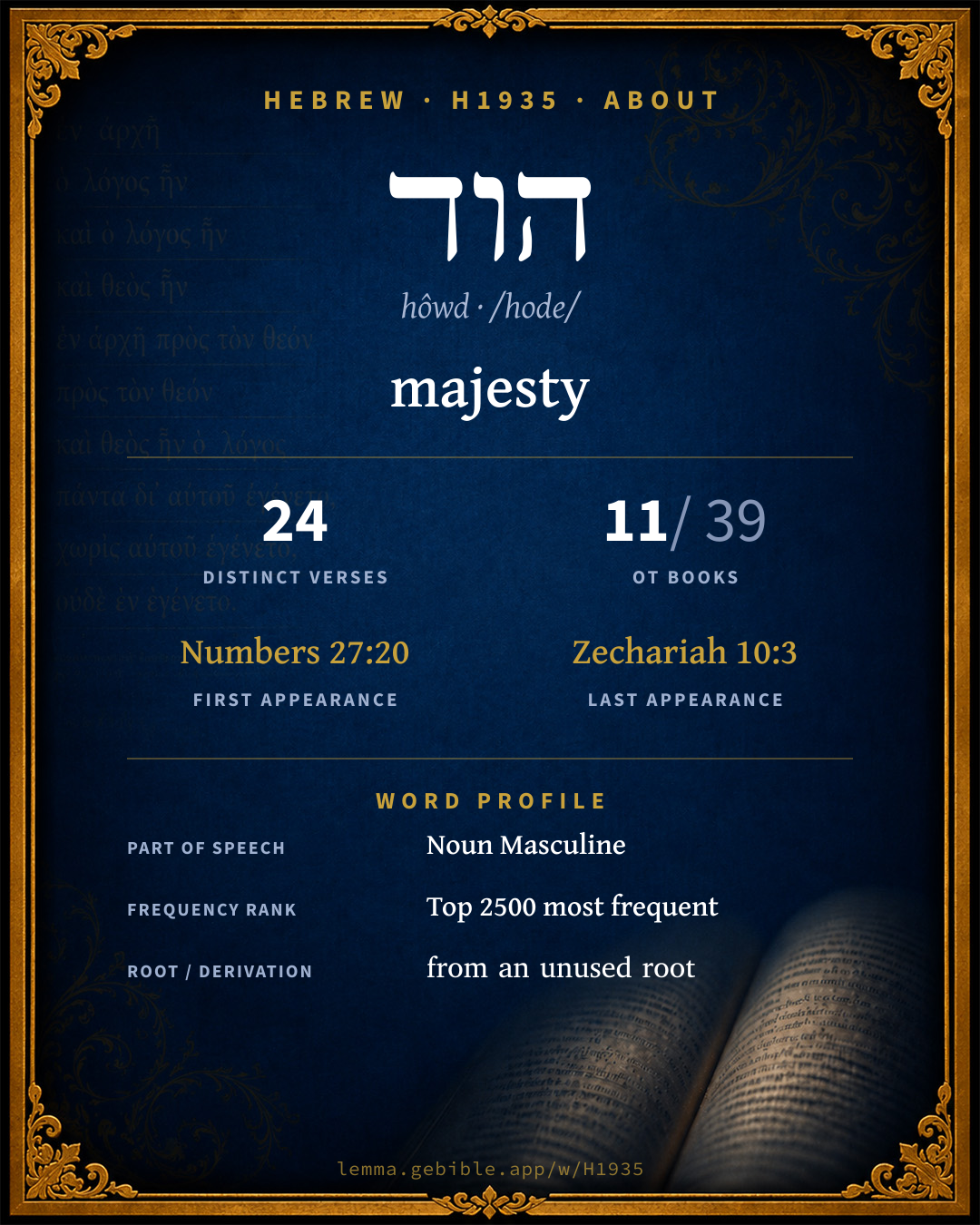
הוֹד
majesty
Full lexicon entry — Brown-Driver-Briggs (BDB)
From Brown-Driver-Briggs (BDB)
Where this word appears
See every Construct-state word in the Hebrew Bible →
Grammar key — what these labels mean
Part of speech
- Noun
- A naming word — a person, place, thing, or idea.
Noun type
- Common
- A common noun — a general class of person, place, or thing (“king,” “city,” “water”), not a specific name.
State
- Absolute
- The independent form of a noun, not bound to a following word.
- Construct
- A noun bound to a following noun in a possessive / “of” relationship (the construct chain).
Gender
- Masculine
- Grammatically masculine.
Number
- Singular
- One.
9 distinct verses where H1935 appears in the Absolute state, across 4 books. Filtered view — show all forms. Click any verse to open its interlinear word-by-word view. Verse text shown in the World English Bible for context — . Each verse’s Hebrew form is shown with its reference; the English is not keyword-highlighted, since the data carries no word-level English alignment. Use “Compare translations” on any verse to read it across multiple English versions. This concordance covers the Hebrew Bible; Septuagint (Greek Old Testament) occurrences are not indexed here.
1 Chronicles 2 verses
- 1 Chronicles 16:27 ה֤וֹד n c ms Honor and majesty are before him: Strength and gladness are in his place.
- 1 Chronicles 29:11 וְ/הַ/ה֔וֹד conj + ptcl def.art + n c ms Yours, Yahweh, is the greatness, the power, the glory, the victory, and the majesty: for all that is in the heavens and in the earth is yours. Yours is the kingdom, Yahweh, and you are exalted as head above all.
Job 2 verses
Psalms 4 verses
- Psalms 21:5 ה֥וֹד n c ms His glory is great in your salvation. You lay honor and majesty on him.
- Psalms 96:6 הוֹד n c ms Honor and majesty are before him. Strength and beauty are in his sanctuary.
- Psalms 104:1 ה֭וֹד n c ms Bless Yahweh, my soul. Yahweh, my God, you are very great. You are clothed with honor and majesty.
- Psalms 111:3 הוֹד n c ms His work is honor and majesty. His righteousness endures forever.
Zechariah 1 verse
About this entry
At a glance — auto-summarized from this page’s data, not written by a person. Every figure links to its source below. This summary describes the numbers; it doesn’t interpret them.
The Hebrew noun הוד centers on the idea of “majesty.” Older and newer Bibles part ways — “glory” in the King James Version, “splendor” (Berean Standard Bible) in modern versions. See the renderings breakdown. It turns up in 24 verses across 11 books, an uncommon footprint. The word gravitates to Psalms (33%), then 1 Chronicles and Job. Its earliest occurrence is Numbers 27:20. Dig into 24-verse concordance and the renderings breakdown below.
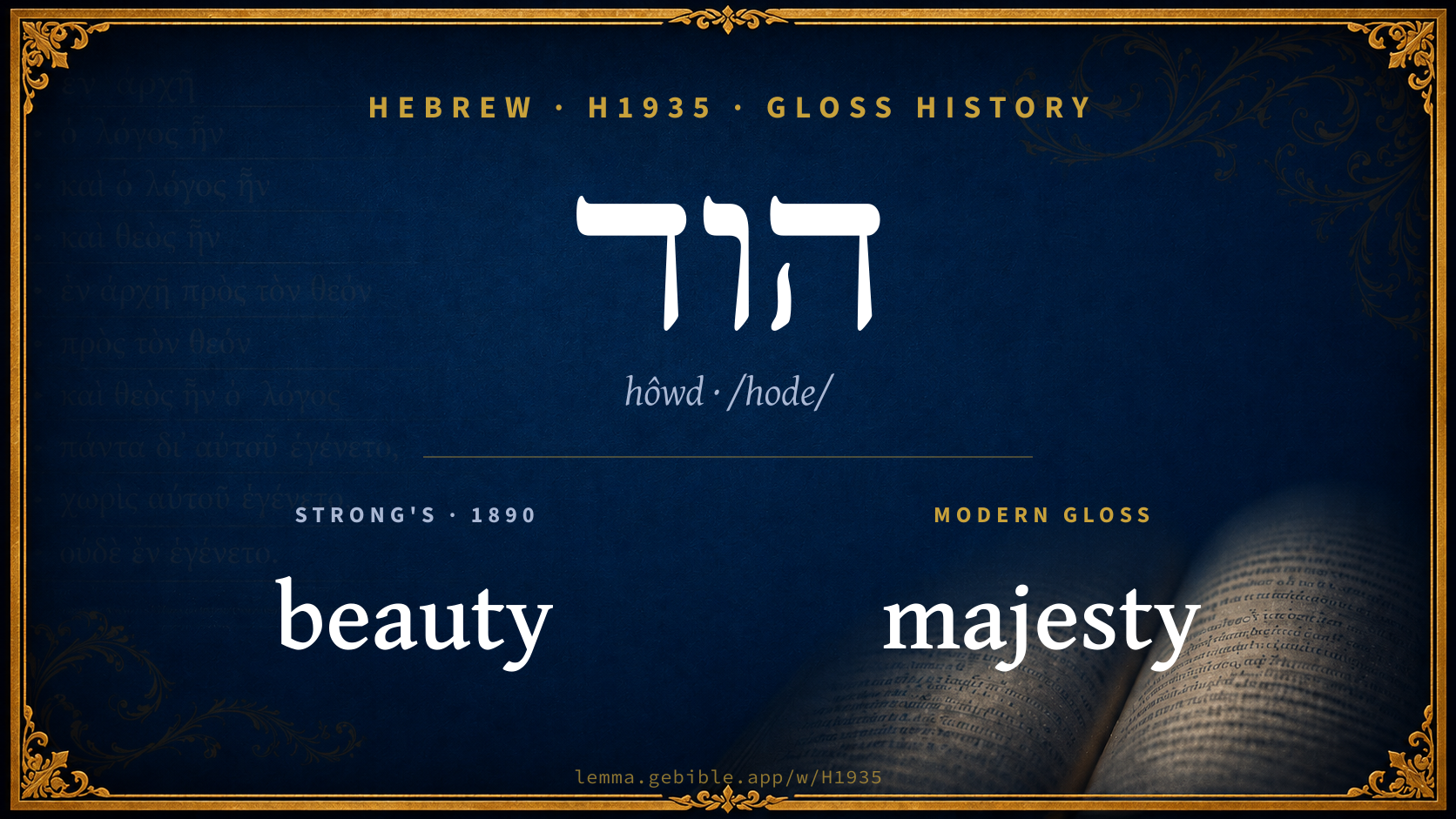
Gloss history
Strong's 1890 vs modern scholarship
About this word
Strong's H1935 catalogs a Hebrew word from the Hebrew Old Testament.
These counts are not copied from any lexicon or concordance. They are computed here, from the morphology-tagged Hebrew Old Testament. What Lemma adds →
- 24
- distinct verses
- The word appears in 24 distinct verses.
- 11 / 39
- OT books
- The word appears in 11 of 39 Old Testament books.
- #1,327
- by frequency
- Top 2500 most frequent Hebrew words (rank 1,327 of 8,640 Hebrew words by occurrence).
View all 24 occurrences in the concordance →
Most concentrated in
- Psalms 8 verses 33%
- 1 Chronicles 3 verses 13%
- Job 3 verses 13%
By section of the Old Testament
By traditional corpus
Conventional, traditional groupings — biblical authorship is debated, so this is a traditional corpus grouping, not an authorship claim. Each share is this word’s portion of its verses in that division of the Hebrew canon. Each figure is a share of the word’s 24 distinct verses.
- Writings (Ketuvim) 17 verses · 71%
- Prophets (Nevi'im) 6 verses · 25%
- Torah (Pentateuch) 1 verse · 4%
How translations render this word
Counts come from each version’s own published word-to-Strong’s tagging or interlinear alignment — an approximate guide to how each version renders this word, not a word-level alignment the data otherwise carries. Because each total is that version’s own tagged count, the per-version totals vary from one another and need not match the appearance or distinct-verse counts above. These counts may also differ from a printed concordance because Lemma counts each distinctly tagged rendering and does not collapse phrase taggings into a single head-word total. This is a fixed set of word-tagged versions (KJV, ASV, BSB, ULT) and does not change with the reading translation you choose elsewhere. Each version’s license is shown beside its name below (and on Sources).
BDB lists this Strong’s number as 2 distinct words (homographs). Each count above pools all of them and is not split by sense — see the Senses section below. A low-frequency rendering may belong to a different one of those words, not the primary meaning.
- King James Version†: Glory 8×, Honour 5×, Majesty 4×
- American Standard Version†: Honor 7×, Glory 5×, Majesty 4×
- Berean Standard Bible†: Splendor 9×, Majesty 3×, Glory 2×
- unfoldingWord Literal Text†: Splendor 10×, Majesty 5×, Glory 3×
King James Version Public Domain
Renders H1935 across 24† tagged occurrences — most commonly:
Plus 7 renderings that appear only once — usually multi-word phrases or single function words the recovered tagging swept in, not distinct renderings.
American Standard Version Public Domain
Renders H1935 across 23† tagged occurrences — most commonly:
Plus 7 renderings that appear only once — usually multi-word phrases or single function words the recovered tagging swept in, not distinct renderings.
Berean Standard Bible Public Domain
Renders H1935 across 24† tagged occurrences — most commonly:
Plus 10 renderings that appear only once — usually multi-word phrases or single function words the recovered tagging swept in, not distinct renderings.
unfoldingWord Literal Text CC BY-SA 4.0
Renders H1935 across 25† tagged occurrences — most commonly:
Plus 4 renderings that appear only once — usually multi-word phrases or single function words the recovered tagging swept in, not distinct renderings.
6 senses and sub-senses in the full BDB
What do BDB’s symbols mean?
BDB uses these scholarly abbreviations:
| Symbol | Meaning |
|---|---|
| 𝔊 | the Septuagint (the ancient Greek translation, LXX) |
| 𝔙 | the Vulgate (the Latin translation) |
| 𝔖 | the Syriac version (the Peshitta) |
| 𝔗 | the Targum (the Aramaic translation) |
| ψ | the Psalms |
| √ | root (the underlying root or stem) |
| ‖ | parallel passage (a synonymous or contrasted parallel) |
| † | the dagger: every passage where the word occurs is cited |
The 6 senses and sub-senses the full Brown-Driver-Briggs lexicon distinguishes for this word, in lexicon order (not ranked by frequency), with BDB’s own verbatim wording and sub-sense lettering. Shown in Hebrew script with BDB’s own scholarly abbreviations. The condensed entry is in the Lexicon Entry tab. See also the Forms in the corpus table below.
הוד I
- 1. splendour, majesty, of king הוֹדְךָ וַהֲדָרֶ֑ךָ ψ 45:4; הוֹד וְהָדָר תְּשַׁוֶּה עָלָיו ψ 21:6, subj. י׳ (‖ גָּדוֹל כְּבוֹדוֹ בִּישׁוּעָתֶ֑ךָ); foretold of the צֶמַה Zc 6:13 וְהוּא־יִשָּׂא הוֹד וְיָשַׁב וּמָשַׁל עַל־כִּסְאוֹ; cf. וַיִּתֵּן עָלָיו הוֹד מַלְכוּת 1 Ch 29:25 (י׳ confers on Sol.); וְלֹא נָֽתְנוּ עָלָיו ה׳ מַלְכוּת Dn 11:21 (of usurper); v. also וְהוֹי הֹדֹה Je 22:18 in lament for king. Hence also e.g. Psalms 45:4
- 2. divine splendour, majesty, light & glory which God wears as king: הוֹד וְהָדָר לָבָ֑שְׁתָּ ψ 104:1 (7 times joined with הָדָר); cf. Jb 40:10 where י׳ addresses Job in irony; עַל־אֱלוֹהַּ נוֹרָא הוֹד Jb 37:22; ה׳ וְהָדָר לְפָנָיו ψ 96:6 = 1 Ch 16:26; also הַגְּדֻלָּה וְהַגְּבוּרָה וְהַתִּפְאֶרֶת וְהַנֵּצַח וְהַה׳ 1 Ch 29:11; see further כִּסָּה שָׁמַיִם הוֹדוֹ Hb 3:3 (‖ וּתְהִלָּתוֹ מָֽלְאָה הָאָ֑רֶץ); אֲשֶׁר־תְּנָה הוֹדְךָ עַל־הַשָּׁמַיִם ψ 8:2 (‖ מָה־אַדִּיר שִׁמְךָ בְּכָל־הָאָ֑רֶץ); also הוֹדוֹ עַל־אֶרֶץ וְשָׁמָ֑יִם ψ 148:13 (‖ נִשְׂגָּב שְׁמוֹ לְבַדּוֹ); הֲדַר כְּבוֹד הוֹדֶ֑ךָ 145:4; of Yahweh’s actions הוֹד וְהָדָר פָּעֳלוֹ 111:3; of his voice וְהִשְׁמִיעַ י׳ אֶת־הוֹד קוֹלוֹ Is 30:30. e.g. Psalms 104:1
- 3.
- a. splendour of Israel under divine blessing וִיהִי כַזַּיִת הוֹדוֹ Ho 14:7. e.g. Hosea 14:7
- b. majesty, dignity, authority of Moses Nu 27:20 (P; only here in Hex) וְנָתַתָּ מֵהוֹדְךָ עָלָיו. Also, e.g. Numbers 27:20
- c. manly vigour פֶּן־תִּתֵּן לַאֲחֵרִים הוֹדֶ֑ךָ Pr 5:9, in warning against licentiousness; as displayed in outward appearance וְהוֹדִי נֶהְפַּךְ עָלַי לְמַשְׁחִית Dn 10:8 (‖ כֹּחַ). e.g. Proverbs 5:9
- 4. of a horse, majesty, majestic force הוֹד נַחְרוֹ אֵימָה Jb 39:20 the majesty of his snorting (majestic snorting, VB) is a terror; also in sim. of Yahweh’s dealings with Judah, וְשָׂם אוֹתָם כְּסוּס הוֹדוֹ בַּמִּלְחָמָה Zc 10:3 and he will make them like the horse of his majesty in battle. e.g. Job 39:20
הוד II m. (splendour, vigour)
Senses from the full Brown-Driver-Briggs lexicon (Brown, Driver, Briggs; Oxford 1906 — public domain), digitized via Sefaria, supplemented by the OpenScriptures HebrewLexicon (CC BY 4.0). Full attribution on Sources.
Word origin
I. n.m. Jb 37:22 splendour, majesty, vigour (chiefly poet.) (NH id.)—ה׳ abs. Jb 37:22 + 8 times (הַה׳ 1 Ch 29:11); cstr. Is 30:30 + 3 times; sf. הוֹדִי Dn 10:8; הוֹדְךָ Nu 27:20 + 2 times; הוֹדֶ֑ךָ Pr 5:9 ψ 145:4; הוֹדוֹ Ho 14:7 + 3 times; הֹדֹה Je 22:18;—
II. n.pr.m. (splendour, vigour)—a man of Asher 1 Ch 7:37.
— Brown-Driver-Briggs (Oxford 1906, public domain), digitized via Sefaria, supplemented by the OpenScriptures HebrewLexicon (CC BY 4.0). See Sources.
Origin: from an unused root
Jastrow Dictionary
A second Hebrew/Aramaic lexicon for comparison, covering Aramaic and post-biblical (Talmudic, Targumic, Midrashic) usage that the biblical-Hebrew BDB does not. Matched by lemma rather than by Strong’s number, so a lemma may carry more than one Jastrow headword (shown separately below), and the entries cover usage well beyond the Bible.
הוֹד
- (b. h.) distinction, pride, majesty. Ex. R. s. 47 קרני ה׳ the rays of majesty (from Moses’ face). Y. Yeb. II, 3ᵈ (play on לה̇ד̇פ̇ה, II Kings IV, 27) he placed his hand בה̇וד̇ שביופ̇יה וכ׳ on the most distinctive of her charms, &c. e.g. 2 Kings 4:27
A Dictionary of the Targumim, the Talmud Babli and Yerushalmi, and the Midrashic Literature (Marcus Jastrow; London, Luzac, 1903) — Public Domain. Digitized via Sefaria. Digitized via Sefaria. Full attribution on Sources.
Forms in the corpus
The 19 distinct written forms H1935 takes in the Hebrew Bible, most frequent first — each parse links to that state’s occurrences in the concordance. Hebrew forms include their vowel points and cantillation, so a single lemma takes many written forms.
Same root — word family
Other BDB entries built from the same root as H1935, grouped by Strong’s listed origin. These share a root / origin per the lexicon — not necessarily a shared meaning. Each links to that word’s own entry.
Proper names from this root
People and places named from this root — a name, not an additional meaning of the word.
Compare all same-root words → 2 of the same-root words are proper names (people or places). They share a root, not necessarily a meaning.
Septuagint verse parallels
This word appears in 24 verses that also exist in the Greek Old Testament (Septuagint), out of the 24 Hebrew verses it occurs in. You can read those verses in Greek by switching the Old Testament edition to the Septuagint.
Read these verses in the Septuagint
- Numbers 27:20
- 1 Chronicles 16:27
- Job 37:22
- Psalms 8:1
- Proverbs 5:9
- Isaiah 30:30
- Jeremiah 22:18
- Daniel 10:8
- Hosea 14:6
- Habakkuk 3:3
- Zechariah 6:13
This is a verse-level parallel only — the same verses exist in both the Hebrew and Greek Old Testaments. No word-level Hebrew↔Greek correspondence is claimed: the data carries no such alignment, so no Greek word is shown as this Hebrew word’s translation. Coverage is not total — the Septuagint omits the deuterocanon and renumbers the Psalms, so some Hebrew verses have no direct Greek parallel.