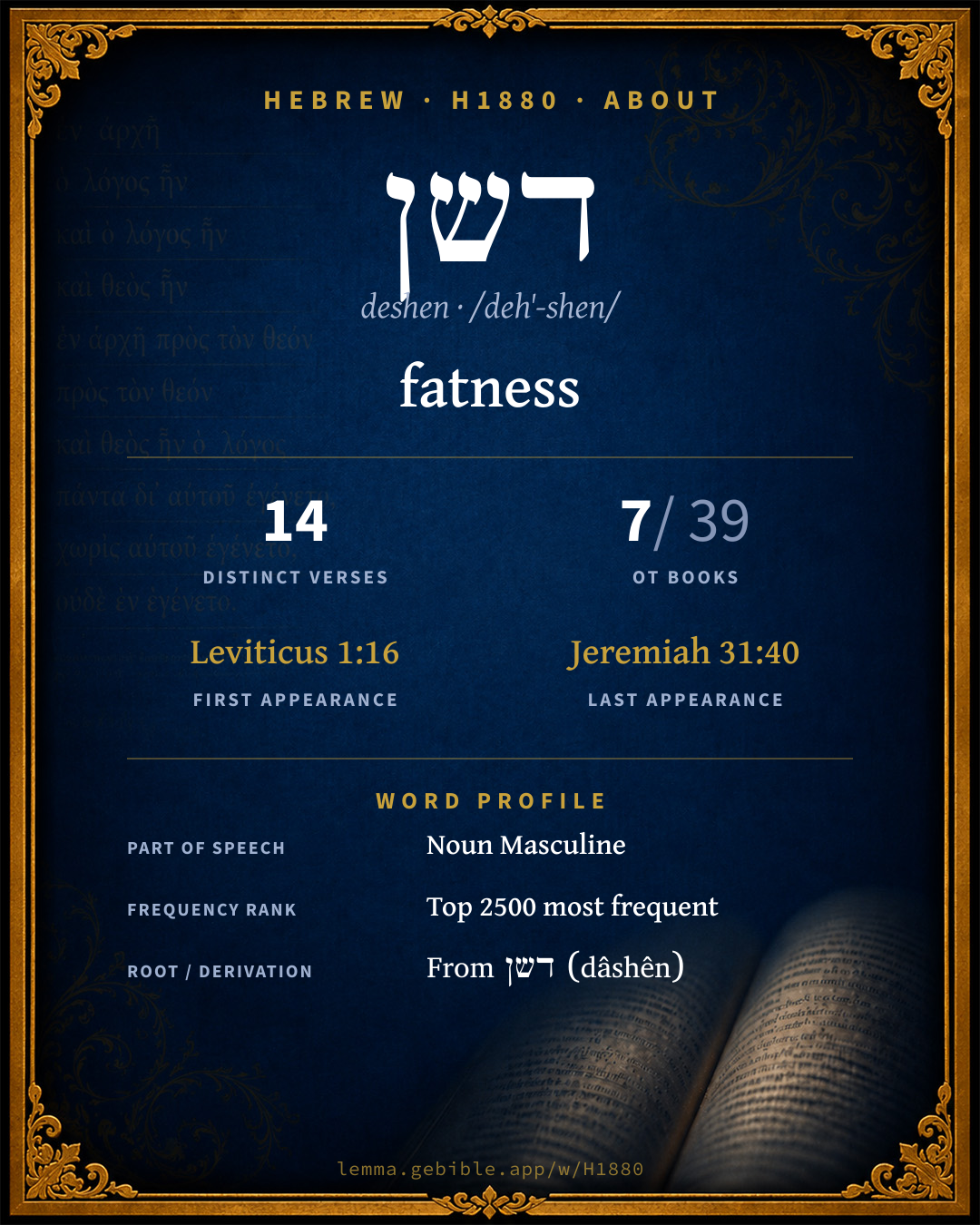
דֶּ֫שֶׁן
fatness
‘fatness’ is one of 3 main senses fuller range ↓
Full lexicon entry — Brown-Driver-Briggs (BDB)
From Brown-Driver-Briggs (BDB)
Where this word appears
Grammar key — what these labels mean
Part of speech
- Noun
- A naming word — a person, place, thing, or idea.
Noun type
- Common
- A common noun — a general class of person, place, or thing (“king,” “city,” “water”), not a specific name.
State
- Absolute
- The independent form of a noun, not bound to a following word.
- Construct
- A noun bound to a following noun in a possessive / “of” relationship (the construct chain).
Gender
- Masculine
- Grammatically masculine.
Number
- Singular
- One.
Every verse where H1880 appears in the Book of 1 Kings — 2 distinct verses. Click any verse to open its interlinear word-by-word view. Verse text shown in the World English Bible for context — . Each verse’s Hebrew form is shown with its reference; the English is not keyword-highlighted, since the data carries no word-level English alignment. Use “Compare translations” on any verse to read it across multiple English versions. This concordance covers the Hebrew Bible; Septuagint (Greek Old Testament) occurrences are not indexed here.
1 Kings
- 1 Kings 13:3 הַ/דֶּ֥שֶׁן ptcl def.art + n c ms He gave a sign the same day, saying, This is the sign which Yahweh has spoken: Behold, the altar shall be torn, and the ashes that are on it shall be poured out.
- 1 Kings 13:5 הַ/דֶּ֖שֶׁן ptcl def.art + n c ms The altar also was torn, and the ashes poured out from the altar, according to the sign which the man of God had given by the word of Yahweh.
About this entry
At a glance — auto-summarized from this page’s data, not written by a person. Every figure links to its source below. This summary describes the numbers; it doesn’t interpret them.
The Hebrew noun דשן centers on the idea of “fatness.” Its earliest occurrence is Leviticus 1:16. It appears 14 verses across 7 books of the Hebrew Bible, among its uncommon vocabulary. The word gravitates to Leviticus (29%), then Psalms and 1 Kings. Its meaning spans more than one sense — see its full sense range. For the data behind this summary, explore the sense tree and the renderings breakdown below.
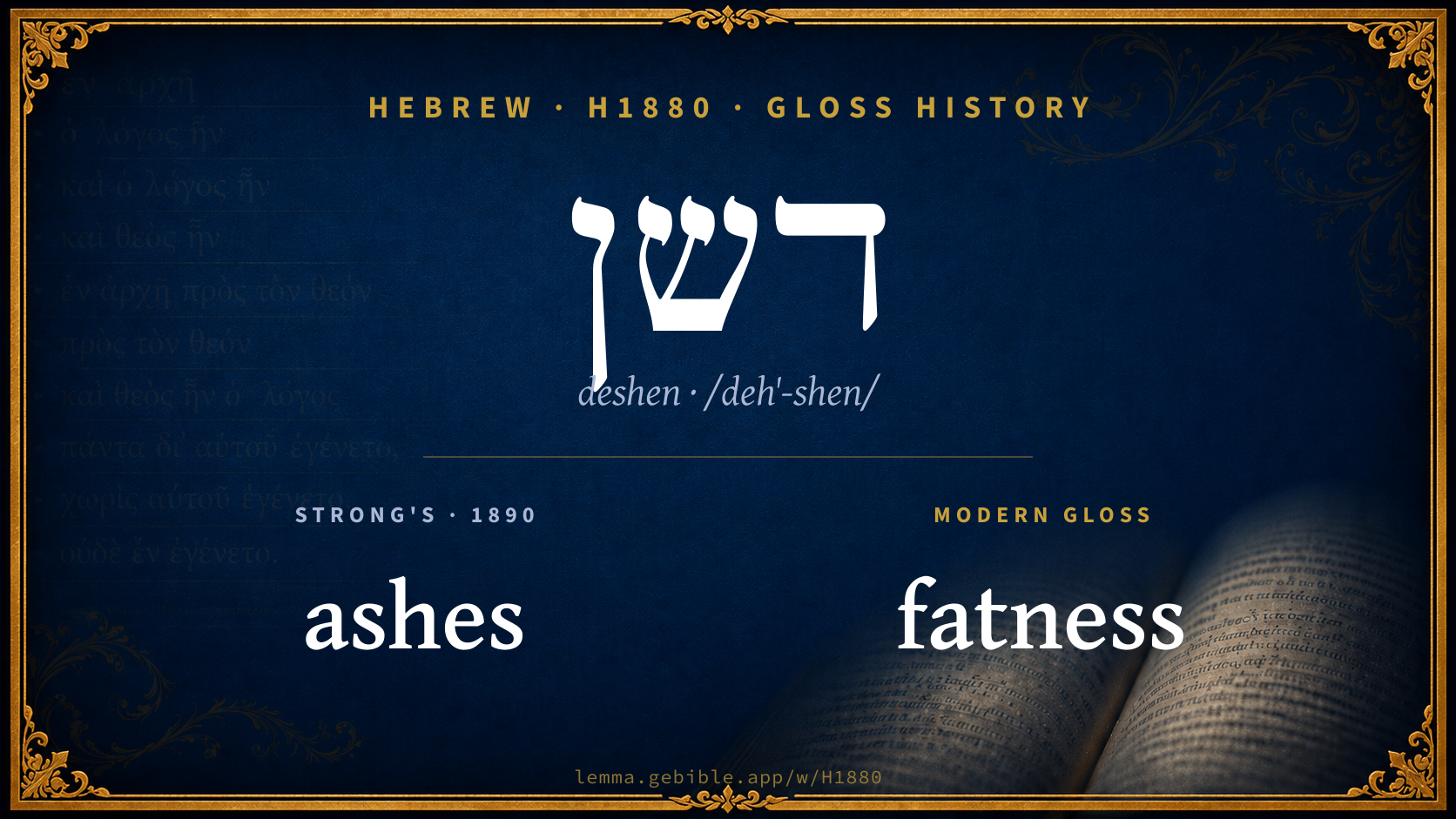
Gloss history
Strong's 1890 vs modern scholarship
About this word
Strong's H1880 catalogs a Hebrew word from the Hebrew Old Testament.
These counts are not copied from any lexicon or concordance. They are computed here, from the morphology-tagged Hebrew Old Testament. What Lemma adds →
- 14
- distinct verses
- The word appears in 14 distinct verses.
- 7 / 39
- OT books
- The word appears in 7 of 39 Old Testament books.
- #1,836
- by frequency
- Top 2500 most frequent Hebrew words (rank 1,836 of 8,640 Hebrew words by occurrence).
View all 14 occurrences in the concordance →
By section of the Old Testament
By traditional corpus
Conventional, traditional groupings — biblical authorship is debated, so this is a traditional corpus grouping, not an authorship claim. Each share is this word’s portion of its verses in that division of the Hebrew canon. Each figure is a share of the word’s 14 distinct verses.
- Prophets (Nevi'im) 6 verses · 43%
- Torah (Pentateuch) 4 verses · 29%
- Writings (Ketuvim) 4 verses · 29%
How translations render this word
Counts come from each version’s own published word-to-Strong’s tagging or interlinear alignment — an approximate guide to how each version renders this word, not a word-level alignment the data otherwise carries. Because each total is that version’s own tagged count, the per-version totals vary from one another and need not match the appearance or distinct-verse counts above. These counts may also differ from a printed concordance because Lemma counts each distinctly tagged rendering and does not collapse phrase taggings into a single head-word total. This is a fixed set of word-tagged versions (KJV, ASV, BSB, ULT) and does not change with the reading translation you choose elsewhere. Each version’s license is shown beside its name below (and on Sources).
- King James Version: Ashes 8×, Fatness 6×
- American Standard Version: Ashes 8×, Fatness 5×
- Berean Standard Bible: Ashes 7×
- unfoldingWord Literal Text: Fatness 5×, Fatty ash 4×, Ash 2×
King James Version Public Domain
Renders H1880 across 15 tagged occurrences — most commonly:
Plus 1 rendering that appears only once — usually multi-word phrases or single function words the recovered tagging swept in, not distinct renderings.
American Standard Version Public Domain
Renders H1880 across 15 tagged occurrences — most commonly:
Plus 2 renderings that appear only once — usually multi-word phrases or single function words the recovered tagging swept in, not distinct renderings.
Berean Standard Bible Public Domain
Renders H1880 across 15 tagged occurrences — most commonly:
Plus 8 renderings that appear only once — usually multi-word phrases or single function words the recovered tagging swept in, not distinct renderings.
unfoldingWord Literal Text CC BY-SA 4.0
Renders H1880 across 13 tagged occurrences — most commonly:
Plus 2 renderings that appear only once — usually multi-word phrases or single function words the recovered tagging swept in, not distinct renderings.
Senses in the full BDB
What do BDB’s symbols mean?
BDB uses these scholarly abbreviations:
| Symbol | Meaning |
|---|---|
| 𝔊 | the Septuagint (the ancient Greek translation, LXX) |
| 𝔙 | the Vulgate (the Latin translation) |
| 𝔖 | the Syriac version (the Peshitta) |
| 𝔗 | the Targum (the Aramaic translation) |
| ψ | the Psalms |
| √ | root (the underlying root or stem) |
| ‖ | parallel passage (a synonymous or contrasted parallel) |
| † | the dagger: every passage where the word occurs is cited |
The 2 senses and sub-senses the full Brown-Driver-Briggs lexicon distinguishes for this word, in lexicon order (not ranked by frequency), with BDB’s own verbatim wording and sub-sense lettering. Shown in Hebrew script with BDB’s own scholarly abbreviations. The condensed entry is in the Lexicon Entry tab. See also the Forms in the corpus table below.
- 1. fatness, abundance, luxuriance, oil, Ju 9:9 (of olive tree); abundance, fertility ψ 63:5 (in simile ‖ חֵלֶב), 65:12, of food and drink, Jb 36:16 Je 31:14; passing over into fig. of spiritual blessing ψ 36:9 (ד׳ ביתך), Is 55:2. e.g. Judges 9:9
- 2. fat ashes, i.e. ashes of victims, mixed with the fat Lv 1:16; 4:12(×2); 6:3, 4 (all P) Je 31:40 1 Ki 13:3, 5. e.g. Leviticus 1:16
Senses from the full Brown-Driver-Briggs lexicon (Brown, Driver, Briggs; Oxford 1906 — public domain), digitized via Sefaria, supplemented by the OpenScriptures HebrewLexicon (CC BY 4.0). Full attribution on Sources.
Word origin
n.m. fatness, fat ashes—abs. ד׳ ψ 63:6 + 8 times, דָּ֑שֶׁן Lv 1:16 + 3 times; cstr. דֶּשֶׁן ψ 36:9; sf. דִּשְׁנִי Ju 9:9—
— Brown-Driver-Briggs (Oxford 1906, public domain), digitized via Sefaria, supplemented by the OpenScriptures HebrewLexicon (CC BY 4.0). See Sources.
Derived from דשן (dâshên) (H1878) — to be fat.
Jastrow Dictionary
A second Hebrew/Aramaic lexicon for comparison, covering Aramaic and post-biblical (Talmudic, Targumic, Midrashic) usage that the biblical-Hebrew BDB does not. Matched by lemma rather than by Strong’s number, so a lemma may carry more than one Jastrow headword (shown separately below), and the entries cover usage well beyond the Bible.
דָּשֵׁן
- to be moist, sappy, fat.
- 1. to bless with rich pastures. Ber. 29ᵃ דַּשְּׁנֵנוּ בנאות וכ׳ (cmp. Ps. XXIII, 2) give us pasture on the meadows of thy land. e.g. Psalms 23:2
- 2. (b. h.; to remove the ashes, to clean (the lamps). Tam. III, 9 מְדַשְּׁנָן trims them. Yoma II, 3 מי מְדַשֵּׁן וכ׳ who shall do the cleaning of the inner altar. Tam. III, 1; a. e.
- 1. to become sappy, vigorous. Pirké d’R. El. ch. XXXII, end.
- 2. to be treated like the charred wick, to become unfit for sacred use. Men. 88ᵇ ני׳ השמן נִידַּשְּׁנָה וכ׳ the oil as well as the wick has become unfit.
דֶּשֶׁן
- v. preced.)
- 1. fat, honorary gift, v. next w.
- 2. ashes (of burnt flesh &c.). Zeb. V, 2, a. fr. בֵּית הד׳ the place where the ashes of sacrifices were deposited.—Pl. דְּשָׁנִין. Ib. 104ᵇ שלש בֵּית הַדְּשָׁנִין(!)
שֵׁן
- c. (b. h.;
- 1. tooth, tooth-like projection. Sabb. VI, 5 (64ᵇ) שן תותבת ושן של זהב an inserted (natural) tooth or an (artificial) gold tooth; (Bab. ed. שן תותכת שן וכ׳, Ms. O. ושן, v. Rashi a. l.). Ib. 10, v. שׁוּעָל; a. fr.—Esp. (sub. נזק) the damage done by an animal’s eating. B. Kam. 2ᵇ שלשה … הקרן והשן והרגל three chief damages are mentioned (in the Scriptural text) with reference to the ox: damage by the horn, by the tooth, and by the foot. Ib. תולדה דשן, v. נְשִׁיכָה. Ib. שן יש הנאה וכ׳, v. הֶיזֵּק. Ib. אשן ורגל it refers to damages by the tooth and by the foot; שן ורגל היכא כתיבי where is the damage by the tooth or the foot written (in the Biblical text)? Ib. ובער זו השן ubhiʿer (Ex. XXII, 4) this refers to damage by the tooth; a. fr.—Du. שִׁנַּיִים, שִׁנַּיִם, שִׁי׳. Ḥull. I, 2 בכל … והש׳ you may cut ritually with anything, except … with teeth in the jaw. Ib. ואם החליקו שִׁינֶּיהָ and if the teeth of the saw have been made smooth. Keth. 71ᵇ בין שיניה, v. אֶצְבַּע. Ib. 16ᵃ, v. כֶּרֶס. Kel. XIII, 8 שניטלו שִׁינָּיו (a hackle) whose teeth are broken off. Gen. R. s. 33 חשש רבי את שיניו וכ׳ Rabbi suffered from tooth-ache for thirteen years. Keth. 111ᵇ טוב המלבין ש׳ וכ׳ he who causes his neighbor to show the white of his teeth (who makes him cheerful) does better than he who gives him milk to drink. Ib. א"ת לבן ש׳ אלא לבון ש׳ read not l’ben shinnayim (Gen. XLIX, 12) but libbun shinnayim (whitening of teeth, cheerfulness); a. fr.— any organ of the body resembling teeth, gland.—Du. as ab. Y. Yeb. VI, beg. 7ᵇ בית הש׳ that part of the vagina which has glands; מבין הש׳ ולפנים from the glands and farther inside; Nidd. 41ᵇ. Ḥull. 16ᵇ שיניו נושרות the glands of his rectum will fall off; Sabb. 82ᵃ; a. e. e.g. Exodus 22:4
- 3. cliff, peak. Gen. R. s. 74 כשן הזה של וכ׳ (the stone which Jacob put up was) as large as the peak of Tiberias; Yalk. ib. 130; a. e.
- 4. (sub. של פיל) ivory. Num. R. s. 312 (play on מי יג̇ור̇ … חזק כש̇ן̇ (ג̇ר̇ש̇ון̇ who can abide snow and hail, and cold and heat? He who is as strong as ivory (or marble?); אין שן אלא לשון חזק וכ׳ shen has the meaning of strong (ref. to Cant. V, 14); a. e e.g. Song of Solomon 5:14
- 5. marble. Cant. R. to V, 11; Yalk. ib. 991, v. עֶשֶׁת.
שֵׁן ²
- Targ. O. Deut. XXXII, 24. Targ. Ex. XXI, 24. Targ. I Kings X, 22 (v. פִּילָא I). Ib. 18. Targ. I Sam. XIV, 4; a. fr.—Y. Kil. IX, 32ᵇ bot; האי שִׁינָּךְ וכ׳ how is that tooth of thine?; Y. Keth. XII, 35ᵃ bot.; Gen. R. s. 33. Ib. יהב ידיה על שִׁינֵּיה וכ׳ he put his hand on his (Rabbi’s) tooth, and it was cured.—Gitt. 68ᵇ ומנח להו אש׳ דטורא וכ׳ he puts it (the Shamir) on the peak of a mountain, and the mountain bursts. Snh. 96ᵇ תא אש׳ דטורא (Rashi דטורי) come (to Jerusalem) even if it be necessary to march over the cliffs of mountains (differ. in Rashi); Yalk. Is. 287; a. fr.—ש׳ דדור, שן דור pr. n. pl. the Cliff of Dor (v. Hildesh. Beitr. pp. 4; 10). Y. Shebi. VI, 36ᶜ (not דרור); Tosef. Shebi. IV, 11 שורא דרור (corr. acc.); Sifré Deut. 51 [read:] מדבר שר שן דור; Yalk. ib. 874 (corr. acc.).—Pl. שִׁנִּין, שִׁנַּיָּא, שִׁנֵּי, שִׁי׳. Targ. Am. IV, 6 (not שְׁנִין). Targ. Prov. X, 26.—Targ. Jer. XLIX, 16. Targ. Y. Gen. XLIX, 21 (not שֵׁינֵי); a. fr.—Y. Kil. IX, 32ᵇ תלת … חשש (ב)שִׁינּוֹי suffered from tooth-ache for thirteen years. Ib. חד שִׁינַּיי וכ׳ one of my teeth annoys me; (Y. Keth. l. c. חד שינא).—Sabb. 82ᵃ, v. כַּרְכְּשָׁא; a. fr.
A Dictionary of the Targumim, the Talmud Babli and Yerushalmi, and the Midrashic Literature (Marcus Jastrow; London, Luzac, 1903) — Public Domain. Digitized via Sefaria. Digitized via Sefaria. Full attribution on Sources.
Forms in the corpus
The 14 distinct written forms H1880 takes in the Hebrew Bible, most frequent first — each parse links to that state’s occurrences in the concordance. Hebrew forms include their vowel points and cantillation, so a single lemma takes many written forms.
Same root — word family
Other BDB entries built from the same root as H1880, grouped by Strong’s listed origin. These share a root / origin per the lexicon — not necessarily a shared meaning. Each links to that word’s own entry.
Derives from
Shares the same root
Compare all same-root words → They share a root, not necessarily a meaning.
Septuagint verse parallels
This word appears in 14 verses that also exist in the Greek Old Testament (Septuagint), out of the 14 Hebrew verses it occurs in. You can read those verses in Greek by switching the Old Testament edition to the Septuagint.
Read these verses in the Septuagint
This is a verse-level parallel only — the same verses exist in both the Hebrew and Greek Old Testaments. No word-level Hebrew↔Greek correspondence is claimed: the data carries no such alignment, so no Greek word is shown as this Hebrew word’s translation. Coverage is not total — the Septuagint omits the deuterocanon and renumbers the Psalms, so some Hebrew verses have no direct Greek parallel.