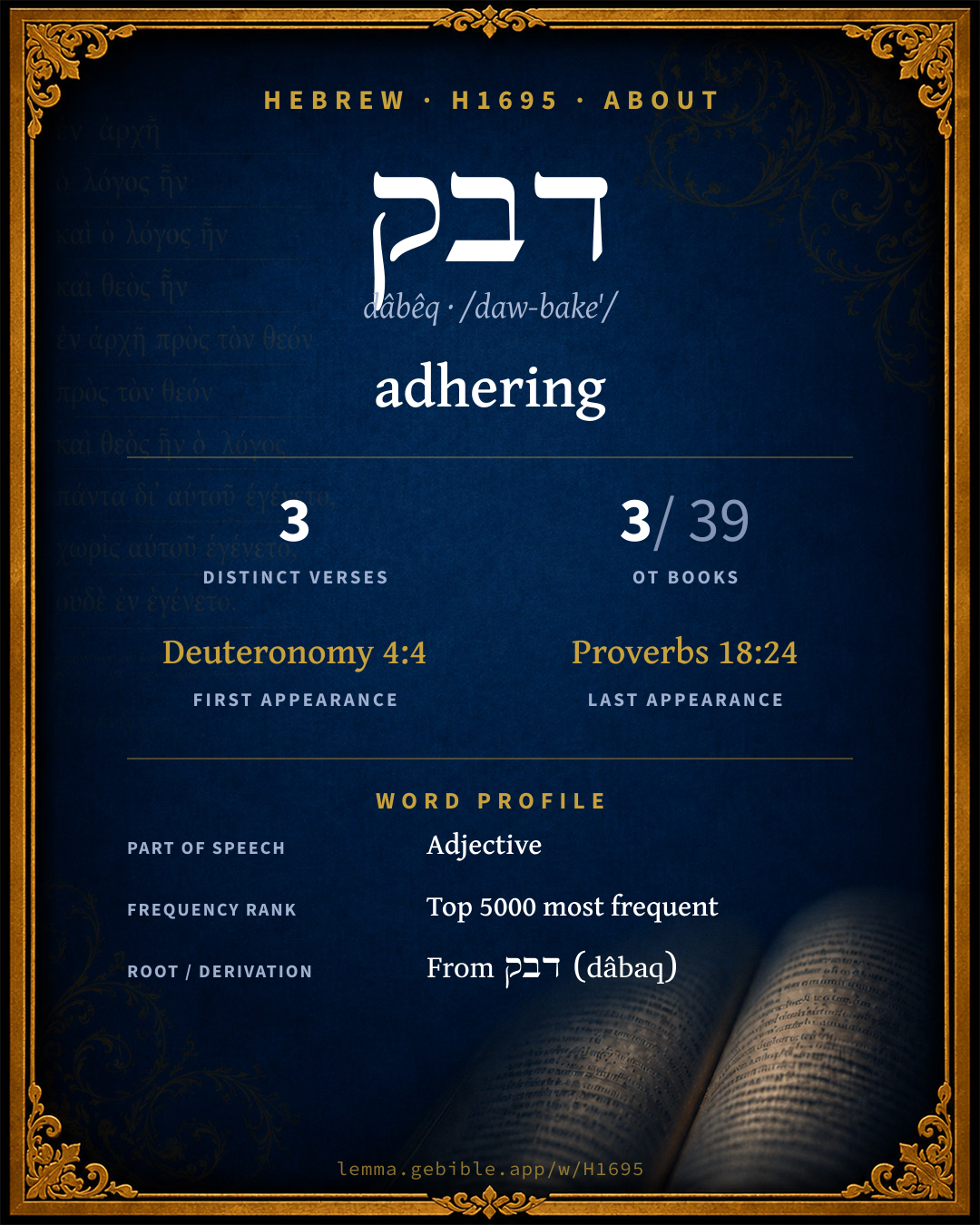
דָּבֵק
adhering
Full lexicon entry — Brown-Driver-Briggs (BDB)
From Brown-Driver-Briggs (BDB)
Where this word appears
Grammar key — what these labels mean
Part of speech
- Adjective
- A word that describes or qualifies a noun.
State
- Absolute
- The independent form of a noun, not bound to a following word.
Gender
- Feminine
- Grammatically feminine.
- Masculine
- Grammatically masculine.
Number
- Singular
- One.
- Plural
- More than one (in Hebrew, generally three or more).
Every verse where H1695 appears in the Book of Deuteronomy — 1 distinct verse. Click any verse to open its interlinear word-by-word view. Verse text shown in the World English Bible for context — . Each verse’s Hebrew form is shown with its reference; the English is not keyword-highlighted, since the data carries no word-level English alignment. Use “Compare translations” on any verse to read it across multiple English versions. This concordance covers the Hebrew Bible; Septuagint (Greek Old Testament) occurrences are not indexed here.
Deuteronomy
About this entry
At a glance — auto-summarized from this page’s data, not written by a person. Every figure links to its source below. This summary describes the numbers; it doesn’t interpret them.
דבק (dâbêq) is a Hebrew adjective most often rendered “adhering.” It occurs a mere 3 verses across Scripture. Deuteronomy dominates its distribution — 1 of 3 verses. It first appears in Deuteronomy 4:4. Related forms include דבק, דבק and דבק. For the data behind this summary, explore the sense tree and the renderings breakdown below.
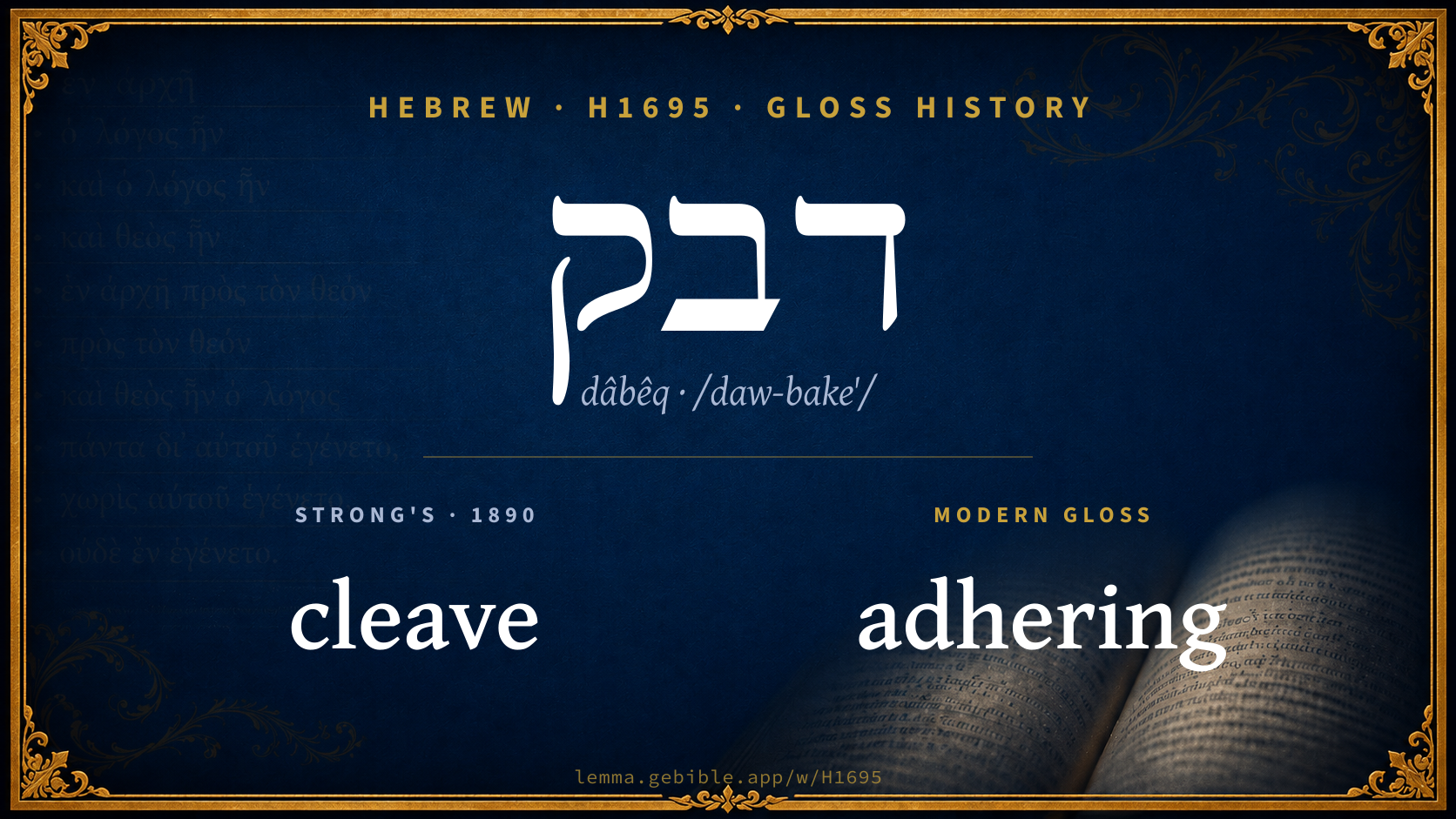
Gloss history
Strong's 1890 vs modern scholarship
About this word
Strong's H1695 catalogs a Hebrew word from the Hebrew Old Testament.
These counts are not copied from any lexicon or concordance. They are computed here, from the morphology-tagged Hebrew Old Testament. What Lemma adds →
- 3
- distinct verses
- The word appears in 3 distinct verses.
- 3 / 39
- OT books
- The word appears in 3 of 39 Old Testament books.
- #4,179
- by frequency
- Top 5000 most frequent Hebrew words (rank 4,179 of 8,640 Hebrew words by occurrence).
View all 3 occurrences in the concordance →
Most concentrated in
- Deuteronomy 1 verse 33%
- 2 Chronicles 1 verse 33%
- Proverbs 1 verse 33%
By section of the Old Testament
By traditional corpus
Conventional, traditional groupings — biblical authorship is debated, so this is a traditional corpus grouping, not an authorship claim. Each share is this word’s portion of its verses in that division of the Hebrew canon. Each figure is a share of the word’s 3 distinct verses.
- Writings (Ketuvim) 2 verses · 67%
- Torah (Pentateuch) 1 verse · 33%
How translations render this word
Counts come from each version’s own published word-to-Strong’s tagging or interlinear alignment — an approximate guide to how each version renders this word, not a word-level alignment the data otherwise carries. Because each total is that version’s own tagged count, the per-version totals vary from one another and need not match the appearance or distinct-verse counts above. These counts may also differ from a printed concordance because Lemma counts each distinctly tagged rendering and does not collapse phrase taggings into a single head-word total. This is a fixed set of word-tagged versions (KJV, ASV, BSB, ULT) and does not change with the reading translation you choose elsewhere. Each version’s license is shown beside its name below (and on Sources).
BDB lists this Strong’s number as 2 distinct words (homographs). Each count above pools all of them and is not split by sense — see the Senses section below. A low-frequency rendering may belong to a different one of those words, not the primary meaning.
- King James Version†: Joining 1×, Sticketh closer 1×, Ye that did cleave 1×
- American Standard Version†: Also 1×, Sticketh closer 1×, Ye that did cleave 1×
- Berean Standard Bible†: Held fast 1×, Stays closer 1×, Touched 1×
- unfoldingWord Literal Text†: Clinging 2×
King James Version Public Domain
Renders H1695 across 3† tagged occurrences — most commonly:
American Standard Version Public Domain
Renders H1695 across 3† tagged occurrences — most commonly:
Berean Standard Bible Public Domain
Renders H1695 across 3† tagged occurrences — most commonly:
unfoldingWord Literal Text CC BY-SA 4.0
Renders H1695 across 3† tagged occurrences — most commonly:
Plus 1 rendering that appears only once — usually multi-word phrases or single function words the recovered tagging swept in, not distinct renderings.
14 senses and sub-senses in the full BDB
Hebrew verbs can shift meaning by stem (binyan): Qal is the basic action, Niphal is often passive or reflexive, Piel often intensifies or makes it factitive, and Hiphil is typically causative. The senses below are grouped under the stem BDB assigns to each. This entry also uses Pual (the passive of Piel) and Hophal (the passive of Hiphil).
What do BDB’s symbols mean?
BDB uses these scholarly abbreviations:
| Symbol | Meaning |
|---|---|
| 𝔊 | the Septuagint (the ancient Greek translation, LXX) |
| 𝔙 | the Vulgate (the Latin translation) |
| 𝔖 | the Syriac version (the Peshitta) |
| 𝔗 | the Targum (the Aramaic translation) |
| ψ | the Psalms |
| √ | root (the underlying root or stem) |
| ‖ | parallel passage (a synonymous or contrasted parallel) |
| † | the dagger: every passage where the word occurs is cited |
The 14 senses and sub-senses the full Brown-Driver-Briggs lexicon distinguishes for this word, in lexicon order (not ranked by frequency), with BDB’s own verbatim wording and sub-sense lettering. Shown in Hebrew script with BDB’s own scholarly abbreviations. The condensed entry is in the Lexicon Entry tab. See also the Forms in the corpus table below.
דבק I cling, cleave, keep close (NH id., Arabic دَبِقَ, Aramaic דְּבֵק, דְּבַק, ܕܒܶܩ, ܕܒܰܩ )
Qal
- Pf. דָּבַק 1 K 11:2 + 2 times; וְדָבַק consec. Gn 2:24; דָּבֵ֑ק 2 K 3:3; 3 fs. דָּֽבְקָה Ru 1:14 + 5 times; דָּבֵ֑קָה Job 29:10; 1 s. דָּבַקְתִּי ψ 119:31; 3 pl. דָּֽבְקוּ 2 S 20:2; וְדָֽבְקוּ consec. Dt 28:60; דָּבֵ֑קוּ Jb 41:15; וּדְבַקְתֶּם consec. Jos 23:12; Impf. יִדְבַּק Dt 13:18 + 3 times; 3 fs. תִּדְבַּק 2 K 5:27 ψ 137:6; וַתִּדְבַּק Gn 34:3 + 2 times; sf. תִּדְבָּקַנִי Gn 19:19; 2 ms. תִּדְבָּ֑ק Dt 10:20 Ez 29:4 (del. B Co); 2 fs. תִּדְבָּקִין Ru 2:8, 21; 3 pl. יִדְבְּקוּ Nu 36:7, 9; 2 mpl. תִּדְבָּ֑קוּ Jos 23:8; תִּדְבָּקוּ֑ן Dt 13:5; Inf. cstr. וּלְדָבְקָה־בּוֹ Dt 11:22 + 2 times;—in Hexateuch only JD, except Nu 36:7, 9 (P);— e.g. 1 Kings 11:2
- 1. cling, cleave to,
- a. lit. sq. בְּ Jb 19:20 (bone to skin), so sq. לְ ψ 102:6; sq. אֶל 2 S 23:10 (hand to sword; accidentally om. with other words 1 Ch 11:13 cf. Dr 2 S 23:11), Je 13:11 (girdle to loins), La 4:4 (tongue to roof of mouth, in thirst), so sq. לְ Jb 29:10 ψ 137:6 (as a judgment); so also in metaph. ψ 44:26 דָּֽבְקָה לָאָרֶץ בִּטְנֵנוּ our belly cleaveth to the earth (‖ שָׁחָה לֶעָכָּר נַפְשֵׁנוּ), 119:25 דָּֽבְקָה לֶעָפָר נַפְשִׁי; fish to scales of crocodile (fig. of Pharaoh), sq. בְּ Ez 29:4 (but cf. supr.); abs. (recipr.) of folds of crocodile’s belly Jb 41:15; further of the חֵרֶם remaining in (sticking to) the hand sq. בְּ Dt 13:18; so of spot, stain Jb 31:7. e.g. Job 19:20
- b. so also of abiding on the land of one’s tribe Nu 36:7, 9 (sq. בְּ). e.g. Numbers 36:7
- c. = remain with, close to sq. עִם Ru 2:8, 21 sq. בְּ v 23. e.g. Ruth 2:8
- a. fig. of loyalty, affection etc., sometimes with idea of physical proximity retained, sq. בְּ Gn 2:24 (J; man to wife) cf. 34:3 (J) 1 K 11:2 Jos 23:12 (D); further Ru 1:14 (Ruth to Naomi); 2 S 20:2 (people to king); especially (sq. בְּ) of cleaving to י׳ Dt 11:22 (‖ אָהֵב, הָלַךְ בְּכָל־דְּרָכָיו) 30:20 (‖ אָהֵב, שָׁמַע בְּקֹלוֹ), Jos 22:5 (‖ אָהֵב, הָלַךְ וגו׳, שָׁמַר מִצְוֹתָיו); cf. further Dt 10:20; 13:5; Jos 23:8 (all D), 2 K 18:6; ψ 63:9 (sq. אַחֲרֵי) & ψ 119:31 דָּבַקְתּי בְעֵֽדְוֹתֶ֑יךָ; so e.g. Genesis 2:24
- b. of the opposite בְּחַטֹּאות יָֽרָבְעָם … דָּבֵ֑ק 2 K 3:3; e.g. 2 Kings 3:3
- c. subj. disease, calamity, sq. בְּ pers. Dt 28:60 2 K 5:27; sq. אַחֲרֵי Je 42:16; sq. acc. Gn 19:19 (J); subj. sin ψ 101:3 (sq. בְּ pers.) e.g. Deuteronomy 28:60
Pual
- Impf. 3 mpl. יְדֻבָּ֑קוּ pass. of Hiph. 1. sq. בְּ, of crocodile’s scales, they are joined together Jb 41:9 (‖ יִתְלַכְּדוּ); abs. of earth-clods Jb 38:38. e.g. Job 41:9
Hiphil
- Pf. 3 fs. sf. הִדְבִּיקָ֑תְהוּ Ju 20:42; 3 pl. sf. הִדְבִּיקֻהוּ 2 S 1:6; 1 s. הִדְבַּקְתִּי Je 13:11; וְהִדְבַּקְתִּי Ez 29:4; Impf. juss. יַדְבֵּק Dt 28:21; וַיַּדְבֵּק Gn 31:23; אַדְבִּיק Ez 3:26; וַיַּדְבִּיקוּ Ju 18:22; 20:45; וַיַּדְבְּקוּ 1 S 14:22 + 2 times (cf. Ges§ 53 R 4 Kö i 210). e.g. Judges 20:42
- 1. cause to cling or cleave to, sq. acc. + אֶל, lit. וּלְשׁוֹנְךָ אַדְבִּיק אֶל־חִכֶּ֑ךָ Ez 3:26; v. also 29:4 (sq. acc. + בְּ; lit., but in metaph.); fig. of causing to cleave to י׳ Je 13:11 (sq. acc. + אֶל); cf. further Dt 28:21 (subj. י׳, sq. acc. of disease + בְּ). e.g. Ezekiel 3:26
- 2. pursue closely, sq. אַחֲרִי Ju 20:45 1 S 14:22; 1 Ch 10:2 = 1 S 31:2 (sq. acc.); so also 2 S 1:6 (sq. acc.) e.g. Judges 20:45
- 3. overtake, sq. acc. Gn 31:23 (E), Ju 18:22; cf. 20:42 (subj. הַמִּלְחָמָה). e.g. Genesis 31:23
Hophal
- Pt. וּלְשׁוֹנִי מֻדְבָּק מַלְקוֹחָ֑י ψ 22:16 and my tongue is made to cleave (to) my gums; cf. sub Qal 1. e.g. Psalms 22:16
דבק II clinging, cleaving (to), דּ׳ abs. וְיֵשׁ אֹהֵב דָּבֵק מֵאָח Pr 18
Senses from the full Brown-Driver-Briggs lexicon (Brown, Driver, Briggs; Oxford 1906 — public domain), digitized via Sefaria, supplemented by the OpenScriptures HebrewLexicon (CC BY 4.0). Full attribution on Sources.
Word origin
I. vb. cling, cleave, keep close (NH id., Arabic دَبِقَ, Aramaic דְּבֵק, דְּבַק, ܕܒܶܩ, ܕܒܰܩ )—
I. adj. clinging, cleaving (to), דּ׳ abs. וְיֵשׁ אֹהֵב דָּבֵק מֵאָח Pr 18:24; דְּבֵקָה לְ 2 Ch 3:12 (of cherub’s wing); of cleaving to הַדְּבֵקִים בְּ י׳ Dt 4:4.
— Brown-Driver-Briggs (Oxford 1906, public domain), digitized via Sefaria, supplemented by the OpenScriptures HebrewLexicon (CC BY 4.0). See Sources.
Derived from דבק (dâbaq) (H1692) — to cleave.
Jastrow Dictionary
A second Hebrew/Aramaic lexicon for comparison, covering Aramaic and post-biblical (Talmudic, Targumic, Midrashic) usage that the biblical-Hebrew BDB does not. Matched by lemma rather than by Strong’s number, so a lemma may carry more than one Jastrow headword (shown separately below), and the entries cover usage well beyond the Bible.
דָּבֵק
- (b. h.) to cleave, adhere, stick. B. Bath. 91ᵇ, v. infra.—Yalk. Gen. 133 דבקו כל החיל וכ׳ the whole army was close to the fortress.—Ib. Deut. 824 ד׳ לסדומיים he joined the Sodomites.—2) to join, glue, affix. Y. Meg. I, 71ᵈ top דּוֹבְקִין בְּדֶבֶק the parchment is joined with glue.—Part. pass. דָּבוּק, f. דְּבוּקָה attached, close, cleaving. Sot. 42ᵇ (ref. to Ruth I, 14) בני הדבוקה the descendants of her who was attached (to Naomi). Gen. R. s. 20 דְּבוּקִין לעור close to the skin. Snh. 64ᵃ (ref. to Deut. IV, 4) like two dates הדְּבוּקִים וכ׳ which stick to one another (easily separated); ib. דבוקים ממש really glued (inseparable); Yalk. Deut. 824 כשתי … הדְּבוּקוֹת; a. fr. e.g. Ruth 1:14
- to be joined, attached, affixed. Keth. 111ᵇ; Yalk. l. c. is it possible for man לִידָּבֵק וכ׳ to be joined to the Divine Majesty? Ib. כאילו נ׳ כשכינה (Keth. l. c. מִדַּבֵּק) as though he were joined. B. Bath. 91ᵇ ששבה ונִדְבְּקָה וכ׳ (Ms. H. ודָבְקָה) (Ruth) who came back and remained attached to Bethlehem (v. supra); a. fr.
- 1. to glue. R. Hash. III, 6 (27ᵃ; 27ᵇ).
- 2. to invite one to join in travel. Gen. R. s. 29 ראה אחד ודִיבְּקוֹ he saw a person and made him go with him.—Part. pass. מְדוּבָּק Yalk. Deut. l. c. שמְדוּבָּקִים לחייו וכ׳ who cling to the Life of the World (the Lord).
- to paste, fasten. Pes. 37ᵃ הרתיח ולבסוף ה׳ he heated the pot and then pasted the dough to its wall. Ib. 37ᵇ
- to be joined. Gen. R. s. 59 אין ארור מִתְדַּבֵּק בברוך (Yalk. Hos. 528 מִדַּבֵּק) the cursed (Eliezer) shall not be joined (through marriage) to the blessed (Isaac). Keth. l. c., v. Nif.—Yalk. Deut. l. c. מִדַּבֶּקֶת; a. fr. [Sabb. 113ᵇ [read:] לִידַּבֵּק עם הנשים or לדבר, v. Rabb. D. S. a. l. note.]
דְּבֵק
- , to adhere &c. Targ. Ps. XLIV, 26. Targ. Prov. XVIII, 24 דָּבֵיק ed. Lag.; a. e.—Keth. 111ᵇ וכי אפשר לדְבוּקֵי, v. preced. Nif.
- to paste, glue. Men. 11ᵃ דַּבְּקֵיה לקומץ וכ׳ if he pasted the handfull of dough to the wall of the vessel.
- to be attached, join. Targ. Ruth I, 14; a. fr.—Gitt. 56ᵇ מהו לאִידְּבוּקֵי בהו how about joining their ranks?—Pes. 49ᵃ לאִידְּבַק אנא בזרעיה Ms. M. (ed. דאדבק בזרעיה) that I should be connected with his descendants. Sabb. 113ᵇ. Gen. R. s. 14 אית חספין מִתְדַּבְּקִין can broken earthen vessels be joined together?
- 1. to reach, overtake, attain to, obtain (corresp. to h. הִשִּׂיג). Targ. Gen. XXXI, 23. Targ. O. Lev. XIV, 21 sq.; a. fr.—Part. pass. מַדְבַּק joined work. Targ. I Kings VII, 29 (h. text ליות; v. 30 עובד דיבוק).
- 2. to join (plans), to contrive fraud (nectere dolos; h. text הצמיד). Targ. Ps. L, 19 (Ms. Pa.).
דֶּבֶק
- preced.)
- 1. glue, paste. Y. Meg. I, 71ᵈ top, v. דָּבַק. Sabb. VIII, 4, v. שַׁבְשֶׁבֶת.
- 2. junction. Ḥull. 50ᵃ מקום הד׳ the place where the entrails adhere to the hip.—Pl. דְּבָקִים followers. Yalk. Deut. 824 אתם ודִבְקֵיכֶם ye and your followers.
- 3. nexus, cause. Pl. as above; constr. דִּבְקֵי, דִּיבְ׳.—ד׳ מיתה duties the neglect of which is the cause of premature death. Sabb. 32ᵃ (a Variant of בדקי, v. בֶּדֶק); Y. ib. II, 5ᵇ bot.; Tosef. ib. II, 10 דיבק ed. Zuck. (corr. acc.); Ber. 31ᵇ
A Dictionary of the Targumim, the Talmud Babli and Yerushalmi, and the Midrashic Literature (Marcus Jastrow; London, Luzac, 1903) — Public Domain. Digitized via Sefaria. Digitized via Sefaria. Full attribution on Sources.
Forms in the corpus
The 3 distinct written forms H1695 takes in the Hebrew Bible, most frequent first — each parse links to that state’s occurrences in the concordance. Hebrew forms include their vowel points and cantillation, so a single lemma takes many written forms.
| Form | Parsing | Example | Uses |
|---|---|---|---|
| דְּבֵקָ֕ה | Adjective, Adjective, Feminine, Singular, Absolute | 2 Chronicles 3:12 | 1 |
| דָּבֵ֥ק | Adjective, Adjective, Masculine, Singular, Absolute | Proverbs 18:24 | 1 |
| הַ/דְּבֵקִ֔ים | Adjective, Adjective, Masculine, Plural, Absolute | Deuteronomy 4:4 | 1 |
Same root — word family
Other BDB entries built from the same root as H1695, grouped by Strong’s listed origin. These share a root / origin per the lexicon — not necessarily a shared meaning. Each links to that word’s own entry.
Derives from
Shares the same root
Compare all same-root words → They share a root, not necessarily a meaning.
Septuagint verse parallels
This word appears in 2 verses that also exist in the Greek Old Testament (Septuagint), out of the 3 Hebrew verses it occurs in. You can read those verses in Greek by switching the Old Testament edition to the Septuagint.
Read these verses in the Septuagint
This is a verse-level parallel only — the same verses exist in both the Hebrew and Greek Old Testaments. No word-level Hebrew↔Greek correspondence is claimed: the data carries no such alignment, so no Greek word is shown as this Hebrew word’s translation. Coverage is not total — the Septuagint omits the deuterocanon and renumbers the Psalms, so some Hebrew verses have no direct Greek parallel.