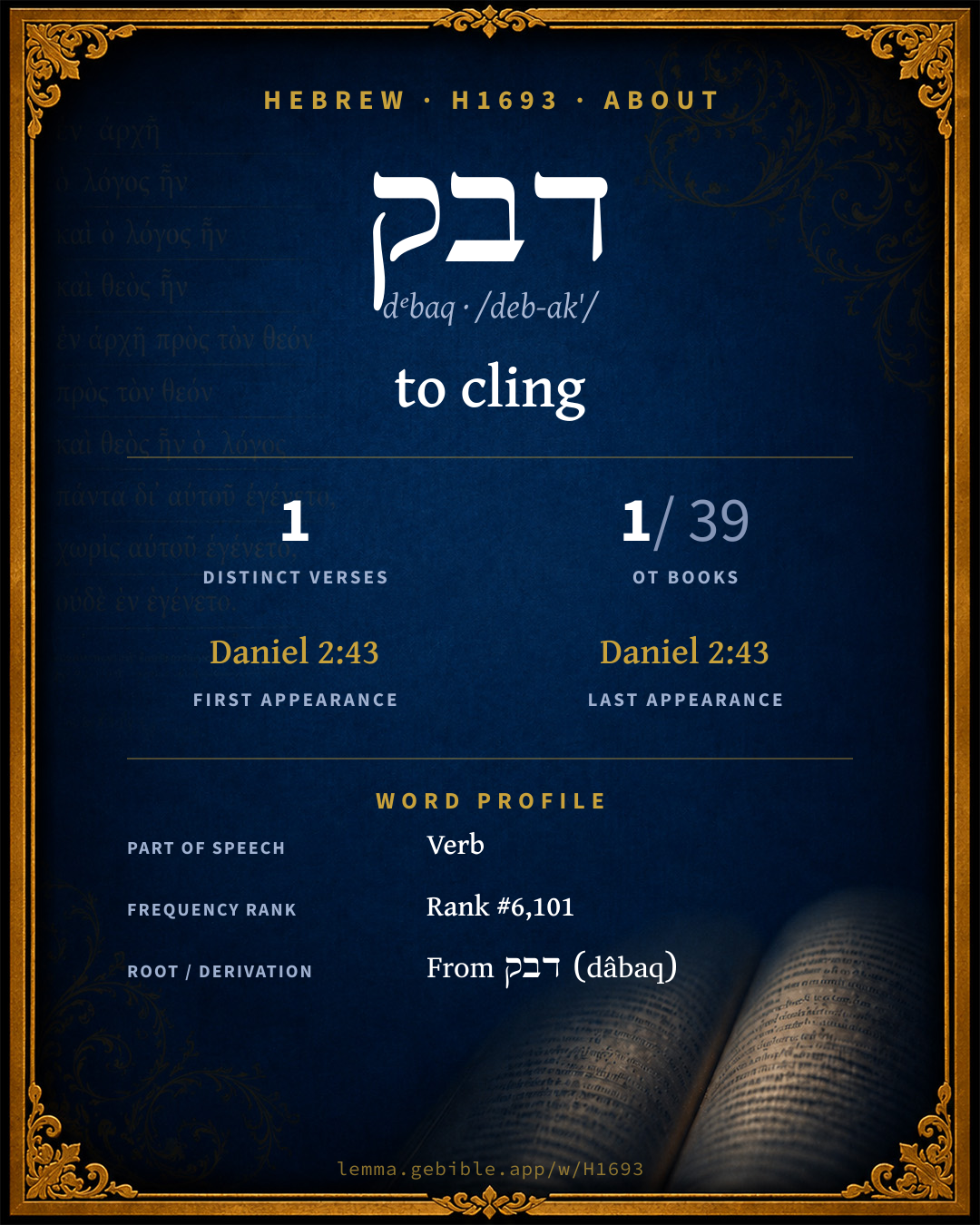
דְּבֵק
to cling
Full lexicon entry — Brown-Driver-Briggs (BDB)
From Brown-Driver-Briggs (BDB)
Where this word appears
Grammar key — what these labels mean
Part of speech
- Verb
- An action or state-of-being word.
Stem
- Qal
- The basic, simple active stem — the plain form of the verb (“he wrote”).
Form
- Participle Active
- A verbal adjective expressing ongoing or characteristic action (“writing / one who writes”).
State
- Absolute
- The independent form of a noun, not bound to a following word.
Gender
- Masculine
- Grammatically masculine.
Number
- Plural
- More than one (in Hebrew, generally three or more).
Every verse where H1693 appears — 1 distinct verse across 1 book. Click any verse to open its interlinear word-by-word view. Verse text shown in the World English Bible for context — . Each verse’s Hebrew form is shown with its reference; the English is not keyword-highlighted, since the data carries no word-level English alignment. Use “Compare translations” on any verse to read it across multiple English versions. This concordance covers the Hebrew Bible; Septuagint (Greek Old Testament) occurrences are not indexed here.
Daniel 1 verse
About this entry
At a glance — auto-summarized from this page’s data, not written by a person. Every figure links to its source below. This summary describes the numbers; it doesn’t interpret them.
The Hebrew verb דבק centers on the idea of “to cling.” With only 1 verse it sits in the long tail of Hebrew Bible vocabulary. Daniel dominates its distribution — 1 of 1 verses. Scripture uses it exactly once, at Daniel 2:43. Sharing its root, it stands alongside דבק, דבק and דבק. Dig into 1-verse concordance and the renderings breakdown below.
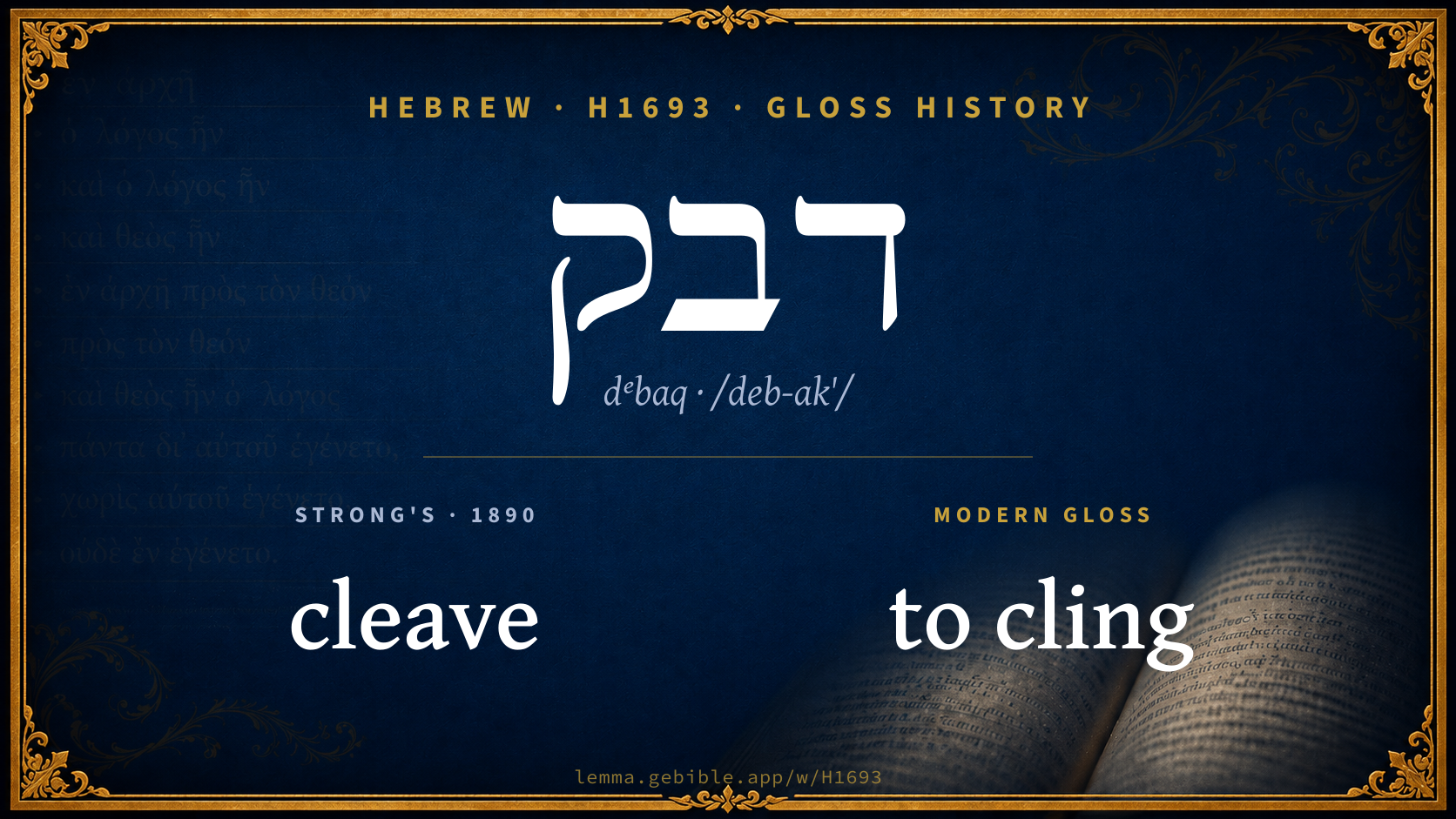
Gloss history
Strong's 1890 vs modern scholarship
About this word
Strong's H1693 catalogs a Hebrew word from the Hebrew Old Testament.
These counts are not copied from any lexicon or concordance. They are computed here, from the morphology-tagged Hebrew Old Testament. What Lemma adds →
- 1
- distinct verses
- The word appears in 1 distinct verse.
- 1 / 39
- OT books
- The word appears in 1 of 39 Old Testament books.
- #6,101
- by frequency
- Rank #6,101 (rank 6,101 of 8,640 Hebrew words by occurrence).
View all 1 occurrence in the concordance →
Most concentrated in
- Daniel 1 verse 100%
By section of the Old Testament
By traditional corpus
Conventional, traditional groupings — biblical authorship is debated, so this is a traditional corpus grouping, not an authorship claim. Each share is this word’s portion of its verses in that division of the Hebrew canon. Each figure is a share of the word’s 1 distinct verse.
- Writings (Ketuvim) 1 verse · 100%
How translations render this word
Counts come from each version’s own published word-to-Strong’s tagging or interlinear alignment — an approximate guide to how each version renders this word, not a word-level alignment the data otherwise carries. Because each total is that version’s own tagged count, the per-version totals vary from one another and need not match the appearance or distinct-verse counts above. These counts may also differ from a printed concordance because Lemma counts each distinctly tagged rendering and does not collapse phrase taggings into a single head-word total. This is a fixed set of word-tagged versions (KJV, ASV, BSB, ULT) and does not change with the reading translation you choose elsewhere. Each version’s license is shown beside its name below (and on Sources).
- King James Version: Cleave 1×
- American Standard Version: Cleave 1×
- Berean Standard Bible: Hold together 1×
- unfoldingWord Literal Text: Adhere 1×
King James Version Public Domain
Renders H1693 across 1 tagged occurrence — most commonly:
American Standard Version Public Domain
Renders H1693 across 1 tagged occurrence — most commonly:
Berean Standard Bible Public Domain
Renders H1693 across 1 tagged occurrence — most commonly:
unfoldingWord Literal Text CC BY-SA 4.0
Renders H1693 across 1 tagged occurrence — most commonly:
Senses in BDB
The 1 sense BDB distinguishes for this word, in lexicon order (not ranked by frequency or importance). The full entry — with sub-senses — is in the Lexicon Entry tab.
- (Peal) to cling
Word origin
[ דְּבֵק ] vb. cling (BH);— Pe. Dn 2:43.
— Brown-Driver-Briggs (Oxford 1906, public domain), digitized via Sefaria, supplemented by the OpenScriptures HebrewLexicon (CC BY 4.0). See Sources.
Derived from דבק (dâbaq) (H1692) — to cleave.
Jastrow Dictionary
A second Hebrew/Aramaic lexicon for comparison, covering Aramaic and post-biblical (Talmudic, Targumic, Midrashic) usage that the biblical-Hebrew BDB does not. Matched by lemma rather than by Strong’s number, so a lemma may carry more than one Jastrow headword (shown separately below), and the entries cover usage well beyond the Bible.
דָּבֵק
- (b. h.) to cleave, adhere, stick. B. Bath. 91ᵇ, v. infra.—Yalk. Gen. 133 דבקו כל החיל וכ׳ the whole army was close to the fortress.—Ib. Deut. 824 ד׳ לסדומיים he joined the Sodomites.—2) to join, glue, affix. Y. Meg. I, 71ᵈ top דּוֹבְקִין בְּדֶבֶק the parchment is joined with glue.—Part. pass. דָּבוּק, f. דְּבוּקָה attached, close, cleaving. Sot. 42ᵇ (ref. to Ruth I, 14) בני הדבוקה the descendants of her who was attached (to Naomi). Gen. R. s. 20 דְּבוּקִין לעור close to the skin. Snh. 64ᵃ (ref. to Deut. IV, 4) like two dates הדְּבוּקִים וכ׳ which stick to one another (easily separated); ib. דבוקים ממש really glued (inseparable); Yalk. Deut. 824 כשתי … הדְּבוּקוֹת; a. fr. e.g. Ruth 1:14
- to be joined, attached, affixed. Keth. 111ᵇ; Yalk. l. c. is it possible for man לִידָּבֵק וכ׳ to be joined to the Divine Majesty? Ib. כאילו נ׳ כשכינה (Keth. l. c. מִדַּבֵּק) as though he were joined. B. Bath. 91ᵇ ששבה ונִדְבְּקָה וכ׳ (Ms. H. ודָבְקָה) (Ruth) who came back and remained attached to Bethlehem (v. supra); a. fr.
- 1. to glue. R. Hash. III, 6 (27ᵃ; 27ᵇ).
- 2. to invite one to join in travel. Gen. R. s. 29 ראה אחד ודִיבְּקוֹ he saw a person and made him go with him.—Part. pass. מְדוּבָּק Yalk. Deut. l. c. שמְדוּבָּקִים לחייו וכ׳ who cling to the Life of the World (the Lord).
- to paste, fasten. Pes. 37ᵃ הרתיח ולבסוף ה׳ he heated the pot and then pasted the dough to its wall. Ib. 37ᵇ
- to be joined. Gen. R. s. 59 אין ארור מִתְדַּבֵּק בברוך (Yalk. Hos. 528 מִדַּבֵּק) the cursed (Eliezer) shall not be joined (through marriage) to the blessed (Isaac). Keth. l. c., v. Nif.—Yalk. Deut. l. c. מִדַּבֶּקֶת; a. fr. [Sabb. 113ᵇ [read:] לִידַּבֵּק עם הנשים or לדבר, v. Rabb. D. S. a. l. note.]
דְּבֵק
- , to adhere &c. Targ. Ps. XLIV, 26. Targ. Prov. XVIII, 24 דָּבֵיק ed. Lag.; a. e.—Keth. 111ᵇ וכי אפשר לדְבוּקֵי, v. preced. Nif.
- to paste, glue. Men. 11ᵃ דַּבְּקֵיה לקומץ וכ׳ if he pasted the handfull of dough to the wall of the vessel.
- to be attached, join. Targ. Ruth I, 14; a. fr.—Gitt. 56ᵇ מהו לאִידְּבוּקֵי בהו how about joining their ranks?—Pes. 49ᵃ לאִידְּבַק אנא בזרעיה Ms. M. (ed. דאדבק בזרעיה) that I should be connected with his descendants. Sabb. 113ᵇ. Gen. R. s. 14 אית חספין מִתְדַּבְּקִין can broken earthen vessels be joined together?
- 1. to reach, overtake, attain to, obtain (corresp. to h. הִשִּׂיג). Targ. Gen. XXXI, 23. Targ. O. Lev. XIV, 21 sq.; a. fr.—Part. pass. מַדְבַּק joined work. Targ. I Kings VII, 29 (h. text ליות; v. 30 עובד דיבוק).
- 2. to join (plans), to contrive fraud (nectere dolos; h. text הצמיד). Targ. Ps. L, 19 (Ms. Pa.).
דֶּבֶק
- preced.)
- 1. glue, paste. Y. Meg. I, 71ᵈ top, v. דָּבַק. Sabb. VIII, 4, v. שַׁבְשֶׁבֶת.
- 2. junction. Ḥull. 50ᵃ מקום הד׳ the place where the entrails adhere to the hip.—Pl. דְּבָקִים followers. Yalk. Deut. 824 אתם ודִבְקֵיכֶם ye and your followers.
- 3. nexus, cause. Pl. as above; constr. דִּבְקֵי, דִּיבְ׳.—ד׳ מיתה duties the neglect of which is the cause of premature death. Sabb. 32ᵃ (a Variant of בדקי, v. בֶּדֶק); Y. ib. II, 5ᵇ bot.; Tosef. ib. II, 10 דיבק ed. Zuck. (corr. acc.); Ber. 31ᵇ
A Dictionary of the Targumim, the Talmud Babli and Yerushalmi, and the Midrashic Literature (Marcus Jastrow; London, Luzac, 1903) — Public Domain. Digitized via Sefaria. Digitized via Sefaria. Full attribution on Sources.
Same root — word family
Other BDB entries built from the same root as H1693, grouped by Strong’s listed origin. These share a root / origin per the lexicon — not necessarily a shared meaning. Each links to that word’s own entry.
Derives from
Shares the same root
Compare all same-root words → They share a root, not necessarily a meaning.
Septuagint verse parallels
This word appears in 1 verse that also exists in the Greek Old Testament (Septuagint), out of the 1 Hebrew verse it occurs in. You can read those verses in Greek by switching the Old Testament edition to the Septuagint.
Read these verses in the Septuagint
This is a verse-level parallel only — the same verses exist in both the Hebrew and Greek Old Testaments. No word-level Hebrew↔Greek correspondence is claimed: the data carries no such alignment, so no Greek word is shown as this Hebrew word’s translation. Coverage is not total — the Septuagint omits the deuterocanon and renumbers the Psalms, so some Hebrew verses have no direct Greek parallel.