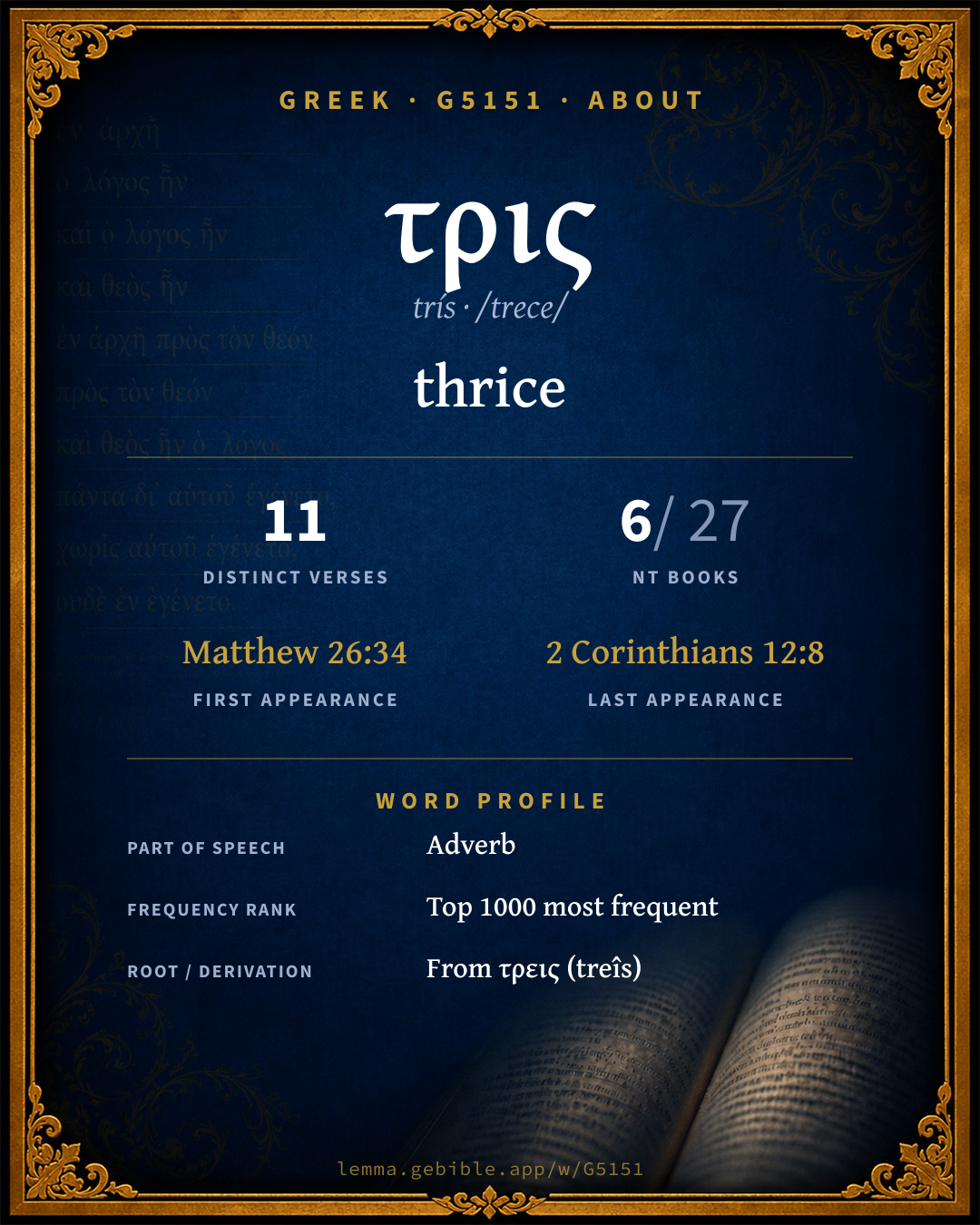
τρίς
thrice
Full lexicon entry — Thayer's Greek Lexicon
From Thayer's Greek Lexicon
Where this word appears
Grammar key — what these labels mean
Part of speech
- Adverb
- A word that modifies a verb, adjective, or other adverb.
Every verse where G5151 appears — 11 distinct verses across 6 books. Click any verse to open its interlinear word-by-word view. Verse text shown in the World English Bible for context — . Each verse’s Greek form is shown with its reference; the English is not keyword-highlighted, since the data carries no word-level English alignment. Use “Compare translations” on any verse to read it across multiple English versions. This concordance covers the Greek New Testament; Septuagint (Greek Old Testament) occurrences of this word are not indexed here.
Matthew 2 verses
- Matthew 26:34 τρὶς adv Jesus said to him, "Most assuredly I tell you that tonight, before the rooster crows, you will deny me three times."
- Matthew 26:75 τρὶς adv Peter remembered the word which Jesus had said to him, "Before the rooster crows, you will deny me three times." He went out and wept bitterly.
Mark 2 verses
- Mark 14:30 τρίς adv Jesus said to him, "Most assuredly I tell you, that you today, even this night, before the rooster crows twice, you will deny me three times."
- Mark 14:72 τρίς adv The rooster crowed the second time. Peter remembered the word, how that Jesus said to him, "Before the rooster crows twice, you will deny me three times." When he thought about that, he wept.
Luke 2 verses
- Luke 22:34 τρίς adv He said, "I tell you, Peter, the rooster will by no means crow today until you deny that you know me three times."
- Luke 22:61 τρίς adv The Lord turned, and looked at Peter. Then Peter remembered the Lord's word, how he said to him, "Before the rooster crows you will deny me three times."
John 1 verse
Acts 2 verses
2 Corinthians 2 verses
About this entry
At a glance — auto-summarized from this page’s data, not written by a person. Every figure links to its source below. This summary describes the numbers; it doesn’t interpret them.
τρις (trís) is a Greek verb most often rendered “thrice.” The King James Version usually renders it “thrice,” while modern versions prefer “three times” (Berean Standard Bible) — see the renderings breakdown. Spanning 11 verses in 6 books, it ranks among the uncommon words of the Greek New Testament. Scripture first uses it in Matthew 26:34. Sharing its root, it stands alongside τρεις, τριακοντα and τριακοσιοι. For the data behind this summary, explore the sense tree and the renderings breakdown below.
Gloss history
Strong's 1890 vs modern scholarship

About this word
Strong's G5151 catalogs a Greek word from the Greek New Testament.
These counts are not copied from any lexicon or concordance. They are computed here, from the morphology-tagged Greek New Testament. What Lemma adds →
- 11
- distinct verses
- The word appears in 11 distinct verses.
- 6 / 27
- NT books
- The word appears in 6 of 27 New Testament books.
- #904
- by frequency
- Top 1000 most frequent Greek words (rank 904 of 5,347 Greek words by occurrence).
View all 11 occurrences in the concordance →
By section of the New Testament
By traditional corpus
Conventional, traditional groupings — biblical authorship is debated, so this is a traditional corpus grouping, not an authorship claim. Some books belong to more than one corpus (Luke is in both the Gospels and the Lukan corpus, and so on), so these shares overlap and need not total 100%. Each figure is a share of the word’s 11 distinct verses.
- Gospels 7 verses · 64%
- Lukan (Luke–Acts) 4 verses · 36%
- Pauline corpus 2 verses · 18%
- Johannine 1 verse · 9%
How translations render this word
Counts come from each version’s own published word-to-Strong’s tagging or interlinear alignment — an approximate guide to how each version renders this word, not a word-level alignment the data otherwise carries. Because each total is that version’s own tagged count, the per-version totals vary from one another and need not match the appearance or distinct-verse counts above. These counts may also differ from a printed concordance because Lemma counts each distinctly tagged rendering and does not collapse phrase taggings into a single head-word total. This is a fixed set of word-tagged versions (KJV, ASV, BSB, ULT) and does not change with the reading translation you choose elsewhere. Each version’s license is shown beside its name below (and on Sources).
- King James Version: Thrice 10×
- American Standard Version: Thrice 10×, Was done esther thrice 2×
- Berean Standard Bible: Three times 12×
- unfoldingWord Literal Text: Three times 12×
King James Version Public Domain
Renders G5151 across 11 tagged occurrences — most commonly:
Plus 1 rendering that appears only once — usually multi-word phrases or single function words the recovered tagging swept in, not distinct renderings. Not rendered by a distinct English word in 1 further occurrence.
American Standard Version Public Domain
Renders G5151 across 12 tagged occurrences — most commonly:
Berean Standard Bible Public Domain
Renders G5151 across 12 tagged occurrences — most commonly:
unfoldingWord Literal Text CC BY-SA 4.0
Renders G5151 across 12 tagged occurrences — most commonly:
Senses in Thayer's
The 1 sense Thayer's distinguishes for this word, in lexicon order (not ranked by frequency or importance). The full entry — with sub-senses — is in the Lexicon Entry tab.
- thrice
Word origin
Derived from τρεις (treîs) (G5140) — three.
Adverb from G5140 ; three times : - three times thrice.
— Strong’s Exhaustive Concordance (1890), public domain.
Forms in the corpus
The 2 distinct written forms G5151 takes in the Greek New Testament, most frequent first — each parse links to that case’s occurrences in the concordance.
| Form | Parsing | Example | Uses |
|---|---|---|---|
| τρίς trís | Adverb | Mark 14:30 | 7 |
| τρὶς trìs | Adverb | Matthew 26:34 | 5 |
Same root — word family
Other Thayer's entries built from the same root as G5151, grouped by Strong’s listed origin. These share a root / origin per the lexicon — not necessarily a shared meaning. Each links to that word’s own entry.
Derives from
Shares the same root
- τριακοντα triákonta G5144 thirty
- τριακοσιοι triakósioi G5145 three hundred
- τριβολος tríbolos G5146 thistle
- τριετια trietía G5148 three years
- τριμηνον trímēnon G5150 three months
- τριστεγον trístegon G5152 third story
- τριτος trítos G5154 third
Derived from this word
Compare all same-root words → Showing 4 of 10 — not the complete family. They share a root, not necessarily a meaning.
Septuagint usage
The same Greek word τρις appears 10 times in the Greek Old Testament (Septuagint), across 10 verses in 3 books.
- 10
- LXX occurrences
- Tagged occurrences of this Greek word in the Septuagint.
- 10
- verses
- Distinct Septuagint verses containing this word.
- 3 / 39
- OT books
- The word appears in 3 of the 39 Old Testament books.
Sample Septuagint occurrences
- 1 Kings 17:21 τρίς
- 2 Kings 13:18 τρίς
- Daniel 6:6 τρίς
Septuagint occurrences (same lexeme)
Every verse where the same Strong’s number (G5151) appears in the Greek Septuagint. Verse text shown in the World English Bible for context; the Greek form is the matched word — the English is not keyword-highlighted.
- 1 Kings 17:21 τρίς He stretched himself on the child three times, and cried to Yahweh, and said, Yahweh my God, please let this child's soul come into him again.
- 2 Kings 13:18 τρίς He said, Take the arrows; and he took them. He said to the king of Israel, Smite on the ground; and he struck thrice, and stayed.
- 2 Kings 13:19 τρίς The man of God was angry with him, and said, You should have struck five or six times: then had you struck Syria until you had consumed it, whereas now you shall strike Syria but thrice.
- 2 Kings 13:25 τρίς Jehoash the son of Jehoahaz took again out of the hand of Benhadad the son of Hazael the cities which he had taken out of the hand of Jehoahaz his father by war. Three times did Joash strike him, and recovered the cities of Israel.
- Daniel 6:6 τρίς Then these presidents and satraps assembled together to the king, and said thus to him, King Darius, live forever.
- Daniel 6:9 τρίς Therefore king Darius signed the writing and the interdict.
- Daniel 6:11 τρίς Then these men assembled together, and found Daniel making petition and supplication before his God.
- Daniel 6:12 τρίς Then they came near, and spoke before the king concerning the king's interdict: Haven't you signed an interdict, that every man who shall make petition to any god or man within thirty days, save to you, O king, shall be cast into the den of lions? The king answered, The thing is true, according to the law of the Medes and Persians, which doesn't alter.
- Daniel 6:14 τρίς Then the king, when he heard these words, was sore displeased, and set his heart on Daniel to deliver him; and he labored until the going down of the sun to rescue him.
- Daniel 6:17 τρίς A stone was brought, and laid on the mouth of the den; and the king sealed it with his own signet, and with the signet of his lords; that nothing might be changed concerning Daniel.
These are occurrences of the same Greek lexeme (G5151) in the Septuagint — not a translation of any one Hebrew word. The store carries no word-level Hebrew↔Greek alignment, so no Hebrew original is asserted here. Counts come from the recovered LXX Strong's tagging — high-frequency vocabulary is well covered, while rare or late forms may be untagged — so they reflect tagged occurrences and may slightly undercount.